
Perspective | A new pathway into the classroom: How NC districts are growing their own teachers


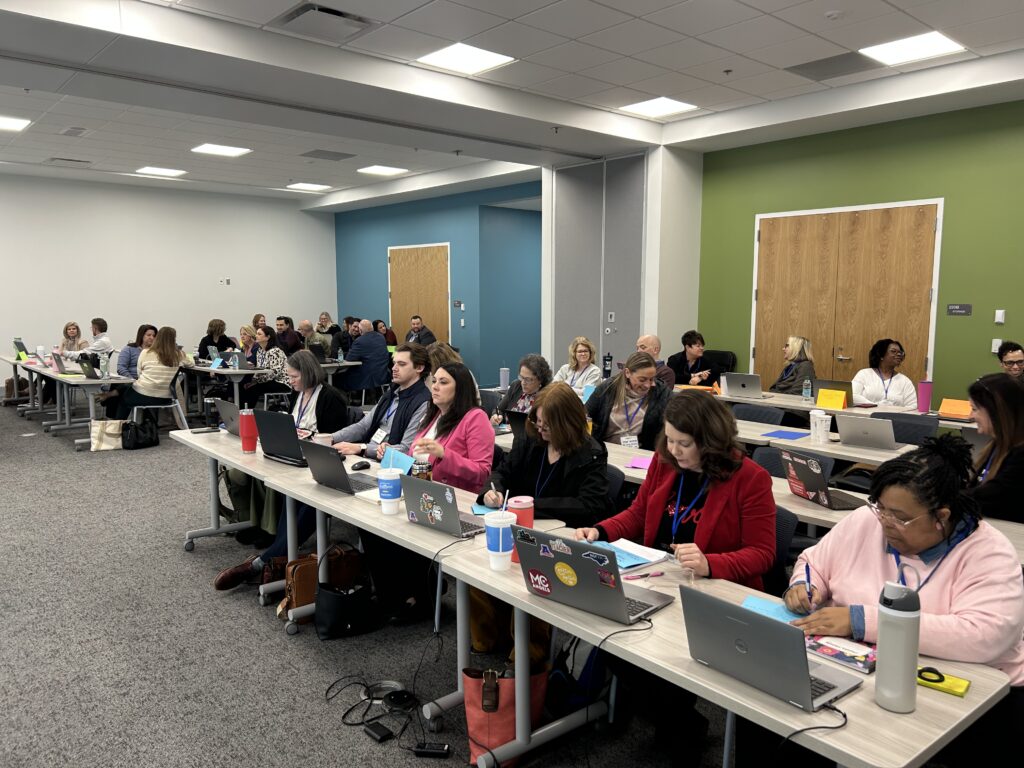
The room was full of energy as candidates and mentors from across North Carolina gathered this summer to kick off a new cohort of registered teacher apprentices.
“I came from nursing, and it’s the best decision I ever made to become a teacher,” said Maria Perez, a registered teacher apprentice in Elizabeth City-Pasquotank Schools.
People with four-year degrees are ready to teach; they just need a pathway, and The Innovation Project (TIP) is working with state partners to build it.
TIP, led by CEO Dr. Sharon L. Contreras, former superintendent of Guilford County Schools, is a collaborative of public education leaders across North Carolina working to solve shared challenges — including the teacher shortage — through innovation and partnership. Its members range from small districts like Warren County Schools to large urban districts like Charlotte-Mecklenburg Schools, and 20 others in between.
“Every child deserves an excellent teacher, but the teacher shortage remains one of the greatest barriers our member districts face in delivering on that promise. TIP, our districts, and our apprenticeship partners are building a sustainable pipeline of highly prepared teachers for North Carolina,” said Contreras.
 Sign up for the EdDaily to start each weekday with the top education news.
The scope of the problem
North Carolina districts have long struggled to keep a well-trained, qualified teacher in every classroom. Districts statewide reported 4,614 instructional vacancies, or 5.1% of all positions, on the first day of the 2025-26 school year, growing to 6,721 vacancies, or 7.38%, by the 40th instructional day, according to the North Carolina Department of Public Instruction’s State of the Teaching Profession in North Carolina 2025-26 report, presented to the State Board of Education in March.
Many of those openings are filled by teachers who aren’t fully prepared. Nearly half of new teachers in North Carolina enter through emergency-licensed or lateral-entry positions, becoming teachers of record with no required training or classroom experience, according to BEST NC.
Registered teacher apprenticeships offer a way forward, letting candidates earn a living while they learn alongside experienced mentors and receive instruction through a strong Educator Preparation Program before taking on full responsibility for a classroom.
More on the NC teacher workforce



Launching the first cohort
This summer, TIP launched its first cohort of eight districts partnering with ApprenticeshipNC to bring K-12 teacher apprenticeships to their communities: Asheboro City Schools, Charlotte-Mecklenburg Schools, Cumberland County Schools, Elizabeth City-Pasquotank Public Schools, Hertford County Public Schools, Rowan-Salisbury Schools, Sampson County Schools, and Thomasville City Schools.
Each has signed an agreement with ApprenticeshipNC to enter TIP’s sponsorship. Districts wanted a cohort model so apprentices would have the support they need to succeed, and apprentices wanted the chance to network across districts as they work toward certification.
TIP’s model brings together a wide network of partners, including ApprenticeshipNC, BEST NC, N.C. Department of Public Instruction, Opportunity Culture-Public Impact, the N.C. Community College System, the UNC System, and Craft Education, giving districts a systems-based approach to meet U.S. Department of Labor requirements for a high-performing program.
“ApprenticeshipNC is excited to partner with The Innovation Project and its member districts to launch its first teacher apprenticeship program,” said James Yarley of ApprenticeshipNC.
A retention problem, too
North Carolina isn’t just struggling to recruit teachers, it’s struggling to keep them.
Experienced, fully-licensed teachers leave the profession at a rate of 9.34%, beginning teachers at 14.73%, and teachers on temporary licenses at 24.14%, according to the state’s 2024-25 Annual Report on the State of the Teaching Profession in North Carolina.
TIP’s cohort model is designed to address both problems at once, giving apprentices and mentors high-quality engagement, resources, and follow-through built for successful outcomes. Students deserve highly-trained educators in front of them, backed by real support, regardless of ZIP code.
The TIP model includes:
- On-the-job learning standards vetted by ApprenticeshipNC, N.C. districts, BEST NC, Public Impact, and DPI
- Mentors with a track record of strong student achievement
- A competitive wage scale with built-in increases to attract top talent
- Related instruction through the N.C. Community College and UNC Systems, aligned with on-the-job learning
- A cross-district network for apprentices, mentors, and staff to share best practices
- Craft Connects, a Craft Education tool for tracking progress on learning standards
Related reads



Look around corners
TIP built teacher apprenticeships into its Advanced Teaching Roles (ATR) grant early, sensing a stronger link between apprenticeships and Advanced Teaching Roles was coming. Meanwhile, BEST NC, NCDPI, ApprenticeshipNC, and other partners shaped a statewide strategy. The grant paired apprenticeships with Opportunity Culture® staffing models so apprentices could learn on Multi-Classroom Leader® teams alongside accomplished educators, ahead of North Carolina formally making that connection through TeachReadyNC.
TeachReadyNC, included in the 2026 NC legislative budget, funds four-year degree holders pursuing a teaching license. It marks a shift away from residency licensure, which requires candidates to serve as teachers of record from day one, toward a supported runway into the classroom. TIP’s early design work benefits its four ATR grant districts, and the lessons are now shaping practice across its broader membership.
“Traditionally, new teachers receive support either through on-the-job mentoring or through formal pedagogical training at a college or university. Teacher apprenticeships combine the strengths of both approaches,” said Yarley. “Apprenticeship is a time-tested model with a long history of success, and I believe this proven approach has the potential to transform the future of K-12 education across North Carolina.”
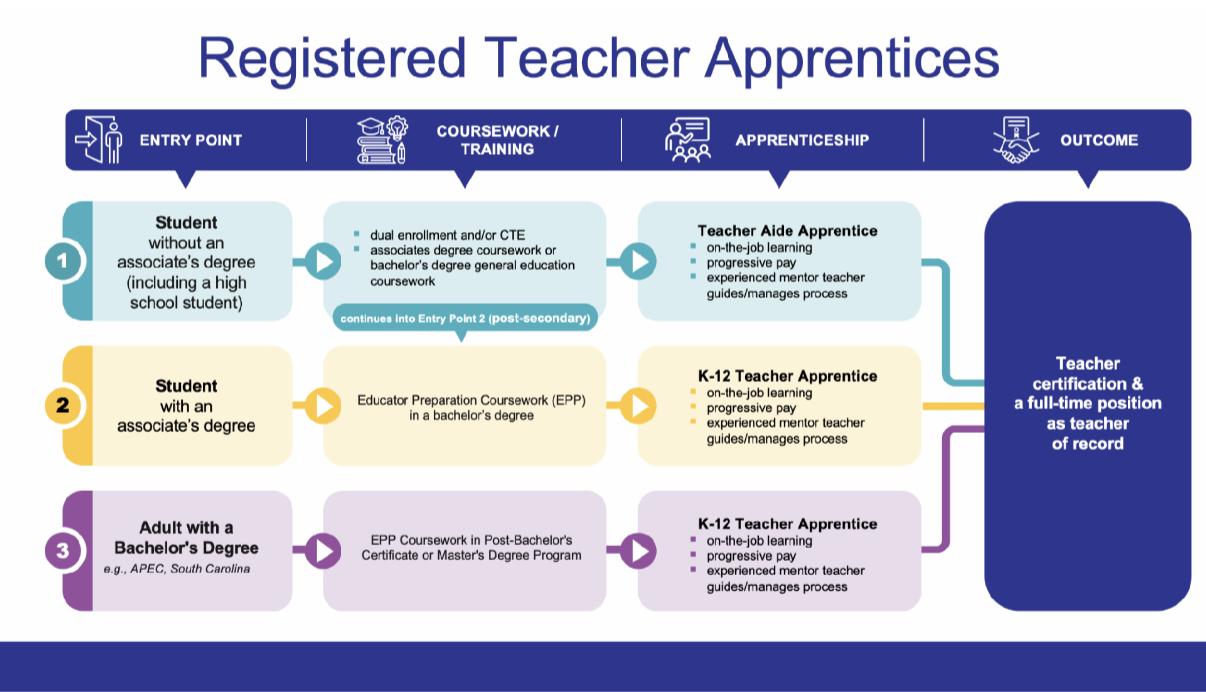
Three ways in
ApprenticeshipNC outlines three entry points: high school students who become pre-apprentices right out of high school, candidates with a two-year degree or some college who begin as a tutor or teacher assistant while working toward a degree and licensure, and four-year degree holders in other fields who need a teaching license.
We are excited to partner closely with the N.C. Community College and UNC Systems, streamlining related instruction to align with the on-the-job training taking place in our districts. We’re grateful to Dr. Jeff Cox, former president of the N.C. Community College System, and Ashton Clemmons, vice president of strategy and policy, along with BestNC, Opportunity Culture, and Craft Education, for their partnership and technical assistance.
The four-year degree holders in this cohort are completing the Pathway to Practice licensure program, a collaboration between NC State University and UNC-Chapel Hill, or the Elizabeth City State University (ECSU) Master of Education program. The two differ by design: ECSU’s program is delivered in person, while Pathway to Practice is competency-based.
“The TIP Teacher-Registered Apprentice Program (T-RAP) cohort creates an exciting opportunity to bring teacher apprentices from across North Carolina together as a true statewide learning community,” said Dr. Alison Winzeler, Pathway to Practice NC director. “We’re proud to have Pathway to Practice NC, an online licensure program for residency-licensed teachers offered by NC State and UNC’s Schools of Education, supporting apprentices as they move into successful, sustainable teaching careers. The summer kickoff gave apprentices the chance to build relationships and recognize they’re part of a larger network navigating this pathway together.”
Built for the long term
The cohort provides real-time scaffolding, support, networking, and coaching — putting candidates a step ahead of emergency-licensed peers with less support. Pathway to Practice has aligned its on-the-job learning with related instruction competencies so candidates don’t duplicate work to demonstrate proficiency.
The goal: Every child has a qualified teacher, every staff member feels supported, and every apprentice has a clear path into the profession.
The Innovation Project has 22 member districts, eight of which are preparing to roll out apprentices, and TIP is opening membership to others interested in joining the effort. Apprentices and mentors meet monthly to share successes and challenges, part of a larger movement to bring highly qualified teachers into classrooms statewide.
TIP believes its Teacher Registered Apprenticeship Program is one solid answer to a question every community is asking: Who will teach our next generation of students?