
Looking for a job? Or the right employee? Look no further than the local workforce development board

So, you’re looking for a job. In North Carolina, your local workforce development might be able to help you land an offer. Or say you’re an employer searching for the right workers. Your local workforce development board probably has the information you need.
Across North Carolina, a network of state agencies, educational institutions, and local workforce boards help job-seekers find their next professional opportunity and businesses find the employees they need. Local workforce development boards sit at the center of those efforts.
“They are really central to identifying the workforce priorities of a local region, convening employers and training providers and other key partners to drive workforce changes and meet the demand in those areas,” said Andrea DeSantis, assistant secretary for workforce solutions at the North Carolina Department of Commerce.
 Sign up for Awake58, our newsletter on all things community college.
What is a local workforce development board?
The state’s 19 local workforce development boards oversee their respective area’s workforce programs. That includes choosing how to allocate federal funds, building partnerships with other workforce and economic development players in their area, and delivering workforce development services.
“We truly do connect our job seekers and our employers,” said Jennie Bowen, board director of the Rivers East Workforce Development Board. “That’s not just a slogan, it’s what we do every day.”
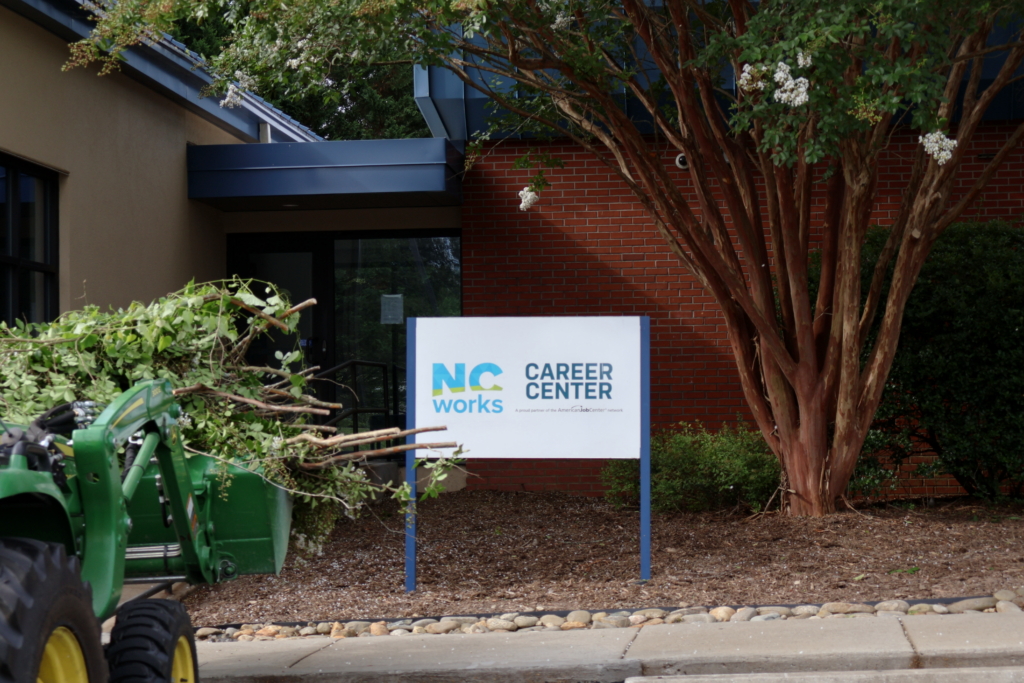
Working with the Commerce Department’s Division of Workforce Solutions and the NCWorks Commission, local boards administer most of those services through the state’s 72 NCWorks Career Centers. At those centers, North Carolinians looking for jobs can get help with every step of the job hunt — from writing resumes and cover letters to practicing for interviews. Centers also offer access to training and education programs, job fairs, job market information, among other support services.
“When you come into a center, we want to understand, what are you doing now? What have you done in the past? What do you see yourself as being really good at? And what do the next steps for you look like?” DeSantis said. “For some people, that is finding a new job or first job. For other folks, they really do want and need additional training.”
In those cases, local workforce boards can connect local residents with additional training and can support individuals through work-based learning experiences, DeSantis said.
“If they’re interested in enrolling in training, then they are assigned a career advisor who tracks them all the way through their employment path, their education path, until the point that they find employment, and then we also follow up with them for a year after they’ve completed the program and entered employment,” said Bowen.
Service providers at these career centers may be from nonprofits, community colleges, or for-profit companies, as local workforce boards generally competitively procure external providers to deliver services. Career advisers may be from one of these service providers or state employees from the Division of Workforce Solutions, DeSantis said.
But behind the scenes of that complicated organizational structure, DeSantis’ division has focused on integrating service delivery to streamline job seekers’ experience.
“We really want to make sure at this moment — North Carolina is the top state for workforce — that our system really is allowing us to easily and seamlessly serve job seekers and employers,” DeSantis said.
Stephanie Deese, executive director for the North Carolina Association of Workforce Development Boards, said boards also support the other side of the workforce equation: identifying their region’s workforce needs and helping employers find the right people to hire.
“They’re required to use data and analyze their local labor market conditions so that they know what those businesses and industries are in their community that they should be providing training for,” Deese said.
At Rivers East, which serves five counties in the northeast region of the state, board members look at labor market data and are in constant communication with partners and the region’s employer base, Bowen said. In Beaufort County, for example, the board meets monthly with representatives from the county’s economic development entity, the K-12 system, the community college, and the North Carolina Division of Employment and Independence for People with Disabilities.
“Primarily what that group does, is to talk about the status of the employers in the county, what’s going on, what we think the needs are going to be, what new programs are being built to address those, all that type of information,” Bowen said.
Other workforce players
Local workforce development boards represent one level of the state’s workforce development landscape.
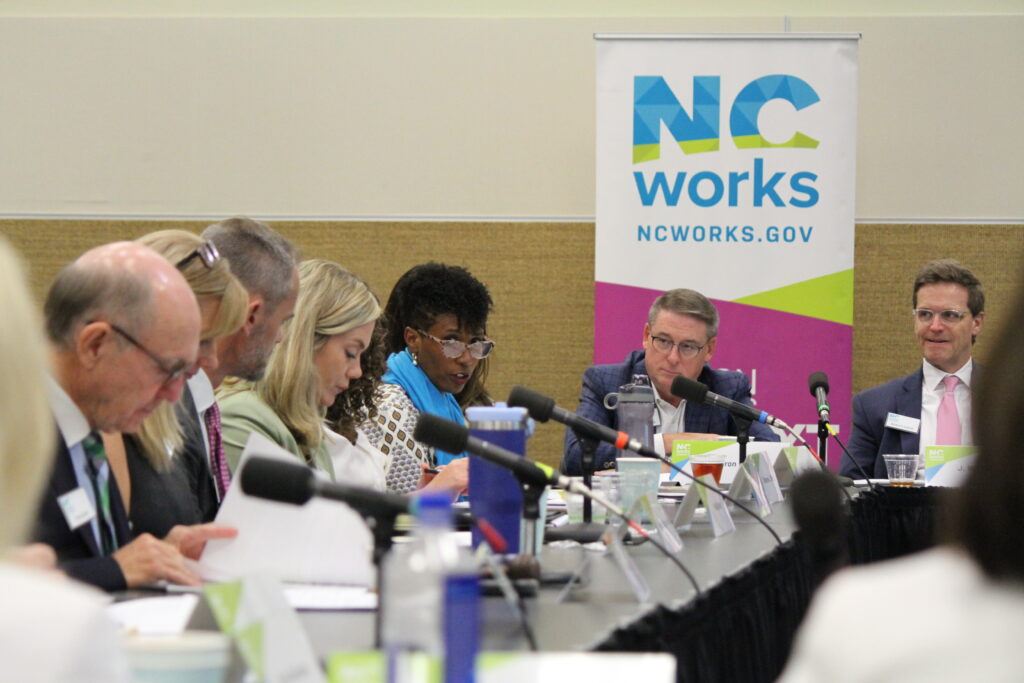
As required by the 2014 federal Workforce Innovation and Opportunity Act (WIOA), North Carolina also has a designated statewide workforce development board: the NCWorks Commission. The 37-member group includes business representatives, heads of the state’s workforce agencies, educators, and community leaders — all of whom are appointed by the governor. The commission has a strategic role, setting workforce policy, overseeing the state’s broader workforce system, and approving certain policies that affect local boards.
Additionally, DeSantis’s division, the Department of Commerce’s Division of Workforce Solutions (DWS), administers federal workforce programs, helps administer the state’s NCWorks Career Centers, and supports the Governor’s Council on Workforce and Apprenticeships, including around subjects such as artificial intelligence and Workforce Pell Grants.
Read more on NC’s workforce

Funding pressures
DWS also distributes WIOA funding to local boards and monitors how WIOA funds are spent. Boards receive WIOA funds through three funding streams designated for youth, adults, and dislocated workers. The amount each board receives is determined through formulas that account for regional economic conditions, including unemployment levels and the number of economically disadvantaged residents.
Boards have wrestled with mounting financial pressures in recent years. According to data from DWS, North Carolina’s federal funding under WIOA Title I and WIOA Title III dropped from nearly $92 million in 2021 to $81 million in 2026.
DeSantis said this decrease has nothing to do with boards’ performance, however. Instead, the drop is due to the variables that go into the funding formula.
“The better your state is doing economically, the less money you’re going to get,” DeSantis said. “North Carolina is in fact doing a great job with our performance measures — and we’re getting less funding.”
The decline can be especially challenging given boards’ responsibility to support people who face barriers to employment — individuals who might have been unemployed for a long time, formerly incarcerated, or who need a new skill set.
“Those are the folks who need additional support, right? They need us to be their social capital that they don’t already have,” DeSantis said. “The amount of resources it takes to get that person ready for work looks really different.”
Still, the drop in funding has affected some boards’ operations.
“We’ve lost funds every year for the last several years,” Deese said. “I don’t know what’s going to happen with future funding. It’s very uncertain now, and that adds a lot of stress to the boards and to the directors and how we move forward and how we navigate. People are reducing staff, people are reducing centers — we’re doing a lot more virtual services because of reduction in staff.”
Rivers East has lost around 30% of its funding in the past two years, Bowen said. While the board’s Pitt County NCWorks Career Center remains open full-time, other career centers in the board’s region are open only two days a week.
“We’re trying to make sure we maintain in-person services for the individuals who need them in addition to what we’re doing virtually,” Bowen said.
These challenges have spurred local boards to begin advocating for greater recognition by elected officials. According to Deese, outreach and advocacy are pillars of the NC Association of Workforce Development Boards’ strategic plan.
That push included a successful effort by the Northeastern Workforce Development Board to receive a state appropriation in the budget approved in July.
Rachel Clipston, the board’s director, said the state budget allocated $750,000 in nonrecurring funds to support operational needs and staffing costs over the next two-and-a-half years. She said the appropriation came after several years of declining funding, which had made her board one of the lowest-funded in the state despite providing services across a 10-county area.
“We realized a while ago that in order to make sure that we’re sustainable and we can continue serving our community members, that we needed to advocate and make sure that our elected officials knew about the good work that we do, the valuable work and the impact that it has on our communities and also let them know how little funding we get,” Clipston said.
That years-long advocacy work included meeting regularly with officials, inviting them to board events and local career centers, and sharing documents outlining the board’s achievements.
Clipston attributed the funding drops to population declines across several counties in her region. However, she said, the region was still in need of the board’s workforce services.
“People benefit greatly from our services,” Clipston said. “And something that a lot of people don’t realize — I think a lot of elected officials don’t realize — is that North Carolina does not provide state funding for the workforce system.”
The NCWorks Commission is also encouraging boards across the state to build stronger relationships with their state and congressional lawmakers through an initiative called “Workforce in my District.”
“The purpose of the Workforce in my District initiative is to strengthen local area relationships and create awareness about the great work that local area workforce development boards do within their regions,” said Annie Izod, executive director of the NCWorks Commission.
In practice, Izod said, local workforce development boards would connect with elected officials and stakeholders in their region to discuss relevant workforce strategies through one-on-one meetings, forums, and community convenings.
Boards’ make-up and geography
Local board membership covers the spectrum of workforce stakeholders, including local business owners, economic development groups, community organizations, schools and colleges, labor groups, public assistance agencies, and other partners.
Though a board’s organizational structure and geographic reach can vary from one board to another, the framework is laid out in federal law. A majority of members must represent businesses, while the rest must cover a variety of workforce stakeholders. Generally, trade associations or local business organizations nominate business representatives, while labor groups nominate labor representatives.
A local chief elected official — usually a county commissioner or mayor of a large city in the board’s geographic area — is responsible for making appointments. In boards with multiple counties or local governments, officials enter a consortium to decide who will have that authority. Again, those appointments must align with state criteria, WIOA, and other federal statutes.
That means there is no statewide procedure to become a board member. Despite being governed by the same federal law, the mechanics of appointments, terms, vacancies, or chief roles can look different from one board to the next.
The minutiae of federal statutes has also partially shaped the state’s map of local workforce development boards. At first glance, the map can be confusing: multiple counties grouped together under one board, single counties — some rural, some urban — operating individual boards, without obvious explanations. But many of these areas trace their origins back to federal laws that preceded WIOA. Even after new legislation, some pre-existing arrangements were carried forward to produce today’s map.
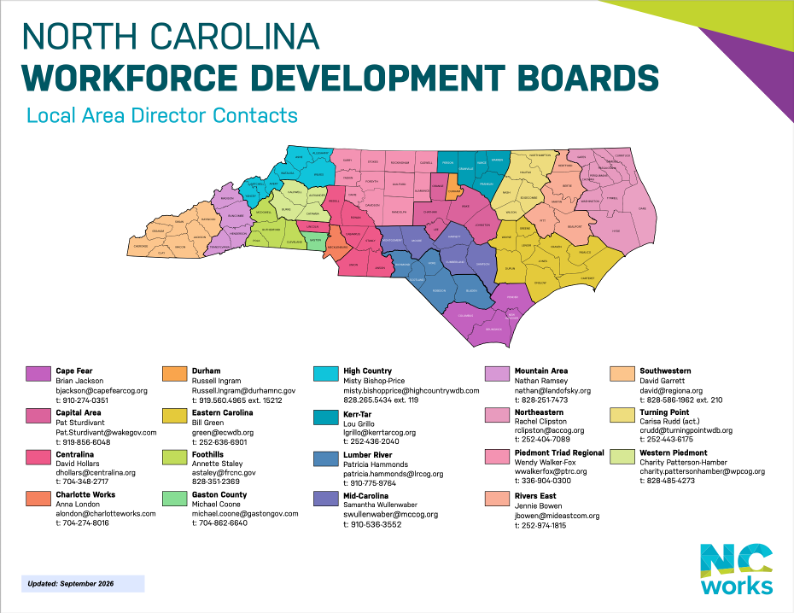
Board members can also hire their own staff to work on strategic initiatives, DeSantis said. These staff members may work on sector partnerships with employers or educational institutions. All boards are also required to have a fiscal agent—an organization that handles financial or administrative tasks. Most boards rely on their local Councils of Government (COG) to serve as fiscal agents, and many boards’ staff work from their COG’s offices.
A local workforce development board in action
Local boards’ workforce efforts can sometimes extend beyond their usual responsibilities to meet their region’s needs. For example, Rivers East has used funding from a Golden LEAF grant to provide over 100 educators with a series of sessions on manufacturing careers at local community colleges.
High school teachers and counselors received information about employability skills, toured community college programs, and got hands-on experience with their facilities. They also met directly with employers in the region to hear about available jobs.
“The teachers were actually able to sit down one-on-one with the employers and hear what that employer does, what type of skill sets they’re looking for,” Bowen said.
The board also participated in Carolina Across 100, a UNC-Chapel Hill initiative to build partnerships across each of the state’s counties. Rivers East supported the initiative’s work to reconnect “opportunity youth” — people ages 16 to 24 who are not working or enrolled in school — with education and employment.
“We still have that group of population that is not engaged, and we need to find a way to engage them because we’re going to need them in that future talent pipeline,” Bowen said.
Recently, the board has focused on examining mental health as a barrier to professional and educational opportunities. The board and its partners have mapped existing resources and provided mental health training to staff at schools, community colleges, and organizations working with young people — illustrating the board’s role connecting a wide range of stakeholders to address workforce challenges.
“Part of the purpose of the workforce board is to be able to bring, convene, and facilitate with those partners, and to really address things in a holistic way, not just piecemealing different solutions,” Bowen said. “We try to bring all the partners together, and there really is a lot of good work going on at the local level.”