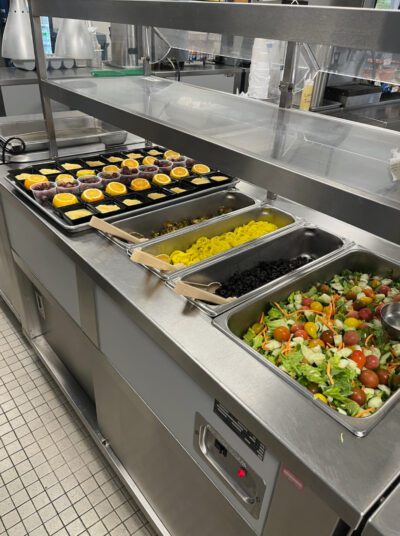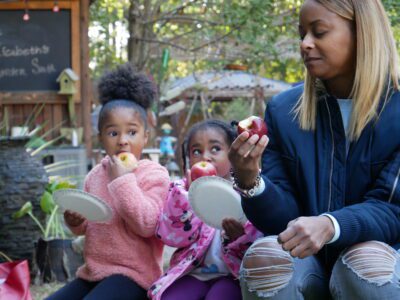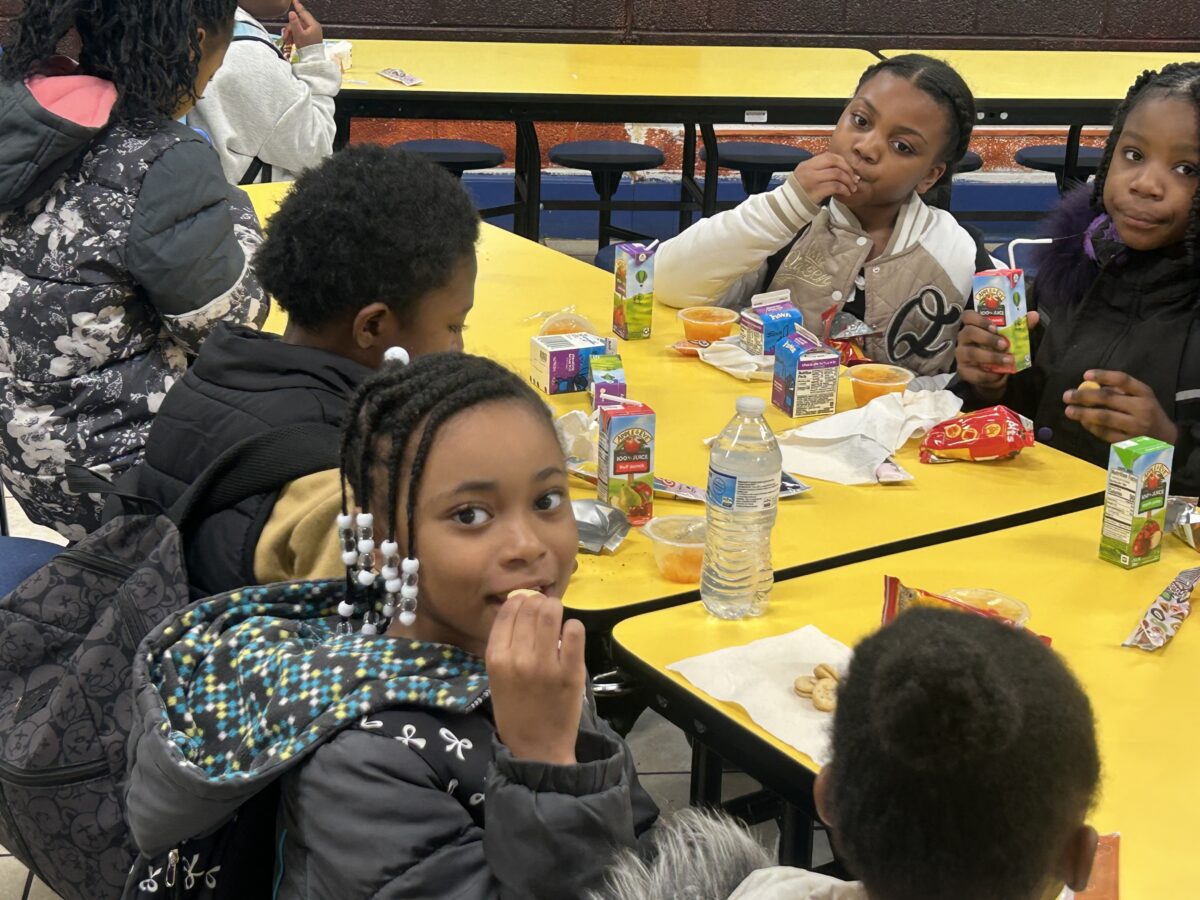
Before the school day begins, hundreds of thousands of students across North Carolina eat school breakfast — in the cafeteria, in the classroom, from grab-and-go kiosks, and more.
In the 2023-24 school year, the most recent available data, more than 73 million school breakfasts were served to roughly 470,000 students across the state. The majority of them were provided for free.
Research shows that eating school breakfast is associated with a variety of positive outcomes for students, including improved academic performance and classroom behavior and better health outcomes.
“School breakfast offers a peace of mind to these students that do not get food at home,” said Keli McNeill, a parent in Richmond County, during a School Meals for All NC meeting ahead of National School Breakfast Week. “They can come into school knowing, ‘I might be hungry right now, but in another 10 minutes, I’m not going to be hungry anymore, because I’m going to have food, and I’m going to be able to make it through my day.’ It’s about so much more than food.”
 Sign up for the EdWeekly, a Friday roundup of the most important education news of the week.
Yet traditional school breakfast approaches, which often require students to arrive before class begins and eat in the cafeteria, can limit access to these important meals.
To increase participation in school breakfast, districts across the state are implementing innovative breakfast models, including breakfast served in the classroom, grab-and-go kiosks, and second chance breakfast, often served after first period.
In 2024, then-Gov. Roy Cooper announced $1.3 million in NC Innovative School Breakfast Grants to help 42 school districts and charter schools implement innovative school breakfast models and expand student participation.
Districts are also increasingly offering free breakfast to all students under the federal Community Eligibility Provision (CEP), available to high-poverty schools.
Advocates in North Carolina, including the School Meals for All NC coalition, have called for school breakfast to be provided to all students at no cost. In March 2025, Gov. Josh Stein included universal free school breakfast for all public school students in his state budget proposal.
Then, in April, a “School Breakfast for All” bill was introduced in the General Assembly, sponsored by four Republican House members. Although the bill did not move forward, it garnered support from both Democrats and Republicans, with more than 50 sponsors.
“If we really want to change our education system, one way is to start by giving every student a nice, nutritious start to the day,” said Tami Poland, principal of Swift Creek Elementary in Johnston County, during the School Meals for All NC meeting.
Read more about school meals
Innovative breakfast models increase participation in Mitchell County Schools
Heather Calhoun has worked in Mitchell County Schools, located in the mountains of western North Carolina, for 27 years. Calhoun considers herself a big advocate for school breakfast and said she has seen the benefits that eating breakfast provides to students firsthand.
“We know hungry kids are not going to learn — they’re not going to do well on tests,” she said, adding that skipping breakfast can also lead to malnutrition and poor behavior.
Today, the roughly 1,700 students in Mitchell County Schools are served free breakfast and lunch through CEP. But according to Calhoun, the district offered free breakfast to all students even before CEP was in place. Soon after, participation in school meals increased as the stigma associated with identifying students by their free, reduced, or paid meals status was gone.
“That’s one of the things I think has really been great for our county and our students — making sure that they have a good breakfast every day,” she said.
The district has also implemented two innovative models to increase participation: breakfast in the classroom and second chance breakfast.
For K-8 students, a cart in the hallway allows them to pick up breakfast and eat it in their homeroom while morning announcements and other activities begin. Calhoun said these breakfast carts have been the most effective approach in increasing breakfast participation, and that students participate at much higher rates compared to serving breakfast in the cafeteria.
“If you say, ‘OK, come into the lunchroom and come through the line and get it,’ they don’t do it,” she said. “We tried that one time … and half the kids didn’t eat.”
For high school students, a second chance breakfast is provided in addition to traditional breakfast in the cafeteria. After the first class block, a cart circles around the hallways, offering a chance for students to eat who may have missed breakfast before the first bell.
“A lot of kids at the high school, they’re not going to get there 30 minutes before class, or they want to go hang out with their friends,” said Calhoun. “They don’t want to stop by the cafeteria.”
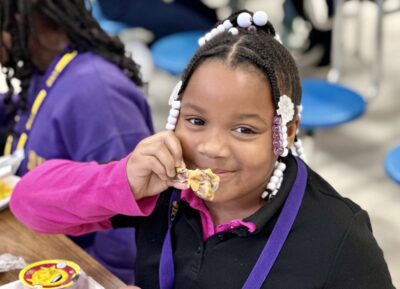
Students’ favorite breakfast items include chicken biscuits, sausage biscuits, and a cheese stick with yogurt or whole grain crackers.
Calhoun said she would like to serve more protein-rich and less grain-focused items, but that those products can often be more expensive, making it difficult to serve them within current federal reimbursement rates. For each free school breakfast served, school districts receive roughly $2.50 in federal funding, which has to cover the costs of food, labor, equipment, and more.
Even if an affordable item is identified, other barriers can stand in the way of sourcing new products. There may be manufacturing or procurement challenges, or the product might not be available in bulk, requiring more staff capacity to individually wrap each item before it goes on the breakfast cart.
“It’s like a Rubik’s Cube — I always say that about school nutrition,” said Calhoun. “It’s like that puzzle, where you have to fit all the pieces together.”
Free breakfast for all makes a difference at Dillard Academy
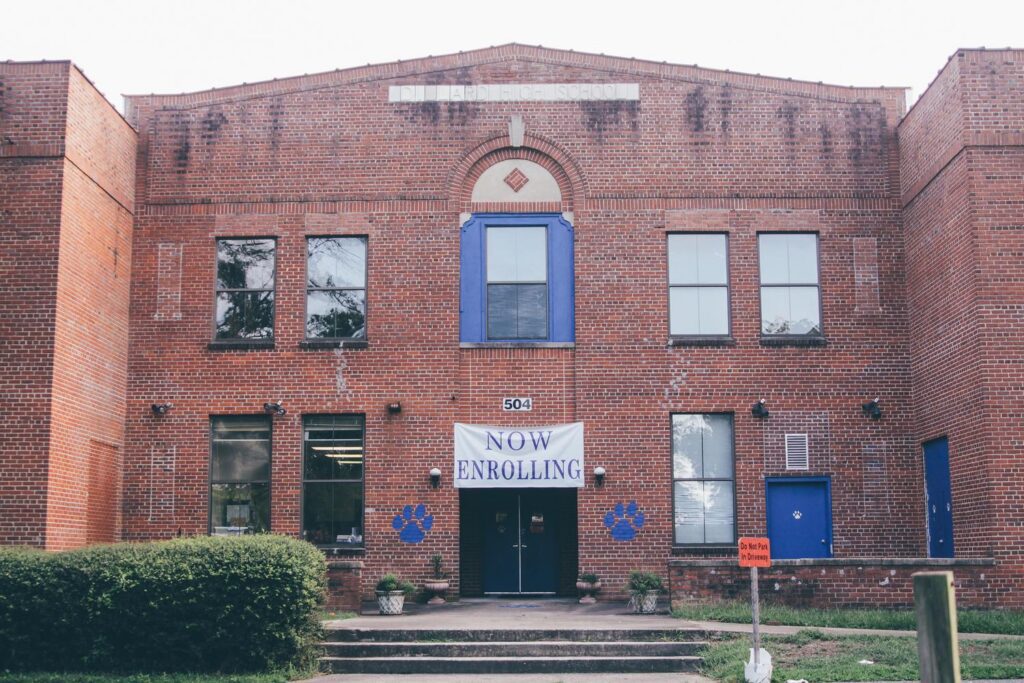
Located in Goldsboro, Dillard Academy is a K-8 public charter school that opened in 1998 with the goal of providing more personalized instruction for local students. That’s according to Danielle Baptiste, the school’s executive director and daughter of the school’s founder, Hilda Hicks.
In addition to overseeing the day-to-day operations of Dillard Academy, Baptiste also serves as the school nutrition director, ensuring roughly 250 students have access to meals each day.
“We’re a very small school, and so you end up having to be that jack-of-all-trades,” she said.
Through CEP, all students receive free meals at Dillard Academy. When students get off of the bus, they have the opportunity to go into the cafeteria and eat, with about 60% of students participating in breakfast each morning. If students get dropped off late, breakfast service continues until 9 a.m.
“We really want to make sure that our students are fed and have that basic level of need met when they go into the classroom so they can maximize their instruction, their learning,” said Baptiste.
As a small charter school, Baptiste said being able to provide free meals to all students has provided multiple benefits. It serves as a draw for parents, who have the peace of mind that there will always been food available for their student. For the school’s small staff, it has reduced the administrative burden of providing meals, as they do not have to collect meal applications or verify eligibility for free or reduced-price meals.
“It’s super simple — every child with a lunch number gets a free lunch and a free breakfast and a free snack,” said Baptiste.
She has also seen a reduction in the stigma associated with participating in school meals, especially among older students.
“It’s not necessarily cool to eat in the cafeteria — but if they see something they really like, they can make that decision right there on the spot,” she said.
Baptiste said her mother’s decision to offer school breakfast and lunch from the very first day the charter school opened reflects a strong belief in the importance of meeting students’ basic needs.
“In education, we don’t always think about how important it is to make sure our students are well fed — and that really feeds their brain for the rest of the day,” said Baptiste.

Recommended reading