
Advocates call for $4.4 million in state funds for farm to school, Summer EBT

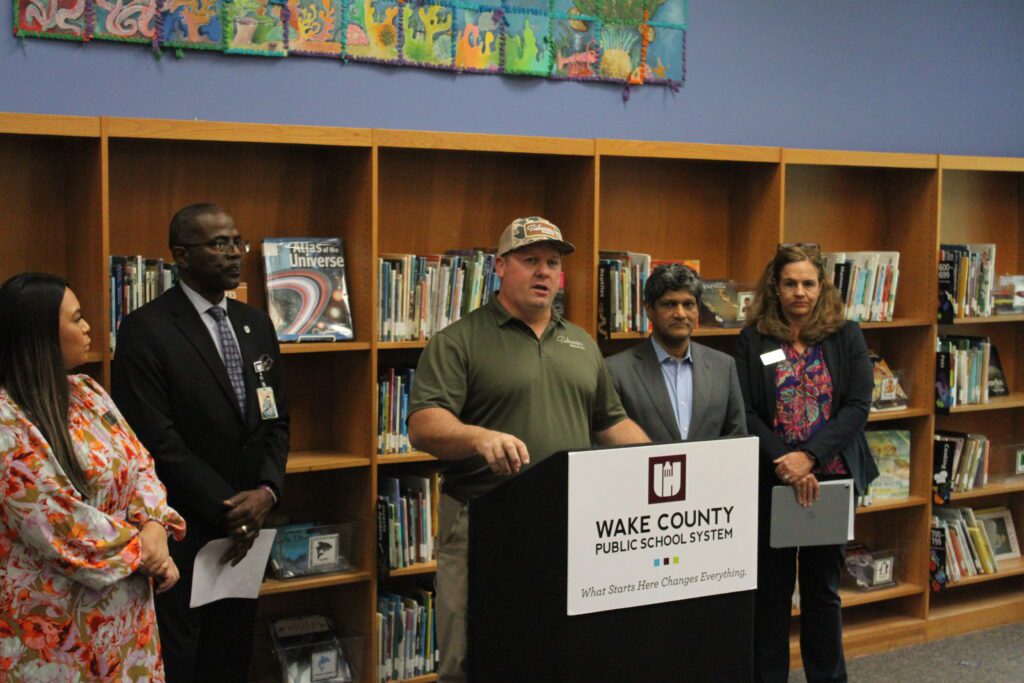
After a round table lunch at Oak Grove Elementary School in Cary on Monday, a group of advocates called for a total of $4.4 million in state funding to support the N.C. Farm to School Program and SUN Bucks, also known as Summer EBT.
At a press conference in the library of Oak Grove, Sen. Jay Chaudhuri, D-Wake, said $2.5 million of the request is for the N.C. Farm to School Program to partly replace lost funding due to federal cuts. The other $1.9 million would satisfy North Carolina’s requirement to continue operating SUN Bucks, which provides $120 in grocery benefits per eligible child during the summer.
 Sign up for the EdDaily to start each weekday with the top education news.
In March, the U.S. Department of Agriculture (USDA) canceled a program that would have provided $18.9 million to North Carolina over the next three years to purchase local food for schools, including $12.4 million for K-12 schools and $6.5 million for child care facilities.
However, the federal SUN Bucks program is still funded, and paying $1.9 million toward the state’s portion of administrative costs would unlock $131 million in federal funding for the program, according to Chaudhuri. That cost was previously funded by philanthropic dollars, according to Abby Emanuelson, director of the North Carolina Alliance for Health.
Other federal cuts to Medicaid and the Supplemental Nutrition Assistance Program (SNAP) will affect students’ ability to get free or reduced-price school meals, in part by reducing the number of schools that qualify for the Community Eligibility Provision (CEP). Through a process called direct certification, CEP uses other means-tested programs, such as SNAP, to determine whether schools qualify to provide breakfast and lunch at no cost to all students.
Wake County Public School System (WCPSS) Superintendent Robert Taylor said that a 10% decrease in the number of students directly certified for free or reduced-price school meals due to federal cuts to Medicaid and SNAP would mean 33 of the 41 Wake County schools that currently qualify for the CEP could become ineligible.
The announcement came at the beginning of National School Lunch Week, and midway through National Farm to School Month. Attendees at the press conference included Chaudhuri; Emanuelson; Taylor; Rachel Candaso, the 2025 North Carolina Teacher of the Year; and Tommy Wheeler of Tidewater Grain Co., a Pamlico County-based farm that supplies food to WCPSS.
Read more about school meals programs


The benefits of farm to school
Wheeler’s farm provides rice to WCPSS, which was served at the round table lunch. He said his farm’s relationship with the school district started through the N.C. Farm to School Program, and may not have happened without it.
“You know, we take more pride, frankly, in serving and supporting North Carolina public schools than we do any other customer we have,” Wheeler said. “We’re supporting ourselves by supporting the state and the Farm to School Program. It’s just, it’s really paramount.”

Advocates said that, aside from the primary benefit of feeding students, there are also health, community, and economic reasons for funding the N.C. Farm to School Program.
The program provides farmers with a stable buyer of their product, Wheeler said, and strengthens community ties by keeping dollars in the local economy. It also teaches kids where their food comes from and reduces stigma in school nutrition programs, Chaudhuri said.
“So farm to school is an obvious win for kids, for farmers, and communities,” Chaudhuri said. “I urge my fellow North Carolinians to reach out to your representatives and ask them to support funding from farm to school. To my colleagues in the legislature, let’s secure every dollar we can for local fresh fruits and vegetables and grain and rice for our students. Let’s put more North Carolina food in North Carolina schools.”
Finding the political will
Currently, the General Assembly is stalled in negotiations on a state budget that was supposed to be passed by July 1, the start of a new fiscal year. The House budget proposal includes $2.5 million for a fresh fruit and vegetables grant program for elementary schools, but neither the House nor the Senate budget explicitly funds farm to school efforts.
House Bill 774, titled “School Breakfast For All,” includes a $5 million farm to school provision that would help schools incorporate locally sourced products into their breakfast programs, if passed. However, that provision didn’t make it into either budget proposal.
Chaudhuri said that the $4.4 million request is “narrow and reasonable” and that he hopes both chambers will see the benefit of funding the programs.
“These are not hundreds of millions of dollars that we are asking for. These are programs that have been proven to work, that are going to help hungry kids,” he said.
Wheeler said that despite political differences, everyone should agree on funding these programs.
“We can argue about the other stuff tomorrow,” he said. “But let’s get through the easy stuff today that we all agree on — because having hungry kids fuels no purpose for any party, no matter which side of the aisle you’re on.”