EdNC’s commitment to public service

EducationNC’s 2025 Annual Report
Highlights
- The N.C. Press Association honored EdNC with its public service award for online journalism.
- An external case study found EdNC “built a team whose talent was matched only by their commitment.”
- Our DC to NC coverage is driven by a news strategy that treats journalism as the first draft of history.
- Our readership increased 15% in 2025.
- In these polarized and politicized times, readers continue to value our “straightforward” approach.
Rolfe Neill, the former publisher of The Charlotte Observer, often told journalists, including us, to not be afraid to be caught loving the community we serve.
You can see EdNC’s commitment to community in our adherence to our rule of thirds: 1/3 of our time is spent out in the world finding stories, building relationships, and investing in local leaders and economies; 1/3 is our process from writing to publication; and 1/3 is pushing the information back out into the world to readers who will not just consume the information but do something with it to build a better world.
The day to day work of EdNC looks like…
- Having a team “whose talent is matched only by their commitment,” as an external case study found in 2025.
- Allocating $200,000 annually to stay on the road.
- An approach to content informed by the leadership of the Blue Engine Collaborative and our participation in the Media Transformation Challenge. This year we met our year-end key performance indicator for users on Oct. 17 and pageviews on Oct. 25.
- A holistic playbook to distribute our content into the world, relying primarily on search engine optimization, paid boosting on Facebook, and newsletters.
- A ripple effects survey to capture the ongoing impact of our stories and leadership in communities across North Carolina.
But along the way, Jama Campbell, the executive director of the SECU Foundation, first helped us back in 2021 realize that the same information we use to write stories can also be used to help those we serve secure funding, and she called that “strategic support.”
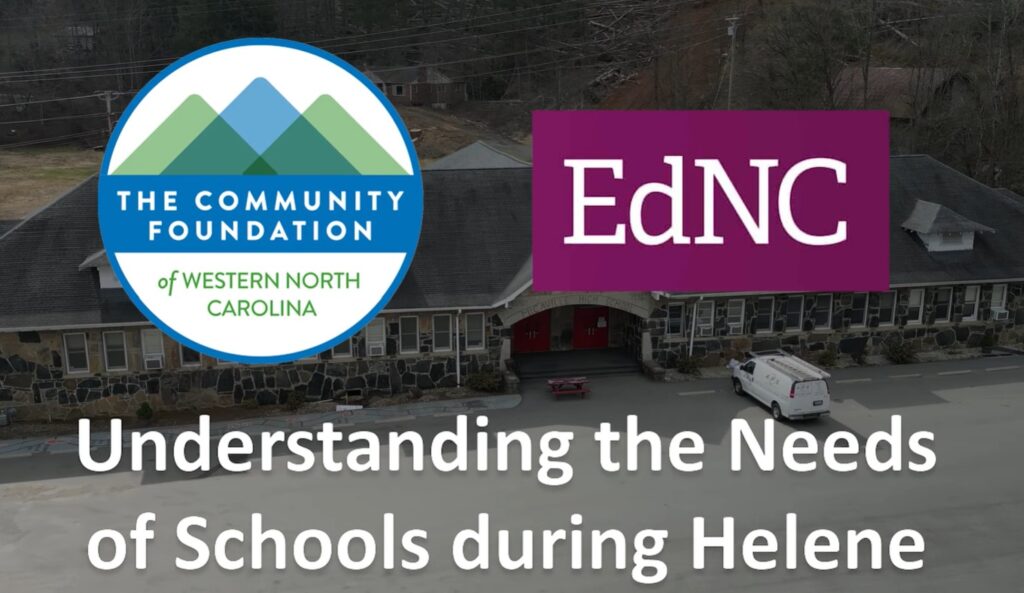
You can see EdNC’s commitment to community in our piloting of strategic support for those we serve from the papermill closing in Canton to our support of four rural counties after Hurricane Helene.
When education journalist Amanda Ripley — the author of “The Unthinkable: Who Survives When Disaster Strikes — and Why” — talks about leadership in crisis, she describes the three phases of disbelief, deliberation, and then the move to decisive action. For our own team and those we support, this framework guides us through crisis.
Terrence Real’s book, “Us,” has also been important in our work to support communities through cycles of harmony, disharmony, and repair.
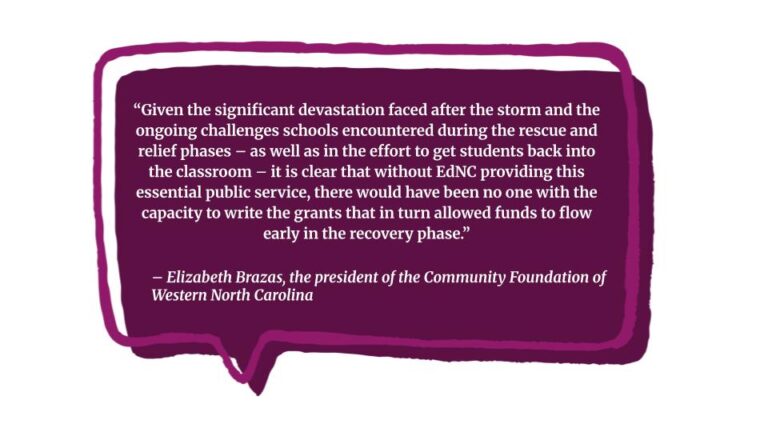
This year, the N.C. Press Association honored EdNC with its public service award. In addition to our coverage about Helene, which includes 145 articles to date, we used our content to write grants, helping to secure $4,044,740 for Avery, Mitchell, Watauga, and Yancey counties.
EdNC’s award-winning documentary, “The Long Way Down” — which has more than 92,000 views — is about the public school playmakers who wrote a play called “Surge” after the hurricane.
In the play, four reporters covering the hurricane serve as narrators, but community members also call them out for how they showed up in communities after the storm.
“You know, it would go a lot faster if you would help us,” a student says to one reporter.
“How bad is it?” another reporter asks the father of a family in the play. “Look around,” the father responds.
Later in the play, as a reporter begins to help, a community member played by Rowan Tait asks, “Are you a day helper or a stay helper?”
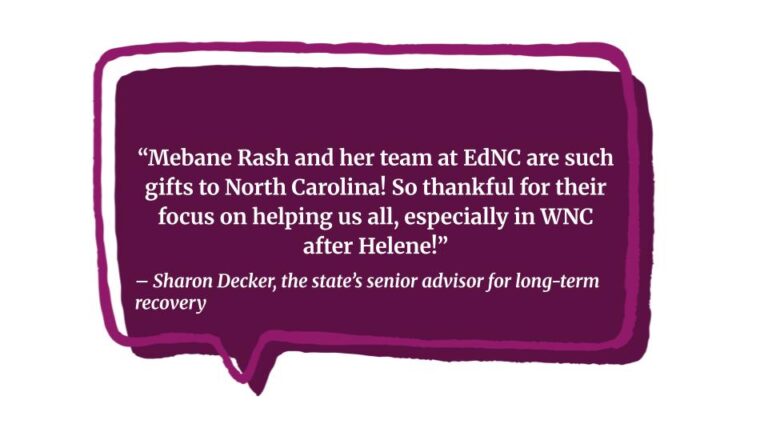
Whether EdNC’s work beyond reporting is thought of as strategic support or public service, we strive to show up in the lives of those we serve as stay helpers.
EdNC’s Theory of Change
Year to year, our annual report provides an update on our mission as operationalized by our theory of change, our outputs, outcomes, key performance indicators, and impact. We believe our direct, widespread, and systemic impact is driven by what we do and why we do it.
How we do the work is guided by our team tenets: we strive to be welcome in all 100 counties, be seen as stay helpers, do no harm, showing up as peer experts, prioritizing our North Carolina audience, attending to the wellness of ourselves and those we serve, providing strategic support as we can, to prompt systemic change aligned with our commitment to being more and more inclusive. Since 2024, we have used this ripple effect survey to better map the impact of EdNC.
1) On the ground in your communities
From the beginning of EdNC, showing up in your communities in person has mattered in building and then strengthening our relationships with you. We strive to be welcome in all 100 counties, all 115 school districts, and all 58 community colleges.
Conducting our reporting and researching on the ground in your communities allows us to establish trust, share relationships, check our assumptions, conduct both qualitative and quantitative research, inform grantmaking and policymaking, and align and build momentum for collective action in addition to storytelling.
In 2025, we visited all eight community colleges in the first cohort of Boost, the state’s accelerated college-to-career program. We also held a “mini-blitz,” visiting eight community colleges with presidents who began their tenure in the last two years. In total, EdNC team members went on 37 community college campus visits to 28 unique community colleges in 2025.
We traveled more than 54,000 miles, the equivalent of driving from Murphy to Manteo 100 times.
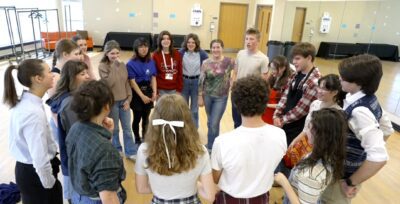
Our 2025 travels took us to Japan twice — once with a community college and a second time with these amazing public school students — and to Singapore.
2) Journalism as the fourth estate in a democracy
EdNC covers the continuum from birth to career, and since our beginning we have known we can’t cover education without also covering poverty, health care, nutrition, and the economy.
Our team uses a layered media strategy to engage our audience, starting with social-first content when we are out on the road.
Our news documents in real time what is happening — when and where and why, providing comprehensive coverage of issues, covering stories over time, and conducting enterprise projects.
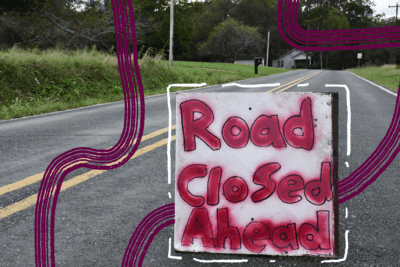
This year, our DC to NC coverage has used an approach to journalism that treats news as the first draft of history. In these articles, we are identifying the responsible leaders, the actions being taken, and the legal authority being cited with links to primary sources.
“I commend you for your well structured and concise articles about the issues and current events happening within the North Carolina education system. It has been refreshing to read them truly due to the linked attachments to primary sources and supporting articles. I also appreciate the straightforward description of what is happening within the world, which excludes biased perspectives.” — Sabree Flood, North Carolina educator
In 2025, thanks to the leadership and expertise of Kristen Blair, EdNC expanded our news coverage to include the Charter Schools Review Board and other charter school news and stories. Our emails distributing these articles had an incredible open rate of 55.2%.
Last year, EdNC’s coverage of the State Health Plan was often the only coverage. We will be covering the transition of the president of the community college system and the development of the system’s next strategic plan in 2026.
Our multimedia capacity allows us to infuse our work with graphics, audiograms, podcasts, videos, and short- and long-form documentaries.
Read more
3) In-depth research on the issues surfaced by the news across the education continuum
EdNC conducts in-depth qualitative and quantitative research, policy analysis, and surveys on the issues surfaced by the news. This research, conducted by policy analysts, informs our capacity to provide thought leadership on policy and politics.
Analisa Sorrells Archer returned to EdNC in 2025 to lead our policy work after completing her masters at the Harvard Kennedy School (HKS) and working at the HKS Government Performance Lab and the Rockefeller Foundation.
In 2025, EdNC published 27 policy-related research projects. That included analyzing data and making sense of trends on ranging from public school market share to the state revenue forecast to school vouchers. It also included research on the Medicaid Learning Collaborative, challenges to reducing ultraprocessed food in school meals, and impacts of federal policy change on Hispanic-Serving Institutions.
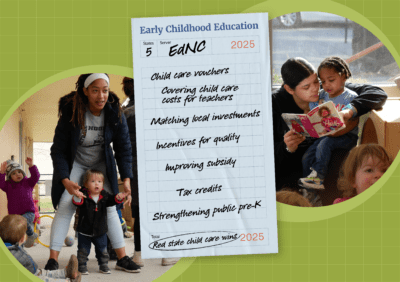
Combining solutions journalism and public policy analysis, Liz Bell and Katie Dukes have continued their look to other states to document what is and isn’t happening in early care and education, but more importantly what must happen moving forward.
Read more
Read more

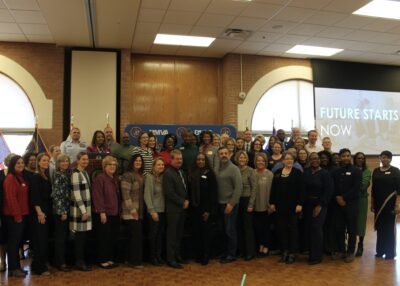
You can find all of the archives of the N.C. Center for Public Policy Research on the EdNC site here, including an AI assistant that will help you find what you are looking for.
4) Building and engaging our audience
EdNC launched with an audience of zero in 2015, and now day-to-day we truly have statewide reach. We had 1,441,002 users visit our website and 2,312,779 pageviews in 2025, a 15% increase from the previous year.
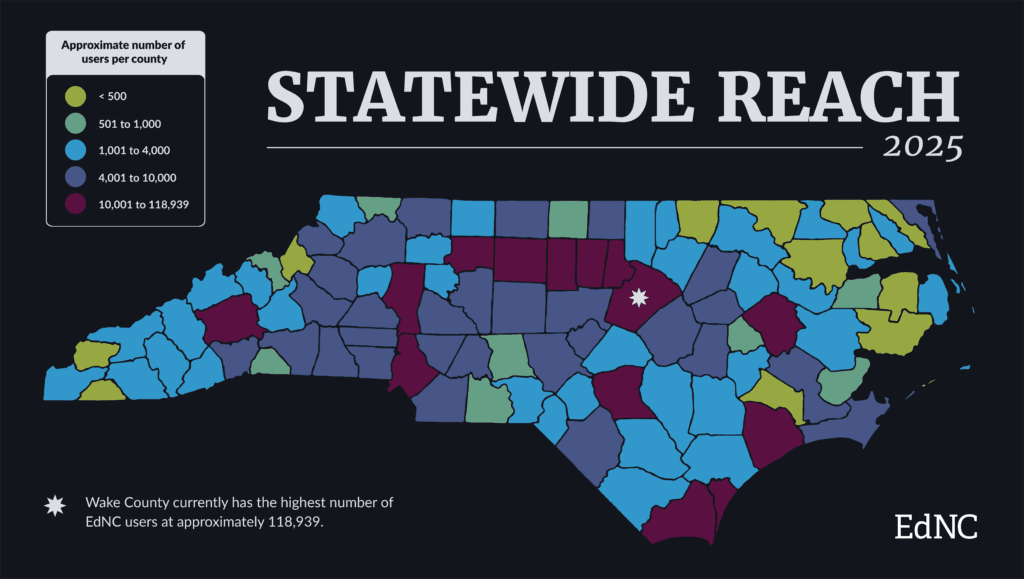
In 2025, our team participated in 789 external meetings to engage with our audience and better understand how to meet their needs.
Annually, EdNC iterates our audience playbook for content distribution, audience growth, and engagement, including our website; email, including newsletters; social media; Reach, our suite of tech tools, including texting and surveys; fostering belonging, including individual donations; events, including ours and others; brand building, including swag and sponsorships; and leveraging redistribution and republication.
Our content also appears on the Apple News app. In 2025, we had 69,629 users and 192,036 pageviews on Apple News. We also had a reach of over 275,000 and more than 2,400 shares on the platform. We gained 440 followers in 2025, bringing our total following to approximately 1,243.
Google search, newsletters, and Facebook drive most of the traffic to EdNC articles, with Google Discover playing an increasingly important role in our search traffic. We had 38.2 million impressions on Google search in 2025, up from 31.2 million in 2024. We send out more than 320,000 emails weekly. We have 30,755 followers on Facebook and 16,489 followers on X.
EdNC shares our platform with a commitment that at least 20% of perspectives published are written by people of color. In 2025, we hit 30%. Here is information on how to submit a perspective.
We offer free subscriptions to four newsletters: EdDaily, EdWeekly, Awake58, and Early Bird. You can sign up for all of them here. Our average open rates range from 26.5% for EdDaily to 37.1% for Early Bird.
This year, more than 150 EdNC articles were republished by other news outlets, allowing our coverage to reach audiences we may not have otherwise reached locally and nationally. Newsletters such as N.C. DPI’s daily education news clips, the North Carolina Tribune, the NC Insider, The 74, and Education Commission of the States often point to our content, allowing us to reach key influencers in education and policy. Here are our republication guidelines.
Collectively, our audience breathes life into the “architecture of participation” we built to tell the story of your commitment to our students, our state, and our future.
5) Belonging
None of our content is behind a paywall. That remains our most important commitment to being part of us.
In 2025, EdNC iterated our ongoing content audit to align with the Maynard Institute’s fault lines in journalism. Annually, we adopt strategic objectives to increase our inclusion across four dimensions: intrapersonal, organizational, community, and systems belonging.
Derick Lee leads our support of other leaders and organizations through five key levers:
- Amplification: inclusion in newsletters, posting and boosting on social media;
- Content: profiles of leaders, event coverage, publication of perspectives, creation of social first and multimedia content;
- Leaders/Organizations: monthly or quarterly check ins;
- Financial: sponsorships, grant writing, sharing other financial assets; and
- Resources: sharing relationships and networks, sharing our team.
In 2025, Lee and EdNC provided targeted support to LENS-NC, CREED, the Dudley Flood Center for Educational Equity and Opportunity, and LatinxEd, among other organizations.
EdNC has our own content expectations for the seven majority Black counties and the Indigenous tribes of North Carolina.
6) Leading innovation in the new media and nonprofit world
There is a spell after a natural disaster where the only thing that really makes a difference is money.
Although we can’t find any evidence that another outlet has tried this before, our innovation was to intentionally broaden our audience to include philanthropy, a strategy we learned in the Knight-Lenfest Newsroom Initiative.
Initially, EdNC used our content to brief philanthropists on weekly calls to inform their investments in rebuilding and recovery. Immediately thereafter, we were asked to also use our content to write grants for the communities we serve. The leaders in those communities had zero capacity to get even the abbreviated grant forms submitted.
In the first weeks after the storm, EdNC wrote grants totaling $932,600 that provided operating support for the regional partnership for children, a Head Start program, three school districts, and a community college. In the school districts, our content made the case for $25,000 per school instead of per district. These dollars were the only dollars to hit bank accounts fast enough to make a difference.
Another round of funding we supported hit just as districts were bringing students back to school, including one district that faced unusual costs because running water had not been restored.
The federal department of education has a SERV grant for schools and community colleges facing an unprecedented crisis, which before Helene had typically been utilized for mass shootings. EdNC supported the grant submissions of four districts and a community college, with awards totaling $1,931,060.
By February 2025, EdNC had become the go-to source for information, with funders asking us to survey the ongoing needs of districts throughout the region.
We also invited funders to join us in WNC so they could see the damage first hand, which led to funding for devices, construction trade programs, and summer learning programs.
In total, EdNC helped secure $4,044,740 for Avery, Mitchell, Watauga, and Yancey counties. This would not have happened without the expertise and leadership of Deanna Ballard, Jeremy Gibbs, and Kelley O’Brien. Thank you.
7) Tracking the impact of our work and moving the needle on policy change
EdNC strives to inform and shape the conversation about education in North Carolina. We love it when the information we publish is used to prompt change.
A highlight for our team is the state funding that is now available for homebuilding programs in districts across North Carolina.
In 2025, almost 2,000 readers again responded to our annual survey. This year, we used a new platform, which eliminated the presence of bots in survey results, increased the user experience, and resulted in an increase in the number of responses for all questions in the survey. For example, the question about actions taken by respondents based on our work had 1,921 responses:
- 70.3% discussed something they read on EdNC with colleagues
- 40.0% directly applied knowledge gained from EdNC to professional life
- 33.4% shared an article or information from EdNC on social media, in an email, etc.
- 18.2% changed their mind about an issue because of something they read
- 10.6% discussed something they read in EdNC with policymakers/legislators
- 5.3% commented on an EdNC article
- 4.2% joined an initiative, community group, or newsletter focused on an issue they read about on EdNC
- 2.9% wrote their own piece based on something they read
Of 1,942 responses, only 6.8% did not think we are providing a neutral view of what’s happening in education. In these polarized, politicized times, we take that as a win, especially since some think we lean left and others think we lean right. Fewer than 1% of respondents have a negative experience of our platform, EdNC.org.
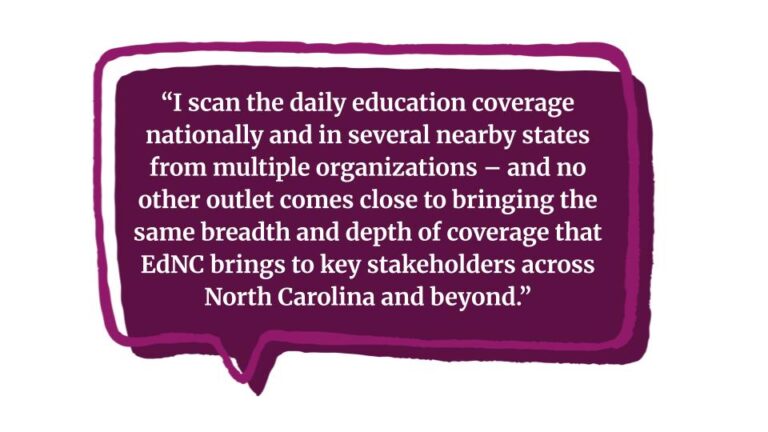
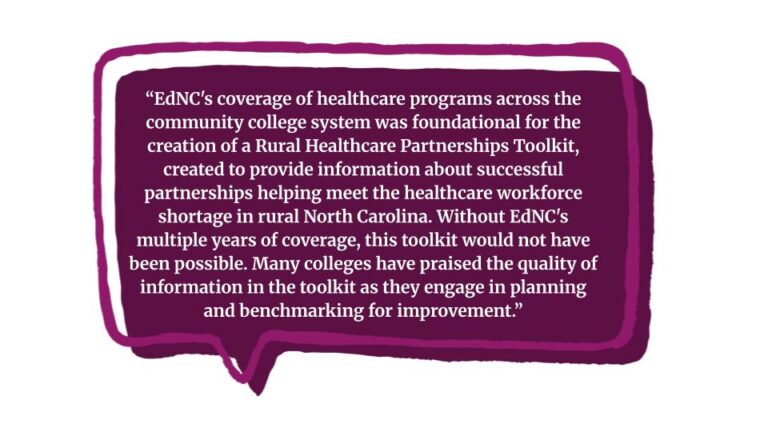
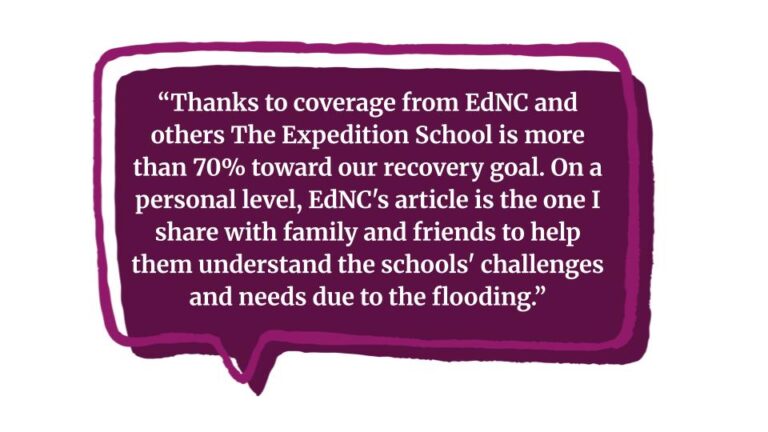
We know from our ripple effects survey that our readers use our content for an incredibly wide range of purposes. Philanthropists use our articles to inform framing documents to support long range planning and investment. Our articles are used to document the scope of work across the state in each sector: early education, K-12, and community colleges. Emerging leaders and new nonprofits use articles to connect to funders and funding opportunities.



8) Increasing leadership capacity statewide

EdNC believes in collective and distributed leadership that is service oriented. We work together as a team of peer experts and thought leaders.
Mebane Rash is the founding CEO and editor-in-chief. Liz Bell is a senior reporter with early childhood expertise and perspectives editor. Molly Urquhart is our vice president and chief operating officer. Analisa Sorrells Archer is our senior director of policy. Caroline Parker is our director of rural storytelling and strategy. Alli Lindenberg Semon is our director of engagement. Emily Thomas is our regional director of western North Carolina. Katie Dukes is our director of early childhood policy and perspectives editor. Hannah Vinueza McClellan is our director of news and content and she helps cover education news and policy, and faith. Derick Lee is a storyteller and our director of culture and partnerships. Lauren Castillo is our associate director of operations. Chantal Brown is a reporter. Ben Humphries is a reporter and policy analyst. Andy Marino is our lead web developer specializing in WordPress and web accessibility. Sophia Luna is a policy analyst.
EdNC had seven fellows in 2025: Jyanne Guide, Rakyah Jacobs, Cheyenne McNeill, Sergio Osnaya-Prieto, Anna Pogarcic, Alessandra Quattrocchi, and Zoe Timperman.
EdNC is deeply thankful for the leadership of Molly and Lauren, who day-to-day manage the operations of the organization with an excellence that is both aspirational and inspirational, and allows the rest of us to focus on content and be on the road out in community. We welcomed Molly’s second baby, Henry Osborne Urquhart, to our EdNC family on Dec. 12, 2025!
Our thanks to Kelley O’Brien, Tara Kenchen, Robert Kinlaw, Deanna Ballard, Dan Gerlach, Jeremy Gibbs, Kristen Blair, Amy Rhyne, and Outfitters4, who play invaluable roles on our team. Many thanks to our attorney, Mike Tadych, and our auditors, Batchelor, Tillery & Roberts, LLP.
A few highlights from our 2025 leadership investments:
- Liz Bell was invited to a convening in DC, titled “Reporting for Change: A Child Care Journalism Convening” hosted by New America’s Better Life Lab and sponsored by the Bainum Family Foundation. Here are her takeaways. She also attended a global early childhood conference in London, co-hosted by Bright Start Foundation and the Higher Colleges of Technology in Abu Dhabi. In 2026, Liz, who was selected for a Better Life Lab Child Care Reporting Grants, will publish, “A Tale of Two Child Care Models: A Military Community Grapples with its Off-Base Crisis.”
- Caroline Parker moderated a panel for The Journalism + Design Lab at The New School entitled, “How Helene Amplified Community Colleges’ Role in Local News and Information.” She led a discussion with Dr. Shelley White and Michelle Harris of Haywood Community College and Kerri Glover of Asheville-Buncombe Technical Community College about the ways community colleges served as information hubs during the storm, the roles of graduates from community colleges as first responders after the storm, lessons learned, and how community colleges continue to serve as anchor institutions in WNC after the storm.
- Chantal Brown attended the UNCF Unite Conference in Atlanta, National Association of Black Journalists regional convening in Charlotte, NC Local News Summit in Durham, and the Black is Brilliant Conference in New Orleans.
- Ben Humphries and Chyna Delk-Bratcher, an educator in Hoke County, are participating in the Public School Forum of North Carolina’s Education Policy Fellows Program.
- Derick Lee attended professional development for journalists in Detroit hosted by the Maynard Institute.
- Alli Lindenberg Semon will be completing the UNC Hussman’s Graduate Certificate program in Digital Communication Strategy in 2026.
- Andy Marino attended All Things Open 2025, the largest open source, web and tech conference on the U.S. East Coast.
- EdNC supported LatinxEd with a $2,500 challenge grant for its Legacy Campaign.
- EdNC supported Principal Leshaun Jenkins in the publication of his book, “Principles of a Principal.”
- Mebane’s leadership was honored by Teach for America North Carolina, the Public School Forum of North Carolina, and with the state’s Order of the Long Leaf Pine for 30 years of public service.
9) The broad base of financial support
Our funders breathe life into our work. Here are our supporters by year. Thank you!
About EdNC
EducationNC has been operating online since Jan. 12, 2015, and June 30, 2025 marked the end of our eleventh fiscal year. EdNC is a registered trademark with the N.C. Secretary of State and the United States Patent and Trademark Office.
Our mission is to expand educational opportunities for all students in North Carolina, increase their academic attainment, and improve the performance of the state’s public schools. We provide residents and policymakers with nonpartisan data, research, news, information, and analysis about the major trends, issues, and challenges bearing on education. We gather and disseminate information employing the most effective means of communication, primarily through the Internet. In addition to the content distributed, we encourage an active and connected community of those interested in education policy and practice throughout the state. Our work encourages informed participation and strong leadership on behalf of the students of North Carolina.
In 11 years, we have published more than 9,300 articles lifting up more than 1,600 voices from across our state, collectively writing the story and history of education in North Carolina.
“Thank you for telling so many stories and finding avenues for helping others share their stories too. You are a true light bearer, and it is an honor to witness.” — 2024 Principal Beckie Spears
Here is our statement on journalistic independence.
EdNC’s Board of Directors and Strategic Council
Thank you to the leaders who currently serve on our board and strategic council.
EdNC’s Annual Reports and Financials
Here are EdNC’s previous annual reports. Here are EdNC’s audited financial statements and tax returns. Our 2024-25 audit will be posted in February 2026.
Thank you for your ongoing support of EdNC. It is our privilege to do this work, and we could not do our work without you.
Expect great things from us, and please donate so we can continue to grow our impact in 2026 and beyond.