EdExplainer | What is special education in North Carolina?
Editor’s note: This series of EdExplainers will serve as a guide for families with children in North Carolina public schools, from pre-Kindergarten through 22 years of age, navigating Exceptional Children services. The goal is to start a dialogue and answer questions about a topic that can be challenging and complex for students, families, and educators.
The state of North Carolina does not usually use the term “special education” in official paperwork. Instead, the state calls it Exceptional Children (EC) services.
Every district in North Carolina has an EC department with a director. The state agency is the Office of Exceptional Children at the Department of Public Instruction. EC is simply North Carolina’s name for the services that federal law requires every state to provide.
Historically, in North Carolina, the “Exceptional Children” umbrella historically covered both students with disabilities and academically gifted students. Gifted education operates on a separate state law with separate rules. If someone in the North Carolina public school system says “EC,” they are almost always referring to disability-related services.
Special education is neither a place nor a program in which you enroll. Rather, it is a set of adjustments that can travel with the child throughout their educational career. It can include how instruction is delivered, who delivers that instruction, the duration of the specially designed instruction a child receives, and what materials are used to deliver that instruction.
 Sign up for the EdWeekly, a Friday roundup of the most important education news of the week.
The law and what it guarantees
Before the 1970s, public schools in North Carolina and across the country could turn children away if they decided the child was not “educable.” Families had no recourse. That changed in 1975, when Congress passed what is now called the Individuals with Disabilities Education Act (IDEA).
IDEA gives every eligible child the right to a free appropriate public education, or FAPE:
- Free: You are not billed for special education, evaluations, or the related services in your child’s plan, whether speech therapy to assistive technology and everything in between.
- Appropriate: This is the word that, perhaps, is the most controversial. It does not mean the best possible education. It does not mean your child will reach grade level. Rather, the Supreme Court’s standard, set in Endrew F. v. Douglas County School District in 2017, is that a child’s program must be reasonably calculated based on the individual. Taking the unique circumstances and potential of the child into consideration, the educational program must be appropriately ambitious. Minimal progress is not sufficient.
- Public: The district is responsible for providing it, in the public system, at public expense, regardless of cost.
- Education: A student’s education covers academics but also includes the other things a child needs in order to access school: communication, behavior, mobility, daily living skills, and planning for life after graduation.
North Carolina layers its own laws on top of IDEA in a document called Policies Governing Services for Children with Disabilities as well as in Article 9 of Chapter 115C of state law. In cases where the state legislation gives families more than the federal law does, the legislation of the state wins.
In North Carolina, parents of Exceptional Children have legal rights called Procedural Safeguards under IDEA and state policies. Families must be offered a written copy of the Procedural Safeguards at least once a year.
Core parents rights include (but are not limited to):
- You must receive a Prior Written Notice before the school changes your child’s evaluation, services, or placement.
- You must provide written consent before your child’s evaluations and services begin.
- You have the right to all of your child’s educational records and must be provided them within 45 days of the request.
- You are entitled to copies of every evaluation conducted.
- You can disagree with the testing conducted by the school and can request an Independent Educational Evaluation (IEE), at public expense.
- You act as an equal member of your child’s Individualized Education Plan (IEP) team and you can bring advocates and/or experts to your meetings.
- You can, should disputes arise, challenge decisions through channels such as mediation, state complaints, and due process hearings.
EC by the numbers
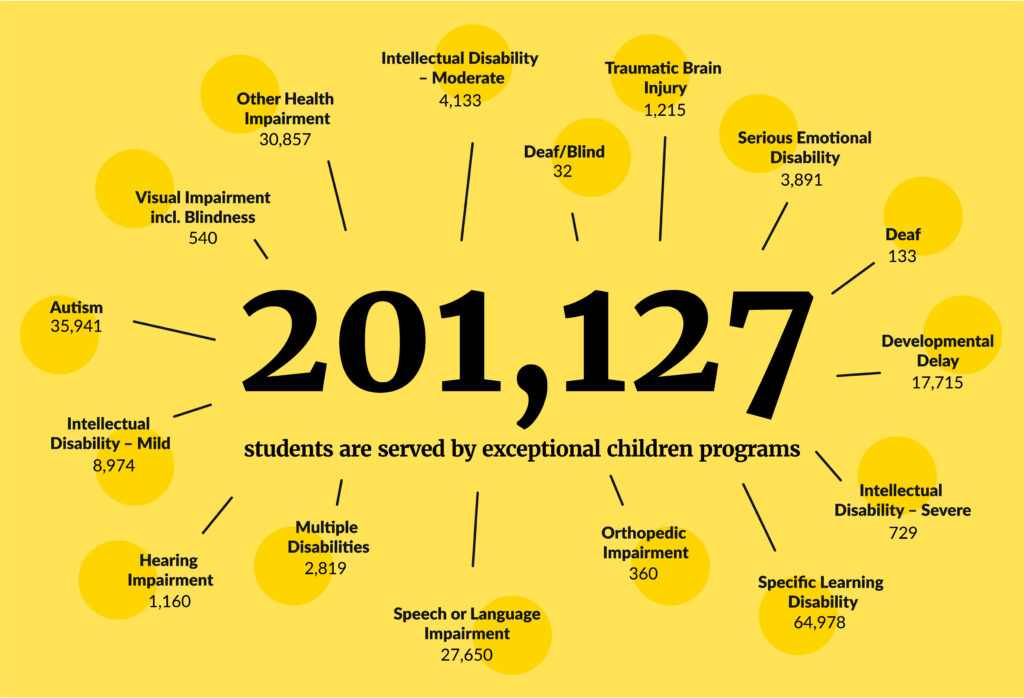
201,127 — North Carolina students ages 3-21 qualified for special education through the state’s 115 districts.
Including charter schools, the number rises to 220,730, per the December 2025 child count.
$4,093.14 — Flat per-student state allotment.
Regardless of the intensity of the child’s needs, the state of North Carolina pays the same amount for each child.
13% — State funding cap.
North Carolina provides additional funding for students with disabilities (the $4,093 per-student allotment), but those funds are capped at 13% of the enrollment of each district. If more than 13% of students are students with disabilities, districts do not receive additional funding for those students. Most districts serve more students than the state funding cap pays for and cover these costs through other budget lines.
Should your child qualify, none of these numbers change what your child is legally owed.
Special education versus intervention
The distinction between special education and intervention can be confusing.
Every North Carolina district runs a Multi-Tiered System of Support, or MTSS. Names for the team that supports and problem-solves student needs vary by school and district.
MTSS provides extra support to any student who is struggling. Support is layered and increases in intensity: high-quality core instruction for all (Tier 1, universal), small-group intervention for students who need supplemental support (Tier 2, targeted), and something more individualized for students who need more individualized intervention (Tier 3, intensive). The support provided by MTSS affords many children the opportunity to close gaps.
Special education is different in kind, not just in intensity.
With hope, this introduction exposes you to what Exceptional Children’s services look like in North Carolina. Throughout this series, a variety of topics will be unpacked from disabling categories to the intricacies of implementation in order to support students and families comprehensively.