
Federal research finds increasing number of students with disabilities spending ‘much of their day’ in general education

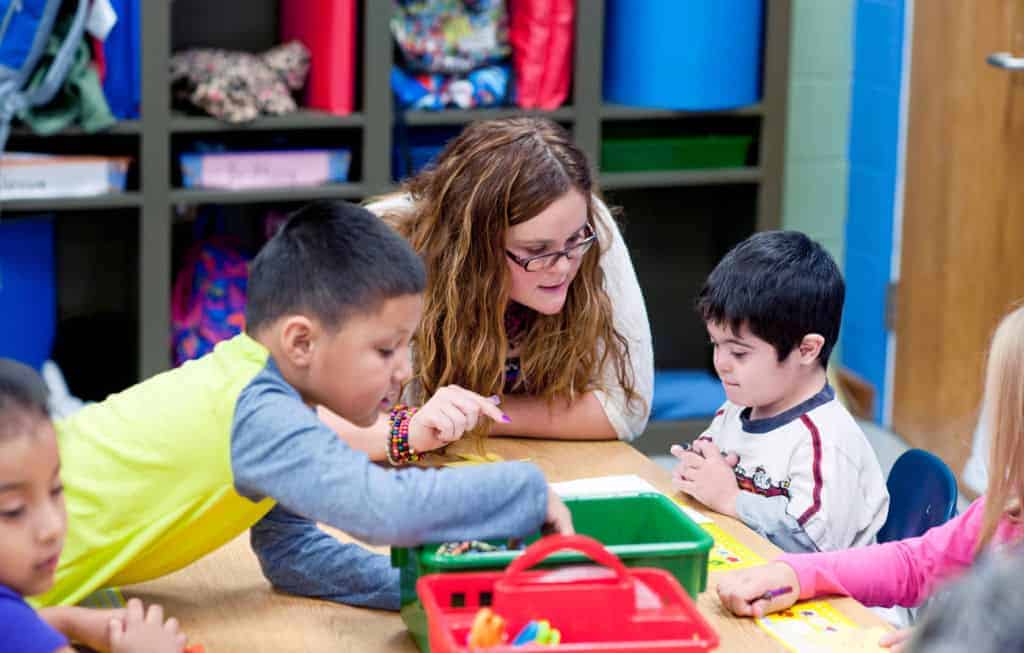
The United States Government Accountability Office (GAO) issued a report in July detailing the findings of a study they conducted on how many students with disabilities are spending “much of their day” — at least 40% — in a general education classroom setting. Their research found that the number increased by 25% between the 2012-13 and 2023-24 school years across the country, while the number of students with disabilities only increased by 21%.
The Individuals with Disabilities Education Act (IDEA) states that students with disabilities have the right to a free public education, ensuring access to special education when necessary for eligible children. Part of IDEA requires that students with disabilities be educated in the “least restrictive environment,” meaning that whenever possible, they should be spending their time alongside their peers without disabilities in general education classroom settings.
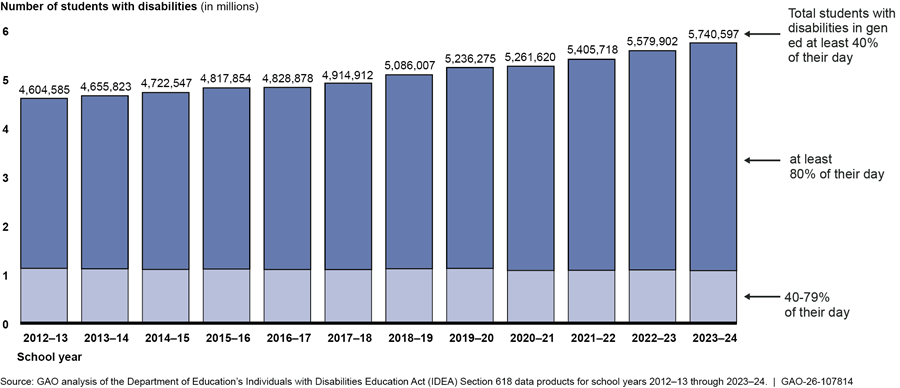
As seen in the chart below, the majority of students with disabilities spent at least 80% of their days in general education classrooms. The research found that 84% to 99% of students with a specific learning disability were placed in gen ed for at least 40% of their day in 49 of 49 states.
“Congress appropriated $14.6 billion for IDEA Part B grants in fiscal year 2025 for states to assist them in providing special education and related services to eligible children with disabilities from age 3 and possibly lasting to the student’s 22nd birthday, depending on state law or practice,” said Sen. Tim Kaine, D-Virginia, and Sen. Bernard Sanders, D-Vermont, in their intro letter that headed the GAO report.
The report addresses state-to-state variations in general education placements for students with disabilities, how schools decide to place students with disabilities in general education or not, and how some public schools are encouraging a sense of belonging for students with disabilities.
State-to-state variations
In accordance with IDEA, all states must provide free appropriate education to students with disabilities, but there is significant variation in how states have interpreted and implemented that guidance. Therefore, GAO was asked to review data to understand the differences in how these provisions of IDEA were implemented across the country.
Their research found that the number of students with disabilities increased in most states between the 2012-13 and 2023-24 school years, including North Carolina, which saw an increase of between 2% and 4%. California and Utah saw the most notable increases, and Nevada and North Dakota saw the most significant decreases.
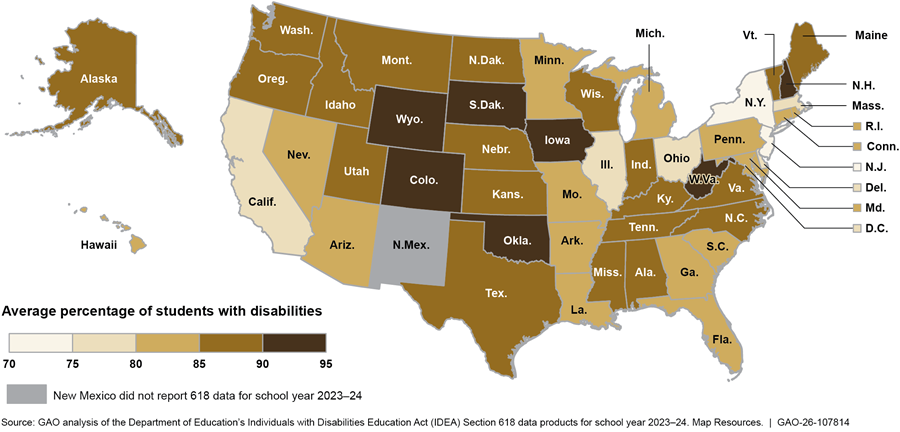
Of the students with disabilities, the percent who were spending at least 40% of their day in general education ranged from 71% to 93% across states in the 2023–24 school year, which represents a significant variation nationally. See the map below.
There were a few notable characteristics that were shared by many students with disabilities who were placed in general education for at least 40% of the day:
- 75% of English learners with disabilities were placed in general education for at least 40% of their day in 49 of 50 states
- Girls were placed in general education for at least 40% of their day more often than boys in 50 of 50 states
- Race was not a differentiating characteristic for 70% of students with disabilities placed in general education in 40 of 50 states
- 46 of 50 states paced students in general education at the same rates between primary and secondary schools
Factors that influence placement
GAO’s research found that there were several key factors and characteristics of school districts associated with higher placement for students with disabilities in general education settings. The child’s needs are not the only factor that shape the decision to place them in a general education setting.
For instance, “students with disabilities who went to school in lower and higher-poverty districts were associated with higher rates of placement in gen ed,” according to the report.
Also, relative to schools with a dedicated special education school, districts without special education schools were associated with a 5.2% increase in placement for students with disabilities in general education. Students with disabilities in districts with lower per-pupil revenue were associated with a higher percentage of placements in general education.
Read more about policy affecting persons with disabilities
GAO performed an analytical deep dive on three states: Connecticut, Illinois, and Washington. In these states, availability of resources, like staffing or lack of available specialized services and programs, was cited most frequently for the reason behind a student’s placement.
“Having more staff could really allow students to stay in their general education classrooms, develop relationships, and not be pulled out as much,” said one surveyed administrator.
Furthermore, parental involvement was also found to be a key indicator for child placement. Parents often had “specific educational settings in mind for their child and requested they be assigned to that setting.”
Finally, the school environment, or the “facilities and school culture,” was found to play a large role in these placement decisions.
“(School culture) is the number one issue,” said one surveyed official. “The (principal) is the most powerful benefit or hindrance to inclusion. Unfortunately, a lot of principals do not have a special education background or a depth of knowledge in special ed.”
 Sign up for the EdDaily to start each weekday with the top education news.
Encouraging a sense of belonging
In the report, educators from the three surveyed states identified several challenges and successes for creating a sense of belonging for students with disabilities at their schools. Below is a table detailing those items.
| Challenges to creating belonging | Successes in creating belonging |
| Teacher contract provisions | Connecting to curriculum |
| School culture | Connecting to peers |
| Lack of resources | Connecting to extracurriculars |
Click here to explore the Department of Education’s best practices for creating inclusion.