Color of Education 2026 calls for commitment to public schools and educational justice
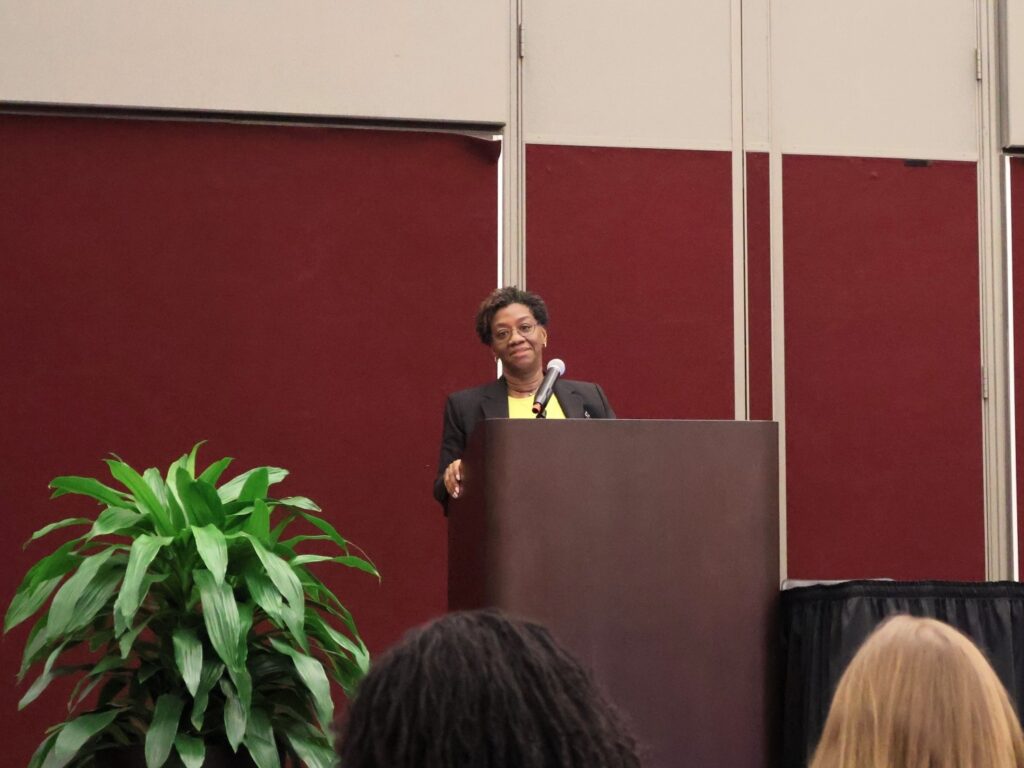
Bishop William Barber II served as one of three keynote speakers at the 2026 Color of Education Summit in Raleigh earlier this month, calling on a renewed commitment to the state’s public schools and students.
The summit is a partnership between The Dudley Flood Center for Education Equity and Opportunity (Flood Center), the Public School Forum of North Carolina, the Samuel DuBois Cook Center on Social Equity, and the Center for Child & Family Policy at Duke University’s Sanford School of Public Policy.
About 600 students, educators, researchers, and community leaders from North Carolina and beyond gathered for the two-day summit, which focused on the theme of “Justice Rising: Repairing, Restoring, Resistance.”
In his remarks, Barber said North Carolina is witnessing a “systematic betrayal of a foundational American promise,” referencing a standard for access to public education depicted in a 1785 quote from the second president of the United States, John Adams:
“The whole people must take upon themselves the education of the whole people and must be willing to bear the expenses of it. There should not be a district of one mile square without a school in it. Not founded by a charitable individual but maintained at the expense of the people themselves.”
 Sign up for the EdWeekly, a Friday roundup of the most important education news of the week.
Despite exclusions in access to education for marginalized communities since the nation was founded, Barber asserted that the following fundamental truth can still be extracted from Adams’ statement: “A free society cannot survive without a robust, universally accepted public school system.”
The aforementioned “promise” refers to the concept that “every child should have access to a publicly funded school system, close in proximity, paid for by the public,” Barber stated.
According to Barber, the betrayal of that promise pertains to North Carolina “dismantling the public infrastructure built to serve every child, and replacing it with a scheme designed to enrich private entities for profit.”
He specifically alluded to the North Carolina Supreme Court April 2026 decision to end the three-decade long Leandro school funding litigation.
Additionally, Barber referenced the expansion of private school vouchers through the Opportunity Scholarship program in recent years, likening it to the Pearsall Plan of the mid-1950s, that, among other things, allowed white families tuition grants to attend segregated private schools post the landmark decision of Brown v. Board of Education.
“It was a voucher system explicitly designed to circumvent justice, block equity, and abandon public education. Today’s voucher expansion is the modern ghost of the Pearsall plan,” Barber stated.
Barber called upon attendees to mobilize and march to election polls in pursuit of representation that honors the constitution’s promise for every child to have a fundamental right to a sound basic education.
“We will no longer allow a betrayal of the public trust, without an all-out moral battle for the soul of this nation, for the lives, the dreams, the hopes, the potential, the possibility of every child,” he concluded.
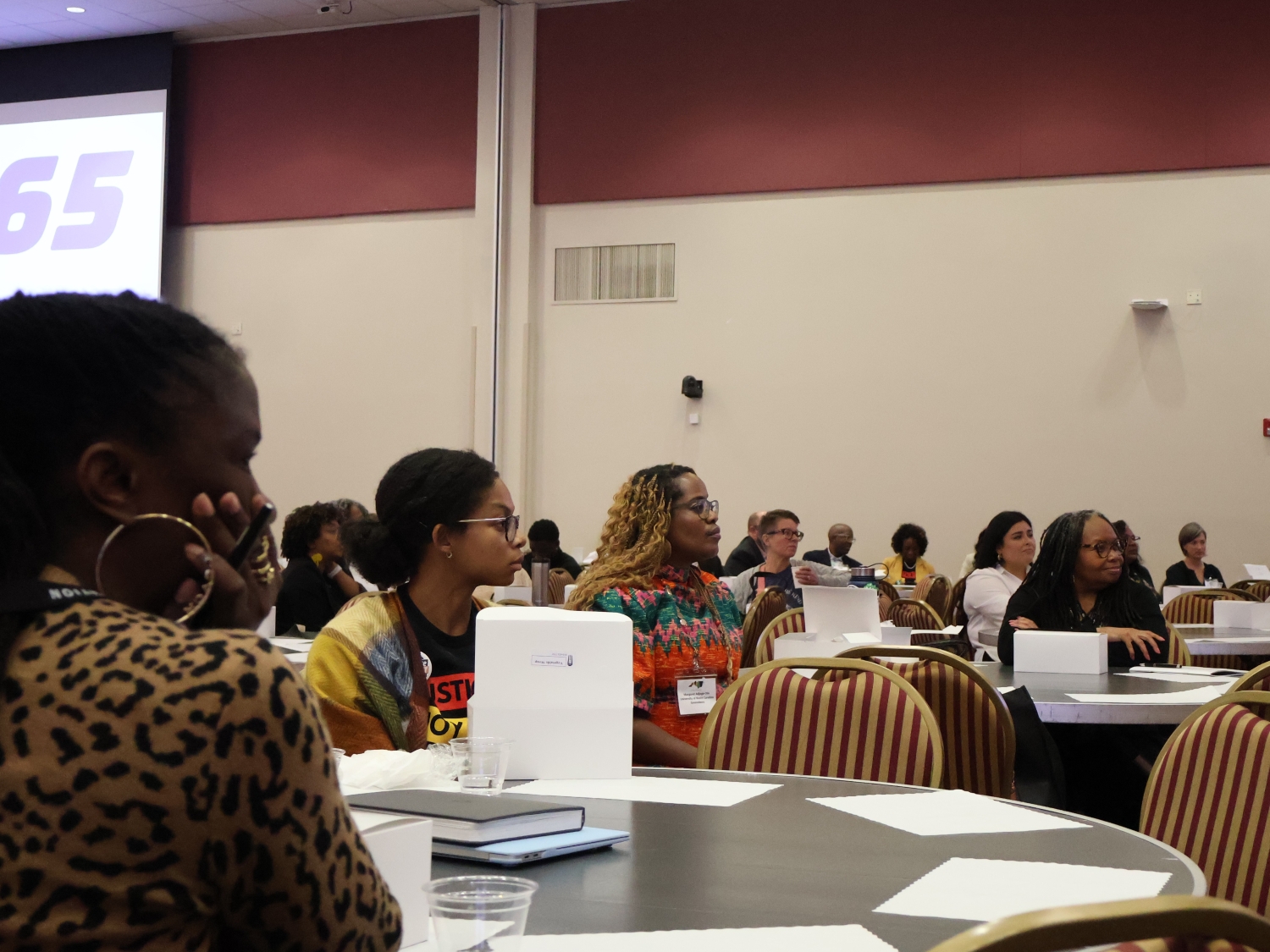
Breakout sessions: Restoring, repairing, and resisting
One of the conference’s breakout sessions was led by the Bridge Builders, a group of high school students from Albany and Atlanta, Georgia, and Durham. Over the summer, the students traveled through the U.S. South and visited historic Civil Rights spots across Alabama, Georgia, and North Carolina.
According to the Color of Education’s conference materials, Bridge Builders emerged through a larger funded initiative, Spurring Collaborative Educational Agendas, which convened scholars, activists, educators, and community leaders to explore how to build a sustained strategy to educate, equip, and inspire Black children for the future.
During their presentation, students shared two key takeaways from their summer trip:
- The way our ancestors gathered and organized are still a model for making change today.
- History helps most when we use it to understand what’s happening now.
After the trip, the Bridge Builders used the knowledge they’d learned to conduct youth participatory action research, a form of research that has young people identify problems in their own lives, investigate the problem, and then advocate for change based on what they found.
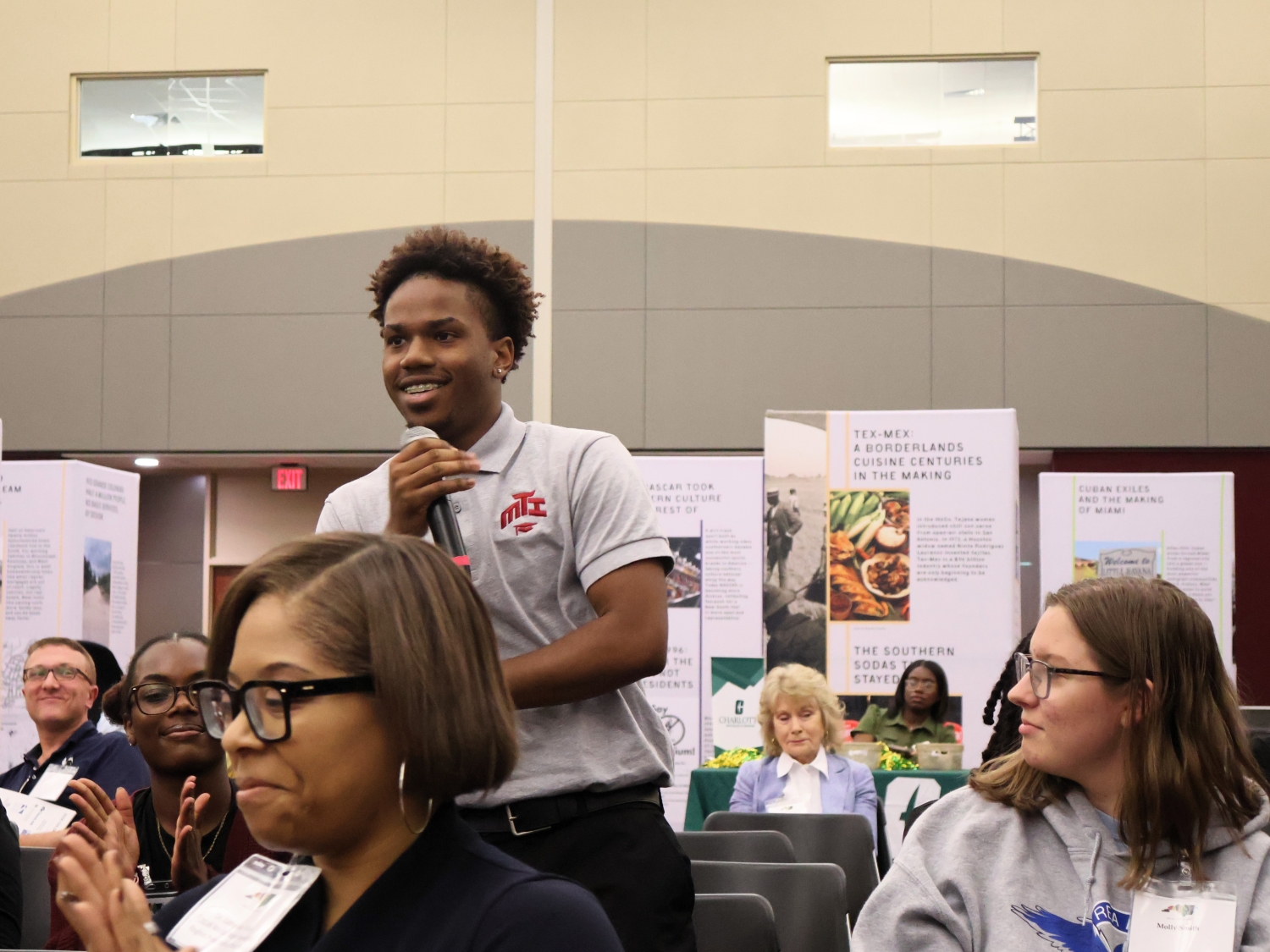
Georgia students Jalen Lewis and Elijah Crawford led a focus group with their Bridge Builder peers in September to reflect on their summer. Lewis and Crawford asked their peers what their schools have taught them about Black history, and what they believe was left out.
“We lose a lot of ourselves when we’re not learning about it in the place where we spend eight hours a day,” said Lewis of Black history. “We’re not immediately taught it. It’s hidden from us.”
At the same time, Lewis said he wouldn’t know about the Southern Christian Leadership Conference (SCLC) or the Student Nonviolent Coordinating Committee (SNCC), two crucial organizations that originated during the Civil-Rights era, if one of his teachers in Georgia hadn’t taken the time to teach about it in depth.
Bakari Craft, a sophomore at J.D. Clement Early College High School in Durham, knows that he wants to be a physicist. He decided to practice place-based history, a learning process he described as conducting historical research through interviews. Using those skills, Craft interviewed his math professor at NC Central University, where he attends early college, to gain insight into what to expect in the journey toward his future career.
“It’s important to interview our community members to learn from them. Because when you don’t ask people questions, experience over time is eroded and forgotten,” Craft said. “And we don’t want that — we want to preserve that.”
A separate breakout session emphasized the power of place-based learning, highlighting the “Democracy in Place” educational program. The session was presented by Carolina K-12 at UNC-Chapel Hill’s Carolina Public Humanities director, Cori Greer-Banks and associate director, Jessie Francese.
A part of Carolina Public Humanities, Democracy in Place offers professional development to educators across the state. Supported by an American History and Civics grant from the U.S. Department of Education, the program holds retreats for educators “to investigate democracy” and learn history of North Carolina communities.
For instance, in an effort to dispel the persisting misconception that slavery didn’t exist in western North Carolina, the Asheville-based “Mountains of Democracy” retreat featured a visit to sites like Vance Birthplace, where Greer-Banks informed educators that the Vance family enslaved at least 27 people between 1795 and 1865.
At location, facilitators encouraged the group of 50 educators to consider the same questions they would pose to students during a lesson:
- Who built this?
- Whose labor made it possible?
- Whose story did the original historic site ask us to remember?
- Whose story had to be recovered?
“Place-based learning is not just taking students somewhere,” Francese stated during the presentation at the summit. “It’s teaching them to interrogate what the landscape has been taught to say.”
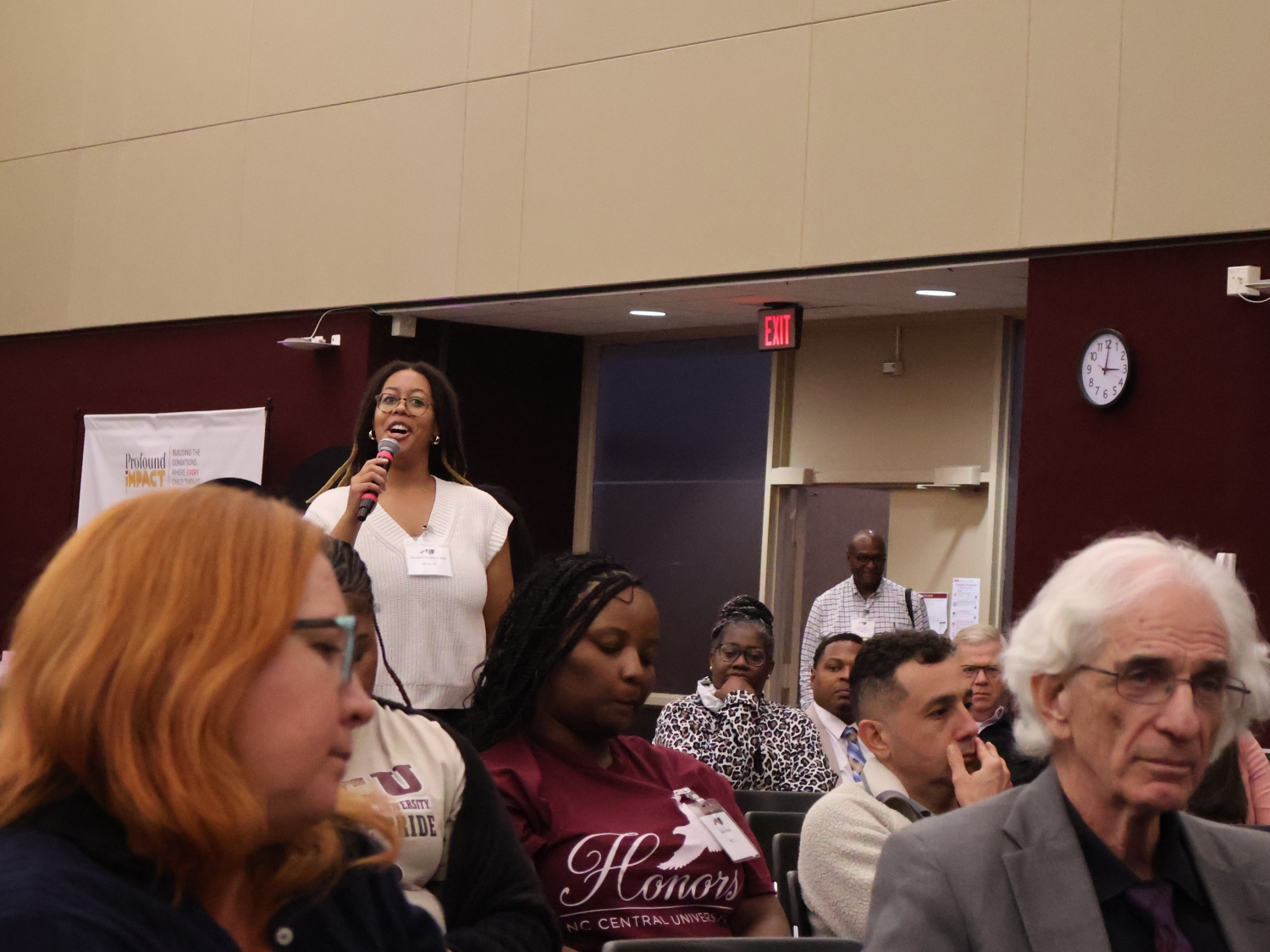
During the eastern North Carolina retreat, a separate group of educators traveled to Wilmington. One of many things they were exposed to was the history of the Wilmington Massacre of 1898, which consisted of the destruction of Black businesses and residencies, the murder of nearly 300 Black citizens, and the violent overthrow of the local government, all at the hands of white supremacists.
As a part of “interrogating the landscape,” Greer-Banks shared that they encourage participants to consider who benefits from the erasure of history.
In all, Greer-Banks considers their work to be an act of resistance, especially when many people may be faced with the pressure to be silent rather than teaching the truth of history.
“I think some of the work being done to erase stories we sometimes inadvertently do ourselves because of fear,” she stated. “There is still a way to teach this content. There is still a way to make sure that we’re not silencing or erasing these stories, and this is how you do it.”
In a later breakout session, archivists from the National Geographic Society discussed the importance of local archive projects. This can look like collecting and preserving family photographs or documents, oral histories, and school, church, or neighborhood collections.
While it sounds like a technical word, archives are simply “materials around the idea of keeping memory,” explained Tessa Shultz, senior manager of outreach and engagement for special collections.
This memory keeping is what allows communities to create, understand, and preserve knowledge of their own history on their own terms.
Panelists encouraged attendees to not just recognize that their family and community stories are inherently important, but to also consider their individual autonomy over how they decide to preserve and share their stories.
One attendee, JaNiya Marks, asked the panelists questions about how she can begin to preserve stories for her family. Marks is from Michigan but is currently a university student in North Carolina.
“You have a responsibility now that you know what you know,” Lela J. Sewell-Williams, the director of archival collections within the special collections division, told Marks.
‘The future has a past’
During her keynote at the summit, Marley Dias shared about her journey as an author, activist, and the #1000BlackGirlBooks campaign that she founded in 2015 as an 11 year old, which has since collected 15,000 books, to promote literacy and representation in children’s literature.
#1000BlackGirlBooks emerged out of Dias’ desire to see people like herself inside of the books that she read.
Yet, she said that the greater movement for representation has encountered opposition, noting the nearly 34,000 books banned in public schools nationwide since 2021; 44% of which feature characters or people of color, according to PEN America.
She described the book bans and narrowing of reading lists as the containment of young people’s minds; the opposite of what schools should be intended to do.
Dias noted that, while important, this containment also includes limiting literacy to decoding, fluency, and other measures, rather than nurturing a child’s desire to read and the development of imagination.
“If we cannot get a child to pick up a book, we have lost the chance to grow her imagination,” she stated. “Everything else depends on that desire.”
Dias further asserted that imagination is not a luxury, but a necessity that allows young people “to feel good about themselves, to lead, to empathize, to reject violence, to see humanity in strangers and immigrants, and to picture a freer world before it exists.”
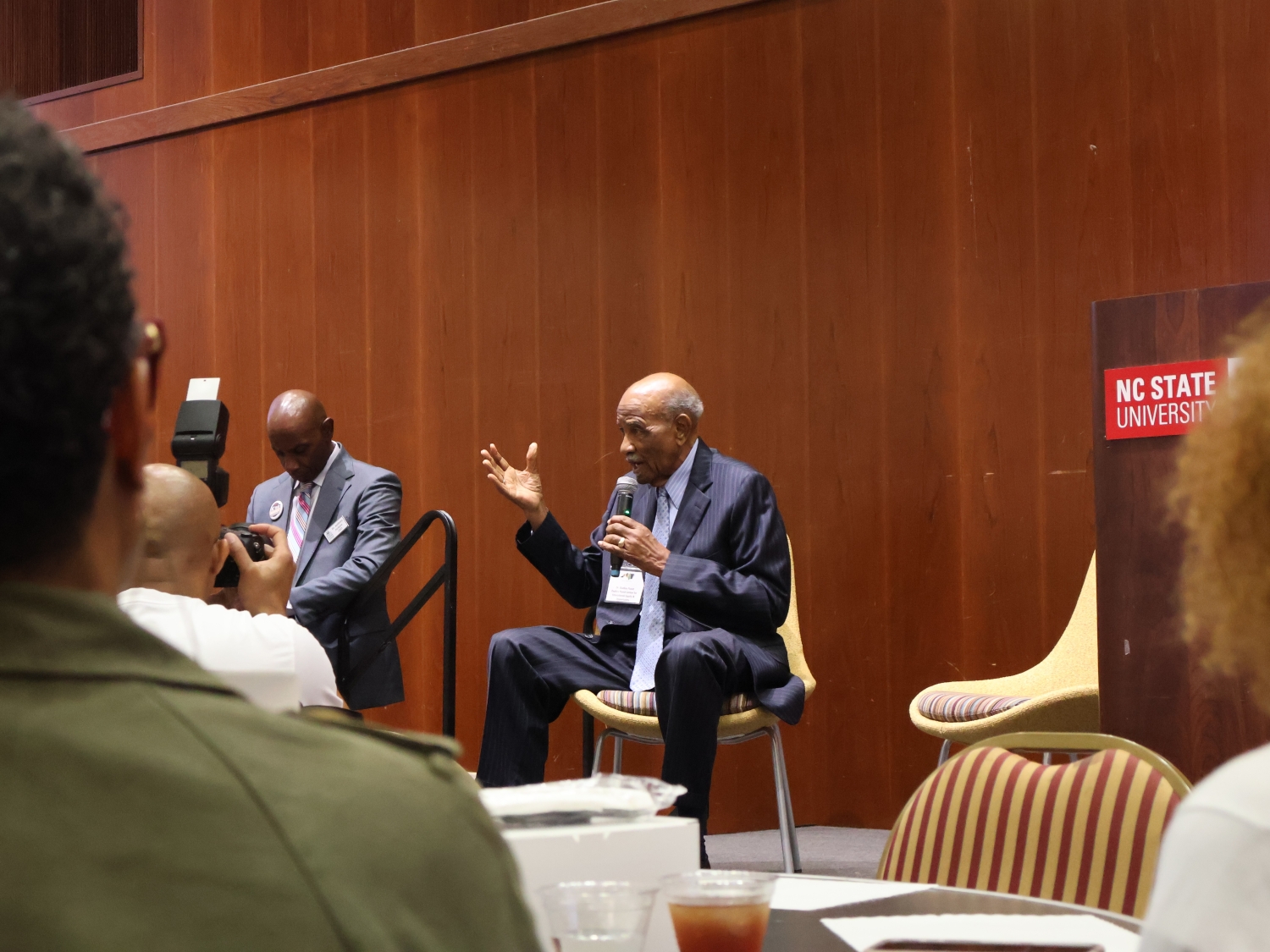
Dr. Tressie McMillan Cottom also delivered an afternoon keynote on Oct. 3. Dr. Cottom is a sociologist, New York Times opinion columnist, and the faculty director of UNC-Chapel Hill’s Center for Information, Technology, and Public Life.
In her keynote, titled “The future has a past,” Cottom told attendees they cannot build a future until they become honest about what’s already been. The progress that has already happened this century was not naturally occurring, she said. Rather, it was the product of organized people seeking change.
“Social progress is not like perennials. We did not achieve the most significant people-powered campaign against a racialized minority state in the history of the world because we planted an idea and just let nature take care of the rest. We did that by building power,” she said.
Power has obtained a negative connotation, she said, in part to messages such as “all power is corrupting,” that ultimate power belongs to a higher power, and that women should strive for peace, not power.
“Power — it is true — without empathy, is authoritarianism,” she said. “But power with compassion is a social movement.”
In response to an audience question that asked what this power looks like in practice, Cottom pointed to civic activist Fannie Lou Hamer.
Hamer built “a very clear idea that power is a structure you build intending to give it over all the time. That (power) needs to always be turned over, so that we never get confused about whether the power lives in the people or in the person,” said Cottom.
Moving forward, Cottom said she wants attendees to develop an appetite for compassionate power. Public education is for the public, she said, and public education is a tool to educate young people in civic discourse, liberty, and history.
Speaking to educators, she said that now is the time to share that message.
In her closing remarks, the Flood Center’s senior director, Dr. Deanna Townsend-Smith, issued a charge to the listeners aligned with the summit’s theme. Her call to action for attendees included the following commitments:
- Repair: Identify the policies, practices, relationships, and systems that have created or sustained inequity and commit to changing them.
- Restore: Reclaim the histories, voices, relationships, opportunities, and community wisdom necessary to build stronger educational systems.
- Resist: Continue speaking truth, protecting opportunity, and standing together when progress toward educational justice is threatened.