A recap of the Color of Education Summit: Recognizing the power in the stories we carry
One million, eight hundred thousand.
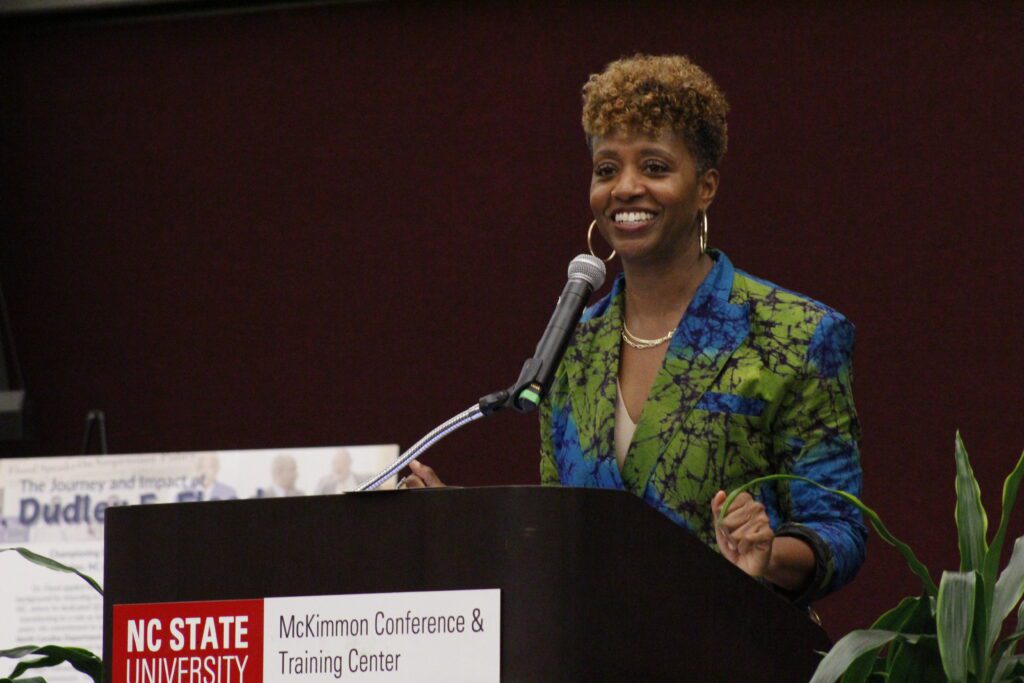
The weight of that number shifted the atmosphere of the room on the morning of Oct. 4 at the Color of Education Summit. Hundreds of listeners fixed their ears on the words offered by National Geographic Explorer-In-Residence, Tara Roberts.
Roberts is author of “Written in the Waters: A Memoir of History, Home, and Belonging,” and the first Black woman explorer to be featured on the cover of National Geographic magazine. She was one of three speakers at the 8th annual Color of Education Summit in Raleigh. Her message reinforced this year’s theme, “Preserving Our Legacy: The Power in the Stories We Carry,” emphasizing the significance of storytelling in documenting history, but also driving action.
According to Roberts, 1.8 million is an estimate of the number of human victims who died in passage during the trans-Atlantic slave trade. Roberts added that of approximately 12,000 vessels used to transport people who were held captive, there were about 1,000 shipwrecks. Fewer than 20 of those wrecks have been discovered and properly documented.
This is knowledge that, before becoming an underwater archaeologist, was entirely unknown to Roberts.
“I could name the Mayflower. I could name the Titanic. I couldn’t name any of those ships,” she said. “There are entire chapters of history that are just missing.”
 Sign up for the EdDaily to start each weekday with the top education news.
Returning home after 200 years
As stated on the Color of Education website, “This year’s theme centers the belief that legacy is not only preserved in history books or institutions—it lives in the stories we carry and share.” The Summit supports the idea that the stories of students, educators, and communities are powerful narratives that help to understand identity, build collective purpose, and spark transformational change.
Legacies are not static — they are stories passed from generation to generation. They remind us that progress is never inevitable; it is built, protected, and sustained through the choices we make together.
— Ann McColl, interim executive director and president of the Public School Forum of NC
For Roberts, a 2016 visit to the National Museum of African American History and Culture (NMAAHC) ignited her call to the depths of the Atlantic Ocean to surface, spread, and heal those histories. Roberts was mesmerized by an image of primarily Black women, in wetsuits, on a boat.
“The clouds parted and the angels began to sing,” Roberts said.
The picture featured scuba divers who were part of the organization, Diving with a Purpose (DWP). According to the website, DWP’s mission is to provide “education and training programs, mission leadership, and project support services for submerged heritage preservation and conservation projects worldwide with a focus on the African Diaspora.”
DWP is one of several global partners with the Slave Wrecks Project, co-coordinated by the NMAAHC and George Washington University. The collective investigates the history of the African slave trade across the globe and engages with the enduring legacies of that past in the present.
In her speech, Roberts shared about a discovery that occurred prior to her time with DWP. Roberts offered the story of the São José Paquete D’Africa using audio from interviews, including the voice of Dr. Lonnie Bunch III, founding director of the NMAAHC and the 14th secretary of the Smithsonian.
The São José was a Portuguese slave ship that wrecked in 1794 off the coast of Cape Town, South Africa, estimated to have trafficked about 500 people.
Following the discovery, Bunch shared that the team of divers, researchers, and historians were able to trace the origins of the humans enslaved on the ship back to the Makua tribe of Mozambique. As a result, after two centuries, Makua descendants were able to hold a celebration for their ancestors.
In a ceremony filled with music, dance, food, and speeches, Bunch was gifted with a gleaming cowrie shell-encrusted basket filled with soil from the region. With that gift, the Makua chief charged Bunch with a mission. The tearful request communicated by the chief, from his ancestors, required Bunch to return to South Africa to spread the soil in the location of where the ship had wrecked.
Once his team arrived back at the site, Bunch honored the request. They chose an African American, a Mozambican, and a South African to pour the soil into the water.
According to Roberts, the overcast sky, the rain, and the turbulent waters required the three bearers of the soil to lock arms to avoid being knocked over as they entered the ocean. Once they poured the soil and returned to the shore, the waters calmed, and the sun emerged.
As phrased by the chief when he first bestowed the task upon Bunch:
“For the first time since 1794, my people can sleep in their own land.”
The power in peoples’ stories
On Oct. 3-4, the Dudley Flood Center for Educational Equity and Opportunity (Flood Center) hosted the summit in partnership with the Public School Forum of North Carolina, Samuel DuBois Cook Center on Social Equity, and the Center for Child and Family Policy at the Duke Sanford School of Public Policy.
The stories we tell and preserve give us the strength to move forward despite the obstacles before us. They anchor us in legacy and propel us toward justice.
— Dr. Keisha Bentley-Edwards, associate professor at Duke University School of Medicine and director of the Research Collaboratory for Diversity and Inclusion

According to a press release, the convening drew in nearly 700 attendees in-person and virtually. Over two days, the summit offered 20 breakout sessions and meetings that addressed urgent challenges in public education, including educator diversity, community-driven school design, culturally sustaining pedagogy, and the role of policy in advancing educational equity.
In alignment with the theme, here’s a look at some of the sessions offered at the summit, many of which detailed storytelling practices for individuals, families, and communities.
Storytelling through journey mapping
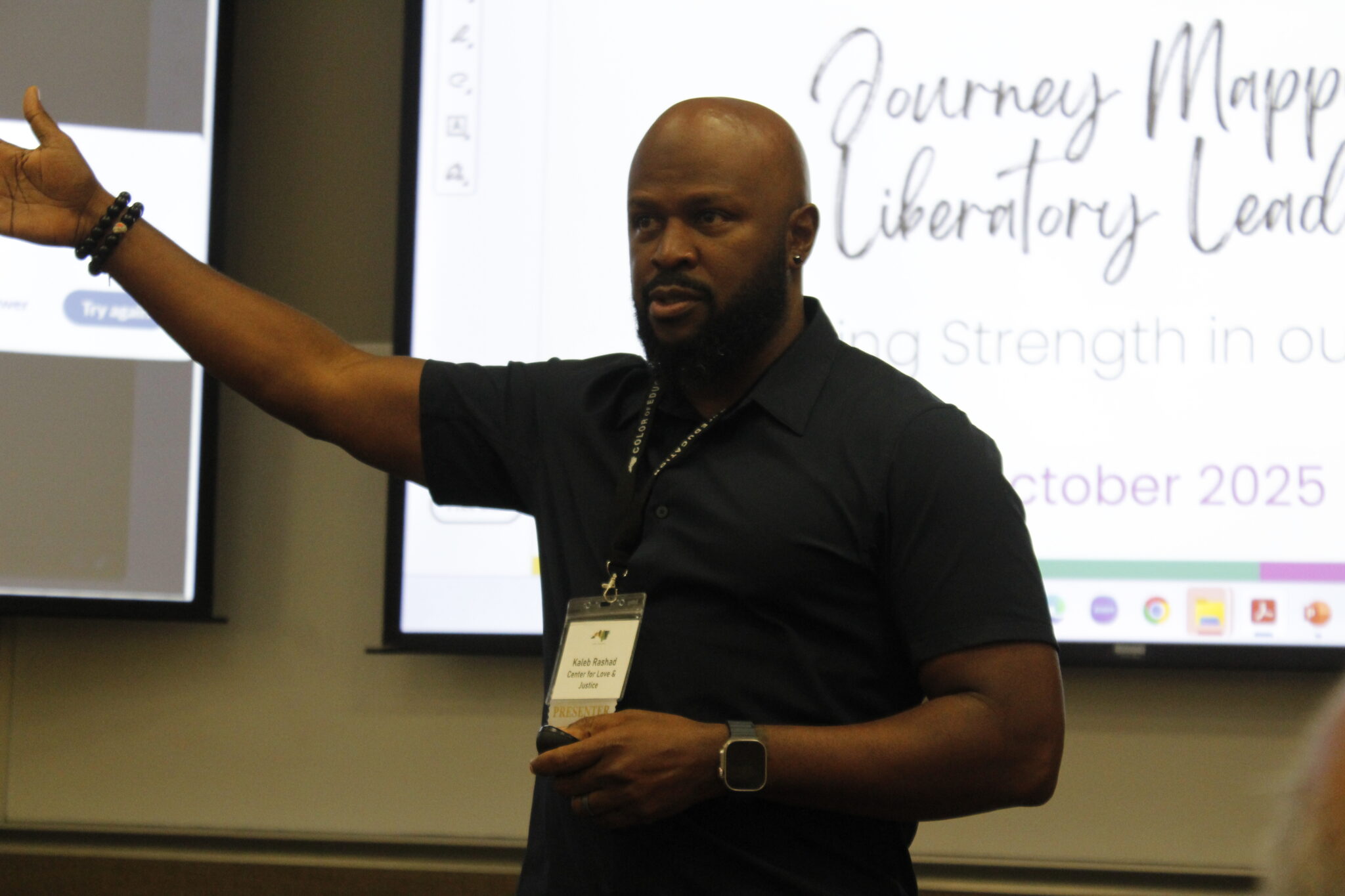
Dr. Kaleb Rashad, creative director of the Center for Love & Justice at the High Tech High Graduate School of Education in San Diego, offered an interactive session focused on “using journey mapping as a reflective and transformative tool for liberatory leadership.”
Participants created visual maps of their life, using drawings to represent significant moments that ultimately influenced their pathway to the work that they do today. From there, the goal of the maps was to deepen awareness of how their lived experiences inform their leadership practices.
Notably, by sharing with each other, the personal storytelling gave opportunity for both reflection and connection among the community.
Storytelling through family history books
As a Yale graduate, North Carolina native, KaLa Keaton’s senior research capstone was titled “Baobab: Family History Books as a Creative Intervention for Black History Preservation and Education.” A segment of her presentation explained the process and value of storytelling as a family. Keaton broke the process down into the following steps:
- Research,
- Organize,
- Write,
- Design, and
- Give it out to family members ,
In all, Keaton said that every family history book will be extraordinarily different.
“Even if my own cousin developed a family history book, it would still be different from mine, because they are meant to be these radical forms of thought and creation and truly speak to us and our perspectives,” she said. “They’re not attempting to be objective historical sources. They’re incredibly subjective, and that’s the beauty of them.”
Storytelling through news and media
Carol Bono, digital storyteller and multimedia specialist with North Carolina State University, provided attendees with practical skills for engaging with journalists.
Bono outlined key considerations for speaking with media such as: being familiar with key media terms (e.g., “on the record”), approaching difficult questions, having autonomy and setting ground rules with reporters, in addition to lifting up local reporters who have a positive reputation in stewarding North Carolina’s stories.
As expressed on her resource document made available to attendees, Bono’s session encouraged others “to be equipped with the agency to interact with the media with confidence and knowledge about their rights.”
Storytelling through podcasting
Though Paige Laurain and Ike Smith completed the Education Policy Fellowship Program in separate cohorts, their paths align for the creation of Longleaf Lessons: Rooted in NC’s Educational Growth. Leading up to the November 2024 election, they sought out perspectives that could contribute to discussions around what the future of public school in North Carolina looks like.
At the summit, they provided a live demonstration, conducting a podcast episode with educators and students. As detailed in the session description provided by Laurain and Smith, the goal was to leave educators with a clear understanding of how podcasts can serve as both reflective practice and public advocacy, and with practical knowledge of the podcasting process.
“What we want to emphasize with y’all today is that you can do what we did with just a laptop,” Smith said. “If you’ve got a laptop and access to Zoom or Google meet, you can have a podcast.”
What type of ancestor do you want to be?
Dr. John Lee King Jr. served in President Barack Obama’s cabinet as the 10th U.S. Secretary of Education and is currently the chancellor of State University of New York. At the summit, he was one of the keynote speakers present that shared stories related to his journey through education.
One key takeaway from King’s message was the importance of not misunderstanding the story.
As featured in his book, “Teacher By Teacher: The People Who Change Our Lives,” King spoke to the audience about the tumultuous experience of losing his mom at 8 years old, along with having a father who succumbed to Alzheimer’s just four years later.

“Home was really scary and unstable. I didn’t know what my father would be like from one night to the next. Some nights he’d talk to me. Some nights, he wouldn’t say a word. Some nights he’d be sad, other nights angry, sometimes violent,” he said.
In contrast, King explained that his school, P.S. 276 in Brooklyn, New York, was a place of consistency and nurturing. He credits his fourth-grade teacher, Alan Osterweil, with saving his life and helping provide stability during that period.
Years later, as a high schooler, King was expelled from school.
“As a teenager, having lost my parents, having gone through the things that I went through, I was really angry. I was angry at adults. I was angry at society,” he said. In reflection, King said that it would have been very easy for him to be written off as a Black and Latino kid with no respect for authority.
Luckily, King said, teachers, school counselors, and other families saw something in him that he couldn’t see in himself at the time. They chose to intervene. Because of that support and intervention, King said, “I’m not special, just lucky.”
King explained this to emphasize what he thinks is a key point in his story: it shouldn’t be used as a means of comparison. King opposes statements like, “You faced all this adversity and look at what you’ve achieved. Why can’t other people do that?” According to King, it is dangerous when people try to use his success and others’ in that way because it fails to acknowledge the brokenness of the system.
He said that he was lucky to have people who intervened at the right moments, but that society shouldn’t be one in which success depends on luck. He emphasized the need for a collective effort in order to fix systems and create pathways to opportunity.
King’s remarks also reinforced the hope offered through storytelling.
King began a family research project while preparing to speak at the University of Maryland, Eastern Shore, the school where his grandmother graduated in 1894. While learning more about his family’s story, King learned the location of the place where his great-grandfather had been enslaved.
He also learned that the cabin that his great-grandfather lived in was still standing and that the property was still owned by the direct descendants of the people who’d enslaved his grandfather. The property was just 25 miles from where King lived.
“Many African Americans know there’s this connection to slavery, but you don’t know that you’re ever going to be able to stand in the place,” he said.
While visiting the cabin, King shared that he was “deeply conscious of the intimacy and cruelty of the institution of slavery. These were two families living in the same physical space, one owning the other.”
Simultaneously, King was conscious of the fact that, within just three generations, his family went from being enslaved in that cabin to serving in the cabinet of the first Black president of the United States.
“My ancestors lived with faith in a future they could not see. Their faith, their perseverance, their survival, made my life possible,” King said. “We can’t get weary. Whatever our struggles in this moment as a country, we have been through worse, and we have to persevere with the spirit of asking as Indigenous cultures do: What kinds of ancestors do we want to be?”
The call to action
In her closing, Dr. Deanna Townsend-Smith charged attendees with a call to action to transform inspiration into impact:
- Carry forward the tenets of trust, truth, courage, and power in daily work.
- Build connections into commitments by sustaining the relationships forged at the summit.
- Turn stories into action by using personal and collective narratives to open doors of opportunity and advocate for equity.
“Color of Education continues to be a space where truth-telling and courageous dialogue meet action,” Townsend-Smith said. “We leave this year’s summit not only carrying our stories, but also committed to building a future where every student has the opportunity to thrive.”