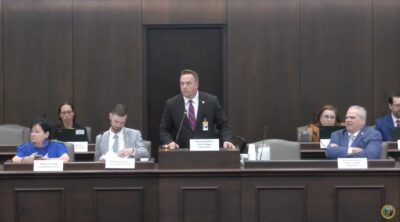
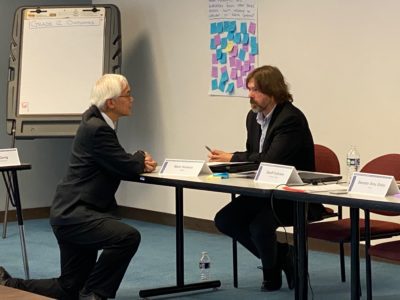
At the State Board of Education’s November meeting last week, Chair Eric Davis released the membership for the newly created Task Force on Accountability for Public School Units.
“The Task Force will design a next generation school accountability system to propose to the General Assembly,” a Board email said. “This group brings together legislators, county leaders, educators, parents, students, and business representatives to create a model that better reflects the full range of what students know and can do.”
Here are the members of the new task force:
State Board of Education (SBE):
- Alan Duncan, vice chair.
- Jill Camnitz, member.
- Janet Mason, member.
Governor’s Office and state lawmakers:
- Sen. Kevin Corbin, R-Cherokee.
- Sen. Jay Chaudhuri, D-Wake.
- Rep. Brian Biggs, R-Randolph.
- Rep. Monika Johnson-Hostler, D-Wake.
- Elena Ashburn, the governor’s senior advisor for education policy.
County commissioners and business leaders:
- Allen Thomas Jr., Hoke County commissioner.
- Shinica Thomas, Wake County commissioner.
- Bob Barnhill, chair of the board of Barnhill Contracting Company.
- John Hood, president of the John William Pope Foundation and board member of the John Locke Foundation, where he formerly served as president.
Educators and education leaders:
- Bruce Friend, Head of School for Pine Springs Preparatory Academy and chair of Charter Schools Review Board (CSRB).
- Lyn Andrews, chair of Johnston County Schools Board of Education.
- Darrell Pennell, chair of Caldwell County Schools Board of Education and advisor to the SBE.
- Crystal Hill, superintendent of Charlotte-Mecklenburg Schools.
- Anthony Jackson, superintendent of Chatham County Schools.
- Don Phipps, currently superintendent of Caldwell County Schools, and will be superintendent of Winston-Salem/Forsyth County Schools effective Dec. 1.
- Tanya Turner, superintendent of Perquimans County Schools.
- Alex Quigley, executive director of Durham Charter School and former CSRB member.
- Phil Rogers, principal of R-S Central High School in Rutherford.
- Beckie Spears, principal at Wilkesboro Elementary School and advisor to the SBE as 2024 Wells Fargo Principal of the Year.
- Kim Jones, English and humanities high school teacher and former SBE advisor as 2023 Burroughs Wellcome Fund NC Teacher of the Year.
- Kim Mackey, teacher in Wake County Public School System and an active member of Wake NCAE.
- Paul Kinsey, director of testing and accountability at Dare County Schools.
Parents and students:
- Shaneeka Moore-Brown, president of the NC PTA.
- Anaston Lassiter, member of the Superintendent’s Student Advisory Council.
- Ben Dombroski, member of the Superintendent’s Student Advisory Council.
- Ian House, SBE student representative.
Board/Department of Public Instruction (DPI) leadership:
- Rupen Fofaria, director of Board operations and policy.
- Michael Maher, chief accountability officer.
- Maria Pitre-Martin, deputy state superintendent.
- Stacey Wilson-Norman, chief academic officer.
- Geoff Coltrane, senior director of the Office of Government Affairs.
 Sign up for the EdWeekly, a Friday roundup of the most important education news of the week.
In October, the Board first proposed the task force to develop a new school-level accountability system.
In North Carolina, under state law, school grades are based on each school’s achievement score (including standardized test grades), weighted 80%, and on students’ academic growth, weighted 20%. Education leaders have long said that formula does not capture the full picture of the work happening in the state’s public schools.
Maher, DPI’s chief accountability officer, said the state’s current accountability system relies heavily on standardized tests and emphasizes proficiency scores over growth. This system, Maher said, offers a limited picture of students’ readiness for life after graduation.
Over the last few years, and under the leadership of former state Superintendent Catherine Truitt, DPI advocated for state lawmakers to change how school performance grades are calculated to account for more factors than achievement and growth. While lawmakers initially showed interest in DPI and Truitt’s plan, they never passed legislation changing the formula. Even before Truitt, lawmakers and the Board have discussed how to change the state’s school accountability model. The creation of a task force this fall reflects another attempt by DPI to reform school performance grades.
The new task force will identify “valid and reliable” measures across all grades, DPI previously said — as opposed to the current system, which covers third grade and on. A new system would focus on students’ readiness beyond graduation, recognize growth and equality of opportunity for students, and offer transparent reporting for parents, educators, and communities, Maher said.
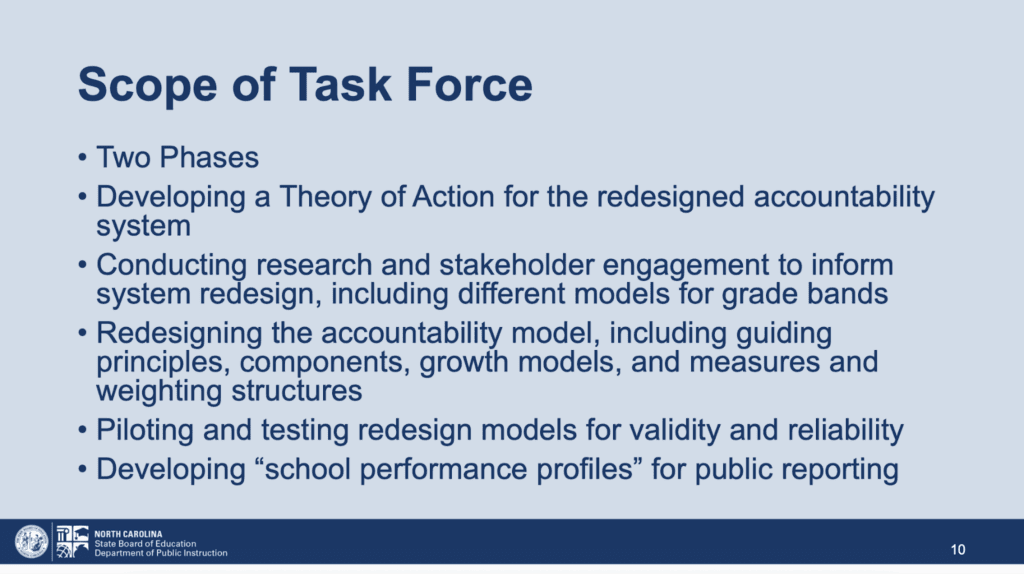
In October, the Board said the task force would convene in November for the first time and deliver a draft framework next summer. Any proposal adopted by DPI and the State Board would need legislative approval to be implemented.
“I believe we can all agree that our accountability system merits improvement,” Davis said after approving the task force’s formation in October. “For example, the current model distracts us from our ultimate mission to understand what we’re successfully teaching, what learning is not occurring, and how to get better.”
In 2022, when DPI convened an advisory group to redesign the accountability model, Truitt said, “The current accountability model does not do justice to the hard work that teachers and students put in every day in schools across the state, and I look forward to working with stakeholders to consider other metrics important to determining school quality.”
At the beginning of those efforts, the national Center for Assessment presented its findings to the advisory group, which also included bipartisan education and state stakeholders.
The center helps states and school districts “design assessments and assessment systems that meet technical and policy goals to support student learning and for other critical uses.” In the history of the organization, the center has worked with almost all 50 states. Here is a look at the center’s 2022 presentation:
Here is a 50-state comparison model on school accountability systems, created by the Education Commission of the States. Among other things, the model “offers comprehensive information on state systems for federal accountability” and “identifies states that maintain a separate accountability system,” like North Carolina.
In 2022, and in partnership with DPI, EdNC conducted a statewide survey about school performance grades, which 26,262 individuals participated in. Most participants agreed that school performance grades should include measures beyond test scores and student growth (90%). However, participants were more divided when asked if schools should be publicly graded on their performance so that parents, community members, and policy makers can compare them (52% agreed).
You can view the full survey results on EdNC’s website.
Sergio Osnaya-Prieto contributed to this report.

Recommended reading