
A look at the state of civic readiness for North Carolina students
Leaders, educators, students, parents, and others gathered earlier this month for an online discussion of the state of civic education in North Carolina, a look at progress compared to other states, and to consider how the state might ensure every K-12 student has the opportunity for high-quality civic experiences.
“NC Civic Readiness for All” was hosted on Aug. 11 by GenerationNation, the North Carolina Department of Public Instruction (DPI), the North Carolina Civics Coalition (NC3), and CivxNow, a project of iCivics.
Amy Farrell, executive director of GenerationNation, welcomed the group and described her team’s work. Based in Charlotte, GenerationNation aims to make sure teachers are equipped with civics resources and students have real-world learning opportunities. GenerationNation programs combine K-12 education and real-life experiences and include a variety of programs designed to build civic literacy and leadership from an early age.
The goal, said Farrell, is to build skills so students can be engaged through elementary, middle, high school, and for a lifetime — through college, career, and adult civic life.
GenerationNation partnered with CivxNow, affiliated with iCivics, to create the North Carolina Civics Coalition. The coalition brings together organizations that want to strengthen civic learning, find out what is happening in North Carolina, identify gaps, and help make sure North Carolina students have access — both at school and after school — to robust civic learning and youth leadership experiences.
 Sign up for the EdWeekly, a Friday roundup of the most important education news of the week.
Overview of the current landscape of civic education in NC
Farrell introduced presenters Tom Daugherty, a K-12 social studies consultant with the DPI, and Chloe Jordan, Southeast state policy lead with CivxNow.
Daugherty described North Carolina’s approach as a K-12 civic learning arc designed to build students’ civic knowledge and skills progressively. It starts early and builds vertically, with each grade band, ideally, adding to and reinforcing the knowledge and skills developed in previous grades, ultimately culminating in application.
Civic learning can begin as early as kindergarten with concepts such as rules, cooperation, community, and consequences; later advancing to understanding local, state, and federal government; and eventually involve students applying what they have learned to real community issues. That might look like advocating for an issue they care about by contacting their General Assembly members or starting a nonprofit to help address a need in the community. The goal is to have students who are prepared at the end of high school to be active participants in society.
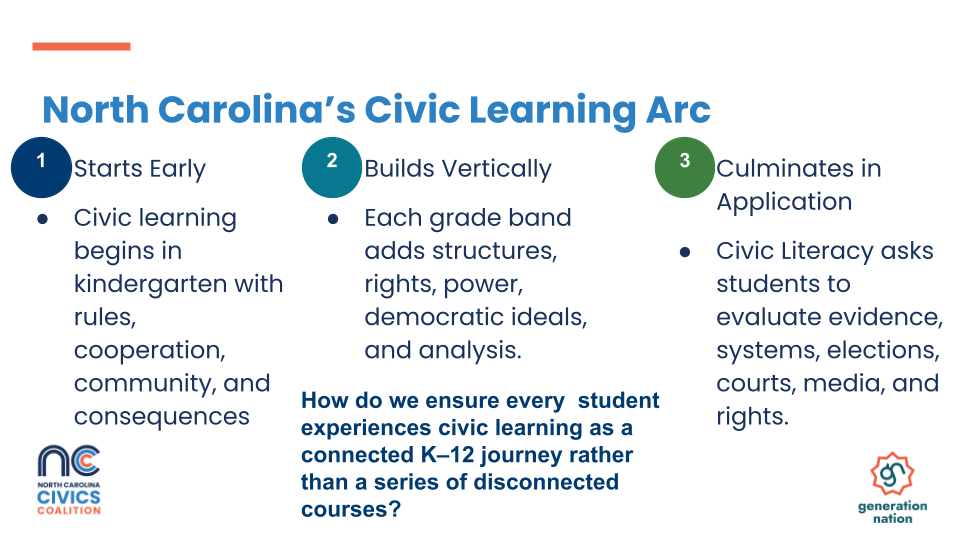
Daugherty said a major question to consider is, “How do we ensure every student experiences civic learning as a connected K-12 journey, rather than a series of disconnected courses?” He added that we need to be purposeful about tying all the learning together with later application.
The civic literacy course that is taken in high school serves as a culmination of the civics journey. Students may take the course at any point from grades 9-12.
As part of the course, students look at all levels of government — federal, state, local, tribal — and address how the interplay of the different levels of government work together in the students’ lives. Some questions students ask through the class include: What does it look like to be an active citizen in a society? What is the media’s role? The overall goal is to prepare students for college, career, and civic life.
Daugherty noted that one portion of the North Carolina standards that runs throughout K-12 is the Inquiry Arc, or the inquiry indicators. This is a content neutral strand that threads through every social studies course.
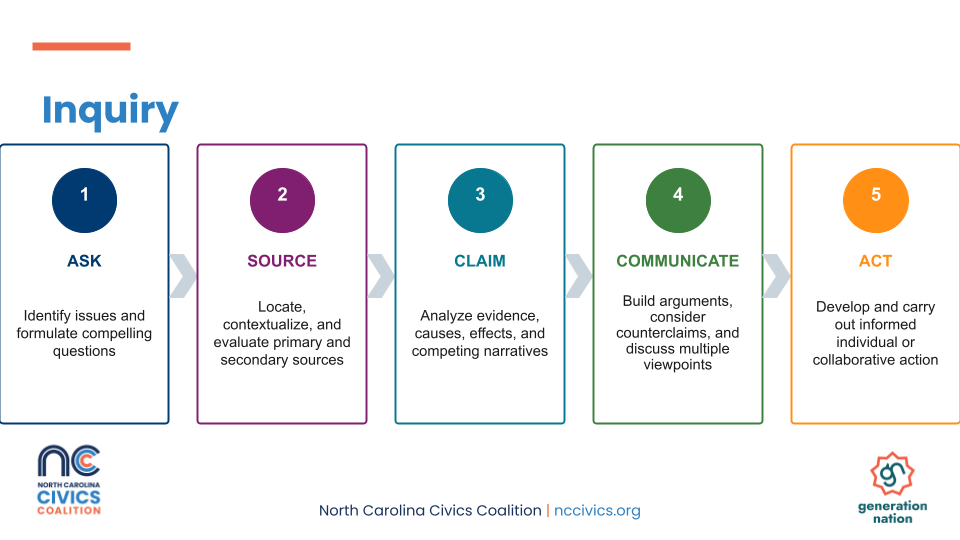
The inquiry band asks students to identify issues and start to ask compelling questions about what’s going on around them. Then, they identify sources — how do we tell reliable sources from unreliable sources, how do we use primary sources, and how do we know the difference between primary and secondary sources?
Next, they analyze evidence and make a claim or argument after gathering evidence, in order to communicate that claim effectively, make counterarguments, research and make counterclaims, and discuss multiple viewpoints. Finally, students act upon the things they feel strongly about to try to make a positive difference in their community. The entire inquiry arc can be utilized at every grade level.
Daugherty noted that civic learning may extend beyond classroom instruction into experiences like developing classroom rules, contacting elected officials, or researching and addressing community problems.
Daugherty also addressed several audience questions. One question was about the state’s citizen proficiency endorsement. Daugherty explained that the citizen proficiency endorsement is a diploma endorsement, meaning it is a sticker added to the high school diploma stating that the student has accomplished a certain task. Established in the 2023 budget, North Carolina students can earn the endorsement by passing questions selected from the United States Customs and Immigration Services (USCIS) naturalization test question bank.
How North Carolina compares with other states
Chloe Jordan shared about her role at CivxNow and then discussed trends and approaches in other states. CivxNow is a policy arm of iCivics and advocates for strengthening civics course requirements, addresses teacher professional development and pre-service trainings, and seeks to align state standards with consensus and best practices.
Among other things, Jordan serves as a technical resource and adviser to coalition partners, like GenerationNation.
Jordan reported that since 2021, 35 states have adopted 61 civic education policies and at least 240 policies have been introduced in 2026. Twenty states offer civic seals, while 37 require stand-alone high school civics courses.
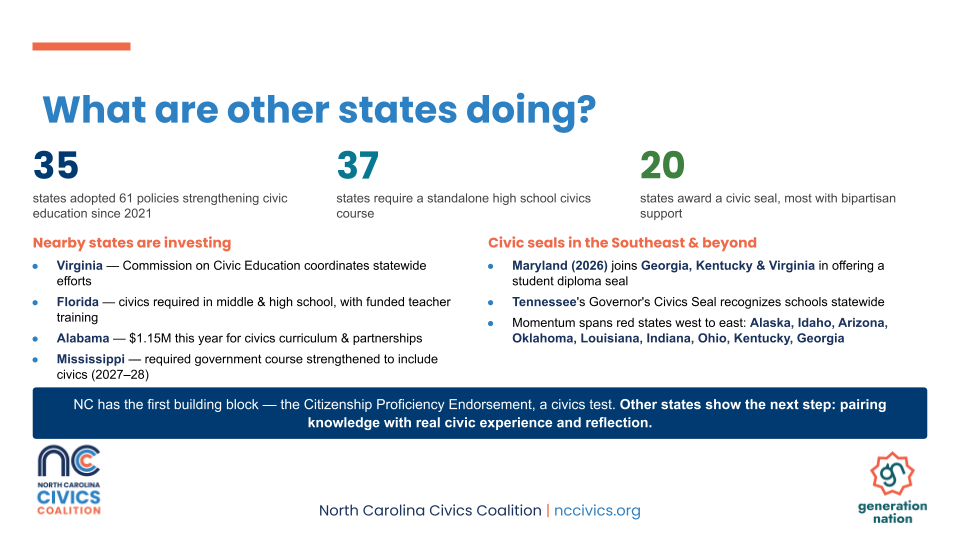
Several states, like Mississippi, Alabama, Florida, and Virginia, are making investments in civic education, she said.
Virginia, for example, has a Commission on Civic Education that coordinates statewide efforts by looking at subgrants and opportunities to partner with museums to provide professional development to teachers. Florida requires that civics be taught to all middle and high school students and provides funds for teacher training. Alabama has made a $1.5 million investment in civics curriculum and partnerships, and Mississippi’s required government course has been strengthened to include civics.
Jordan said that North Carolina could learn from comparable Southern and Mid-Atlantic states about how they began investing more substantially in civic education.
Discussion focused on North Carolina’s current investment in civic education, the potential creation of a Civic Seal, and opportunities to strengthen civic learning through standards, funding, and partnerships.
Civic education funding
Participants noted that North Carolina does not currently have a recurring state budget item specifically dedicated to civic education.
The state does provide recurring funding for character education, which could potentially connect to service learning and civic education, but it is not explicitly designated for civics.
The UNC School of Civic Life and Leadership was highlighted as an example of existing state investment and as a potential partner for developing teacher-preparation and K-12-to-college pathways in civic education.
Participants suggested that future General Assembly funding could support a broader K-12-to-postsecondary civic education infrastructure.
AI, digital literacy, and social studies standards
North Carolina is currently reviewing its social studies standards, a process that occurs roughly every 8-10 years. Currently, AI literacy and media/digital literacy are being discussed as possible components of the standards.
If revised, draft standards are expected to emerge during the revision process, followed by opportunities for public comment and stakeholder feedback.
Webinar participants said that AI and digital literacy could be incorporated through project-based learning, experiential learning, capstones, and student research, rather than simply as stand-alone content.
Civic Seal of recognition
A major portion of the discussion explored creating a North Carolina Civic Seal for students.
Other states — including Maryland, Georgia, Kentucky, Virginia, Tennessee — were cited as examples of states using civic seals, certificates, or similar recognitions.
A suggested North Carolina model might include any or all of the following:
- Recognize both civic knowledge and civic participation
- Include a variety of meaningful experiences such as service learning, community projects, legislative simulations, research, and public engagement
- Potentially connect to existing coursework and graduation requirements
- Go beyond a notation on a diploma by potentially having the UNC System and North Carolina Community College System recognize the achievement
- Create a tangible indication that a student is prepared to participate as an informed citizen
Students participating in the discussion generally expressed interest in a Civic Seal, while emphasizing that it should encourage genuine civic learning rather than simply becoming another credential students pursue for its own sake. North Carolina’s existing Seal of Biliteracy was mentioned as a potential structural model for developing a Civic Seal.
Participants identified several possible avenues for establishing a Civic Seal, including through the General Assembly, the Governor’s Office, the State Board of Education, DPI, or the Secretary of State’s Office.
Suggested advocacy strategies included:
- Identifying legislators, particularly those serving on education committees, who may be interested
- Building relationships with legislators and their staff
- Participating in legislative workshops and public-feedback opportunities
- Reviewing education legislation and committee reports
- Attending public hearings and providing testimony;
- Engaging local school boards, county commissioners, and other education stakeholders.
Participants emphasized that civic education needs more visibility and clearer requests for state support and encouraged communication with state and local government officials as well as education and civic organizations. They also noted that the North Carolina Civics Coalition is developing resources and opportunities for students and other stakeholders to participate in civic-learning efforts.
Going forward
Farrell noted that North Carolina will have an opportunity to obtain state-level civics assessment data in 2028, which could help establish a baseline and identify student needs. Also, Civic Learning Week will be hosted nationally by North Carolina the following March, creating a significant opportunity to highlight civic-learning initiatives in the state.
Participants were encouraged to become involved in the social studies standards revision process and the coalition’s youth advisory efforts.
You can view the entire presentation and discussion on YouTube.
Resources
From DPI:
- Character Education, which receives recurring funding
- DPI Civics and Government Strand Map
- DPI Social Studies Unpacking Documents
- DPI Social Studies Standards
From CivxNow:
- CivxNow’s State Policy Scan
- CivxNow state affiliates
- CivxNow’s analysis of civic education legislation by state
- CivxNow State Civic Education Policy Agenda Recommendations
Behind the Story
The author used ChatGPT for editing, including feedback on clarity, flow, and grammar.