Blue Ribbon Commission discusses how to strengthen education through school operations reforms

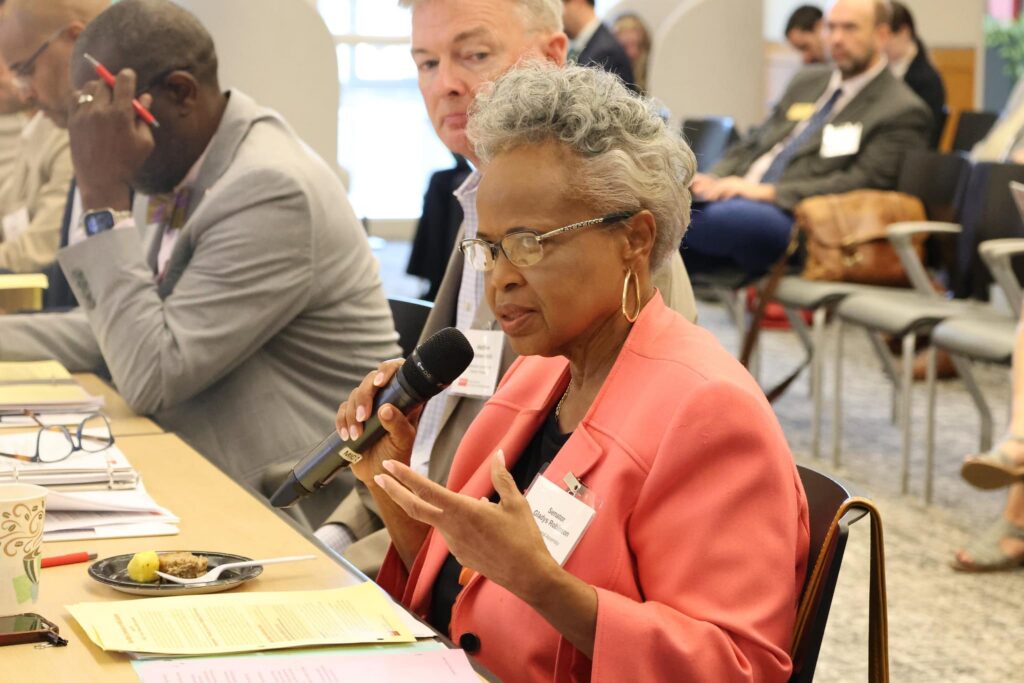
The Blue Ribbon Commission on Public Education held extended discussions during its meeting on Monday on the nitty-gritty operations of schools that seldom make headlines or campaign commercials.
Meeting for their seventh session, members of the bipartisan advisory panel were divided into three roundtable groups to grapple with the day-to-day challenges of managing budgets, employing teachers and staff, purchasing equipment, keeping student records, and utilizing digital technology and cybersecurity.
The commission did not hold a plenary session and did not take votes on a set of recommendations. Still, the discussions over five hours at the Friday Institute for Educational Innovation produced nuggets of information and insight, summarized below.
 Sign up for the EdWeekly, a Friday roundup of the most important education news of the week.
‘Incredible variance’ among districts
A persistent challenge is developing uniform state policy for what Bill Harrison, a veteran superintendent of schools in several counties, described as the “incredible variance” among North Carolina’s 115 public school districts.
Wake County Public Schools with more than 161,000 students and Charlotte-Mecklenburg Schools with nearly 142,000 students rank in the top 20 districts in enrollment in the nation. Several other districts, however, have fewer than 1,000 students — Tyrrell County with 447, Hyde County with 454, and Weldon City 674.
The commission has debated to what extent the state should issue mandates or provide incentives for cross-district sharing of administrative services to bolster school systems lacking administrative capacity.
“Research has consistently found that small districts face structural diseconomies of scale and that consolidation can reduce these costs,” says a brief prepared by the Friday Institute staff for the commission’s Sept. 28 meeting. “Consolidation carries financial and community costs and is not necessarily appropriate for every district. An alternative is to capture economies of scale through facilitated or voluntary resource pooling while persevering local governance.”
Modernizing school business systems
Vanessa Wrenn, chief information officer at the state Department of Public Instruction (DPI), gave an hour-long presentation on the history and current work of modernizing school business systems.
She noted that state efforts dating back to the 1980s had made North Carolina a data-rich state for education researchers and policy analysts. “North Carolina is probably the No. 1 state that other states look to for data,” she said.
In the new state budget, the General Assembly directed DPI to institute a common statewide “enterprise resource system’’ for traditional public schools and charter schools by June 2031. Wrenn told the commission that DPI would not meet the November deadline laid out in the budget to develop a plan for the transition, and is therefore seeking an extension of two months.
She also noted that the fifth pillar of DPI’s strategic plan includes modernizing and integrating core business systems to “improve transparency and decisions informed by data.”
Math reform
At its previous meeting, the commission adopted five recommendations to strengthen early literacy, including a provision that the state “fund up to three evidence-based, developmentally appropriate K-3 literacy curricula” from which public schools would be required to choose.
Brenda Berg, president of BEST NC, sought to add a similar provision for math curricula. The commission decided to retain the focus on reading.
But the issue remains on the table. In his remarks to open the session Monday, co-chair Don Martin, a Forsyth County commissioner, announced the formation of a subcommittee to consider whether to add a recommendation on math.
Commission’s tasked study topics and next steps
The Blue Ribbon Commission was established in March with a charge to examine four specific topics: teacher training and student advancement, administrative operations, educational leadership, and accountability.
From time to time, commission members have pushed against the boundaries of the initial charge to raise other matters of policy and political consequence. In September, for example, the commission added a robust call for increasing teacher pay to its set of recommendations.
On Monday, summary reports from small-group discussions indicated that some commission members raised such issues as a proposed “weighted student formula’’ for financing schools, the state’s subsidy for students in private schools, and the sometimes-tense relations in counties between charter schools and the traditional public school district, along with school safety.
In her report from a roundtable, Krista Glazewski, executive director of the Friday Institute, said the discussion raised the “need to benchmark” the effectiveness of private schools and that “parents need to be fully informed.” North Carolina has a built-in expansion of state appropriations for vouchers, known as Opportunity Scholarships, which will reach $825 million a year in 2032-33.
Mary Beth Piecham of the Friday Institute reported that the roundtable she monitored had included some discussion of an “adequate funding study” along with legislative consideration of a weighted formula.
“Shifting to a new model is a significant change,” she said regarding roundtable conversation.
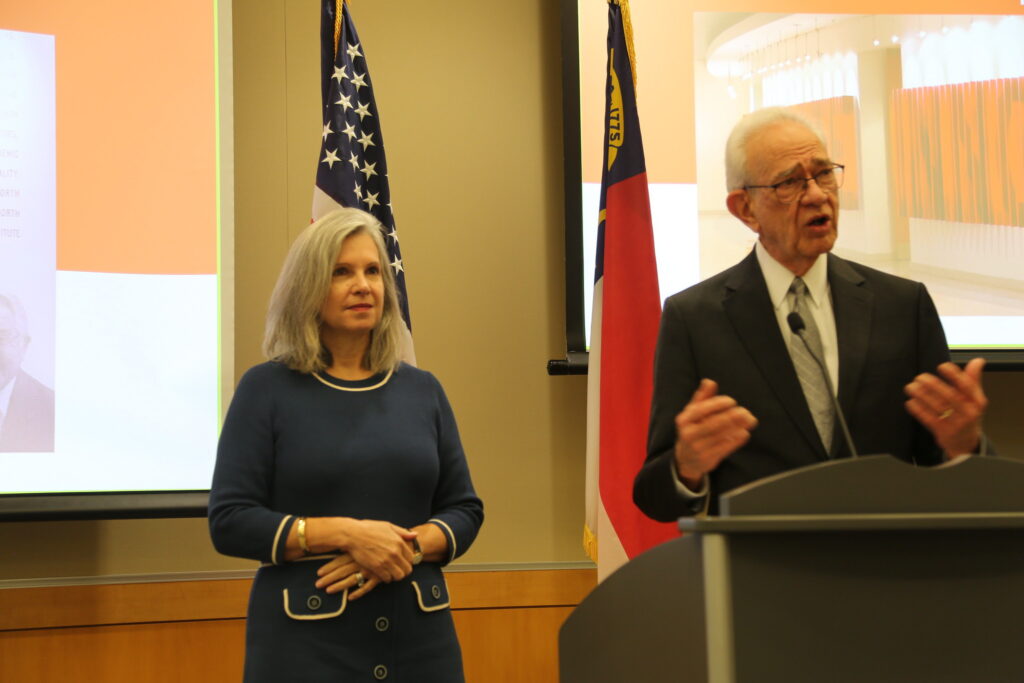
The commission is scheduled to meet on Nov. 19, when, Martin said, the members will discuss the theme of educational leadership. Meanwhile, he said, members will receive a draft set of recommendations on administrative operations and technology modernization from the Friday Institute in preparation for a “potential vote” in December. You can view a document on “emerging themes” around school operations here, shared with members ahead of the meeting.
In addition, Martin said the commission would soon receive a “working draft” of report language in support of its recommendations on teacher training and student advancement, approved by vote in September. The Blue Ribbon Commission has March 2027 as a deadline for its full report.
You can watch the full meeting below, and view all meeting materials on the Friday Institute’s website.