
Blue Ribbon Commission adopts recommendations on teacher pay and literacy, discusses financial management

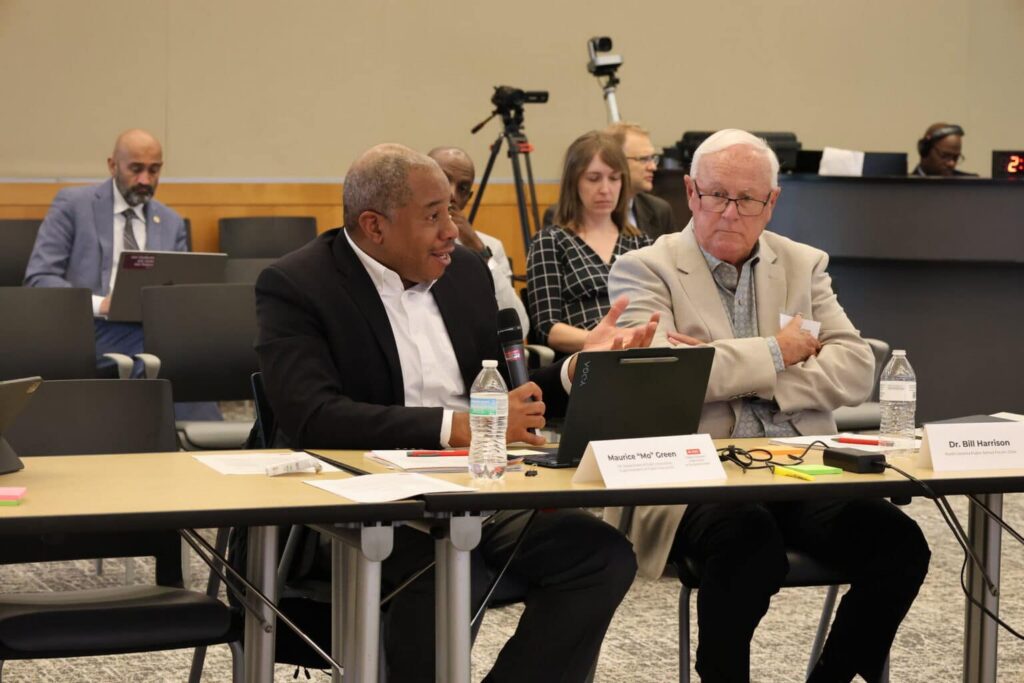
The Blue Ribbon Commission on Public Education has adopted two sets of recommendations, including a mixture of initiatives to ensure North Carolina an adequate corps of well-qualified classroom teachers and to propel literacy gains among students in kindergarten through third grade.
At its sixth meeting on Monday, the bipartisan commission approved without dissent a direct declaration that North Carolina “establish and sustain a competitive teacher compensation system” by 2028 so that the state becomes “a regional leader in teacher pay.”
 Sign up for the EdWeekly, a Friday roundup of the most important education news of the week.
The commission, appointed by Democratic Gov. Josh Stein, Republican House Speaker Destin Hall and Republican Senate leader Phil Berger, also called for the state to “adopt and fund” three K-3 literacy curricula and to “establish and fund… high-dosage tutoring’’ targeted to young students exhibiting reading difficulty.
The commission’s proposals come in the wake of the 8% average pay increase for classroom teachers in the 2026-27 fiscal year budget passed by the General Assembly in July. The recommendations also come in the context of an array of data depicting North Carolina at or near the bottom of state rankings on public school funding and educator compensation.
In its most recent report based on 2024-25 data, the National Education Association placed North Carolina 43rd among the states in annual average teacher pay. Its $60,323 average falls below the national average of $74,495. The NEA ranked North Carolina below Georgia, Alabama, Tennessee, South Carolina, and Virginia, and above Florida, Louisiana, and Mississippi.
The Southern Regional Education Board offers a state-by-state “teacher compensation dashboard” that reports on benefits as well as salaries. SREB reports that North Carolina has a 25% “teacher wage penalty,” a calculation to show how much educators’ compensation falls below professionals with comparable educational attainment and experience.
“Educators in the South,” says SREB, “earn substantially less than the national average: K-12 teachers earn 15% less, principals 11% less, Early Head Start teachers 11% less, and Head Start pre-school teachers 7% less.”
Related reads
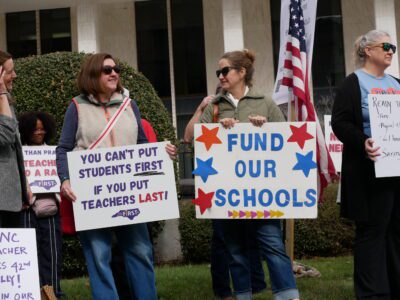
In its annual report on public school finance, the U.S. Census Bureau measures the states’ revenue and spending in relation to $1,000 in personal income, a rough indicator of a state’s effort in terms of its population and economic capacity. In the most recent Census report, North Carolina ranked 49th in revenue, 44th in spending on instruction, and 47th in total spending, combining administration and instruction.
Over their six meetings so far, commission members have heard briefings on state-local financing and on local administrative differences among small rural and large metropolitan counties. The commission has not attempted to determine potential costs of its proposals.
At the outset of Monday’s meeting, co-chair Anne Faircloth urged commission members to give “policy direction,’’ but “to resist turning every recommendation into legislation.”
During her opening remarks as the staff director, Emma Braaten of the William & Ida Friday Institute for Education Innovation regularly offers a reflection on norms and standards for commission deliberations. On Monday, she said the commission should have a “sense of urgency.” She also said, “Remember that improving education is not just about more money; it is also about determining if our current investments are yielding best results.”
Still, the commission’s first set of proposals signaled that extending high-quality teaching into more classrooms and accelerating student advancement would require increases in government spending. The commission asserts that improved compensation “supports the recruitment and retention of effective educators.”
The recommendations to nurture early-career educators and to expand opportunities for experienced educators to engage in mentoring and coaching, says the commission, should be “supported by sustainable state funding.”
In addition, the commission proposes a “summer reading camp’’ or alternative intervention for third grade students falling short of reading proficiency — with “state funding to support implementation.”
Here is a link to the complete list of recommendations approved by the commission on Monday.
After voting on the early literacy and teacher pipeline items, the commission turned its attention to financial management and administrative structures in the state’s 115 local school districts. A panelist of school superintendents, administrators, and school finance officers discussed school finance and the challenges with the state’s current allotment-based model.
Joan Wade of the national Association of Educational Service Agencies then gave the commission a briefing of models on “shared services for districts” in other states. Ahead of the meeting, members also reviewed a 2007 report on shared services in North Carolina, and a 2020 report on shared services in rural communities.
At issue is whether North Carolina can achieve operational efficiencies and cost savings through consolidation of administrative functions, especially among low-wealth districts, while also respecting the desire for local autonomy by elected school boards.
“Research has consistently found that small districts face structural diseconomies of scale and that consolidation can reduce these costs,” says a brief prepared by the Friday Institute staff. “Consolidation carries financial and community costs and is not necessarily appropriate for every district. An alternative is to capture economies of scale through facilitated or voluntary resource pooling while persevering local governance.”
The commission was formed with a four-part agenda in studying the structure and implementation of public education: 1) teacher training and student advancement, 2) administrative operations, 3) educational leadership, and 4) accountability.
Reflecting concern about addressing all four elements in depth by its March 2027 deadline, the commission has shifted its scheduled Oct. 19 meeting from a virtual session over a livestream to an in-person work session at the Friday Institute on NC State University’s campus.
According to its website, the commission’s “proposed recommendations will be provided to the Executive and Legislative branches in early 2027.”
You can view a summary from the Friday Institute on the commission’s Aug. 31 meeting about school administrative operations here, and watch the Monday meeting below.