
Following momentum from lawmakers, Public School Forum releases report on a weighted student funding model

The Public School Forum of North Carolina released a report on Wednesday detailing findings and recommendations from its two-year study of a weighted student funding model, which lawmakers and advocates have proposed as an alternative to North Carolina’s current model for funding public schools.
The Public School Forum’s report comes after a 2017 report ordered by the General Assembly exploring the transition to a weighted student funding formula, a 2023 bill sponsored by N.C. Senate education leaders which would have instated a weighted student funding formula, and, most recently, a provision in the 2026 budget (Page 217) creating a weighted student funding formula work group through the North Carolina Collaboratory.
Weighted student funding models, also called student-based funding models, have been on the rise in school systems across the country. Such a model would distribute funding to school districts using a base amount per student, plus set percentages for certain student attributes like students with disabilities or who are economically disadvantaged. North Carolina’s current funding model for schools uses a hybrid of a resource-based and program-based allocations.
“A weighted student formula is incredibly important,” said Sen. Michael Lee, R-New Hanover, in a Senate Education/Higher Education Committee meeting in May. “We need to move forward with it.”
Nearby states have recently implemented weighted student funding models, such as Tennessee (implemented in school year 2023-24) and Mississippi (implemented in SY 2024-25). According an EdBuild map cited in the Public School Forum report, 41 states have fully or partially implemented a student-based funding model.
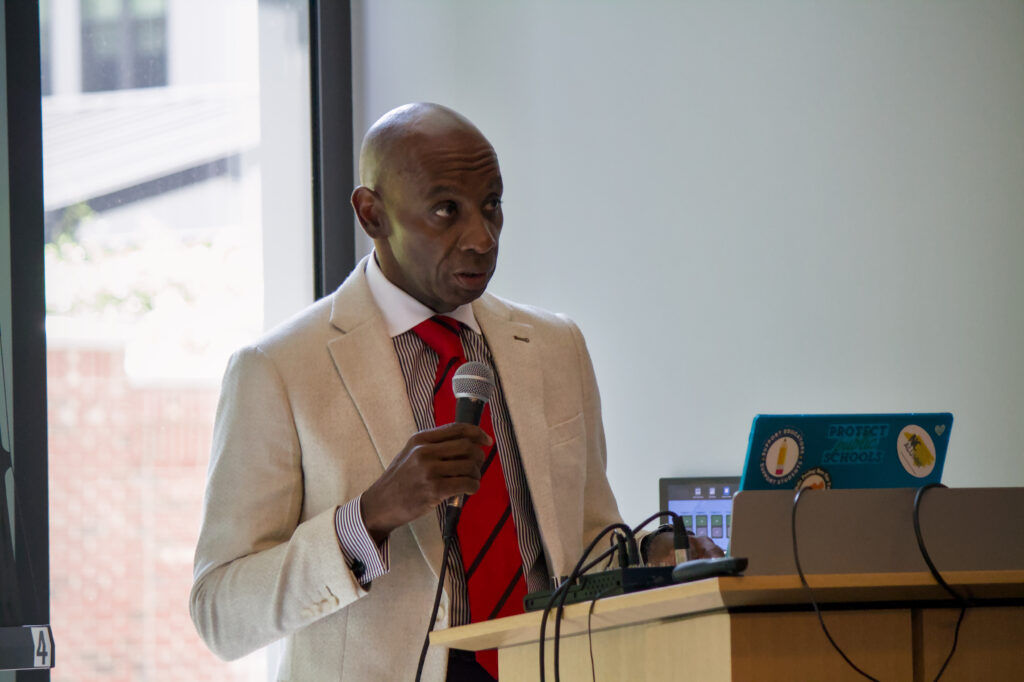
“Today is not about advocating for a particular political position or suggesting that there is one simple answer to school funding,” said Anthony Jackson, CEO of the Public School Forum, at an event announcing the report. “It is about providing policymakers, education leaders, communities, and the public with better information about the choices before us, and about the opportunities, challenges, and potential consequences of those choices.”
 Sign up for the EdDaily to start each weekday with the top education news.
Why switch funding models?
There are a few reasons advocates have cited in pushing for a shift to a weighted student funding model. One is that it would potentially be more equitable. North Carolina’s current funding model “produces only a weak correlation between state expenditures relative to economically disadvantaged student populations,” the report says.
There is also a growing gap between the highest- and lowest-wealth counties’ education spending which contributes to the inequities between districts, the report says.
“Because local governments have taken on an increasingly significant role in funding schools, counties with stronger tax bases are better positioned to supplement state funding for operational expenses, using local resources to help attract well-qualified staff and provide additional educational opportunities to students,” the report says.
It also notes that, “(in) 2024-25, the ten poorest districts in North Carolina taxed themselves at 1.8 times the average tax rate of the ten wealthiest districts. Yet despite that greater taxing effort, lower-wealth communities continue to operate with fewer resources.”
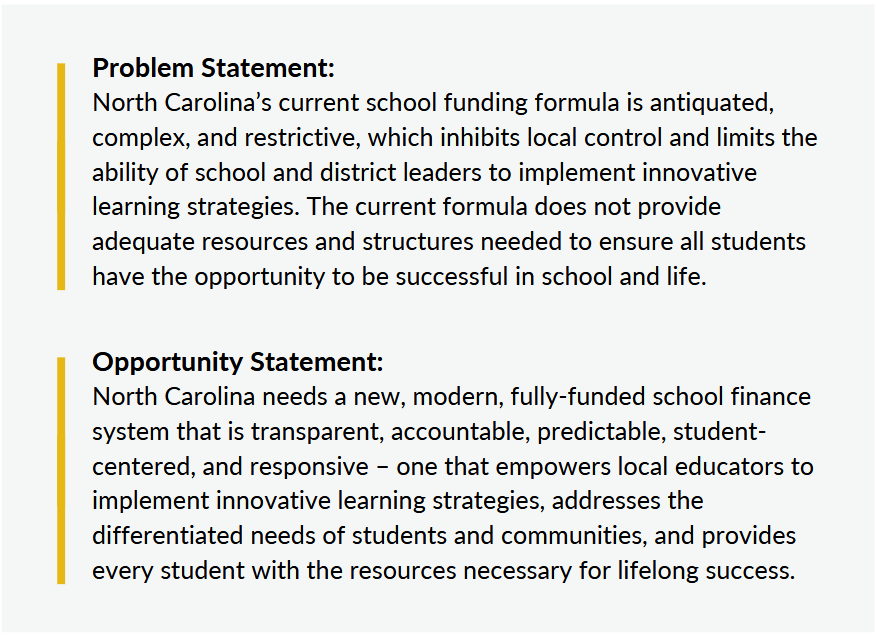
Additionally, a weighted student funding formula could be more streamlined and simpler for districts to navigate, the report says, and could provide more local flexibility in funding decisions. Currently, many state allotments are restricted to specific purposes and cannot be transferred if needs present themselves.
“Study group members noted that North Carolina’s current school funding model relies on complex allotments and formulas that can take district leaders years to fully understand,” the report says. “Participants largely agreed that the present structure fails to meet the needs of students, schools, and districts statewide, citing challenges with insufficient overall funding, restrictions on local flexibility, and inequitable distribution of funds across districts and allotment categories.”
Read more



The report’s findings
The Public School Forum’s study, which “convened a statewide group of over 100 education leaders, elected officials, and school finance experts,” and partnered with the national education nonprofit Bellwether, examines four scenarios with the same weight distribution and different base allocation amounts. The report states the weight distribution was “agreed upon by study group members.”
The weights are as follows, with the percentages representing the additional funding on top of the base amount districts would receive for each student based on their attributes. Also included are “community weights,” that are based on district attributes like student population density. Some weights are on a sliding scale.
- Economically Disadvantaged: 40%
- Students with Disabilities: 110-150%
- Multilingual Learners: 17.5%
- Academically/Intellectually Gifted: 5%
- Career and Technical Education: 16.1%
- Sparsity: Up to 25%
- Concentrated Poverty: 5%
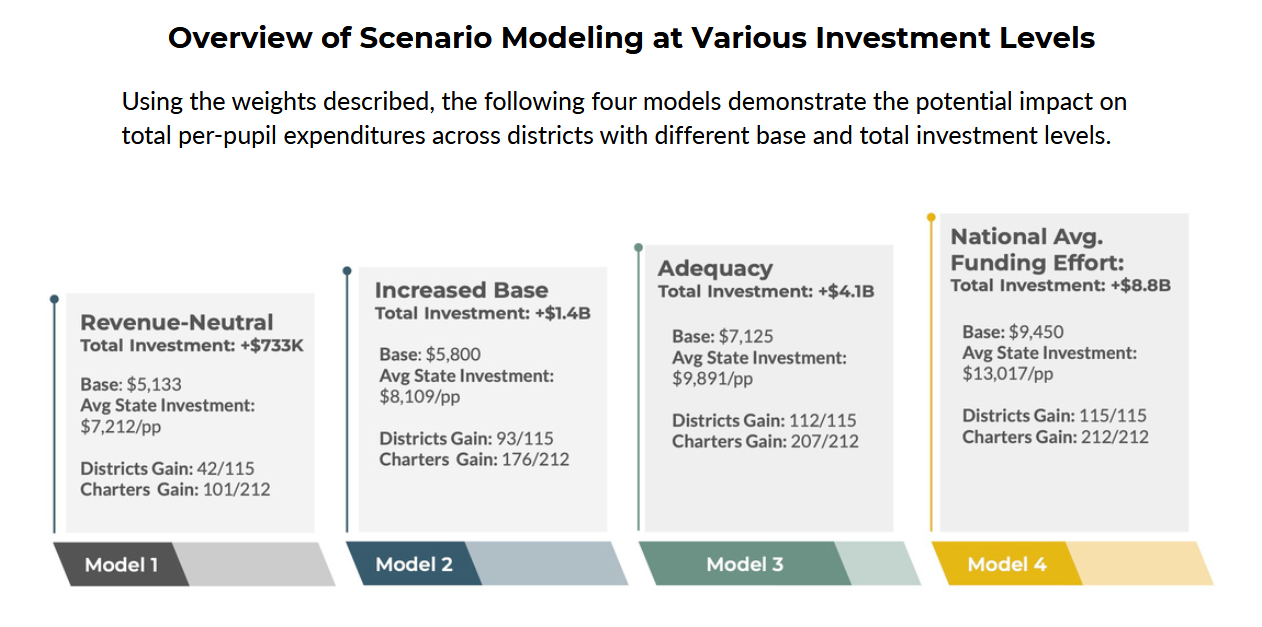
The four scenarios include a revenue-neutral case, where state education remains nearly the same as today, and three cases of increasing state investment. The base funding amounts range from $5,133 in the neutral case to $9,450, the amount which would bring North Carolina in line with the national average funding effort, according to the report.
For reference, the base funding amount in Tennessee for the 2025-26 school year was $7,295, the report says. In Mississippi, it was $6,847.
Without investment, weighted funding could harm low-wealth districts
Each of the four scenarios would result in “a more equitable distribution of resources for students with greater need, including students in poverty, students with disabilities, and multilingual learners,” the report says in its list of key takeaways.
However, it adds that changing to a weighted funding model without increasing overall investment in public schools would result in “significant funding losses” for most school districts. The state’s smallest, often rural, districts would experience greater losses.
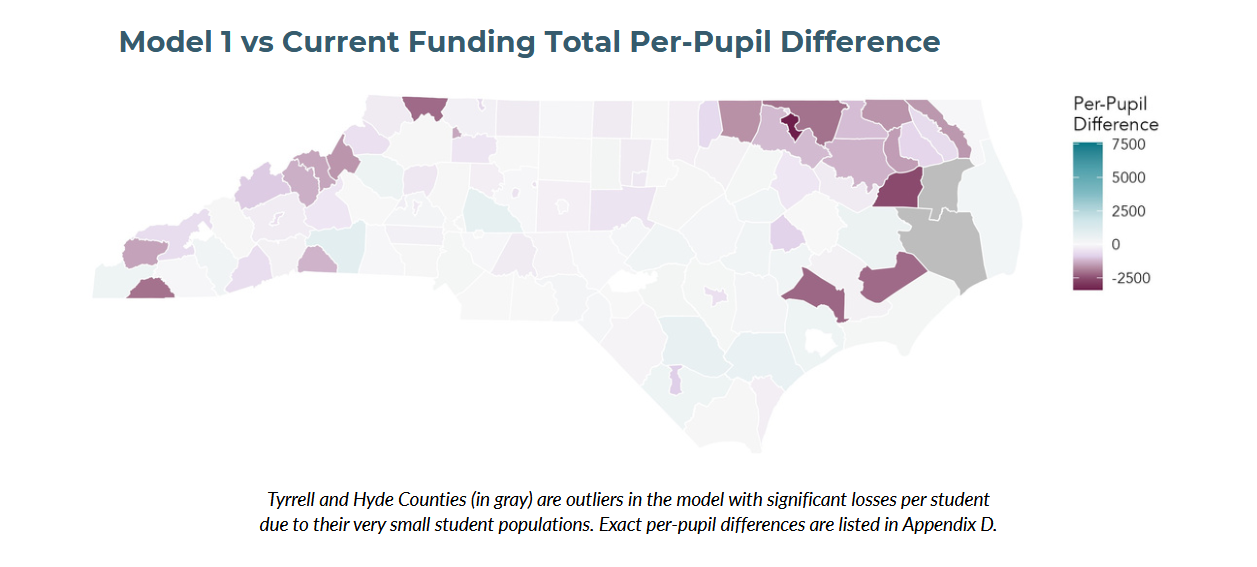
The first scenario, where total education funding remains the same as today, would result in the majority of districts — 73 of the 115 — losing funding. The majority of charter schools — 111 of 212 — would also lose funding.
The second scenario, representing a statewide investment of $1.4 billion, would see about 80% of districts and charter schools gain funding. The third, representing an investment of $4.1 billion, would see about 97% of districts and charter schools gain funding.
And under the fourth scenario, all districts and all charter schools would see a funding increase, at a cost of $8.8 billion.
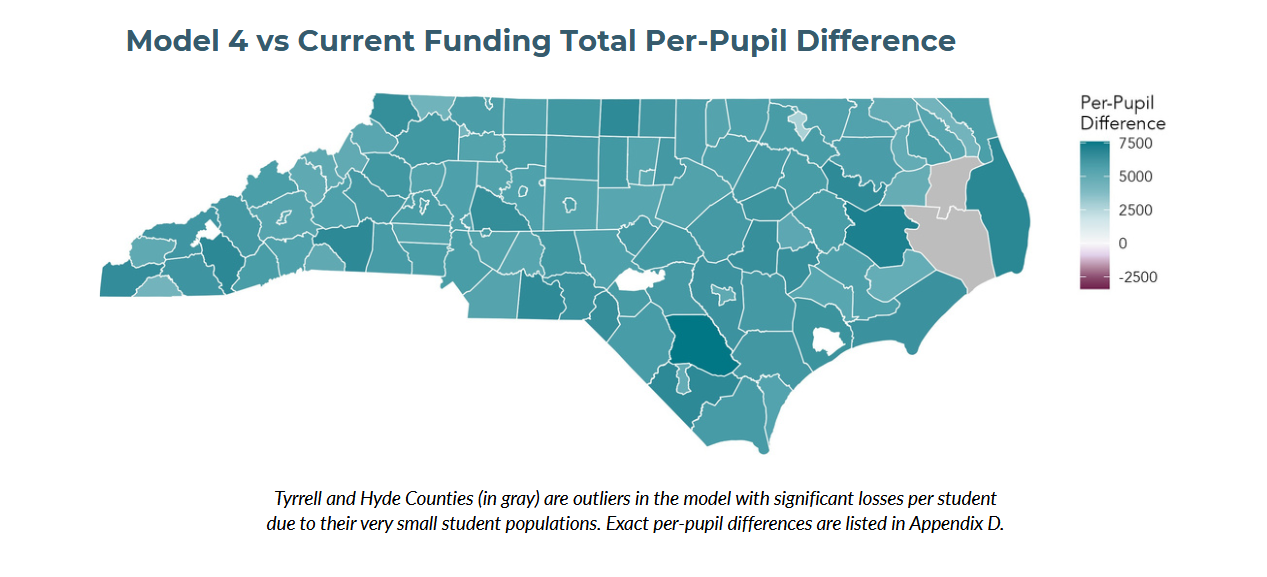
The study group “is not endorsing a specific weighted student funding formula at this time,” the report says. But these scenarios led to the conclusion, in the report, that great investment is needed “regardless of how funds are distributed.”
“As the modeling presented in this report clearly demonstrates, implementing a cost-neutral model would result in untenable funding losses for the majority of the state’s school districts and charter schools,” the report says. “Transitioning to a weighted student funding formula will require significant, sustained new state investment and a guarantee that no districts or charter schools will be harmed as a result of the transition.”
Next steps
In addition to the report’s recommendations to significantly increase investments in public schools, target investments to the students and communities who need it most, and continuously improve the funding formula as it is implemented and afterward, the report recommends implementing “low-cost adjustments to the current formula in the short-term.”
These could include increasing flexibility and the ability to transfer funds between allotments, which would “empower local district leaders to address the challenges specific to their communities.” The report also says implementing the Department of Public Instruction’s proposed weighted Exceptional Children model would be “an impactful first step.”
The report also outlines other questions to consider before switching to a weighted student funding formula, like implementation training for district staff, an examination of state mandates, and the potential necessity of new data collection mechanisms.
The report’s main conclusion: “Model prototypes clearly demonstrated potential benefits of weighted student funding, with the caveat that realizing these benefits will depend heavily on the specific formula design, overall investment levels, and how changes are implemented.”
“I want to thank each of you again for being here, and for engaging in this important conversation around a topic that will impact just about every person in this state at some point. Whether it’s through a child or a community, how we fund schools impacts us all,” Jackson said to the attendees of the announcement event, which included many study group members.
Read the full report here for a detailed account of the study group, its methodology and membership, and its recommendations.