
Blue Ribbon Commission | Members discuss draft recommendations on teacher training and student advancement


Members of the Blue Ribbon Commission on Public Education arrived Monday for their fifth monthly meeting with an agenda designed to focus on draft recommendations on teacher training and student advancement.
The six-page draft, prepared by the staff of the Friday Institute for Educational Innovation at NC State University, proposed such measures as providing a state-funded literacy coach in every “low-performing” elementary school, identifying three state-recommended “evidence-based K-3 literacy curricula,” and assigning teacher compensation “as a priority for future study.”
 Sign up for the EdWeekly, a Friday roundup of the most important education news of the week.
Shortly after commission co-chair Anne Faircloth, a Sampson County farm and business owner, opened the discussion by urging the members to work toward “finding consensus.” Some members raised concerns about the draft’s policy-paper language and some urged a more expansive action plan.
“I’m struggling here, and I’m struggling big-time,” said Allen E. Gant Jr., chairman of the Glen Raven textiles company. He raised concern that the draft would lead to a too-long and too-dense report.
“If you want to sell this on Main Street, we’ve got to get back to a sixth grade level of English in communication,” said Gant, who also mentioned during the meeting that he had been among the business leaders who had urged Democratic Gov. Josh Stein, Republican House Speaker Destin Hall, and Republican Senate leader Phil Berger to establish the bipartisan 29-member commission.
Sen. Gladys Robinson, D-Guilford, said she was “a little disappointed” in the absence of a strong proposal on early childhood development.
“How does a child enter school ready to read or ready to do anything without us funding early childhood development?” she asked.
Lisa Godwin, a teacher mentor in Pender County Schools, worried over teachers becoming “trapped’’ by the imposition of state-specified curricula. “Yes, we need great curricula,” she said, but teachers also “need some autonomy to be able to read and teach students.”
In the commission’s final report, she said, “We’ve got to make it personal.”
Matthew Bristow-Smith, principal of Edgecombe Early College High School, urged the commission to go beyond calling for a teacher-compensation study. The commission, he said, “misses an opportunity if we don’t draw a line in the sand and say if we want to change the landscape and the ecosystem for North Carolina public education that we must make some recommendations about teacher compensation.”
Read more
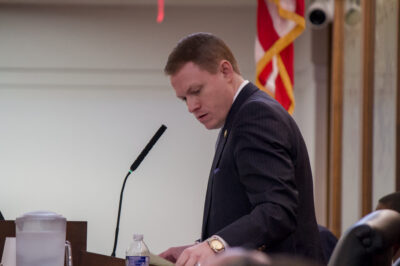

The commission heard extensive presentations on school finance from Alexis Schauss, chief financial officer of the state Department of Public Instruction, and Eric Houck, associate professor of education at the University of North Carolina at Chapel Hill.
As members asked Schauss and Houck questions, the meeting took a turn into a discussion of whether the commission should delve into financial management in local school districts, including consolidating offices or neighboring districts sharing offices.
Schauss said she had observed a “drought of financial professionals in public service.” Elon University President Connie Book suggested some small districts could streamline by consolidating the offices of financial management, human relations, and procurement.
While several members said that arranging joint district management would be politically difficult, Gant spoke up to suggest bringing in a national management consulting firm to study “what’s mergeable.”
Brenda Berg, president of the business coalition BEST NC, recalled that North Carolina had engaged the Brookings Institution of Washington, D.C., to develop a plan to shore up state and local governments during the Great Depression. The 1931 Schools Machinery Act shifted the base funding of schools to state government.
“We hired Brookings and we became the only state in the South that didn’t close our K-12 schools,” Berg said.
Superintendent of Public Instruction Maurice “Mo” Green embraced the idea of engaging business leaders in considering whether and how to share resources and positions within and across school districts. The 2025-2030 strategic plan, he said, envisions steps to modernize management.
“The political part is real,” said Green, but an effort to examine managerial and financial practices is worthwhile “when you think about the number of districts that are losing enrollment and that are struggling with how to be sure more dollars remain in classrooms.”
The commission took no votes or any final actions on the six-page draft recommendations. After each session, the Friday Institute staff has the task of revising commission documents to reflect the discussions and to prepare for the next monthly meeting.
The next meeting is scheduled for Sept. 28.