
North Carolina congressional leaders find common ground on childcare, families, and workforce

For families across North Carolina, childcare is about more than finding a safe place for their children while they work. It is connected to whether parents can stay in the workforce, whether businesses can find and retain employees, whether families can afford their basic needs, and whether young children have the opportunity to thrive.
Those connections and the role of federal policy in supporting them were at the center of a virtual town hall on Friday, Aug. 21, hosted by the North Carolina Partnership for Children (NCPC) through the statewide Smart Start network.
The town hall offered early childhood leaders an opportunity to bring experiences and questions of families, providers, employers, and communities directly to federal policymakers as Congress considers decisions affecting childcare, family economic supports, and the early childhood workforce.
 Sign up for Early Bird, our newsletter on all things early childhood.
Members of North Carolina’s congressional delegation and their staff joined early childhood leaders from across the state to discuss the issues affecting young children and families, from childcare affordability and workforce shortages to federal funding, healthcare, tax policy, and higher education.
The conversation included U.S. Reps. Don Davis and Deborah Ross, both Democrats, along with Lindy Robinson, senior advisor and district director for U.S. Rep. Greg Murphy, a Republican. Dylan Heneghan, Davis’ communications director, also joined the discussion. All 14 members of North Carolina’s congressional delegation were invited.
The participants represented different districts, communities, and political perspectives, but one theme surfaced repeatedly throughout the conversation: Supporting young children is a priority, which requires supporting the families, educators, businesses, and communities around them.
“These are not Democratic issues. They’re not Republican issues,” Davis said. “These are issues that are dealing with affordability, dealing with fundamentally the family.”
Childcare is a workforce issue
For Davis, who represents North Carolina’s first congressional district in eastern North Carolina, the conversation about childcare begins with the economic pressures families are facing.
“The expenses of raising kids are outpacing income,” Davis said. Parents need affordable care in order to work, he continued, while employers need a reliable workforce. Children, meanwhile, need high-quality care and education.
That relationship between childcare and employment was echoed by Robinson, who described what Murphy’s office hears from businesses throughout their largely rural district. Without childcare, she said, employees miss work or leave the workforce altogether. The numbers illustrate the challenge.
Robinson shared data from One Place in Onslow County showing 19,905 children under age 6 in its service area, including 9,340 with all available parents working. Yet only 3,119 children from birth to age 5 were enrolled in licensed childcare. An employer survey of 25 Onslow County businesses also found that cost, lack of available openings, and the absence of care during evenings, overnight hours, and weekends were among employers’ top childcare concerns.
Those challenges are not isolated to Onslow County. Robinson pointed to similar pressures in rural communities across eastern North Carolina.
For Davis, the childcare discussion is part of a larger question about how economic growth reaches families across the state. He emphasized that North Carolina’s strong business climate is worth celebrating, but economic opportunity is not distributed evenly. That means conversations about childcare must also include wages, housing, healthcare, rural economic development, and other pressures on family budgets.
“When I think about families, right now, that are being hit so hard, with their budgets stretched to the max, I am reminded that they are having to choose between putting food on the table, paying for rent or a mortgage, and finding safe childcare,” Davis said.
Employers as part of the solution
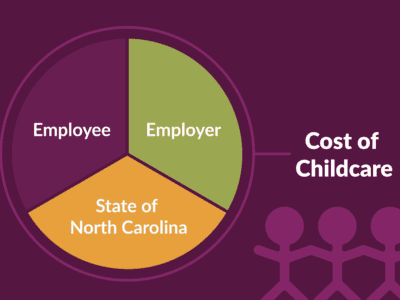
One strategy discussed during the town hall was North Carolina’s Tri-Share childcare pilot. The model divides participating families’ childcare costs among three contributors: the employee, the employer, and the state.
North Carolina established its Tri-Share program in 2023, with implementation beginning in 2024. A bipartisan federal proposal, H.R. 6312, the Tri-Share Child Care Pilot Act of 2025, would create a pilot through which states could compete to participate in a similar cost-sharing model.
Town hall participants expressed support for North Carolina being part of such an effort. Robinson said Murphy would also support North Carolina being considered for a federal Tri-Share pilot, particularly if rural and military-connected communities have opportunities to participate.
Heneghan said North Carolina has an opportunity to build on work already underway in the state. For families in eastern North Carolina, he said, “access and affordability are the greatest challenge that we face.” Having employers at the table alongside families and government offers another way to approach that challenge.
“It takes a village,” Heneghan said.
Ross highlighted SAS, headquartered in her district, Wake County, as an example of why employer investment in childcare can also make business sense. She said companies benefit when employees have access to supports that allow them to remain in their jobs. SAS is a family-friendly business where employees receive healthcare and childcare. Employees even have the option to visit their children during lunch. She said Jim Goodnight did not do this for the same reasons they were in the room.
“He did it to retain good employees,” Ross said. “That is good business sense.”
Related reads


Family economic stability goes beyond childcare
The conversation also highlighted how interconnected early childhood policy issues are for families. Smart Start invests heavily in childcare, NCPC President Amy Cubbage said, but the network also addresses child and family health, family support, early literacy, and other needs.
“We are a network that looks at whole child and whole family needs,” Cubbage said.
For members of the delegation, that led to a broader discussion about wages, healthcare, food assistance, the child tax credit, earned income tax credit, housing, and other policies that affect families’ economic stability.
Ross argued that federal economic policy should place greater emphasis on working families. Davis emphasized the particular challenges facing rural communities, including health disparities, access to healthcare, and uneven economic development. And Robinson said Murphy’s office would continue looking at how the child tax credit and earned income tax credit interact with other family supports.
While their policy approaches differed, participants agreed that families do not experience these issues separately. A parent struggling to afford childcare may also be struggling with housing, healthcare, food, transportation, or wages. And instability in one area can quickly affect another.
The people caring for children are part of the equation
The town hall ended with another challenge facing North Carolina’s early childhood system: the workforce itself.
Cubbage raised concerns about federal higher education policy that ties participation in federal student loan programs to graduates’ earnings. The concept may appear reasonable on the surface, but it can create unintended consequences for professions where compensation has historically failed to reflect the highly skilled nature of the work, including early childhood education and social work. That is especially concerning in a field already struggling to recruit and retain teachers.
Ross said the issue reflects a larger problem with how the country values professions disproportionately held by women.
“We have got to compensate people for providing these essential services,” she said. She described early childhood educators and others in similar professions as “high-touch” workers whose work cannot simply be replaced by technology.
“They are what form people’s character, their values, their dedication to work,” Ross said.
Robinson offered a different perspective on the legislation but identified a similar problem. She shared that while the policy was likely well-intended, it may have been written too broadly, creating unintended consequences for fields such as early childhood education and social work, where compensation has not caught up with the value of the work.
Heneghan emphasized the shortages in childcare, healthcare, and social services across eastern North Carolina. He shared that removing barriers to credentials and training is important to building the workforce needed in those communities.

Finding common ground
Perhaps the clearest theme of the discussion was not agreement about every federal policy. It was agreement about the problem. Parents need childcare to work. Businesses need employees. Communities need healthcare and economic opportunity. Early educators need pathways into the profession and compensation that allows them to stay. And young children need stable families and communities surrounding them.
The issue was also personal for each of the speakers. Ross connected her commitment to the issue to her mother, who spent decades as an early childhood educator. Davis recalled being raised by his grandmother, who ran an early childhood education center, and later marrying an early childhood director. Robinson drew on her years in county government and social services, where she saw firsthand the barriers that could prevent a parent from going to work because they could not find childcare. Those experiences crossed political and geographic lines.
That is also where Cubbage said North Carolina’s Smart Start Network can play an important role. Smart Start was designed as a state-to-local system serving all 100 counties, with local partnerships positioned to identify community needs, bring together public and private partners, and provide policymakers with information about what families are experiencing. Cubbage encouraged congressional offices to visit those local partnerships, hear directly from communities, and use them as resources when shaping policy.
Robinson said listening to people with different perspectives is part of finding solutions.
“We may have a different way of getting there,” she said, “but we’re willing to listen and learn.”
For Davis, that kind of engagement is essential.
“We have to engage as never before to really, truly be champions for our children,” he said.
And Ross framed the stakes in generational terms.
“How we treat our youngest residents is a reflection of what we want for our future,” she said. “This is an intergenerational commitment that we need to make.”