
Prioritizing parents and ‘passing the trash’: 7 federal education updates from this summer

While America at 250 played prominently in the news cycle this summer, significant policy changes impacting students, educators, and schools were underreported.
The changes impact Head Start, vaccine recommendations, the Science of Reading and tutoring, the protection of students, policies regarding transgender students, nonwhite students, and the wind down of the U.S. Department of Education.
This political era continues to prioritize parents’ rights, and U.S. Secretary of Education Linda McMahon said, “the Trump administration will always put them first.”
McMahon is also asking districts to stop “passing the trash,” a practice that protects adults accused of assaulting or harassing children from consequences, enabling them to find other employment and potentially continue to harm kids in a different setting.
Inside Higher Ed reports that this comes “as McMahon is defending herself against similar allegations. Decades earlier, she failed to protect minors from sexual abuse at the hands of an employee at World Wrestling Entertainment (WWE), alleges a lawsuit filed in late 2024.” In December 2025, a judge ruled that two of the claims against McMahon can move forward.
 Sign up for the EdDaily to start each weekday with the top education news.
Sweeping changes to Head Start proposed
On Aug. 6, 2026, the U.S. Department of Health and Human Services announced a proposed rule, “Reducing Federal Burden for Head Start Programs,” which claims to “expand access, reduce red tape, and refocus the program on its core mission of preparing America’s most vulnerable children for success.”
A notice of proposed rulemaking preserves the federal-to-local program model, aiming to preserve or expand Head Start slots nationwide by decreasing administrative costs. According to the press release, the proposed reforms:
- specifically recognize parents as children’s primary teachers
- emphasize health, nutrition, and physical exercise
- shift governing authority for group size and ratios, education requirements, background checks, and transportation practices to states
- remove duplicate layers of compliance
Immediately, civil rights and disability organizations issued a joint statement in opposition to the changes, finding “at the heart of the program are standards that ensure every child gets the support they need and that parents are full partners in governing the program and as their child’s first and most important teachers.”
This article by The Hechinger Report explores the tension between the flexibility that would be gained and the costs it comes at.
The proposed rule is open for public comment until Oct. 6 here.
Federal recommendations on childhood vaccines are changing
President Donald Trump issued 225 executive orders in 2025, and he has issued 48 to date in 2026. Issued on Aug. 10, 2026, his latest executive order is on childhood vaccine recommendations.
“For too long, America recommended more childhood vaccines than any peer nation,” says a White House post on Facebook. “No longer.”
The order recommends all children get immunizations to provide protection against 11 diseases, including measles, mumps, rubella, diphtheria, tetanus, and pertussis (whooping cough), polio, haemophilus influenzae type b (Hib), pneumococcal disease, human Papillomavirus (HPV), and varicella (chickenpox).
This is a decrease from the previous list of 18 diseases all children should be vaccinated against, which also included recommendations on COVID-19, influenza (flu), rotavirus, Hepatitis A, Hepatitis B, respiratory syncytial virus (RSV), and bacterial meningitis.
The order recommends separating out the combined measles, mumps, and rubella (MMR) vaccine into three single-disease shots — not currently available in the United States — and recommends administering all vaccines during separate medical visits.
States that enact school vaccine requirements are advised to update their laws.
“The Order maximizes parental choice over childhood vaccines,” according to the administration.
The executive order follows a presidential memorandum issued in December 2025 and an accompanying release, a U.S. Department of Health and Human Services assessment of immunization schedules compared to other countries published in January 2026, and an executive order in May 2026 and an accompanying release.
Here is additional information on this executive order from the White House.
Here are North Carolina’s vaccine requirements for school-aged children.
Read more from DC to NC
National initiative to protect students from adult sexual predators focuses on educators, not all caregivers
Catherine Truitt, the former superintendent of the N.C. Department of Public Instruction (DPI), testified while she was in office, “I know the issue of sexual misconduct is not something the vast majority of our schools or districts face regularly.”
She also said, “I firmly believe that one violation is too many.”
Violence against our children — be it physical, sexual, or emotional — is never OK.
Violence against children happens not just in our homes and all kinds of schools, it also happens in churches, in community sports and clubs, in summer camps, and anywhere and everywhere that children find themselves in a position of trust and power with an adult.
Schooling is compulsory in North Carolina, and for the 1,025 hours that children are in our public school classrooms each year and teachers stand in loco parentis, or in the place of parents, students and their parents deserve to know they are safe.
In 2024, statewide in North Carolina there were 18,990 substantiated abuse cases by parents and caregivers.
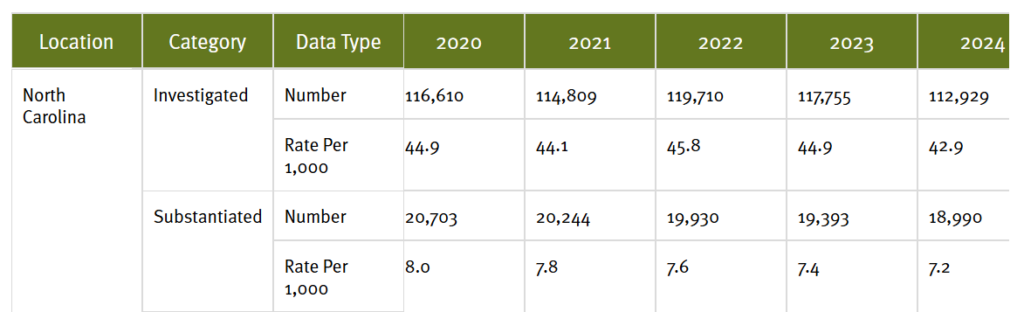
In the same year, there were 52 disciplinary actions involving educators in DPI’s database that may have involved students and inappropriate conduct.
On July 10, 2026, the U.S. Department of Education launched a national K-12 initiative to protect students from adult sexual predators in schools, according to this press release.
The federal guidance instructs schools to:
- prevent school employees, contractors, or agents in obtaining new employment if there is knowledge or probable cause to believe they engaged in sexual misconduct involving a student
- collect and report data, and districts that inaccurately report — or report zero incidents of rape or sexual assault despite evidence suggesting otherwise — may face enforcement by the Office of Civil Rights
- thoroughly investigate allegations of sexual misconduct and not rely solely on referrals to law enforcement to satisfy their obligations under Title IX.
The initiative follows news reporting that focused on sexual misconduct by educators specifically.
Protecting children requires a comprehensive approach across all settings by all offenders, and it requires teachers, parents, and community members to all serve as checks on each other.
Protecting students is more complicated than both the current reporting and the current politics.
The administration’s ‘crack down’ on transgender policies in school districts continues
According to a U.S. Department of Education press release on July 27, 2026, “policies that instruct teachers, counselors, and other employees to hide a child’s ‘gender transition’ records from parents infringe on parents’ rights under FERPA.”
FERPA is the Family Educational Rights and Privacy Act.
The release also notes that districts that classify information about a student’s gender identity as confidential medical information that cannot be shared with parents are being investigated.
In March 2025, a Dear Colleague Letter was sent to state superintendents regarding their obligations under FERPA and designating the practice of hiding a child’s gender identity from that child’s parents as a priority concern.
McMahon attached this cover letter, stating that “by natural right and moral authority, parents are the primary protectors of their children.”
“School districts that hide information from parents are violating federal law,” said Assistant Attorney General Harmeet Dhillon. “FERPA is not optional, and any districts that attempt to bypass or distort its requirements should expect immediate federal action. In partnership with the Department of Education, the Department of Justice will initiate enforcement proceedings with districts that fail to comply.”
The department issued a series of press releases in late July 2026 announcing investigations and actions in schools districts across the country, including in Colorado, Maryland, Massachusetts, Michigan, Minnesota, and Washington.
U.S. Department of Education removes disparate impact from Title VI regulations without public comment
On July 23, 2026, the U.S. Department of Education’s Office for Civil Rights announced significant deregulatory actions rescinding several disparate impact provisions from the department’s regulations implementing Title VI of the Civil Rights Act of 1964 (Title VI) in accordance with Executive Order 14281.
According to the Associated Press, “The rule was published and took effect immediately without public comment, an unusual step for major regulatory change.”
A former manual from the U.S. Department of Justice Office of Civil Rights about the Civil Rights Act of 1964 says disparate impact theory ensures “that public funds, to which all taxpayers of all races contribute, not be spent in any fashion which encourages, entrenches, subsidizes, or results in racial discrimination.”
In calling for the enactment of the Civil Rights Act, according to the Department of Justice, President John F. Kennedy stated:
Simple justice requires that public funds, to which all taxpayers of all races contribute, not be spent in any fashion which encourages, entrenches, subsidizes, or results in racial discrimination. Direct discrimination by Federal, State, or local governments is prohibited by the Constitution. But indirect discrimination, through the use of Federal funds, is just as invidious; and it should not be necessary to resort to the courts to prevent each individual violation.
Nonwhite students impacted by “neutral-seeming rules causing very non-neutral outcomes” will bear the brunt of this policy change.
Federal science of reading bills are moving through Congress
In the U.S. Senate, the Reading Excellence and Achievement for Development Act, S. 4689, has been put on the legislative calendar.
An analysis by Accelerate, the national collaborative for accelerated learning, says the bill “rewrites the federal government’s main reading grant program — the Comprehensive Literacy State Development (CLSD) program — so that federal reading dollars must support research-backed instruction.”
The bill also would create the first federal definition of high-impact tutoring.
According to Accelerate, the U.S. House literacy bill, H.R. 7890, is far narrower.
While there is bipartisan support in both chambers, each bill needs to pass its respective chamber before a compromise on the scope of the legislation can be reached, and this Congress ends on Jan. 3, 2027.
Where does Congress stand on the wind down of U.S. Department of Education?
The U.S. House Education and Workforce Committee passed 10 bills on July 15, 2026 to begin codifying the Trump administration’s plan to “right-size” the U.S. Department of Education.
“Today marks a major step by Congressional leaders to cement the Trump Administration’s historic reforms to right-size the federal role in education,” said McMahon.
But the U.S. Senate is emerging as a source of bipartisan pushback on the department’s wind down. It is considering a bill, S. 5046, that would prohibit the transfer of certain offices and functions of the U.S. Department of Education to other agencies.
Following a committee vote in the Senate, on July 31, 2026, McMahon and six other leaders in partner agencies in the administration sent a joint letter to Congress making the case for the “wind down” of the department and highlighting the role of the 14 interagency agreements that have been signed and are being operationalized to that end.
“By increasing competition in grantmaking, streamlining government operations, and better aligning federal agencies with the work they are best equipped to perform, we are ensuring that essential federal education functions once again serve students, families, states, institutions, and taxpayers,” says the letter.
One example of the “historic number of applications” for federal grants, includes the Child Care Access Means Parents in School program, or CCAMPIS.
“Under our partnership with HHS’s Administration for Children and Families (ACF), CCAMPIS received almost 300 applications, nearly double the 161 applications received in last competition of the program,” says the letter.
Want to dive deeper on what’s happening in DC?
Read this article by The Carolina Journal on the possible insolvency of social security and the impact on North Carolinians, then check out McMahon’s remarks at Turning Point’s leadership summit, and wrap up with McMahon’s three-page “call to action” to university presidents and governing boards on admissions, free speech, intellectual pluralism, affordability, rigor, and safeguarding research.