
State Board discusses results from Teacher Working Conditions survey, ed tech, and more

Approximately 93% of North Carolina teachers believe their school is a good place to work and learn, according to preliminary data from the 2026 North Carolina Teacher Working Conditions Survey.
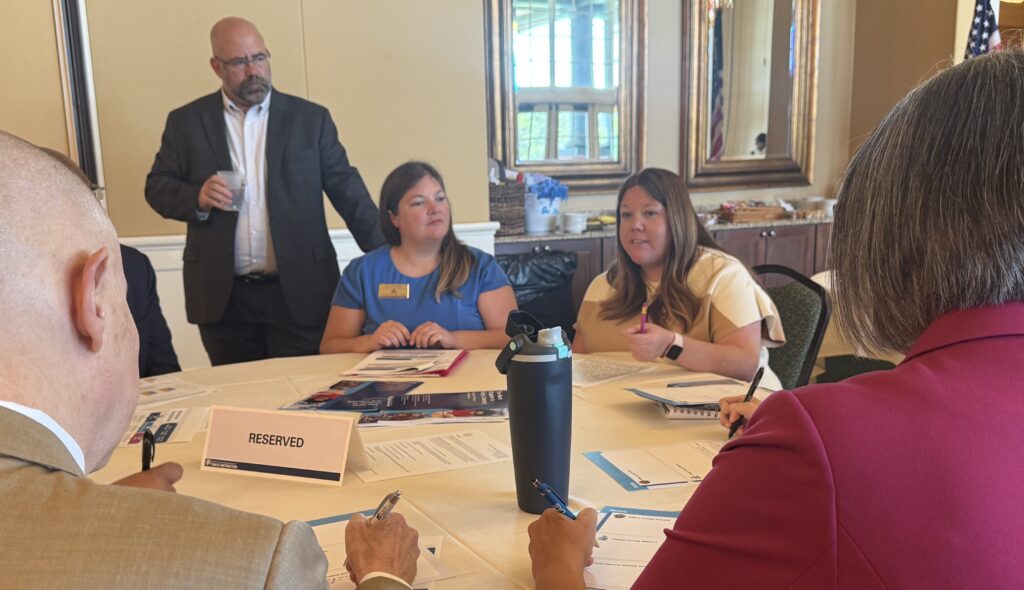
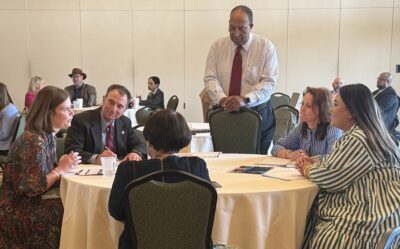
Dr. Shaun Kellogg, senior director of the Department of Public Instruction’s (DPI) Office of Research & Promising Practices, presented preliminary results during the State Board of Education’s biannual planning and work session last week. During the three-day meeting, held in Duplin County, Board members heard updates on the survey results, discussed educational technology, and approved adding schools to the Golden LEAF initiative.
Board members and district leaders also examined the progress, challenges, and next steps tied to the state’s sweeping literacy reforms. They also voted to approve six new remote academies and heard from administrators about the impact of these academies across the state.
More coverage of the Board’s May planning and work session
Teacher Working Conditions survey
The Teacher Working Conditions survey, conducted every two years, had more than 102,000 respondents — a 90.5% response rate. The survey’s 100 questions covered issues ranging from school leadership to student conduct. According to Kellogg’s presentation, teachers are “largely positive about their working conditions” and “strongly committed to their schools.”
Nine in 10 teachers reported planning to remain in teaching, while 84% planned to stay at their current school. Those considering leaving the profession or their school reported challenges around the job’s time commitment, student behavior, and school leadership.
“Together, these patterns indicate that teachers’ future plans are tied not simply to general regard for a school, but to a broader set of working conditions that influence whether they can see themselves continuing there,” the report says.
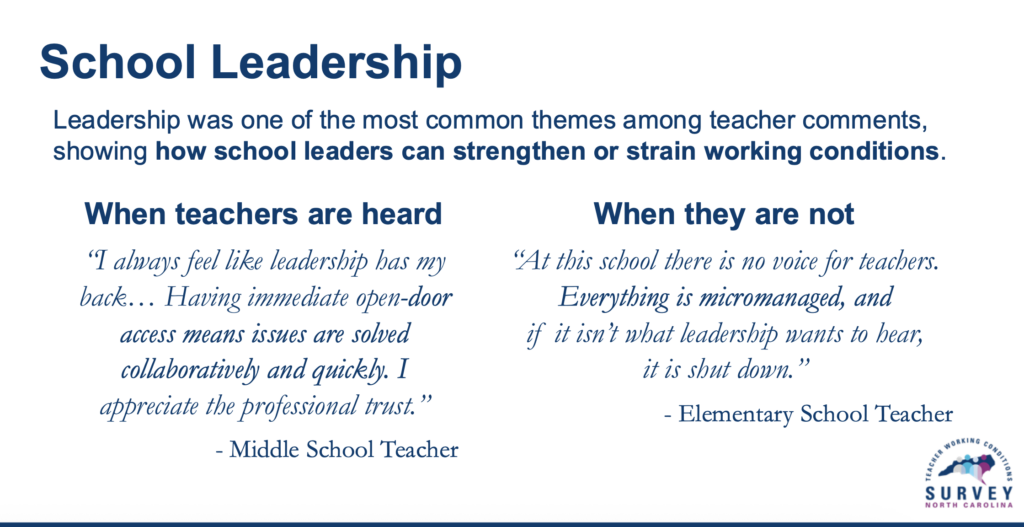
The report also revealed that teachers are working nine additional weekly hours on average outside of the school day, and about 40% believe the time provided to them for noninstructional purposes — such as planning — is not enough.
“I think we would be remiss if we did not acknowledge that teachers are making the time. It is simply uncompensated,” said Kimberly Jones, the 2023 North Carolina Teacher of the Year. “Our academic results are showing that teachers are making the time. They are sacrificing the time from their own lives. So we are asking for more compensated time to do the work.”
Those trends fueled a reported need for protected time to “plan, collaborate, observe peers, communicate with families, and manage core professional responsibilities,” the report said. Respondents also requested opportunities to learn from other teachers and attend professional conferences.
The presentation added that “teachers’ comments and professional development priorities suggest that additional support is needed to meet the increasingly complex needs of students.”
 Sign up for the EdDaily to start each weekday with the top education news.
Student conduct also remains a concern for many teachers, according to the report, especially in middle and high school. While 85% of teachers agreed that schools have positive behavior interventions and supports in place, only 73.8% agreed that students follow school conduct rules. Nearly 70% of middle school teachers reported student disrespect towards teachers as an issue in their school, and 77% of high school teachers reported students’ tardiness or skipping class as an issue.
Board Chair Eric Davis called on Kellogg to provide the Board with policy recommendations based on the survey results.
Dr. Patrick Greene and Donna Bledsoe, members of the NC Principal of the Year Network, also presented results from the NC Principal Working Conditions survey, a pilot launched in 11 school districts across the state. The pilot survey had responses from 381 principals — a nearly 91% response rate — on 58 items covering issues such as climate, district leadership, and professional development, among others.
The survey found positive views of districts among principals, with more than 96% saying their district is a good place to work and learn, and nearly 93% saying they would recommend working there. But about three-quarters of respondents reported working more than 50 hours a week, with the largest share of time spent on safety and managing student conduct. More than 60% also said their school is not provided sufficient data to make informed decisions.
“Professional learning and leader wellness is a relative area for growth,” the survey found. “About one quarter of leaders disagree that the district supports their overall wellness; items on differentiated PD (professional development) and time to try/evaluate new ideas are also more mixed than other domains.”
Green and Bledsoe said they are working to scale the survey and are planning to offer it statewide to any eligible respondents who would like to participate in October.
Read more
Beginning teacher support
After reviewing survey results on Wednesday, the Board discussed supports for the state’s beginning teachers.
Beginning teachers are leaving the profession at “concerning rates,” said Dr. Derrick Jordan, DPI’s chief operations officer, a trend that has prompted a statewide effort to strengthen their retention and mentoring support. DPI officials outlined several strategies that are part of this effort, including expanded regional training, policy revisions, and stakeholder advisory councils, among others.
The presentation also pointed out the positive effects of support programs on beginning teachers’ retention rates, especially for those entering the profession through alternative licensure pathways.
Leaders from New Hanover County Schools also presented their local beginning teacher support model, which includes monthly professional development, classroom walkthroughs, guided observations, and mentor programs for new teachers and alternatively licensed educators.
District officials said beginning teacher retention rates have remained above 84% in recent years and pointed to strong support systems and school culture as major reasons teachers stay.
More on beginning teachers

Educational technology and research
The Board kicked off its work session on Tuesday with a panel discussion highlighting growing concerns about technology use in schools, including screen time, student attention spans, social media — and their effect on student conduct and mental health.
“Technology in education right now sits in a set of competing realities, and that is going to require careful balance as we move forward, and careful consideration in how we support our schools to make sure our students are learning,” said Dr. Vanessa Wrenn, chief information officer at DPI. “When does technology improve learning and when does technology get in the way? I think that’s the crux of the question.”
Citing survey data from the Winston Center on Technology and Brain Development, Dr. Karl Johnson, an assistant professor at the UNC Gillings School of Global Public Health, said 73% of middle school teachers report education technology creates more distractions and challenges to focus, while 87% said students are distracted by school-issued devices for noneducational purposes.
“I think it’s hard to overstate the importance of focus in education,” Johnson said. “So, I don’t want distraction to be kind of one thing on the side, so to speak, as we think about this issue, but really, like a core aspect of the thing we’re grappling with.”
Panelists emphasized the ubiquitous presence of technology in students’ lives. They said the challenge for educators is using that technology to teach critical skills — and teaching students to think critically about the technology itself.
“Technology is here, so how can we incorporate that, how can we use it, utilize it in a way that has a positive impact?” said Dr. Ellie Ebrahimi, an associate professor at the University of North Carolina at Wilmington.
DPI officials Heather Pennica and Dr. Ashley McBride gave the Board an overview of the state’s existing digital learning guidelines. They unveiled a draft of the state’s new screen use guidelines, which focus on how educators use technology instead of screen time.
“The question is not how much screen time. Instead, the question becomes, what kind of screen use and what is its purpose?” McBride said. “Research shows us that both extremes — unlimited screen use and eliminating screens entirely — are ineffective. Healthy screen use is not about strict time limits. It’s about thoughtful design and shared responsibility.”
McBride said these guidelines would be shared with districts as part of a toolkit. Officials did not share a timeline for disseminating the guidelines.
Golden LEAF Initiative update
The Board also approved four additional North Carolina middle schools to join the Personalized, Competency-Based Education (PCBE) Cohort of the Golden LEAF Schools Initiative, a five-year $25 million initiative to improve rural middle schools’ performance with a focus on mathematics and career development.
The four new members of the initiative include:
- North Davie Middle School, Davie County Schools
- Overhills Middle School, Harnett County Schools
- Rockingham County Middle School, Rockingham County Schools
- West McDowell Middle School, McDowell County Schools
This group brings the PCBE cohort to nine schools, including the original five announced last June. Participation in the PCBE cohort is meant to help schools prepare to begin a shift toward competency-based education, which focuses on students demonstrating their mastery of a subject.
The initiative also includes the Transformative Schools Cohort, which features 10 low-performing schools that will be implementing the Marzano High Reliability Schools framework and the Open Up Resources Problem-Based Math Curriculum.
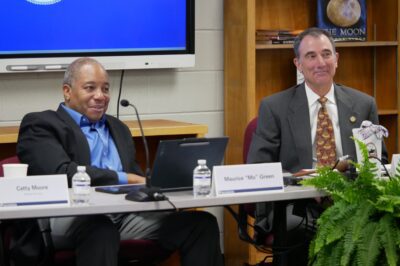
“The energy and commitment I have seen across the first 15 Golden LEAF schools is inspiring, and these four new schools will only add to the momentum,” said State Superintendent Maurice “Mo” Green in a press release. “When I visited the schools in the initiative during the last few months, I saw positive school cultures and students actively engaged during classes. I look forward to seeing continued progress in these areas and with academic performance next year.”
Update on strategic planning, the legislature, and more
- Geoff Coltrane, senior director of government affairs and strategy for DPI, said 78 of the 110 actions in the state’s 2025-2030 strategic plan will launch by the end of the year. Coltrane also shared a draft of a new dashboard highlighting the state’s progress on 14 measures included in the strategic plan, such as the graduation rate or ACT composite scores. Rupen Fofaria, the Board’s director of operations and policy, said the dashboard would be published by the next quarterly update on the plan.
- Coltrane also presented an update on the legislative short session, which began on April 21. Coltrane said Senate Bill 840, which modifies some teacher licensure requirements, passed the Senate Education/Higher Education Committee on April 29. House Bill 301, which originally focused on restricting social media access for minors under 16, was amended in the Senate to include artificial intelligence (AI) requirements for schools. The bill would require updates to computer science standards, a statewide model AI policy for districts, local district AI policies, a framework for evaluating AI tools used in schools, and teacher professional development modules. Coltrane also gave Board members an overview of Gov. Josh Stein’s budget proposal.
- The Board voted to approve an RFP for districts to join the Advanced Teaching Roles program, which enables highly effective teachers to earn additional pay for taking on more students or mentoring their peers. After the RFP launches on May 11, districts must submit their applications by Aug. 14, and the Board will select participants on Oct. 15.
- Ryan Collins, deputy general counsel, presented final proposed updates to the state’s athletic eligibility rules after a public comment period. The changes would formally allow athletic associations to grant waivers when they determine a student transferred schools for non-athletic reasons, clarify that excused absences under state attendance rules do not count toward athletic ineligibility limits, and adjust the structure of appeals hearings so appellants present their case first.
- Finally, the Board recommended approving the University of Lynchburg in Virginia’s initial authorization to be recognized as an educator preparation program (EPP) that can provide residency licenses in North Carolina.
The full Board meets next June 3-4.