
The 2027-28 FAFSA is open. Here’s what you need to know

The 2027-28 Free Application for Federal Student Aid (FAFSA) form is online and open to the public — coming in just over a week ahead of the congressionally mandated launch of Oct. 1.
New this year, the FAFSA form provides real-time results, allowing students to view their federal Pell Grant and other federal financial aid eligibility immediately after completing the form. The form also includes earning indicators for colleges students are applying to.
“We are incredibly proud to launch the earliest FAFSA form in our nation’s history, which ensures American students and families have access to the critical resources they need on their postsecondary education journey,” said U.S. Secretary of Education Linda McMahon in a press release.
The 2027-28 FAFSA form must be submitted by 11:59 p.m. CST on June 30, 2028, though students are encouraged to submit it as soon as possible. Some colleges or trade schools may have their own deadlines for submitting FASFA, and most award aid on a first-come, first-served basis. Any corrections or updates to your application must be submitted by 11:59 p.m. CST on Sept. 12, 2028.
In North Carolina, the priority date to submit a FAFSA for the Next NC Scholarship is June 1, 2027 for UNC System institutions and community colleges. On average, the form takes an estimated 15 minutes to complete, according to the press release.
Read more about FAFSA


Completing the form makes current and prospective college students eligible for need-based financial aid including federal Pell Grants, work-study programs, and student loans. Pell Grants can help cover “tuition and fees, housing and meals, and other additional education-related expenses,” and do not have to be repaid, unlike a traditional loan.
According to previous reporting by EdNC, many states, including North Carolina, also use the FAFSA to award state grants, and colleges use the FAFSA to award their own scholarships.
In North Carolina, for example, submitting the FAFSA is a prerequisite for receiving the Next NC Scholarship, which covers full tuition and fees for all North Carolina community colleges and more than half the cost for public universities for most families making $80,000 a year or less. The FASFA also makes students eligible for the NC Need-Based Scholarship for Private College Students.
Students should complete the FAFSA form every year they plan to receive aid.
 Sign up for the EdDaily to start each weekday with the top education news.
How to apply
The first step to filling out the FAFSA is creating your StudentAid.gov account. You can create your account here, which will ask you for your Social Security Number (SSN) if applicable and your own email address. Additionally, each person who’s required to add information to your FAFSA form (for instance, your parent or spouse) needs their own StudentAid.gov account.
If you don’t have a SSN, you can still complete the application if you are a citizen of the Freely Associated States (the Federated States of Micronesia, the Republic of the Marshall Islands, and the Republic of Palau). In this instance, an identification number will be created for you. If your parent or spouse does not have a SSN, they can still create an account — they will just need to indicate that they do not have a SSN by clicking a box.
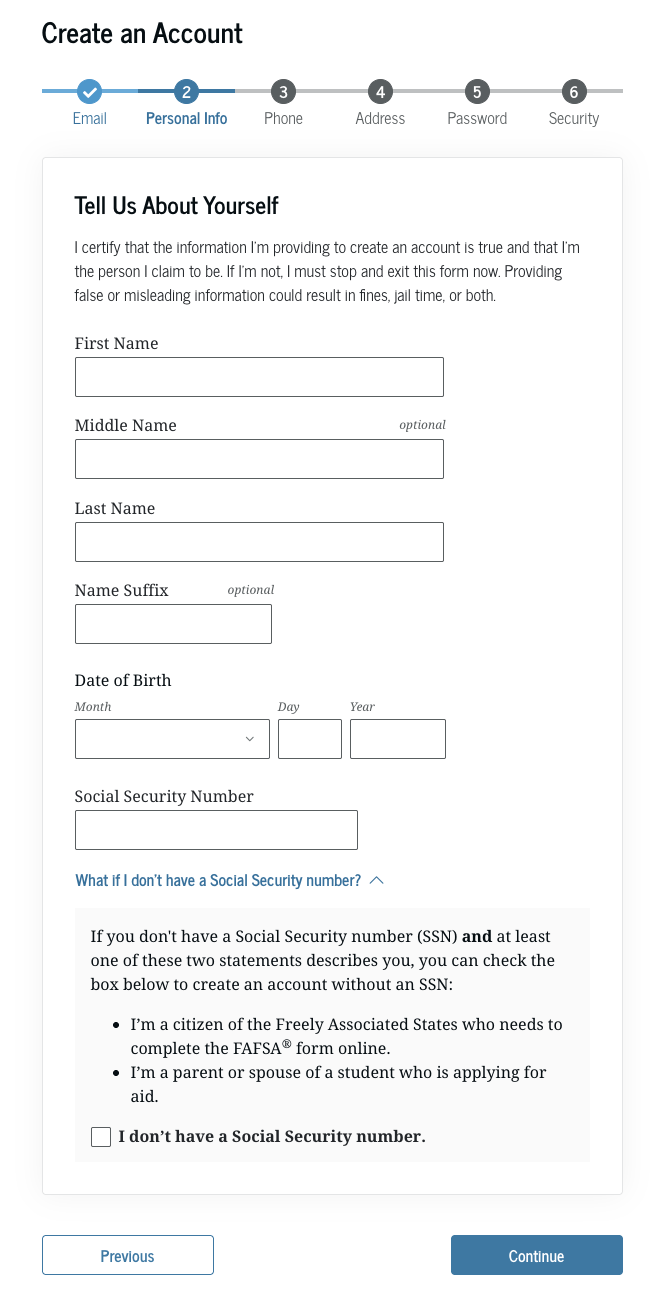
Once you have your account, you can begin filling out the online FAFSA form.
- Go to this site, and click “Start New Form.”
- Next, select which FAFSA form you want to fill out. To apply for financial aid for the 2027-28 academic year, select 2027-28.
- Log in using your StudentAid.gov account username and password.
- Select “Student.” (If a parent wants to start their dependent child’s FAFSA form, they should select the “Parent” option.)
Next, you’ll want to gather some financial and personal documents. While the FAFSA form can be completed without referring to any documents, some people might find the following documents helpful or necessary during the process:
- Your parents’ SSNs if they have SSNs and you’re a dependent student
- Tax returns
- Records of child support that you’ve received
- Current balances of savings and checking accounts
- Current amount of cash if it’s more than $1,000
- The value and any debt owed on nonretirement investments, businesses, and farms
According to studentaid.gov, “If your or your family’s current financial situation differs a lot from the one reflected in the tax information added to your FAFSA form, complete and submit your FAFSA form. Then, contact the financial aid office at the school you plan to attend to explain how your current financial situation has changed.”
Eligibility, citizenship, and parents’ information
According to studentaid.gov, some non-U.S. citizens are eligible to submit the FAFSA form. U.S. nationals and permanent residents are eligible, as are people with an I-94 form showing they are a refugee, asylum grantee, conditional permanent resident, or other applicable designations.
Explore the full list of who qualifies as an eligible noncitizen here.
Students without legal status, including Deferred Action for Childhood Arrivals (DACA) recipients, are not eligible for federal student aid but may still be eligible for other types of student financial aid, like school aid or private scholarships. Students without legal status should check with their school’s financial aid office to see what options might be available.
A student’s parent or spouse’s immigration status does not affect their FAFSA eligibility.
Related reads



Why does the FAFSA matter?
According to College for North Carolina (CFNC), four out of five college students rely on some type of financial aid to pay for college.
Research has shown that completing the FAFSA form increases a student’s likelihood of enrolling in a postsecondary institution.
“Seniors who complete the FAFSA are 84% more likely to immediately enroll in postsecondary education, and for students in the lowest socioeconomic quintile, FAFSA completion is associated with a 127% increase in immediate college enrollment,” the National College Attainment Network says on their website.
From an attainment perspective, more students being financially supported through college means more students graduating and receiving the financial and other benefits of postsecondary education.
And on an individual level, the less a student has to pay for college, the better.
FAFSA completion rates
“Any student, regardless of income, who wants to be considered for federal, state, and school financial aid programs” should complete the FAFSA form, according to the FAFSA website.
Last year, North Carolina ranked 12th in the nation for estimated high school seniors in the class of 2025 or 2026 who completed the FAFSA. However, despite the benefits that FAFSA brings, one-third of North Carolina high school students still did not complete the form.
myFutureNC has set a goal of an 80% statewide FAFSA completion rate by 2030. A number of organizations, as well as school districts and colleges, are promoting FAFSA completion. See this 2025 list on myFutureNC’s website.
Resources for the FAFSA application
- The 2027-28 FAFSA
- FAFSA FAQ page
- FAFSA deadlines
- FAFSA eligibility requirements
- FAFSA assistance through CFNC
- If you are a student reapplying for the FAFSA, your college’s counseling office is also a great resource.
- Financial Aid FAQ from CFNC
- FASFA Videos: Information to help students and families understand the importance of the FAFSA, who is a FAFSA contributor, how to complete the FASFA form, and what happens after submitting the form.
- What is FAFSA®?
- Who Is a Contributor on the FAFSA® Form?
- Create and Access Your StudentAid.gov Account
- Troubleshooting Your StudentAid.gov Account
- Applying for Financial Aid With the FAFSA® Form
- Complete the Financials Section of the FAFSA® Form
- What Happens After Submitting Your FAFSA® Form?
- Where’s My Financial Aid?