
Blue Ribbon Commission | Educators teach students and mentor other teachers
“The greatest predictor of student achievement is a high-quality teacher,” said Stephanie Logan, instructional facilitator at Lincoln Heights Environmental Connections Magnet Elementary School in Wake County.
“Watching another teacher in action is the best thing you can do for a new teacher,” said Maiden Middle School social studies teacher Brandon Tobin.
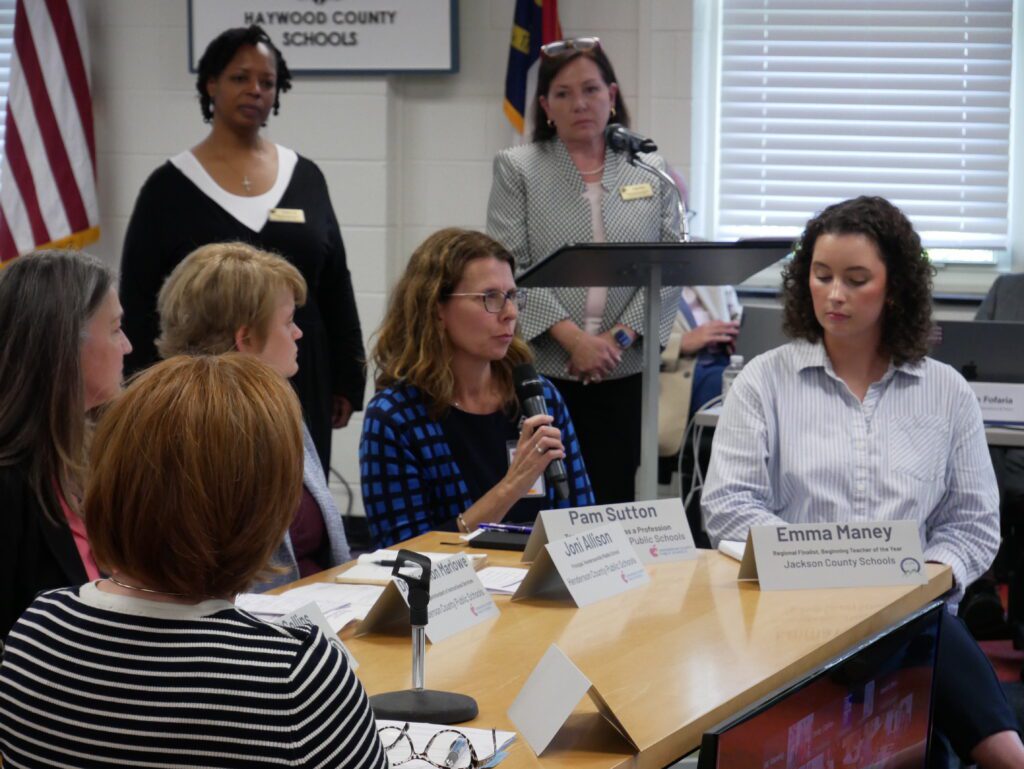
Logan and Tobin participated in an educators’ panel discussion Monday during the third monthly session of the Blue Ribbon Commission on Public Education. The 29-member commission was established by Democratic Gov. Josh Stein and Republican legislative leaders Phil Berger and Destin Hall in March.
Meeting at the Friday Institute for Educational Innovation on NC State University’s campus, the commission grappled with an intricate array of policies and practices through which the state prepares and licenses teachers, as well as measures effectiveness and provides professional support. Emma Braaten of the Friday Institute, which is coordinating the commission’s deliberations, informed the members that they were on track to make initial recommendations in September.
In addition to Logan and Tobin, the educators’ panel consisted of Christopher McDaniel, a social studies teacher at Mineral Springs Middle School in Winston-Salem/Forsyth County Schools; Jessica Odom, an English teacher at Jordan High School in Durham; and Stacey Wall, a multiclassroom leader-educator at Edwards Elementary School in Nash County.
 Sign up for the EdDaily to start each weekday with the top education news.
The commission also received an extensive 30-slide PowerPoint briefing on teacher licensure and preparation by Thomas Tomberlin, senior director of the Office of Educator Performance, Licensure, and Performance in the state Department of Public Instruction. Tomberlin reported that “by and large, our districts do an extraordinary job of filling our classrooms’’ with teachers, while also reporting that North Carolina has become “very dependent on out-of-state teachers’’ who move into the state.
Tomberlin’s data show that educators from other countries represented 13.4% of “newly hired teachers’’ in North Carolina in 2024-25, an increase from 5% in 2017-18.
Tomberlin reported that 84% of teachers say they are satisfied to remain employed in their current school. Then, subsequently he sparked concern among commission members with a chart showing markedly higher attrition rates among beginning teachers and retiring teachers than among their mid-career colleagues.
According to his presentation, North Carolina has about 15,000 beginning teachers each year, with an expected attrition rate of 15% — 2,700 leaving the classrooms. The state has 8,000 teachers with 28 years or more in the schools, with an expected attrition rate of 20% — 1,700 experienced teachers departing.
Some commission members as well as educators worried that the North Carolina flat pay structure for experienced teachers led them to calculate that it made more economic sense to retire with benefits — and teach in a charter school or seek other employment — than to remain in the classroom. On the teachers’ panel, Odom recalled a former colleague who said, “I had 12 more years to go and there was no more pay for me.”
During the Monday commission meeting, there was no general conversation on North Carolina’s low ranking among states in teacher pay or the salary proposals in the proposals at General Assembly. Nor was there focus on the shortages of school counselors, workers, and psychologists, with a heavier burden on classroom teachers without such instructional supports.
Read more
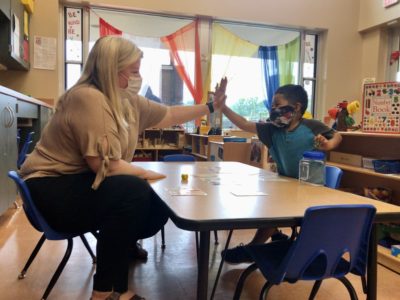
During their panel discussion, the working educators gave commission members insights into how financial assistance and certain policies play out in personal experience. They spoke of the importance of school principals, of teacher-to-teacher mentoring, and of connections to students’ families.
Tobin said he found an “alarming’’ lack of reading among his seventh graders. He partnered with another faculty member in a “teacher-coach collaboration’’ that resulted in his own initiative. He told his students, “We’re going to read a book, in class, every day.” When they completed a book, the class engaged in a “Socratic seminar,’’ run by the students who pose questions to draw insights from the book.
Odom recalled her key lesson learned from receiving a Kenan Fellowship for Teacher Leadership. As a Kenan fellow, she was assigned to spend three weeks at a biotech company.
“I had an epiphany at one point,’’ she said. “To prepare my students, it wasn’t all about the content.”
Such companies want potential employees with creativity and critical thinking, with collaboration and communication skills. Now she says she works on those skills with her students.
Wall told the commission members of her concern that the state’s recently enacted legislation on elementary reading has the side effect of placing a “stigma’’ on some third-grade students. The law prohibits a direct promotion to the fourth grade to those students who fall short of third-grade standards.
“What do we do with those kids?” Wall asked. Then Logan spoke out, “We need to look at a stronger system for supporting those students.”
The next Blue Ribbon Commission meeting, scheduled for July 27, will be a three-hour virtual session. It will involve, Braaten said, commission members deliberating in small-group breakout rooms, and include discussions of student advancement, teacher training, and accountability.
Commission sessions are livestreamed and links to video and online materials are here.