
Blue Ribbon Commission | Lessons for North Carolina in Mississippi’s education climb

Rachel Canter wants North Carolina legislators and education policymakers to know that Mississippi’s two-decade vault to the top in fourth grade test scores did not result solely from a literacy initiative with phonics at its core.
“Our story is bigger than literacy,’’ she said Monday in a video conference with the new North Carolina Blue Ribbon Commission on Public Education. The full story, she said, consists of “whole-cloth transformation.”
EdNC’s coverage of the Blue Ribbon Commission

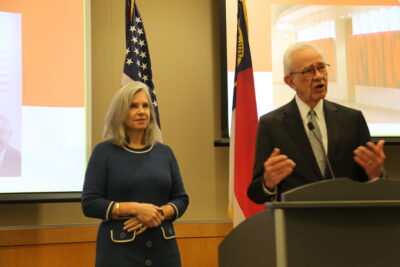
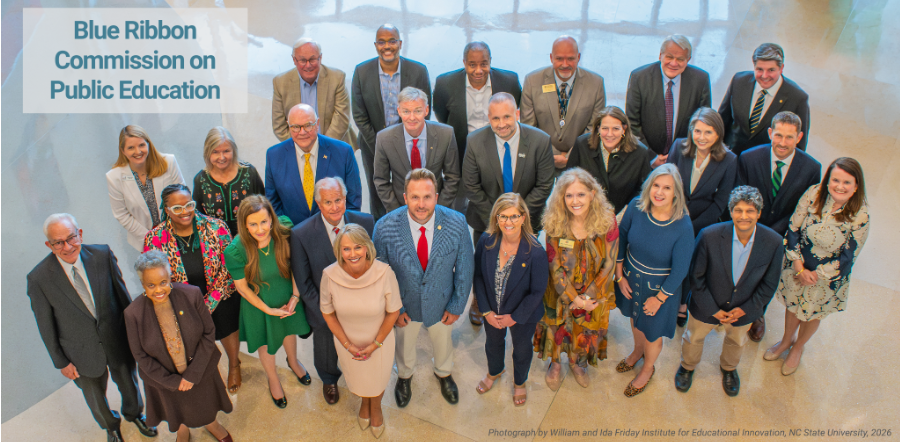
Canter spoke to the Blue Ribbon Commission at the second meeting since it was established jointly by Democratic Gov. Josh Stein and Republican House Speaker Destin Hall and Senate Leader Phil Berger. The commission has monthly meetings scheduled until February 2027 — thus its final findings will emerge into the legislative landscape configured by the 2026 elections.
After serving as a Teach for America volunteer in the Mississippi Delta, Canter founded and spent 17 years as executive director of Mississippi First, an advocacy organization that was a major force in the state’s education reforms. Now, she is director of education policy for the Washington-based Progressive Policy Institute, which recently published her 68-page paper, “Inside the Mississippi Marathon.”
“Many policymakers seem to have taken away the message that the science of reading, and particularly phonics, is the one silver bullet that all states should implement,” she writes. “To date, 40 states have adopted policies aimed at changing classroom instruction to align with these proven practices.”
“But this narrow understanding of Mississippi’s story is wrong, or at least very incomplete,” she added. “No one policy, and no one person, is responsible for our educational turnaround. It also didn’t happen overnight, or in a few years. Mississippi’s progress is neither a miracle nor a myth, as some skeptics have insisted; it’s been a two-decade marathon.”
In Canter’s assessment, the attention-grabbing national test scores of Mississippi fourth graders in 2024 came about as the product of four “policy pillars: 1. standards, testing, and accountability, 2. consequences for poor performance, 3. evidence-informed instructional policy, and 4. support for implementation.” (See Mississippi’s 2024 NAEP Results here.)
She described the state’s educational advancement as a “case study in collective leadership.” She urged lawmakers to refrain from “messaging bills.” Policymakers, she said, should “build a system, not a campaign.”
Mississippi’s plethora of small rural school districts required state guidance and a centralized literacy coaching process, she said.
Mississippi has 425,000 students in 137 public school districts, most of them rural. By contrast, North Carolina has 1.5 million students across 115 districts (and charters), mostly countywide. Both states face enrollment declines in public education.
 Sign up for the EdWeekly, a Friday roundup of the most important education news of the week.
Earlier in their meeting, commission members received briefings from staff of the North Carolina Department of Public Instruction (DPI). In their presentation, Cynthia Barber and Mary Derfel described the current status of the state’s early literacy policies. They pointed to gains in kindergarten and first grade, while second and third grades have hit “a plateau.”
“In North Carolina we learned lessons from Mississippi,” said Barber, who advocated for a literacy coach in every school as “a critical leverage point.”
Michael Maher, DPI’s chief accountability officer, presented the commission with a deep-dive power point analyzing state and federal requirements for assessing public school performance.
“North Carolina has a long history in accountability,” he said. “This is not new work.”
The State Board of Education has appointed a task force to recommend an accountability system to replace the current A-to-F grades attached to every school, with 80% of the grade based on test scores and 20% on year-to-year improvement, described as “growth.’’
Maher said North Carolina assigns more Ds and Fs to schools than peer states, and he argued that a better formula would identify schools that need intervention and support. His presentation set off a lively period of questions and comments indicating that the commission may decide to weigh in on the issue.
As the discussion wound up and speaking broadly of her aspirations for the commission, co-chair Anne Faircloth said, “We’re going to make real changes.”
According to the agenda, the meeting goals included:
- Establishing a clear picture of where N.C. students currently stand in reading and math;
- Examining how N.C. currently measures student progress and what lessons can be drawn from other states’ approaches to improving literacy, math, and student advancement; and
- Identifying priority questions and decision points to guide the commission’s first set of recommendations.
The Friday Institute for Educational Innovation is serving as the administrative lead and strategic research partner for the Blue Ribbon Commission. Here is the institute’s summary of the first meeting of the commission.