State Board of Community Colleges discusses projected impact of Propel NC, announces Boost expansion
Days after North Carolina Republican leaders announced an initial budget framework, the State Board of Community Colleges unveiled new estimates of the impact of its primary legislative request during its May meeting.
During the Board’s executive committee meeting on Thursday, Alex Fagg, the community college system’s vice president of government and external relations, discussed new projections for the benefits of funding Propel NC, the system’s proposed overhaul of its funding model.
 Sign up for Awake58, our newsletter on all things community college.
The new return-on-investment estimates come nearly a month into the General Assembly’s short session, during which N.C. Community College System (NCCCS) officials are asking lawmakers for the third time since 2024 to fund their $93 million recurring request for Propel NC. The funding model would prioritize funding for high-wage, high-demand sectors.
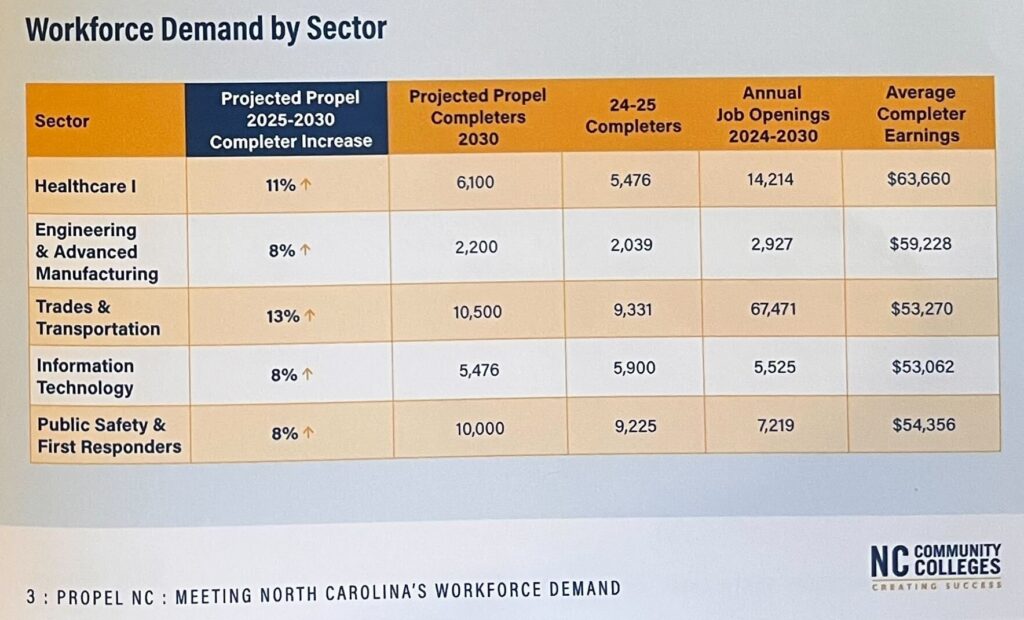
According to the new estimates, the number of students completing community college health care I programs in 2030 would increase 11% under Propel NC, compared to last year’s levels — around 600 more completers. For trades and transportation programs, the increase would be around 1,100 additional completers, or a 13% increase. Completion of programs in information technology, public safety & first responders, and engineering & advanced manufacturing would all go up 8%.
Fagg noted that, absent Propel NC being fully funded, $18.5 million to create parity in funding between curriculum and continuing education courses would be “vitally important.”
House and Senate leaders announced an initial state budget agreement last Tuesday with a 3% raise for state employees, including community college employees. Fagg said the system’s other legislative priorities are actively being discussed during the budgeting process — including Propel NC, funding for apprenticeships, and the system’s largest-ever funding request to cover enrollment growth.
Read more about community colleges’ legislative requests

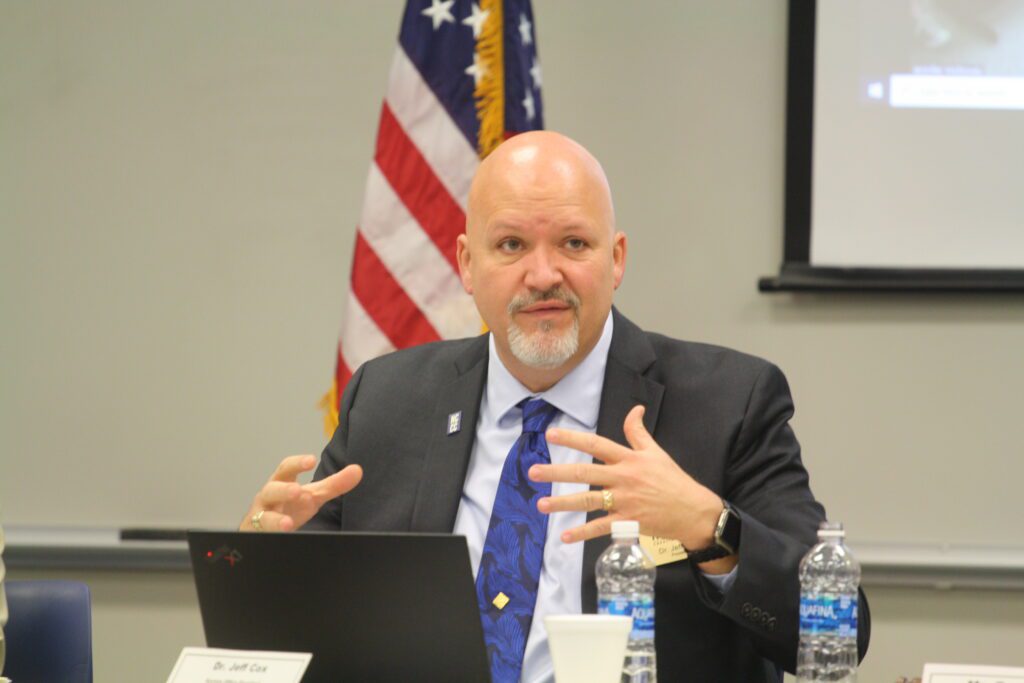
Last week’s meeting was also possibly Jeff Cox’s final one as president of the system ahead of his June 30 retirement. Board members repeatedly thanked Cox for his three-year tenure and three-decade career in education. Near the end of the meeting, Cox was inducted into the Order of the Long Leaf Pine, the highest award for service to the state granted by the governor’s office.
The search for Cox’s successor has been ongoing since he announced his retirement nine months ago. The Board voted last week to approve Bill Carver as interim president, as most candidates considered for the permanent role said their earliest start date could be Sept. 1, according to Board Chair Tom Looney.
“Bill Carver has proven himself more than capable in this role, and we are fortunate to have someone of his experience and dedication available to lead the System during this transition. We are confident in his ability to keep the work moving forward while we conduct a thorough search for our next permanent president,” Looney said in a press release. “On behalf of the Board, I also want to thank Jeff Cox for his years of service to North Carolina’s students and communities.”
Boost expansion
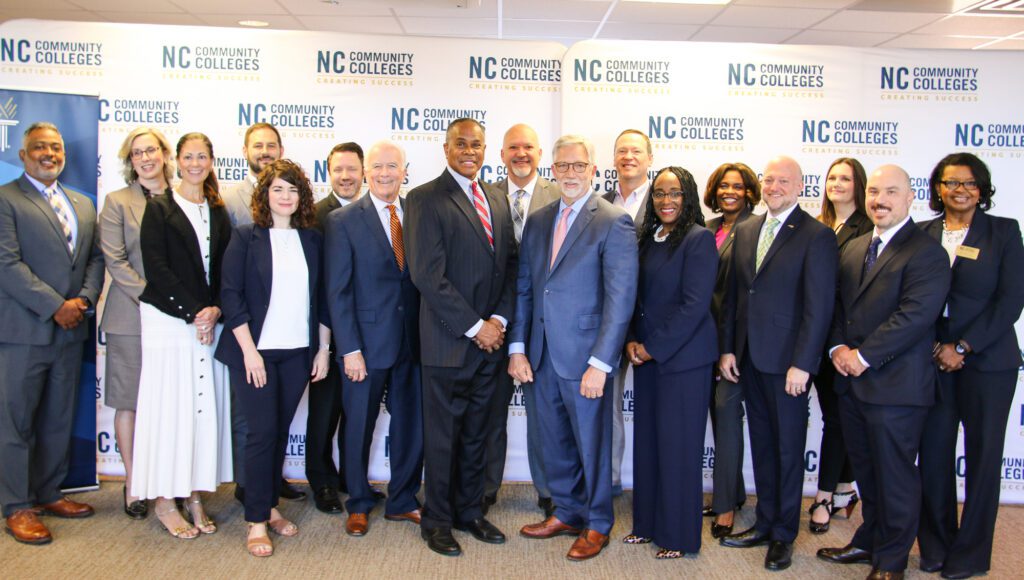
On Friday, Cox also announced two $3 million donations to expand Boost, a statewide initiative designed to help more students graduate and enter high-wage, high-demand careers. Students in Boost meet frequently with a dedicated adviser, receive financial support, and have access to additional wraparound services. The program is currently available at eight colleges, with seven additional colleges launching the program this fall.
The William R. Kenan Jr. Charitable Trust’s $3 million investment will make Boost available to around 450 students in health care programs at Wake Technical Community College. The college’s president, Scott Ralls, said the expansion will support the college’s efforts to grow its health sciences programs and integrate with its advising model based on job sectors.
“It’s a monumental step today for Wake Tech and our students, but also the future of North Carolina’s health care workforce and models that will support growing the health care workforce across the North Carolina Community College System,” Ralls said.
AmeriHealth Caritas North Carolina announced the second $3 million investment to launch the Bridge initiative, an adaptation of the Boost model for students pursuing short-term health care credentials.
Heidi Chan, market president for AmeriHealth Caritas North Carolina, said many students in these programs are not eligible for Pell Grants and will not be eligible for the upcoming Workforce Pell Grants, limiting the ability of federal financial aid to shrink the state’s ongoing health care workforce shortage. Starting as a pilot program at three colleges, the investment will “bridge” the gap for up to 1,000 students in high-demand, short-term health care tracks.
“This investment will provide flexible, last-dollar, if you will, supports to these students,” Chan said. “We aren’t just paying for books. We’re helping to cover the life expenses that could derail a student’s path to graduation and the high-demand, high-earning job potential that is waiting for them.”
In a press release, the system said the “combined $6 million counts directly toward the NC Community Colleges Foundation’s $75 million Soar campaign, which has raised more than $60 million to date in support of student success and system growth.”
The system is expected to release a Request for Proposals this fall to select the three colleges that will launch the AmeriHealth Caritas Bridge pilot, according to the release.
Read more on Boost

Three-year degrees
On Thursday, the Board’s executive committee also discussed how the system should respond to the UNC System’s early work exploring the creation of three-year bachelor’s degrees.
The News & Observer reported earlier this month that 11 member institutions have submitted pitches for these accelerated degrees, and the UNC System will review these proposals in the next few weeks. Selected pitches would receive $20,000 planning grants, which would be required to “prepare graduates for direct entry into the workforce” as required by the Southern Association of Colleges and Schools Commission on Colleges, the UNC System’s accreditor.
Sarah West, chair of the Board’s programs committee, said these degrees could have “significant implications” for the community college system, including a potential realignment of its transfer pathways and a renewed conversation on the role of community colleges.
Several committee members expressed skepticism about the value of the proposed degrees, with some urging restraint in the system’s response.
“There’s no market demand for it, there’s no utility for it, there’s no identify for it — it’s brand new,” said Dale McInnis, chair of the Board’s strategic planning committee. “I think we need to be very careful and cautious about investing time in energy into a product, the utility of which, and commercial value of which, would be totally undefined.”
However, McInnis also raised concerns about the market for three-year degrees — and how it could overlap with the community college system’s market.
“They’re going after the same market from a slightly different angle with a different product that no one recognizes yet,” he said. “But let’s not overreach and let’s not overreact.”
Cox said he told UNC System President Peter Hans that the community college system should be included in conversations about these new degrees.
“We’ve got to have that seat at the table and be aware of and involved in that conversation,” Cox said. “We don’t need to get too far ahead or too excited, but we certainly need to have a seat at the table.”
Among the proposals sent to the UNC System, two mentioned community colleges: Winston-Salem State University proposed a three-way collaboration with Forsyth Technical Community College and the Education Design Lab, a national nonprofit. Appalachian State University would only make its three-year degrees available to students transferring from a community college.
A potential systemwide CRM
The system has released a Request for Information from potential vendors to implement a cloud-based Customer Relationship Management (CRM) system across all 58 colleges.
A February survey revealed colleges’ frustrations implementing CRMs to their full potential due to staffing and capacity issues, as well as significant differences in CRMs’ functionality, contract terms, and costs — which ranged from $30,000 to over $100,000.
The move to a systemwide CRM would support a unified approach to recruitment, enrollment, and student engagement, according to a document from the Board’s transformation committee. The committee will make a recommendation to the Board in July.
Access to Achievement
The Board also heard a report on Access to Achievement, the state’s Intellectual and Developmental Disabilities (IDD) workforce training program. The program offers intensive support services to help students with IDD earn credentials, gain employment skills, and access the full college experience.
According to the report, colleges have achieved that through peer mentorship opportunities, tutoring services, inclusive campus events, accessibility technology training, internships, and partnerships with employers and workforce agencies.
Fiscal year 2025-26 was the program’s second full year of implementation across 15 colleges, following a two-year pilot program at Catawba Valley Community College and Brunswick Community College.
In its two years, the program’s coordinators have supported 871 students, the report says, who have completed nearly 90% of their courses successfully. More than 300 students have earned a credential.
“These are students who’ve had trouble typically throughout their academic careers, so these are pretty startlingly good statistics,” said Nancye Gaj, the program’s state director.
Gaj also said that her team has met with 400 different community partners, sponsored 200 events, and held more than 100 high school visits to promote the program.
“This isn’t just about getting a certificate or a degree. This is about establishing someone’s path to an independent, meaningful, productive life,” said West.
The Board also approved a $2.9 million allocation to the 15 colleges in the program — which West said could grow to 25 colleges under Senate Bill 991. That bill passed the Senate Education committee unanimously on Wednesday.
Performance measures report
The Board also approved the 2026 Performance Measures for Student Success Report, the system’s major accountability document and the basis for colleges’ performance funding. The report evaluates colleges across seven metrics, including English and math course completion, first-year progression, curriculum completion, licensure pass rates, basic skills progress, and transfer performance.
Colleges fall in one of five tiers based on standard deviations. The state’s baseline is two standard deviations below the average, while “excellence” is achieved at one standard deviation above average.
According to the report, five colleges achieved excellence across five of the seven measures: Central Piedmont, Wayne, Catawba Valley, Johnston, and Caldwell community colleges.
Bill Schneider, vice president of system effectiveness, said curriculum completion has continued to increase steadily, largely driven by an increase in dual-enrollment students.
Six-year completion rates are measured nationwide and can be used to compare colleges across states, Schneider said. North Carolina’s rate has been around 45% for the past three cohorts, five percentage points ahead of the national rate, but behind Georgia, Kentucky, and Virginia.
The Board reviews and refines these measures every three years. The next vote on revised metrics will be in June or July 2027.
Amanda Lee, president of Bladen Community College, expressed interest in refining some of these measures. But she said colleges have made significant progress using data to drive decision-making.
Schneider discussed the challenges that come from having most metrics unavailable until many years after the fact and the lack of flexibility in the measures.
“One of our big challenges is that we’ve been kind of boxed into these measures a little bit. So every single change we make to a measure needs to be statutorily changed and included,” Schneider said. If given more flexibility in statute, “we can kind of think about: What does the future of state performance measures looks like with that flexibility?”
Other business updates
Allocations
The Board approved allocations requested by its finance committee, including:
- $1.5 million for Finish-Line Grants — emergency grants of $1,000 per semester or $2,000 per year for students to help cover “costs such as transportation, childcare or dependent care, housing assistance, utility bills (including internet), and medical needs (including accommodations for individuals with disabilities).”
- $1 million to continue funding the Short-Term Workforce Development Grant Program. The program offers $750 per course for North Carolina students enrolled in short-term, noncredit workforce training programs.
- A six-month extension of previously awarded American Rescue Plan-funded health care workforce grants through December. As of March 31, colleges had spent $4.6 million of the $20 million initially allocated, according to the allocation request.
New course approvals
The Board approved a set of new micro-credential courses designed by AdvanceNC, a collaborative initiative of community colleges, state universities, and local workforce development boards, that can be used by other colleges. West said the courses will fast-track and solidify workforce pathways and will be strong candidates for Workforce Pell Grants — though they must operate for one year before becoming eligible applicants for these grants.
Separately, seven of the 29 community colleges approved as educator preparation programs received Cox’s approval to offer additional licensure areas, listed here.
“This is huge for us as a system to continue to build pathways for teacher licensure,” West said.
Innovators-in-Residence Network
The Board approved a request for $40,800 in State Board Reserve funds to launch Innovators in Residence, a professional development program for colleges to learn from each other on topics related to innovation and artificial intelligence.
“This program will elevate college successes across a variety of contexts and support colleges in documenting, piloting, testing, refining, and scaling replicable practices related to AI-enabled teaching, learning, onboarding, advising, curriculum redesign, and student momentum strategies,” according to the funding request.
The State Board of Community Colleges does not typically meet during the month of June, but Looney has indicated that the Board may vote to approve a candidate for system president on June 19.