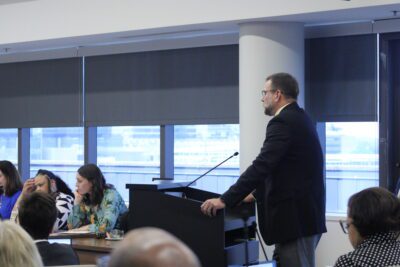
During the State Board of Education’s meeting on Thursday, Board members discussed updated data showing how many recipients of private school vouchers previously attended public schools in North Carolina.
According to the new report, 12,252 of North Carolina’s 106,704 Opportunity Scholarship recipients attended public schools prior to receiving a voucher — nearly 11.5% of voucher recipients. The analysis looks at prior public school enrollees who first received the scholarship the fall and spring of the 2024-25 school year, along with fall 2025-26.
This year’s report shows a slightly larger percentage of prior public school students receiving vouchers than last year’s report, which showed 8.4% of total voucher recipients were found to have previously attended public schools.
In both reports, the Department of Public Instruction (DPI) data suggests that most new voucher recipients were already attending private schools.
 Sign up for the EdWeekly, a Friday roundup of the most important education news of the week.
In 2023, the Republican-led General Assembly expanded funding for private school vouchers through the Opportunity Scholarship program, removed income eligibility requirements, and stopped requiring new recipients to have previously attended public school. At the time, DPI predicted that most recipients of the newly expanded Opportunity Scholarships would be students who were already attending private schools, based on trends in other states and waitlists at North Carolina private schools.
As part of the voucher expansion, DPI is now tasked annually with “reporting the cumulative financial difference between the Opportunity Scholarship grant amount awarded to students who previously attended public schools and the average State per-pupil allocation for students enrolled in public school units,” according to a DPI presentation.
Rob Dietrich, DPI’s senior director of enterprise data and reporting, said on Thursday that prior public school enrollees are defined as “students who received an Opportunity Scholarship beginning in 24-25 school year, who enroll in any public school for the majority of either their first or second month (of the school year prior) to receiving the scholarship.”
Below is a look at prior public school enrollees who received vouchers. EdNC previously reported that during the entire 2024-25 school year (not just the fall), public school prior enrollees made up 6,710 of the total 80,325 Opportunity Scholarship awardees.
In a statement to EdNC, authors of the report said the difference in 2024-25 numbers listed in this year’s report “may be because some of the students from last year left the opportunity scholarship program. We only counted those who were still receiving the opportunity scholarship.” The DPI team is still looking into the discrepancy.
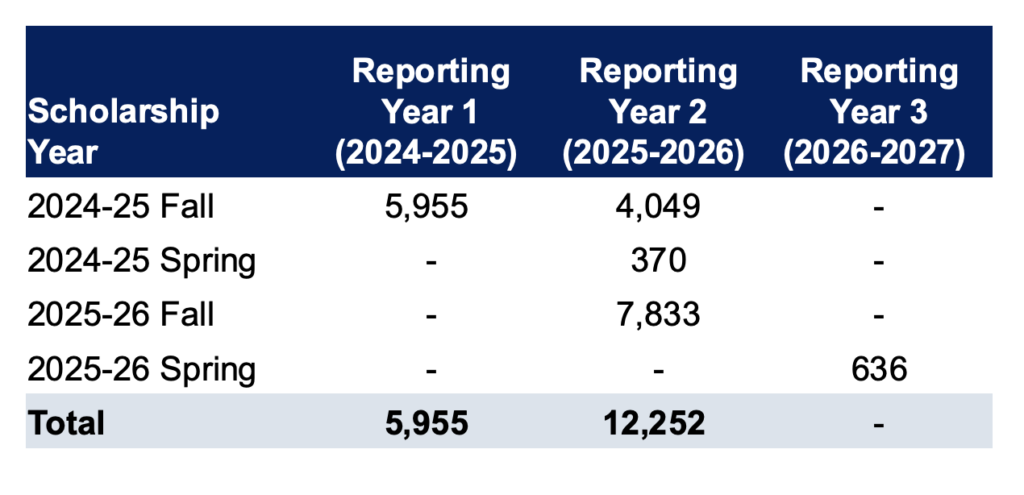
The report says there were also 1,554 students in 2025-26 spring cohort, “of which 636 were found in public school enrollment in the fall of 2025-26.” Those 636 students were excluded from the analysis, the report says, as “their fiscal impact will occur in the subsequent fiscal year, 2026-2027.”
The report was developed by using a North Carolina State Education Assistance Authority (NCSEAA) dataset on scholarship data, along with NCSEAA-provided student demographic and address information that DPI “used to match recipients to prior public school enrollment records,” per the presentation. The NCSEAA is the state agency designated by law to administer K-12 scholarship programs, including Opportunity Scholarships and Education Student Accounts.
The DPI report also analyzes the differences between the voucher funds awarded and the average state per-pupil allocation for students enrolled in public school units. In 2025-26, the maximum voucher amount was $7,686. Only students in Tier 1 were offered that full voucher amount, with maximum scholarships decreasing for higher tiers.
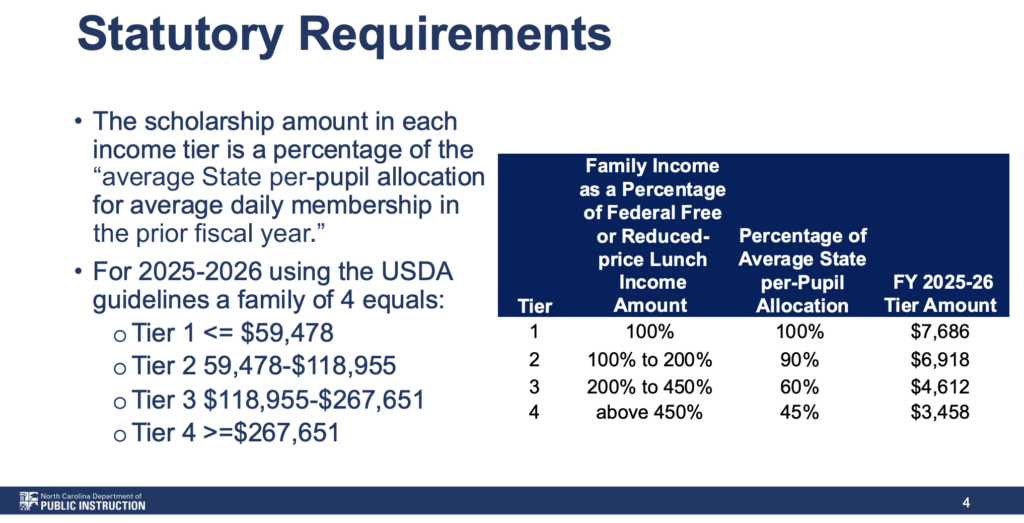
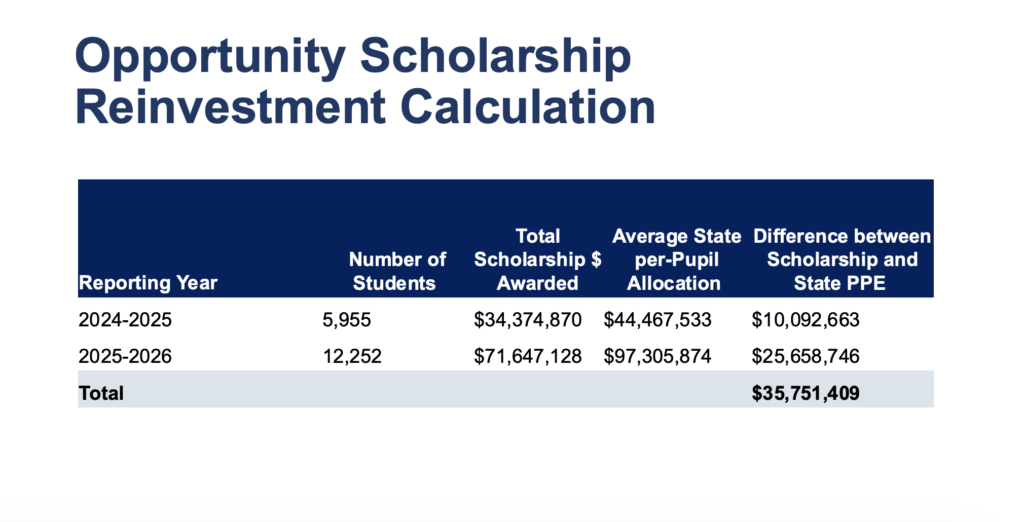
The 2023 budget said it is “the intent of the General Assembly to reinvest in the public schools any savings realized by the State each year, beginning in the 2025-2026 school year,” when a student from a public school accepts an Opportunity Scholarship amount less than 100% of the state’s per-pupil allocation.
According to the presentation, “the total cumulative financial amount needed for reinvestment in FY 2026-27 is $35,751,409.” That number includes the savings from both the 2024-25 and 2025-26 reporting years.
“The language in the in the law says that is their intent to create a public school reinvestment fund and to put the funds from that are identified in this report into that fund,” said Amanda Fratrik, DPI’s director of school business services.
“As of now, there has been no money that has been” put in such a fund, she said.
According to DPI’s report, most prior public school enrollees were in elementary school (50.4%). Approximately 32.3% were in middle grades, and 17.3% were in high school. Only 0.4% were in kindergarten.
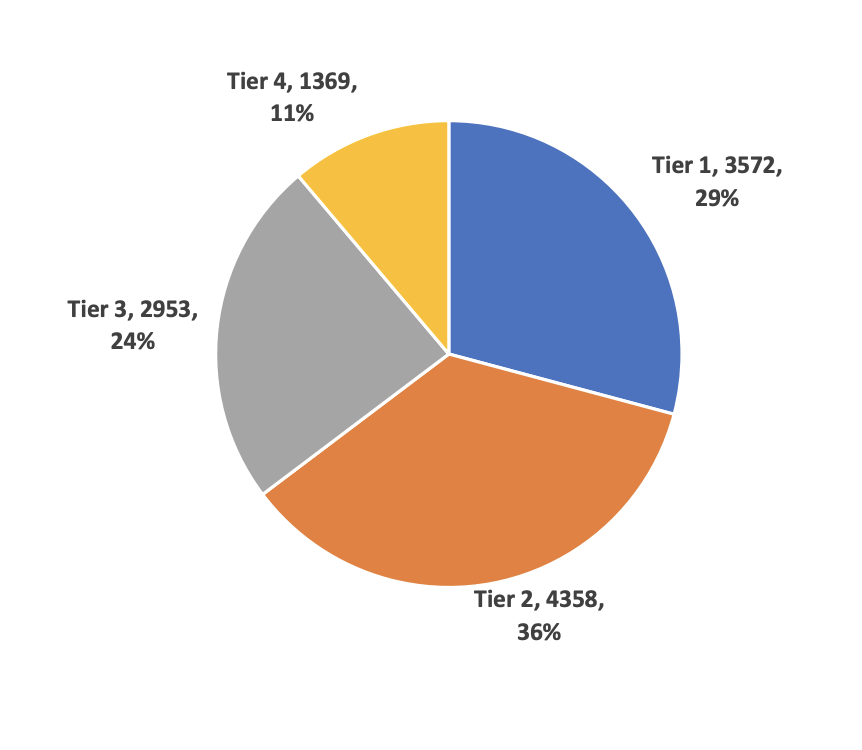
Of prior public school enrollees receiving vouchers, the largest proportion — 36% — received Tier 2 awards, or $6,918.
Prior enrollee recipients were residents of 99 counties, though 50.6% came from 10 counties (Wake, Mecklenburg, Cumberland, Guilford, Forsyth, Union, Cabarrus, Onslow, Pitt, and Durham).
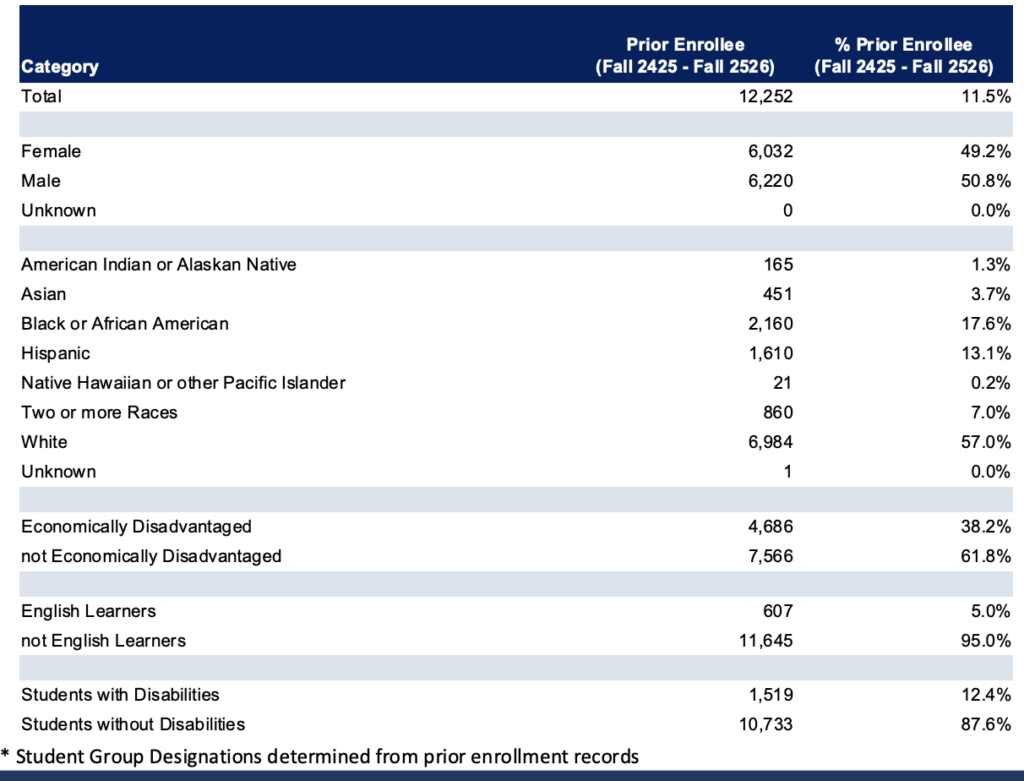
You can see demographic data about prior public school students in the table below.
The Board will vote on the report at its meeting next month, ahead of the report’s June 15 due date to the General Assembly.
You can read the full report here.

Recommended reading