
Report finds nearly $18 billion in facility needs for NC public schools for 2027-2031

Every five years, state law requires that local boards of education submit their long-range plans for “meeting school facility needs” to the State Board of Education. The reports are then aggregated by the N.C. Department of Public Instruction (DPI) into a statewide summary, which is submitted to the General Assembly to shape their decisions regarding fiscal allocations in the state budget to potentially meet these school needs.
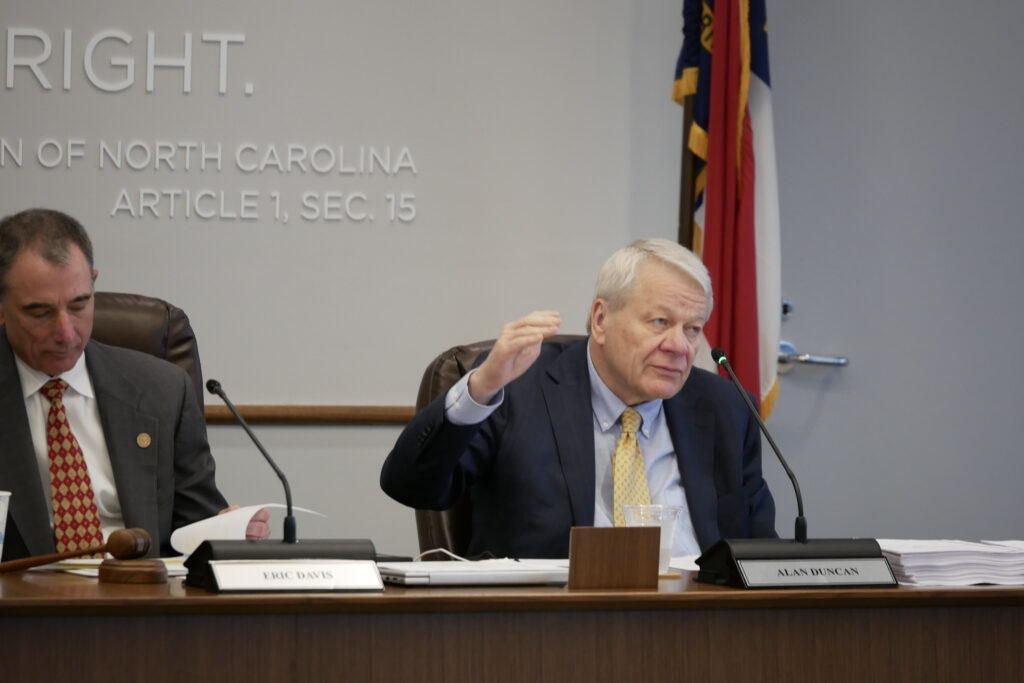
During its November meeting this week, the Board heard a presentation on the 2025-26 Statewide Facility Needs (FNS) Report. The report identified $17.96 billion in facility needs for fiscal year (FY) 2027-2031, which is a more than $5 billion increase from the needs identified in the last report for FY 2022-2026. Board Vice Chair Alan Duncan said funding for public schools is at a “very critical point.”
“The needs increased from $13 billion to $18 billion, and they’re going up fast,” Duncan said after the presentation on Wednesday. “Also the construction industry costs have gone way up, and we talk about inflation with technology — well construction is very much in that competition.”
 Sign up for the EdWeekly, a Friday roundup of the most important education news of the week.
The report captures both five- and 10-year facility needs, with all 115 local school systems self-reporting their projected costs related to new construction, additions, major repairs to education facilities, and renovations. The report is partially based on the following existing data:
- Existing schools by district (2,451 schools)
- Current average daily membership (ADM) by school
- Existing building data (as previously reported)
There were several other estimate calculation factors that districts were asked to consider, which Nathan Manune, DPI director of the Office of School Facilities, said were “key to this survey.” For instance, K-12 space programming guidelines provide guidance for the construction of a facility based on how many students it will serve, and there are also classroom capacity requirements. Both standards have cost implications.
Furthermore, districts were asked to reflect on existing school construction cost data as well as other cost calculation factors. The goal of the survey is to capture future facility needs estimates with the greatest accuracy. However, not every cost can be predicted.
“We cannot anticipate future market variations and volatility, whether they be tariffs or availability of certain materials,” said Manune. “We asked respondents to consider cost escalation if this project is four or five years away versus one year away.”
You can explore the full DPI presentation on the 2025-26 Facility Needs Survey below.
Identified needs and planned projects
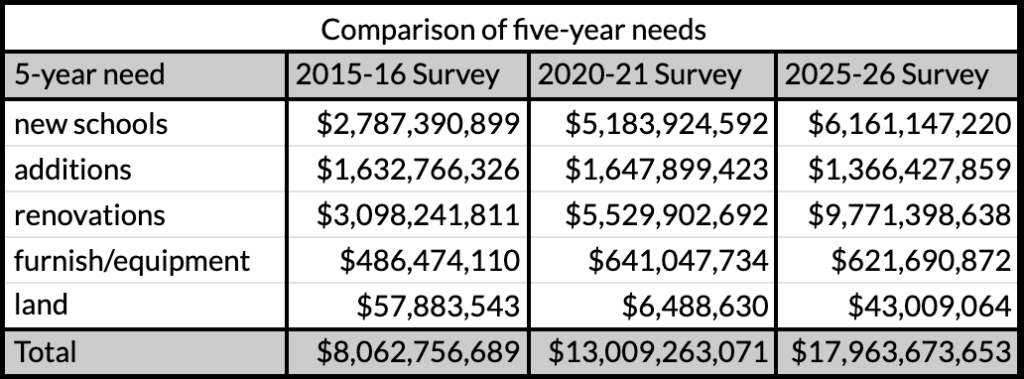
Over the last 10 years, estimated costs for facility needs have increased significantly — by over $10 billion. Renovation costs have almost doubled since the 2020-21 survey, while all other measures, except for additions and land, have increased, as well.
Currently, the 2026 baseline cost estimates $350 per square foot for new facilities, which is a $100 increase from the 2021 report’s cost estimate. For FY 2027-31, construction is planned for 88 new schools across 56 districts, which is estimated to serve up to 65,559 students.
There are additional projects planned at 127 schools. Renovation projects are planned at 1,416 schools across 93 districts, reflecting about 81% of all state school districts.
According to the report, 54% of the facility needs identified came from renovations to existing school facilities, which is 76% higher than reported in the prior report. The chart below shows how facility needs cost estimates have changed over the last decade.
During the presentation, Manune said that 49% of all school buildings are over 40 years old, and 29% are over 60 years old. After the presentation, Duncan identified the age of school facilities as one of the potential reasons that renovation costs make up such a substantial portion of the needs survey.
Seventeen school districts were identified as having the greatest fiscal need regarding their facilities over the next five years. See the chart below.
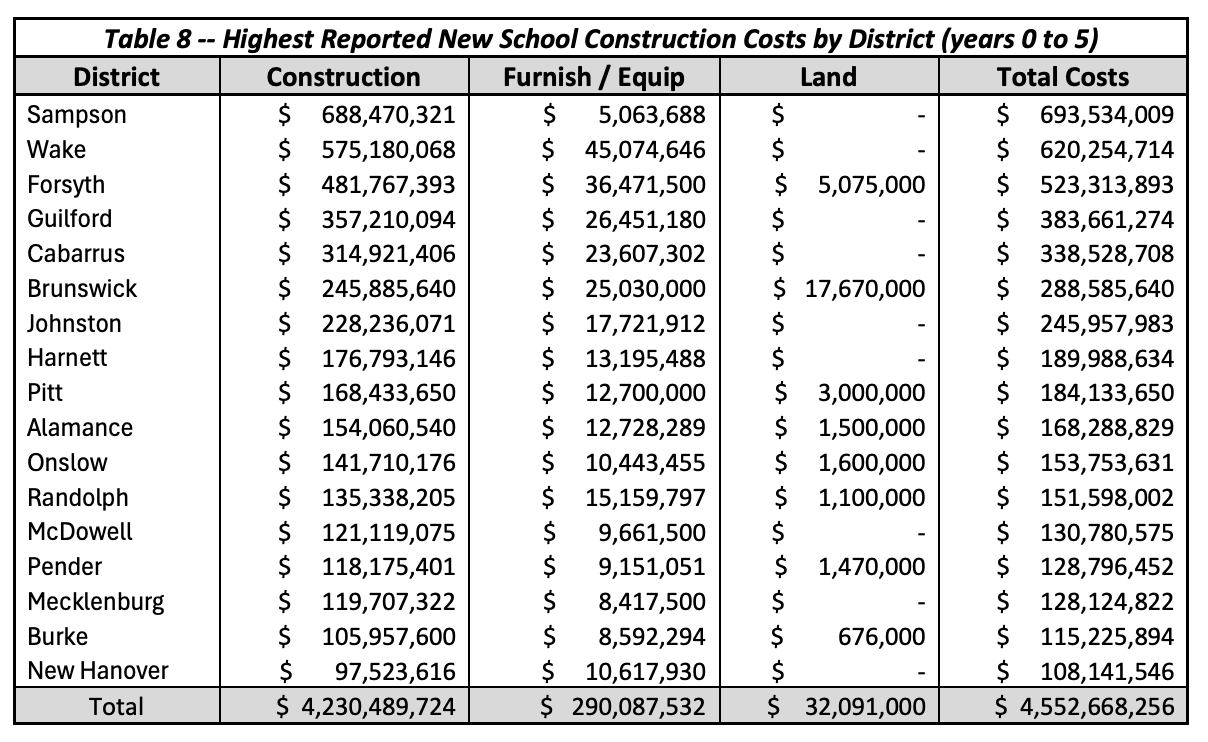
Overall, there was a 37.47% increase in facility cost estimates in the 2025-26 report from the 2020-21 report. At the end of the presentation, Duncan reflected on the sheer amount of funding needs identified by schools in North Carolina, raising concerns over the possibility of the state truly meeting those needs.
“When we see $18 billion for this five-year plan,” said Duncan, “I don’t see us cutting into that number very much, and I think it’s going to go up a lot more in the next five years, particularly with these construction costs.”
However, he said it is the state’s “responsibility under our constitution” to meet that need, covering school’s operating costs.
Read more


Funding sources for school facilities
Between 2022 and 2026, there were four main sources of funding for school facility needs, according to the presentation:
- Public School Building Capital Fund (PSBCF)
- Needs-Based Public School Capital Fund (NBPSCF)
- Public School Building Repair & Renovation Fund (PSBRRF)
- Local bonds for school construction
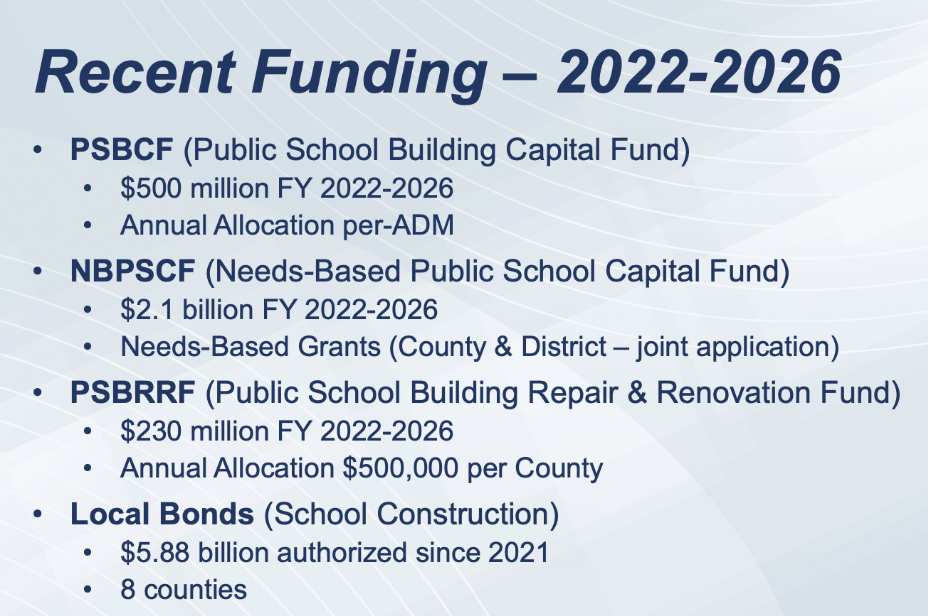
The highest amount of funding came from local school bonds, totaling $5.88 billion since 2021. As EdNC has previously reported, school bonds can be a solution to the high cost of school building maintenance and construction. However, school bonds between 2022 and 2026 only came in eight counties, which Duncan said is a serious issue.
“So that’s 92 counties that have not done that — either because they don’t have the wherewithal, which is true for most of those counties, or the will, which is probably true for very few of those counties. There is a real issue of where the money is going to come from,” said Duncan.
Furthermore, North Carolinians had the opportunity to vote on three constitutional amendments during the 2026 general election on Tuesday. One of those amendments would require “limits on property tax increases by local governments.” Unofficial voting results from the N.C. State Board of Elections indicate that the amendment passed, with 60.43% for, 39.57% against. Duncan said the passage of this amendment will make passing bonds even harder.
“The ability of property taxes to increase may be limited, which could then limit the amount of money when you’re trying to do a bond that could be available for construction costs,” said Duncan.
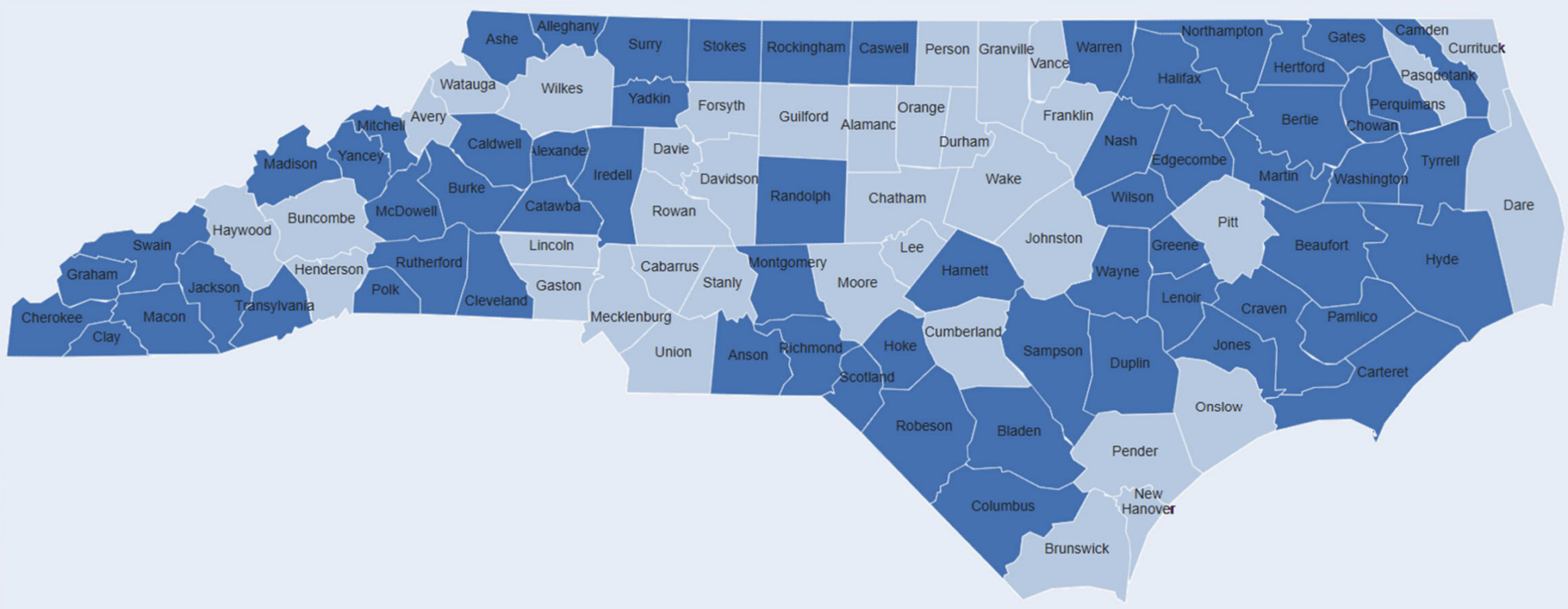
The next greatest source of funding came from the Needs-Based Public School Capital Fund, with $2.1 billion going to schools from 2022 to 2026. According to the presentation, over nine grant cycles from 2018-2026, NBPSCF grants provided funding for 62 counties across all regions of the state. See the map below.
The Public School Building Capital Fund provided $500 million in an annual allocation based on a school’s ADM, per the presentation, and the Public School Building Repair & Renovation Fund annually allocated $500,000 per county. See the full breakdown of funding from the presentation in the slide below.
Future legislative requests
The Board heard about two “key capital funding requests” that DPI and the Board have put forward as a legislative request previously and will put forward to the General Assembly once again in the upcoming long session.
For the NBPSCF, they will request an increase of $117 million to the annual appropriation, for a total of $400 million. For the PSBRRF, they will request an increase of $25 million to the annual appropriation, which would bring the total to $75 million.
Earlier in their meeting on Wednesday, Board members discussed their legislative priorities for the upcoming 2027 long session. After hearing the costs identified in the FNS, Duncan told members to consider how the report should affect their advocacy because many counties cannot afford the funds necessary to meet facility needs.
“This Board, as we saw earlier from the (legislative agenda) presentation, has very significant, genuine needs on behalf of our students and school districts around the state for additional funds,” said Duncan. “School districts have needed that funding and need a lot more.”
He also highlighted research that supports the importance of a safe learning environment to effective instructional practice, emphasizing that providing these funds for facility needs is a critical part of the state’s duty to the education of its youth.
“If we’re truly focused on giving a sound public education to our students — that includes a safe and nurturing learning environment,” said Duncan.
The Board will vote on the report next month at its December meeting for submission to the General Assembly.