
Start with equity: Strengthening North Carolina’s early childhood system for the next 40 years

Editor’s note: This article, along with this one by Amy Rhyne, will be considered by state and national philanthropists at a conference in North Carolina on Oct. 28-30, 2026, held by the Early Childhood Funders Collaborative.
North Carolina is celebrated for its national leadership in building an early childhood system, but celebration alone is not enough. A system that has been influential for nearly four decades must now be judged not only by the programs it created, but also by whether those programs have equitably improved access, experiences, and outcomes for the children, families, communities, and workforce most affected by inequity.
Impactful early childhood systems must start with equity. For North Carolina, this means moving beyond a narrow focus on service availability or average outcomes and asking whether the system has repaired inequities in access, quality, experience, and opportunity for children, families, and communities who have been historically underserved. Equity requires acknowledging how historical and ongoing injustices have harmed particular people and communities and continue to shape the conditions in which children and families live, learn, and thrive.
As North Carolina reflects on nearly 40 years of early childhood system building, strengthening the system for the next 40 years must involve both repair and redesign: repairing past injustices and redesigning policies, investments, and accountability structures, so they produce a more just future.
This work requires centering the needs, strengths, knowledge, and aspirations of children, families, and communities most likely to be underserved, harmed, or made vulnerable by existing policies and practices. It also requires asking who has benefited from system investments, who has been excluded, and whose leadership and expertise have been overlooked.
 Sign up for Early Bird, our newsletter on all things early childhood.
Findings from my research illustrate why an equity-centered approach is essential. Across access, experiences, and outcomes children encountered different opportunities and constraints.
Black children experienced lower classroom quality across all measured domains, despite greater exposure to positive pedagogical practices. Latine children experienced significant teacher-child racial mismatches and more punitive disciplinary approaches, while also benefiting from stronger program-level supports. Both Black and Latine children had limited access to special education services. Dual-language learners experienced more positive learning practices and stronger teacher-family alignment, even though they had significantly lower rates of teacher-child racial and language matching.
These patterns show that equity is multidimensional: Progress in one area does not necessarily eliminate disparities in another, and a system cannot be called equitable by focusing on a single indicator. Comprehensive equity implementation at both structural and individual levels is necessary to support children’s development and learning.
For North Carolina, these findings point to the need for equity measures that attend to enrollment, special education access, teacher-child racial and linguistic match, family partnership, classroom quality, and disciplinary approaches, as well as workforce compensation, curriculum, child assessment, and funding distribution.
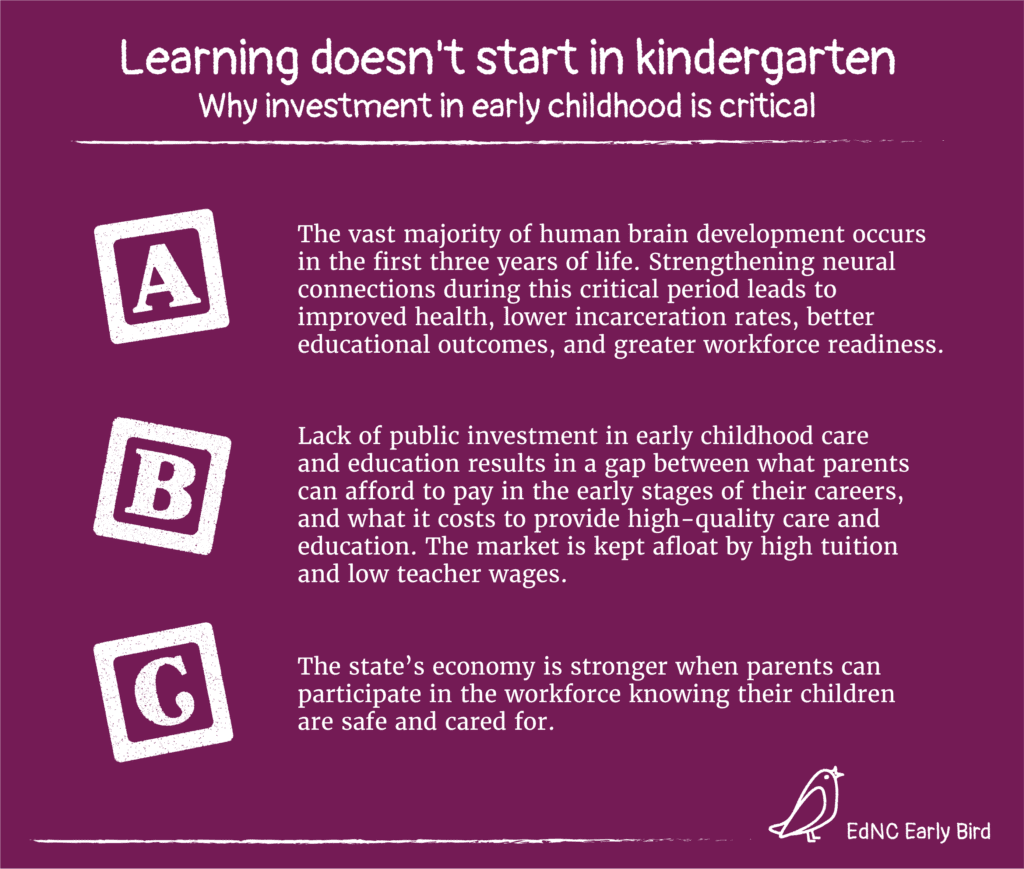
A commitment to equity must also include the early childhood workforce. During enslavement, Black women were forced to provide caregiving, childrearing, and educational labor within systems that denied their own families’ safety, autonomy, and freedom. In the periods that followed, and across contemporary informal care settings, Black and Brown women have continued to serve as essential caregivers, educators, and community supports. Yet this labor has often been unrecognized, underappreciated, underpaid, and excluded from formal definitions of expertise and professional contribution.
The early childhood system continues to depend on the labor of women whose work is often treated as natural, private, or limitless rather than as skilled and essential. In doing so, institutions and systems extract their economic, emotional, cognitive, spiritual, and aspirational labor without providing the compensation, stability, benefits, protection, respect, and care they need.
Strengthening the system therefore requires more than workforce recruitment. It requires a workforce justice agenda that repairs the conditions that have historically devalued care work by investing in living wages, benefits, paid leave, mental health supports, professional learning, career advancement, safe working conditions, and accessible pathways to credentials and leadership. It also means recognizing the expertise of family, friend, neighbor, family childcare, and informal caregivers rather than building policies that erase or penalize the ways communities have long cared for children.
Workforce development must be accompanied by diverse leadership and meaningful family partnership. Leaders who reflect the racial, cultural, and linguistic diversity of the children and families they serve bring essential knowledge about community strengths, historical experiences, and unmet needs. Family-centered approaches must move beyond inviting families to participate in programs; they must share power with families in setting priorities, shaping services, and defining what quality and success should mean.
They must also ensure that families have the conditions necessary to make meaningful choices, including economic stability, access to healthcare, housing security, reliable transportation, safe neighborhoods, strong social networks, and supportive communities. Without these foundations, the formal availability of early care and education does not necessarily create real opportunity or choice.
More EdNC coverage of early childcare


North Carolina should understand early care and education as essential infrastructure for the future: infrastructure that supports child development, family well-being, workforce participation, maternal, family, and child health, housing stability, transportation access, and community development.
Early childhood systems cannot promote child flourishing in isolation from the conditions surrounding children, families, and the workforce that supports them. If we want children to flourish, families, communities, and the caregivers and educators who sustain them must also have the resources, relationships, security, and opportunities necessary to flourish.
The next 40 years of system building should be guided by healing, shared power, and justice. This means using disaggregated data to identify inequities in access, experiences, and outcomes across all system levels; investing in historically marginalized communities; elevating family and community expertise; honoring and fairly compensating the workforce; and designing systems around both the assets and needs of those most affected.
It also means refusing to reproduce the extraction of care from Black and Brown women while calling the system equitable and sustainable. North Carolina has already shown that it can build early childhood infrastructure; the next challenge is to ensure that the infrastructure is just.
Child flourishing is community-rooted, relational, and justice-oriented. Starting with equity means not only improving early care and education, but also transforming the broader conditions and valuing the people who make flourishing possible. For North Carolina, the measure of the next 40 years will be whether the state can build a system in which children, families, communities, and the early childhood workforce flourish together.