
Pre-K access in North Carolina below the national average, and drops in national rankings

North Carolina now ranks 32nd nationwide in preschool access for four-year-olds, according to the National Institute for Early Education Research’s (NIEER) 2025 State of Preschool Yearbook, dropping four positions from last year.
The report finds that North Carolina Pre-K served 26,707 children, or 21% of the state’s 4-year-olds, and did not serve 3-year-olds. These amounts are below the national average of 37% of 4-year-olds and 9% of 3-year-olds, the report found.
 Sign up for Early Bird, our newsletter on all things early childhood.
The state also ranked 27th in spending per child after spending $98,840,868 and $68,186,143 in Temporary Assistance for Needy Families (TANF) funds. Spending per child also dropped $995 from 2023-24, equaling $6,254 in 2024-25.
That amount of total spending represents a 16% drop — nearly $31 million after adjusting for inflation — since last year, the report found. This was the second largest drop in funding after Arizona, where funding dropped 48%, according to the report.
“North Carolina Pre-K has lost its place as a leader in preschool with the state dropping in pre-k access rankings as other states catapult ahead,” said Dr. W. Steven Barnett, NIEER’s senior director and founder, in a press release. “Georgia, by contrast, has a universal preschool program that newly meets all 10 of our research-based quality standards, showing that quality preschool can be expanded at scale.”
Currently, 44 states and Washington, D.C. fund preschool programs, most of which serve four-year-olds — reaching 1.8 million children nationwide through a historically high investment of $14.4 billion from states.
Enrollment grew by 44,000 students nationwide, though more than half of that — more than 25,000 children — came from California.
Twenty-eight states grew their spending compared to the year before, totaling a $434 million increase — about 3% after adjusting for inflation, the report says. When federal and local contributions are included, overall spending nationwide reached nearly $17.7 billion.
However, the report’s authors found that increases were more modest than the previous year, and access still varies dramatically across states.
“Not every state moved forward,” the report says. “Some states even lost ground. If providing high-quality preschool education to all 3- and 4-year-olds were a race, some states are nearing the finish line, others have stumbled and fallen behind, and a few have yet to leave the starting line.”
Allison Friedman-Krauss, the report’s lead author, highlighted that beyond access, states must also focus on the quality of every child’s preschool experience.
“Only high-quality early care and education programs support children’s development enough to result in lasting academic and other gains that ultimately deliver savings for taxpayers,” Friedman-Krauss said in the release.
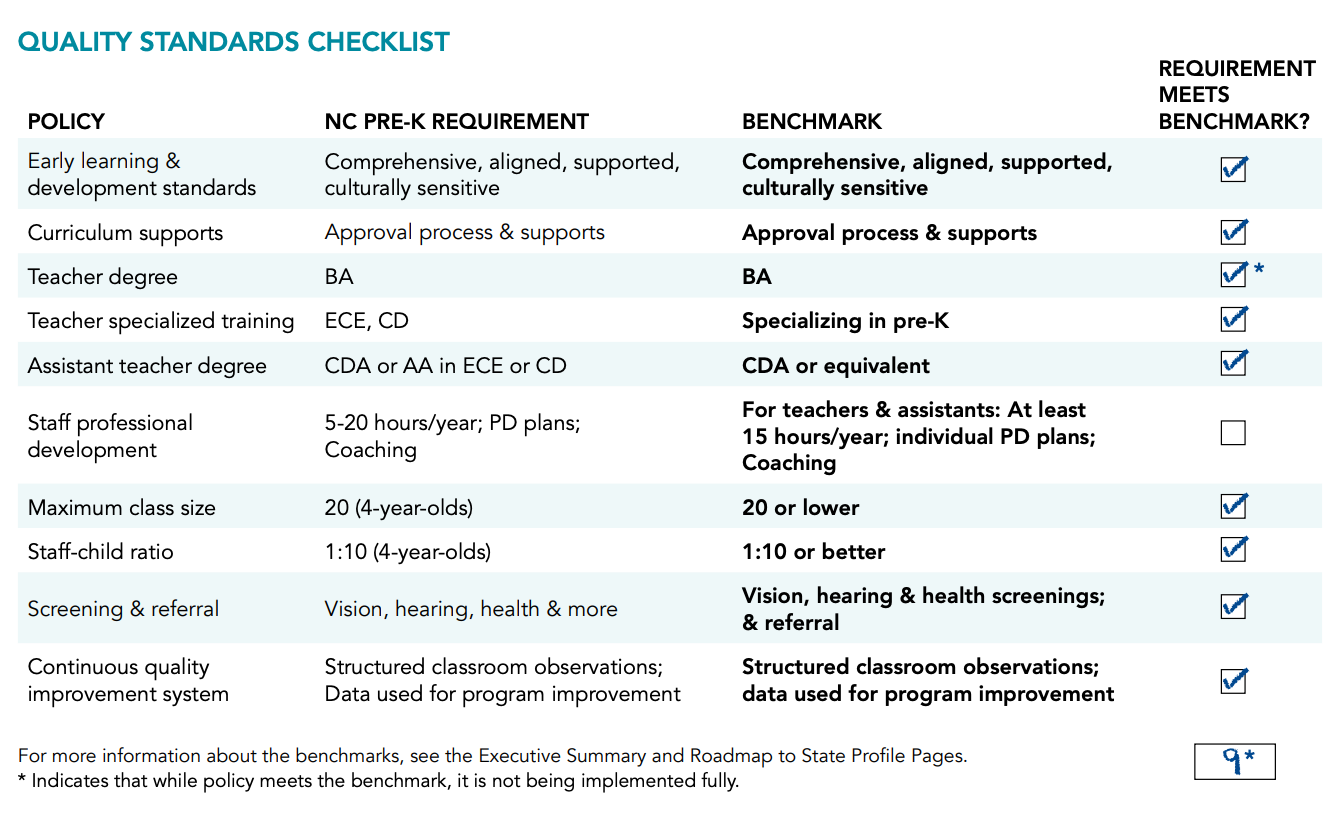
North Carolina met nine of the 10 quality benchmarks recommended by NIEER. These include indicators such as teacher qualifications, class sizes, early learning standards, and curriculum support. See the checklist below for more details on these benchmarks.
Georgia’s publicly funded pre-K program for 4-year-olds became the largest state-funded preschool program in the nation and the first universal program to meet all 10 quality benchmarks recommended by NIEER, the release said.
Only five other states met all 10 benchmarks — Alabama, Hawaii, Michigan, Mississippi, and Rhode Island.