
Perspective | The policy that forced a North Carolina Principal of the Year to take an $8,000 pay cut

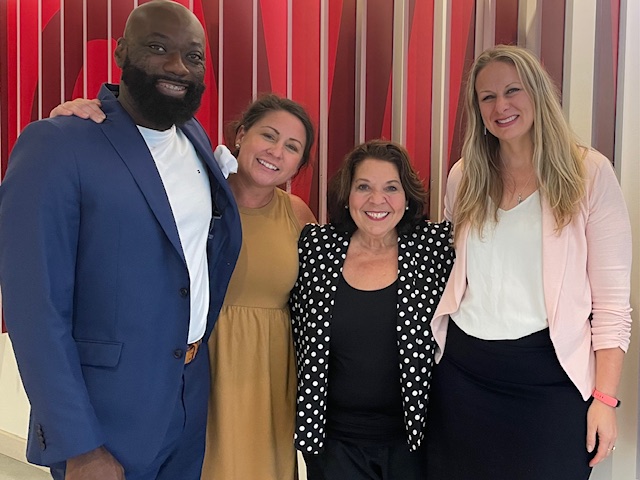
What I am about to share is personal — but it’s not unique. It is the result of a system affecting school leaders like me all across North Carolina.
To be honest, I am deeply ashamed to write this. But it is a bigger shame that North Carolina even has a pay policy that does harm to principals like me.
In early January, the name of the Chief Human Resource Officer lit up my phone. I believe most principals will agree that you always answer that call. As we began our conversation, I jokingly made the same comment to him. He kindly laughed; we checked in on how we were doing, then he launched into the reason why he was calling: to inform me that I would be facing a $700 per month salary cut, effective immediately.
My heart dropped. Tears came to my eyes.
He told me the reasoning was that my school Did Not Meet “expected growth” for two years in a row. My brain crashed into itself trying to recall the data. I knew he was right, but why had I not realized this back in September when the scores were released? How had I not better prepared myself?
A school in transition
It is true. In the 2023-24 school year, my former school Did Not Meet school accountability growth. It was a challenging year for our school. Half of our staff was new to their positions. With 34 certified staff members, this was significant. Our student population also saw a gradual shift in socioeconomic status, which, of course, required us to adapt. But considering our staff capacity going into that school year, this became doubly challenging.
At the end of that year, we saw our EOG data, and we knew growth scores were going to be different from those in the past. In September 2024, we received a school performance grade of 71 (B), which came with a growth index score of -8.77. Educators know this is not good. Ironically, we were also named by the U.S. News World & Report as one of the ten best middle schools in the state of North Carolina. In our 2024 North Carolina Teacher Working Conditions Survey, 95.83% of our staff said, “Overall, my school is a good place to work and learn.”
Before we even knew our growth scores, we knew we had to do some serious work going into the 2024-25 school year with a fresh sense of urgency. We reshaped our entire MTSS process and adjusted our instructional strategies for the better. Our staff worked SO hard! With the 2025 EOG scores, we saw improvements, and we were proud of our students and staff. We also received the National Showcase School Distinction from Capturing Kids’ Hearts, and we went into our second consecutive year of being a “Top 10” middle school in North Carolina.
In September 2025, we received our scores. Our growth index was -2.10, and our school performance grade was a 75 (B). Honestly, when I saw these scores, I was so proud and thrilled at going from a 71 to a 75 and -8.77 to -2.10. While I knew we did not Meet Expected Growth, we grew tremendously, albeit still in the negative. Absolutely none of this urgency for school improvement was motivated by self-interest or salary. I was focused on the hard work of our staff and students and digging ourselves out of that hole for the sake of student learning.
Related reads
The reality of policy
Then, in January 2026, this all came flooding back down to me as I tried to cover up my tears on the phone with my Chief Human Resources Officer.
This year, many principals across North Carolina experienced a salary cut similar in nature to my own.
Still, the shame overwhelmed me.
Adding insult to injury, this salary will remain in place for at least two years. Our school’s growth score will have to Meet Expectations or Exceed Expectations for 2 years in a row before a change will be reflected in my salary.
This is not a short-term blip. I need to live with this salary cut at least until January 2028, regardless of how well I or my school performs over the next two years. As a single mom with two sons — one who just started college — this pay cut hits home, literally. What bills or expenses can I pause or cancel or redirect? Are there additional income opportunities I can pursue? What does “enough” look like for my family right now? This principal pay plan has now done harm to my two children.
 Sign up for the EdDaily to start each weekday with the top education news.
Reputation as a leader
I have had the opportunity to teach school administrators across the state through organizations like the North Carolina Principals and Assistant Principals’ Association (NCPAPA) and the North Carolina Principal of the Year Network. As an instructor, I have consistently discussed how being the principal is a huge mantle of responsibility that no one fully understands until you are physically in that position. For years, I have also said that test scores are not the only thing that matters; that helping children be better humans matters even more. And now, I feel like I have been punched in the face by a law that I’ve known about for years, but never fully felt.
I know with certainty that I am a better principal now than I was a decade ago when I was North Carolina Principal of the Year, but I cannot shake the shame of being a Does Not Meet principal. While I know many principals across the state have felt this significant change in their salaries due to accountability growth scores, this just hit differently. Now, it is personal.
I am terrified to share this with you, my peers. Honestly, I wonder if you will look at my leadership differently. How can this law strip principals of over $8,000 — or in more extreme situations, up to $16,000 a year — because of growth scores?
Do those scores even reflect the whole truth about a school?
How did we even get to this?
Attempted reform
A decade ago, principals in North Carolina were the lowest paid in the nation. As a reform measure, our N.C. General Assembly raised principal pay significantly but also linked it to two factors: school size and school growth, as measured by EVAAS. A harmful consequence of this pay model is that principal salaries, like my own, can drop precipitously due to factors beyond my sole control.
Perhaps the most significant concern with the current salary model is how heavily it is influenced by geography and poverty. Schools in rural and high-poverty communities face structural challenges that extend well beyond the school walls. Recruiting and retaining high-quality teachers in these areas is often far more difficult than in more affluent or urban regions. These realities directly impact student outcomes, which in turn drive school growth measures — and ultimately, principal compensation. As a result, the model risks penalizing leaders working in the very contexts that demand the highest levels of school leadership.
Larger districts like Wake and Mecklenburg realize the fallibility of our current principal pay plan. Instead, they provide their principals with contracts that guarantee a fixed salary because they have the financial means to do so. Importantly, most districts in our state do not have the means to do this.
These issues get compounded by school choice options that did not exist when the current pay plan was created a decade ago, leaving us with a new problem. And, it’s significant. The plan does nothing to incentivize a school leader to come to or stay in areas that need strong leadership the most.
NCPAPA did a study and found a direct correlation between school growth status and economic status. The story is simple but not surprising: Schools with fewer economically disadvantaged students perform better in EVAAS-measured growth. Generally, this means these schools also have principals with higher salaries, while schools with greater need are less likely to compensate school leaders at the same rates.
So what would a reform model look like?
Alternative reforms
North Carolina needs a principal pay plan reflective of the challenges a school brings to the role and is stable enough to encourage lasting leadership. This means replacing the current scale based on school size and growth score with a model reflective of the unique characteristics of a school. Factors such as Economic Disadvantage, Exceptional Children’s populations, and Multilingual student populations create challenges that necessitate strong leadership.
The second reform would be to reduce the impact of accountability growth indexes to stabilize salaries so that principals see less dramatic swings in their paychecks. An even better plan would be to modernize the salary system so that it reflects the whole story of school, measuring outcomes well beyond student growth. Current efforts from North Carolina Association of School Administrators (NCASA), NCPAPA, and the NCPOY Network are trying to bring these reforms to the General Assembly to do just that.
I share this story not for sympathy but to call upon our legislators for change. The current principal pay model is not just flawed — it is inequitable, and it does harm to school leaders in communities that need them the most. I urge the North Carolina General Assembly to reform this system so that it values leadership in high need settings and compensates principals in a way that is fair, stable, and sustainable.
Now is the time to act for our General Assembly to act to solve this problem.