
Perspective | From books to college to life, how one educator motivates students

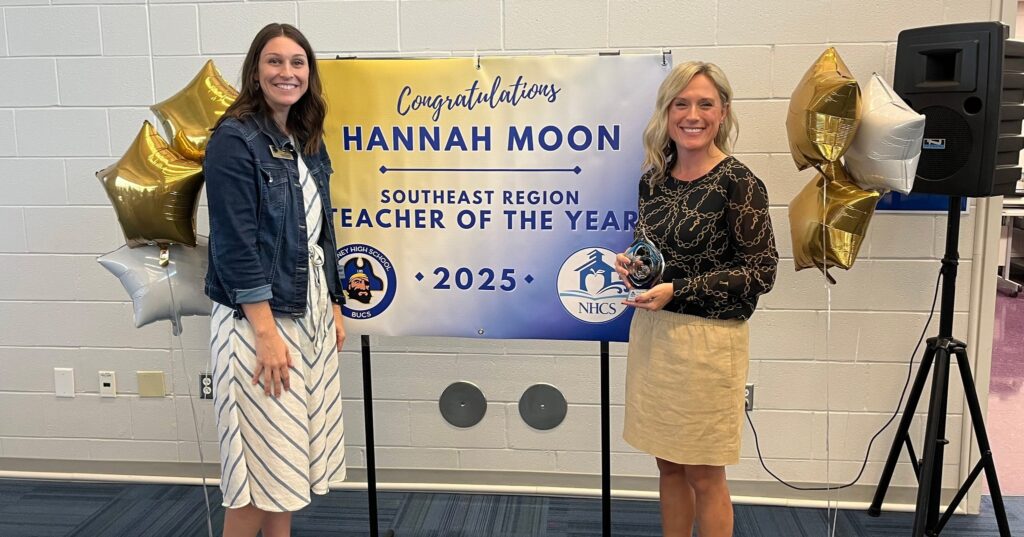
Hannah Moon is the kind of teacher who attracts students looking for an inviting place to hang out during free class periods. “Can I come sit in your classroom?” calls out a senior looking for refuge during a study period. “Of course,” Moon tells her. “We’re just talking today.”
Moon, who teaches English at Wilmington’s sprawling E.A. Laney High School, is big on getting her students to talk. In AP English Literature, she walks around with a stack of cards bearing each student’s name, shuffling them during the class period and calling on students at random. “You’ve really got to be paying attention,” one of her students tells me. “And you’ve got to know what you’re talking about.”
I visited Moon’s class earlier this month, a few days after students took the AP exam, to hear about their college plans, their career anxieties, and to get their view on what has made Moon an award-winning teacher and a student-favorite at Laney. Several of the AP students said they were persuaded to take the challenging, reading-intensive class because they trusted Moon to make it worthwhile.
 Sign up for the EdWeekly, a Friday roundup of the most important education news of the week.
“You can tell how much she cares about us,” says a senior girl who confessed to some reluctance about taking the course. “Some teachers, you can tell they’re just checking a box and they don’t really want to be there. Mrs. Moon forces us to learn because you don’t want to disappoint her.”
That personal approach to student motivation has worked well for Moon. Every one of the 30-plus students crowded into her AP Lit classroom are bound for a four-year college in the fall, aiming to study everything from international diplomacy to chemical engineering. “These are all ambitious kids,” Moon tells me before the start of class, the kind of high-achievers with crammed schedules and loads of extracurriculars.
During an hour-long discussion, it’s striking how much pressure and anxiety those students feel. Despite holding acceptance letters from Carolina, Wake Forest, NC State, or Elon, they’re worried about what’s happening with the job market and what kind of careers will be waiting on the far side of graduation. “What’s, like, the safest job from AI?” a boy in the back asks.
Several students are betting on health fields — nursing, exercise science, physical therapy — as a hedge against automation. A few ask whether public policy or law or political science will still be worthwhile, now that artificial intelligence can write research papers and policy briefs. I try to argue that no one knows for certain how the economy will evolve in the half-decade before they’re clocking into their first jobs, that our track record of predicting the future of the workforce is murky, at best. They do not find this reassuring.
The advice to study what they love — to use college as a time to explore and try out new interests — is also met with some skepticism. The pressure to get into a “good” college, to build the transcript and the resume strong enough to stand out in a sea of straight-A’s, has left much of the class with a restless fear that they have to keep hustling for the next rung. “There’s so much pressure to keep performing at the very top,” says a young woman wondering if she’ll have time to indulge her interest in performing arts. “It just takes away so much of the passion.”
Still, it’s clear that a good literature class can make room for the kind of deep wonder that education is meant to encourage. Several students mention how much they loved reading “Demon Copperhead,” Barbara Kingsolver’s Pulitzer-winning novel that pays homage to Charles Dickens with a story set in Appalachia.
“It was really long, but amazing,” says a senior girl. “I’ve thought about it all year.” Students recall a lively debate about “A Doll’s House,” and how much of Henrik Ibsen’s critique of gender roles still holds true. That prompts me to ask why AP Lit has almost 30 girls and only a handful of guys. “Boys don’t really like to read books,” offers one of the few young gentlemen in the classroom. “But I had Mrs. Moon for my earlier English class, and I really liked it.”
Motivating students to pick up a book and talk about it — to keep finding sparks of passion, even as they worry about resumes and job-eating robots — is what great English teachers do. As the literature class filed out and Moon’s next group of students settled in, a junior girl asked anxiously about her schedule for next year. “Realistically, should I take AP Lit?” she asked Mrs. Moon. “I’ve heard it’s hard, and I don’t want to get a B!”
Moon looked at her for a moment, eyebrows raised and a slight smile spreading across her face. “Can you read a book?” she asked. “Then you can take Lit!”