
NC’s math scores are increasing post-COVID, but reading growth trails behind, report shows


Editor’s note: This story was produced in collaboration with the Associated Press’ Education Reporting Network.
North Carolina students have experienced one of the fastest post-pandemic recoveries in math scores nationwide since 2022. Reading scores, however, have dropped since 2022 — and both scores remain below 2019 levels.
These results are part of the Education Scorecard, a collaboration between the Center for Education Policy Research at Harvard University and the Educational Opportunity Project at Stanford University, released last week. Researchers analyzed 2024-25 reading test scores from third to eighth grade in 35 states and math test scores in 38 states across more than 5,000 districts to create the scorecard.
 Sign up for the EdDaily to start each weekday with the top education news.
Nationwide, that analysis yielded worrying results for researchers. They warn that the U.S. has been experiencing a “learning recession” since 2013 — a crisis exacerbated by the pandemic.
That year, the researchers say, students’ reading improvements were “essentially zero,” and their math performance began to decline. And while math scores began their rebound in 2022, reading scores only began to improve last year. Between 2022 and 2025, only seven states and the District of Columbia saw growth in reading test scores, according to scorecard data.
“The pandemic was the mudslide that followed seven years of erosion in student achievement,” said Tom Kane, faculty director of the Center for Education Policy Research, in a press release.
The cause of the “recession” is still unclear. But researchers said in the release that the slowdown in student achievement coincided with the rise of social media use among young people and a drop in the use of test score-based accountability systems for schools.
You read the full report here.
Math recovery
North Carolina’s academic growth in math ranked ninth out of the 38 states in the analysis. Students are performing around one-third of a grade level better than in 2022, the data shows. Compared to 2019, though, math scores are .41 grade levels lower.
Data on both subjects from Halifax, Hertford, Hyde, Tyrrell, Warren, and Weldon City were not included in the scorecard’s analysis, according to data compiled by the Associated Press. Reading data for Graham County Schools and Thomasville City Schools is also not available.
At the district level, Northampton, Moore, and Johnston lead the state’s math score recovery since 2019, with 18 districts total surpassing 2019 levels.
Graham, Alleghany, and Swain have experienced the biggest drops in math test scores since 2019. For reference, Graham County Schools’ math achievement has dropped two grade levels relative to the 2019 national average.
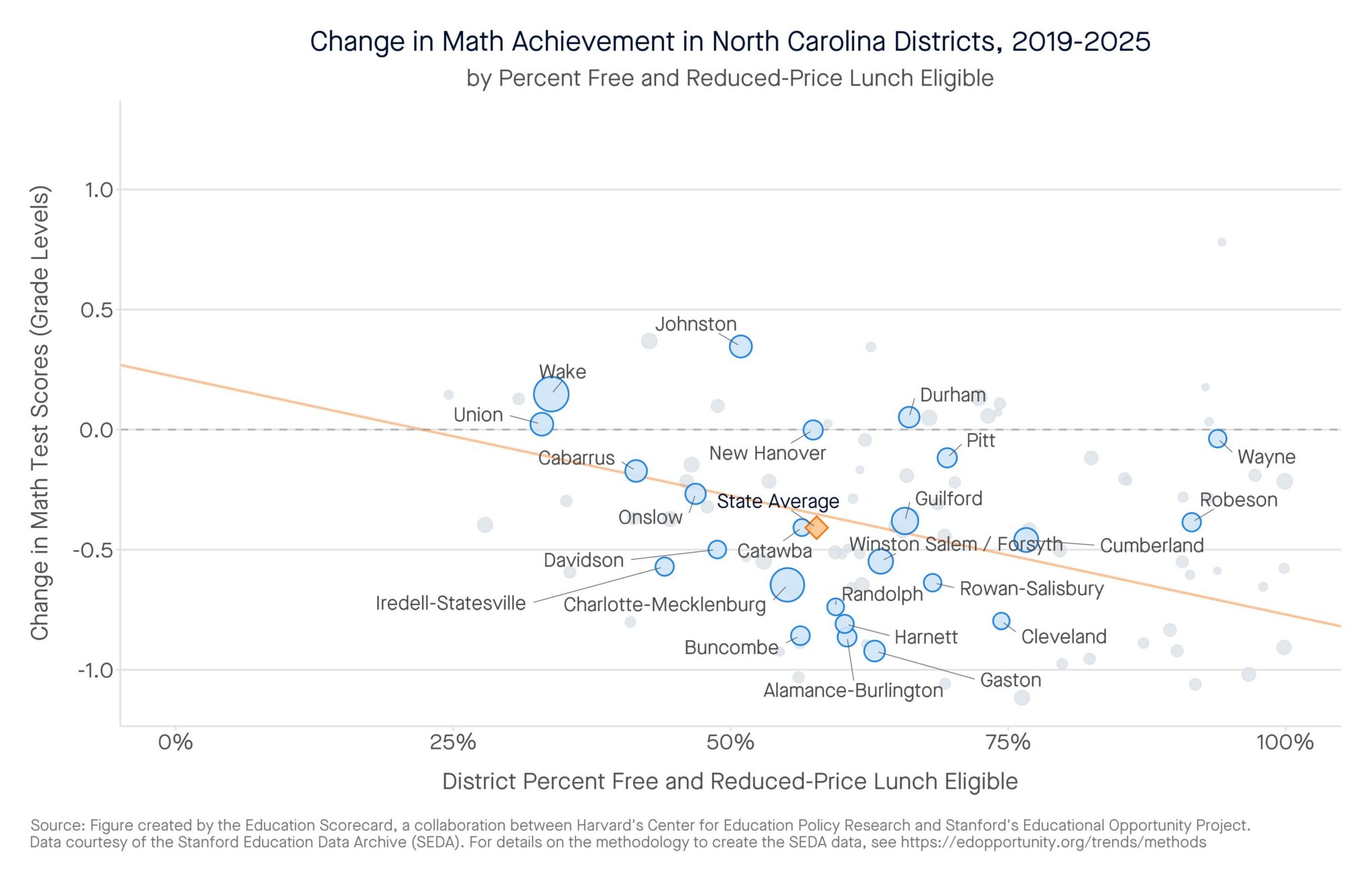
Since 2024, the Department of Public Instruction (DPI) has been working on rewriting the state’s math standards — the end goals for grades and mathematics courses. These changes align with workforce needs and give students greater choices, according to a DPI official speaking to the Joint Legislative Education Oversight Committee in April. The State Board of Education will vote on the standards this summer.
Separately, this short session, Senate Bill 1044, the “Foundational Mathematics Act,” was introduced and has passed through the Senate’s committee on education.
SB 1044, among other things, would require school districts to provide high-quality math instruction in grades K-8, would provide for math screening in those grades, and would require districts to implement math success plans for struggling students. The bill includes $21 million in recurring funds that would go to DPI to implement the requirements for districts.
Reading recovery
The state’s recovery in reading ranked 22nd out of 35 states between 2022 and 2025, according to scorecard data. Students are performing slightly below their 2022 level, and .69 grade levels below pre-pandemic levels.
Elkin City, Kannapolis City, and Asheboro City schools saw the worst changes in reading achievement since 2019, all three of which have reading test scores nearly two grade levels below the 2019 national average. Northampton, Johnston, and Clay have been the only North Carolina districts to show growth in reading scores relative to the 2019 national average.
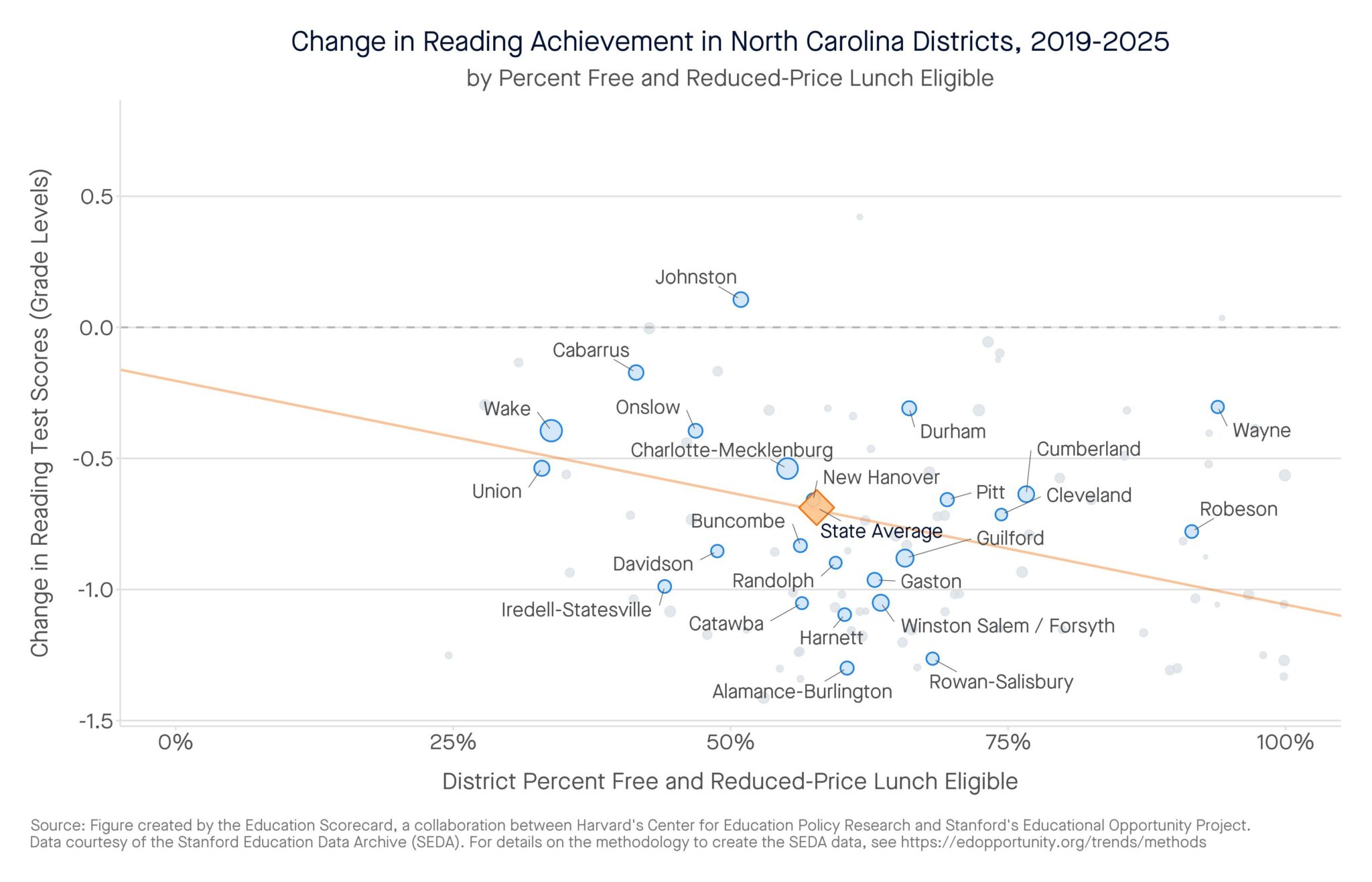
The researchers pointed to early-literacy reforms as a potential factor in reading score improvements. Every state that saw reading gains between 2022 and 2025 had adopted “science of reading” policies. And the opposite is true: States that did not pass literacy reforms by January 2024 failed to show reading improvement during that same period, researchers said. Still, those reforms might not be enough, as a handful of states that implemented some “science of reading” tactics did not see test scores go up.
North Carolina lawmakers updated the Excellent Public Schools Act in 2021 to require the use of the science of reading. This research-based approach emphasizes “the acquisition of language (phonology, syntax, semantics, morphology, and pragmatics), and skills of phonemic awareness, accurate and efficient work identification (fluency), spelling, vocabulary, and comprehension.”
Since then, kindergarten and first graders have shown promising initial results. Third graders saw gains in reading proficiency through 2024-25, when scores dropped from 49% to 47% on a standardized assessment.
Read more

Bright spots across the state
The scorecard also identified eight North Carolina “districts on the rise,” which saw higher growth rates than other districts across the state with similar demographics. Currituck, Onslow, and Moore county schools received this designation for their growth in reading achievement compared to similar districts, while Person and New Hanover stood out for their growth in math performance. Beaufort, Wayne, and Stanly stood out for their progress in both subjects compared to similar peers.
The scorecard specifically spotlighted Wayne County Public Schools (WCPS), featuring the strategies the district relied on to achieve its growth, including high-dosage tutoring, consistent discipline guidelines, and training on data-driven instruction tactics.
“WCPS is a District on the move,” said district Superintendent Marc Whichard. “We lead with intentionality and are serious about educational outcomes for our students. While we are proud of our achievements, we expect to continue to move the needle. Parents have choices about where to send their students to school. We intend for WCPS to be the system of choice.”
Chronic absenteeism and recovery trends
Researchers also analyzed the state’s chronic absenteeism — referring to students who missed more than 10% of a school year. In North Carolina, that rate has dropped from 32% in 2022 to around 25% in 2025. But that number is still almost 10 percentage points above pre-pandemic levels.
Some districts had chronic absenteeism rates that dwarfed the 2025 national average of 22.9%. More than 60 districts had rates above that number, with Vance and Northampton showing rates twice the national average.
The scorecard’s authors found that the country’s post-pandemic recovery has been U-shaped, with the most significant improvements occurring in the highest- and lowest-income districts. North Carolina followed this trend, with authors saying the gains in high-poverty districts were possible primarily due to the $5.60 billion in federal pandemic relief.
“Unfortunately, many middle-poverty districts (those with 30 to 70 percent of students receiving federal lunch subsidies) received little federal aid,” the North Carolina scorecard says. These districts “have seen the least improvement on average.”
The researchers called on the state to focus its attention — and dollars — on middle- and high-poverty districts now that COVID relief funding has ended.
Researchers also said the country is capable of making consistent academic gains, as it has been done before. From the early 1990s to the early 2010s, the scorecard press release says, math and reading skills “improved dramatically,” and racial disparities shrank.
“That shows that we can improve our public schools and equalize educational opportunity,” said Sean Reardon, faculty director of the Educational Opportunity Project in the press release. “But we haven’t been doing much of that for the last decade. It’s time now to make our public schools once again the engine of the American Dream.”
You can see all the Education Scorecard data here.