
Perspective | Aiding to leading? Pathways and outcomes for early-career teachers with teaching assistant experience


The start of the 2025-26 school year is here. Across North Carolina, districts and schools are working to ensure that each classroom is staffed with an effective educator. But how do we accomplish this, especially with waning interest in the teaching profession and elevated levels of teacher attrition?
An answer to this question is already part of the fabric of North Carolina’s schools: Teaching assistants (TAs). Each year, North Carolina public schools employ over 20,000 TAs. These individuals fill a range of key roles — like working with students with disabilities and leading small group instruction — that are vital to teacher and student success. In fulfilling these roles, TAs gain valuable knowledge and experience that may increase their interest in teaching and help prepare them for the rigors of teaching.
TAs may represent an important source of future teachers. However, we know little about the TA-to-teacher pipeline in North Carolina. To inform the recruitment and hiring decisions of state and local education officials, we used data from the North Carolina Department of Public Instruction to learn more about TAs that become teachers. In particular, we identified the number of TAs that become teachers, examined the characteristics of beginning teachers with TA experience, and assessed outcomes for beginning teachers with TA experience. Our four key takeaways show that former TAs are making positive contributions to teaching and learning in North Carolina.
 Sign up for the EdDaily to start each weekday with the top education news.
Finding 1: Individuals with TA experience already make up a meaningful percentage of beginning teachers
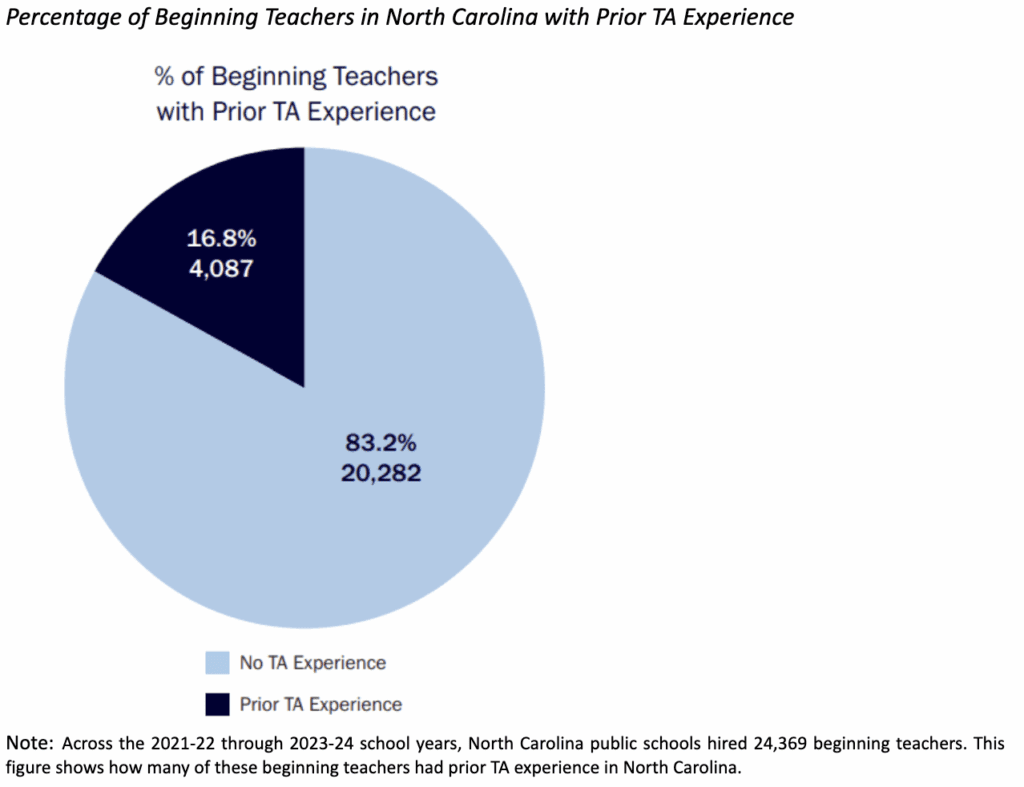
Over the 2021-22 through 2023-24 years, North Carolina public schools hired 24,000 beginning teachers. Nearly 17% of these beginning teachers — more than 4,000 in total — served as a TA in North Carolina before becoming a teacher. While this suggests that the TA-to-teacher pipeline is strong, there is more to learn, including how many TAs want to become teachers and the challenges faced by TAs in transitioning into teaching. It may be possible for districts and schools to strengthen this pipeline through more intentional recruitment and support practices.
Finding 2: Former TAs possess many characteristics valued by schools
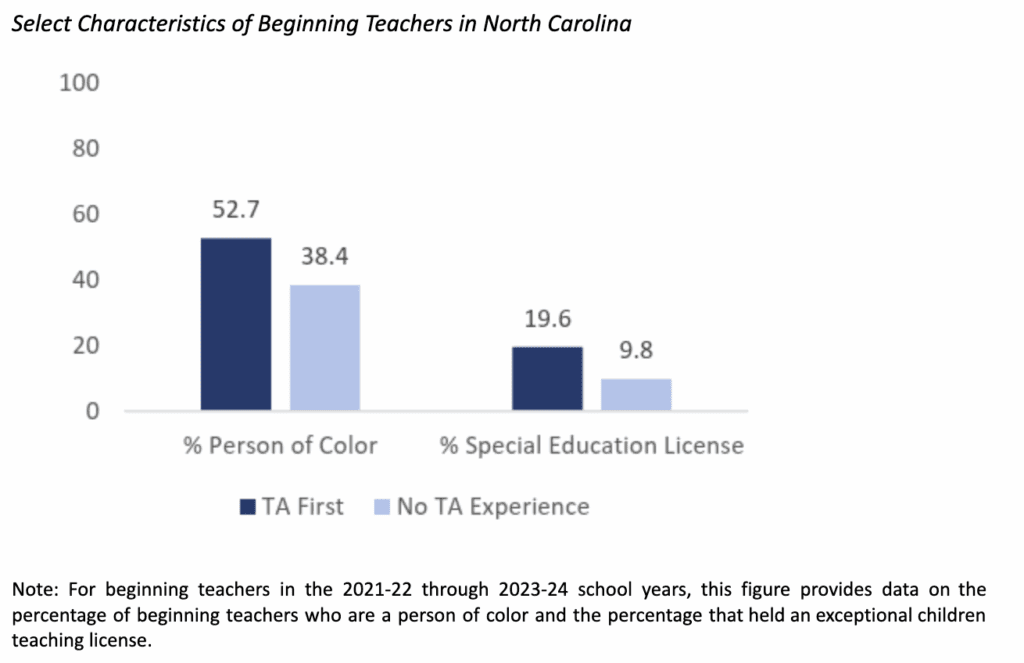
More than half of beginning teachers with TA experience are a person of color. This is a much higher percentage than for beginning teachers without TA experience and comparable to the percentage of K-12 students of color in North Carolina. Former TAs are helping to diversify the state’s teacher workforce. This is an important finding given the impacts of teachers of color on same-race students.
In addition, beginning teachers with TA experience are twice as likely to hold an exceptional children license and teach a higher percentage of students with disabilities. Former TAs are filling high-need positions in schools.
Finding 3: Beginning teachers with TA experience perform comparably to other beginning teachers
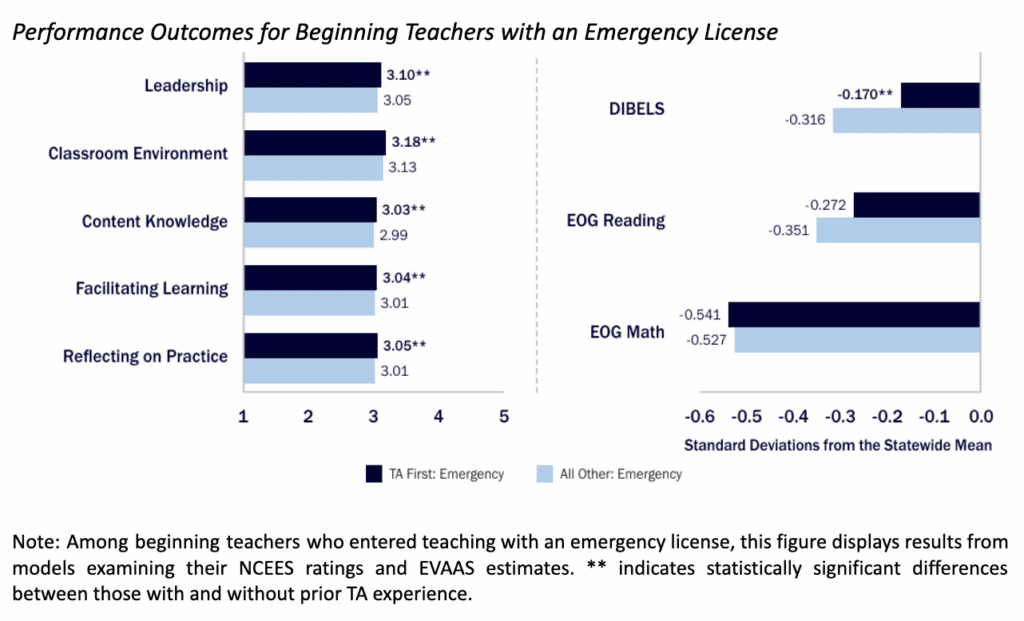
Relative to beginning teachers without TA experience, former TAs have similar NCEES (NC Educator Effectiveness System) ratings and EVAAS estimates. When we focused our analyses on beginning teachers with an emergency license — 38% of former TAs and 31% of all other beginning teachers entered teaching with an emergency license — we found that those with TA experience earned higher evaluation ratings and had higher EVAAS estimates in early grades reading (K-2 DIBELS). These results suggests that former TAs are an especially good option when schools make an emergency hire.
Finding 4: Former TAs have higher retention rates than other beginning teachers
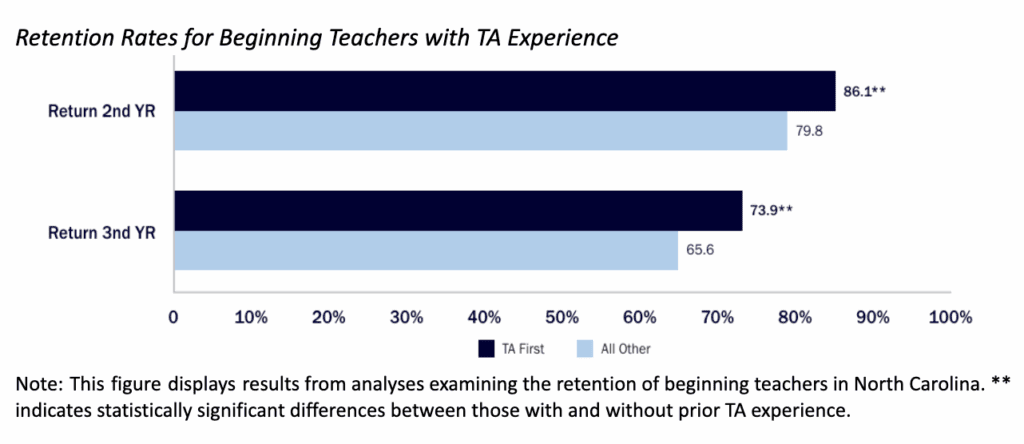
By the time they become teachers-of-record, former TAs have spent considerable time in K-12 classrooms. This may help them be better prepared and more committed to the teaching profession. Consistent with this hypothesis, we find that beginning teachers with TA experience are six percentage points more likely to return for a second year of teaching and eight percentage points more likely to return for a third year of teaching in the state.
If all first-year teachers had the same retention rates as former TAs, 1,300 more beginning teachers in the 2021-22 through 2023-24 entry cohorts would have remained in North Carolina for a second year of teaching.
Next steps
We recommend that districts view TAs as a valuable source of prospective teachers and strengthen the TA-to-teacher pipeline through the creation of registered apprenticeship programs and deeper partnerships with local teacher preparation programs.
For individuals thinking about becoming a teacher, working as a TA may be a beneficial “first stop” to more fully understand the day-to-day joys and challenges of public schools. Lastly, further research should assess ways to best recruit, prepare, and support TAs interested in teaching and use these findings to inform state and local education officials.