
Morehead City’s mayor reflects on reentry, rehabilitation, and the future

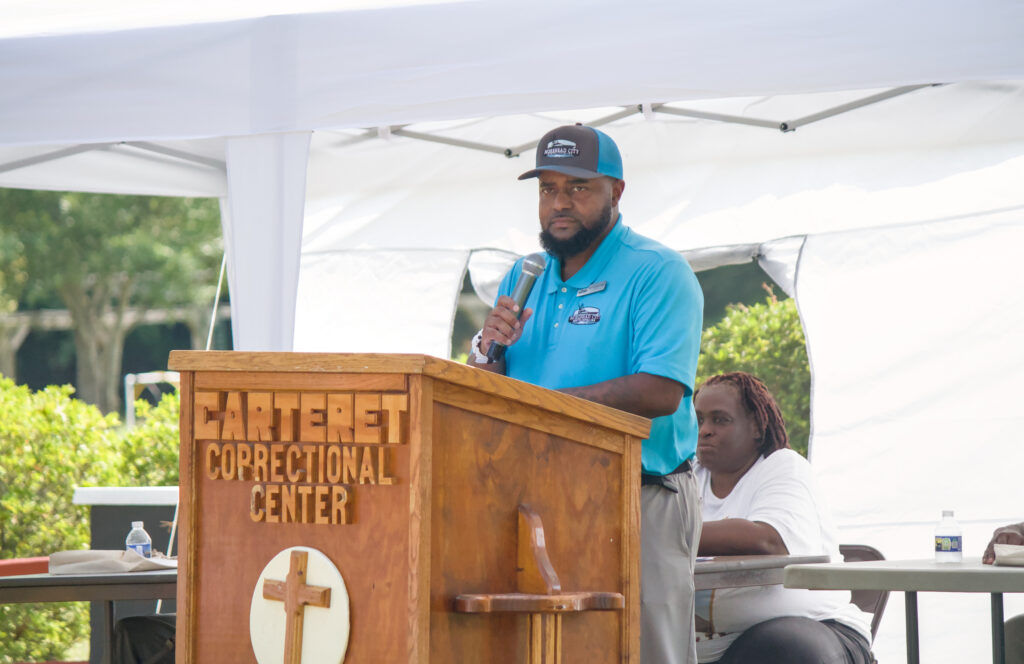
At midday, in dizzying mid-August heat, the mayor of Morehead City began his speech to the men of Carteret Correctional Center. The men and some of their family members had gathered on the prison’s lawn to discuss the challenges they face in incarceration and those they may one day face upon release.
“Society is constantly changing,” the mayor said. It was a news bulletin as much as an all-too-familiar adage. Many of the men at Carteret Correctional, a minimum security facility that can house 300, have been walled off from society for decades. Some have never held a smartphone.
The men, mostly serving life sentences, sat straight in their seats with sweat dripping from their brows. They hoped to be released on parole. Whatever difficulties leaving prison would pose — reentry into society is almost always difficult — they were eager to face them.
The mayor spoke to the men from behind a podium, but talked like a friend. He knew what they were going through.
“This conversation is personal to me,” the mayor said, “Because I got released from this very prison on Dec. 5, 2012. Praise God.”
Lee Anthony Stiles is a notable mayor for many reasons. One is that he is the first new mayor of Morehead City since the turn of the century. Another is the dramatic circumstance of last year’s election: Stiles won by a single vote in November 2025 before sweeping a redo race in March 2026.
And then there’s the reason you just learned. Stiles left prison almost 14 years ago after serving time for multiple felonies.
The fact is no secret to his constituents. During his mayoral campaign, and in public life, Stiles was open about his history of incarceration and the reasons for it. His experience with the justice system is what led to him to running for public office.
“I’m a person with a checkered past, a person of many scars,” Stiles told EdNC. “But if it wasn’t for that checkered past and those scars, I wouldn’t be where I am today.”
 Sign up for the EdWeekly, a Friday roundup of the most important education news of the week.
Facing rehabilitation alone
Stiles was born in Morehead City at what used to be called Carteret General Hospital. He was, he recalled, an academically gifted student. But toward the end of his teenage years, he started “experimenting with drugs,” and then sold them. First marijuana, then cocaine. From there it was a “downward spiral” that sent him to prison for the first time in 2007.
Without casting blame, Stiles said structural roadblocks impeded his rehabilitation while in prison. He remembers dark days of “deep depression” and panic attacks. Recently, North Carolina prisons have expanded education program offerings; back then, there were fewer opportunities.
“My first time in prison, I didn’t even try to change. Gambled in prison, sold marijuana in prison, and got back out and did the same thing. No real rehabilitation,” he said. “I wish there was programs in prison that would have helped me reintegrate into society.”
The outlook upon his first release, in 2009, wasn’t bright.
“They weren’t trying to help you get a job upon release, wasn’t trying to help you get transportation, wasn’t trying to help you if you didn’t have housing or a stable home to go to, wasn’t trying to get you shelter. They just sent you home with a bus pass,” Stiles said.
Without supports, people leaving prison have a high chance of recidivating — returning to criminal behavior. The post-release recidivism rate in North Carolina is 41% after two years.
Stiles, he said, returned to what he knew. When police caught him selling cocaine in a sting operation, he faced 10 to 14 years before he took a plea deal that reduced his sentence to 19 months.
“This is gonna sound crazy,” he said. “Best 19 months of my life, spiritually.”
The long path to mayor
At his lowest point, when he was having nightly panic attacks, Stiles decided to dedicate his life to God. He said that decision changed his life.
After he was released again, he set off on a trying journey toward making a prosperous life. Stiles said it took three months before he finally found work as a dishwasher at a restaurant called Mykonos Grill.
“He was the first person to take a chance on me,” Stiles said of his old boss. “When Walmart turned me down for a job, and several other places, because of my criminal background, he gave me an opportunity.”
Stiles went from earning minimum wage at Mykonos Grill to $9 per hour at Olive Garden, to $11 per hour at LongHorn Steakhouse. It was painstaking progress.
“Then I started getting jobs at several different places, working three or four jobs at a time, sometimes even five jobs at a time,” he said.
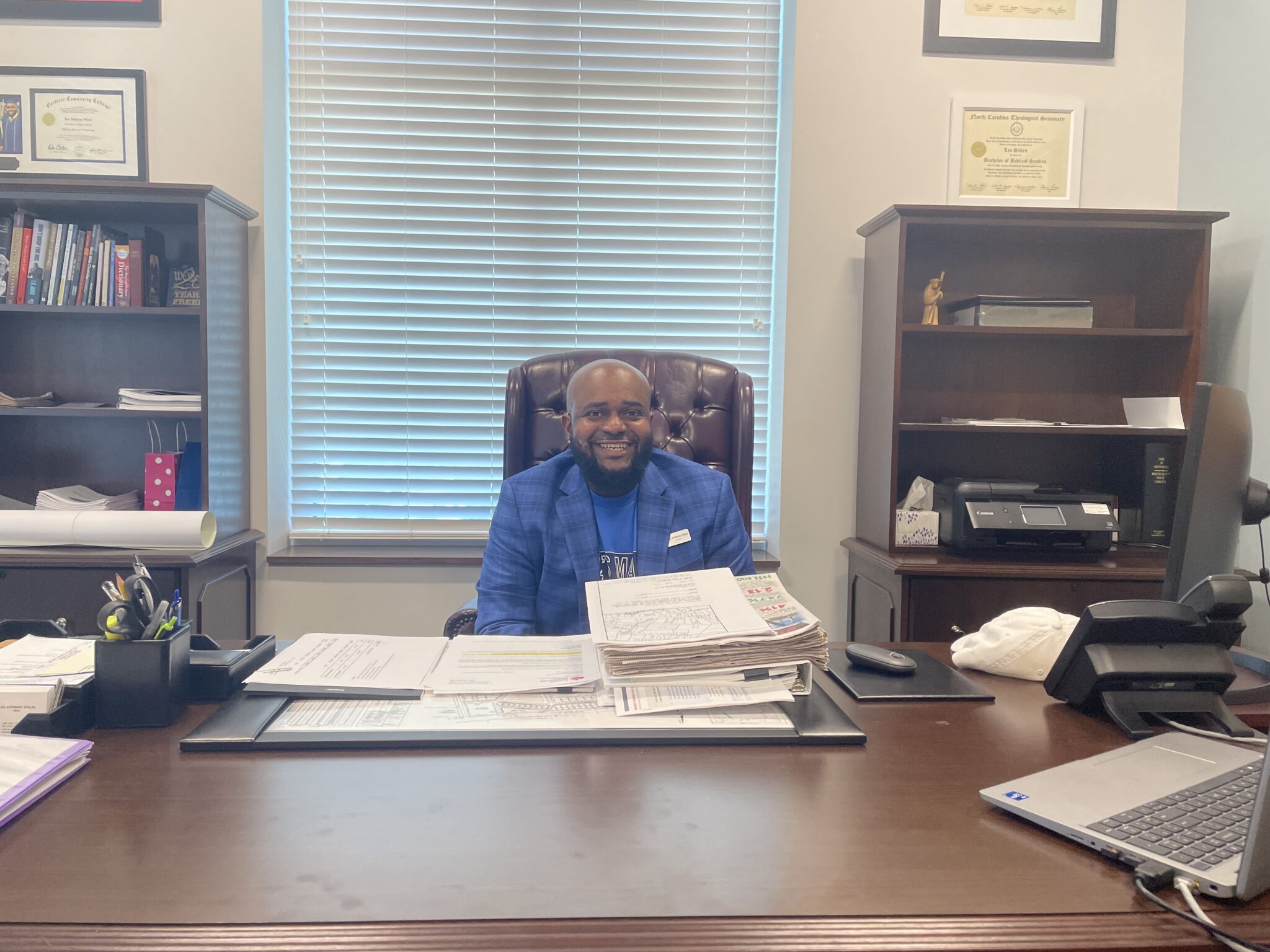
After earning stable income, Stiles could resume his educational journey. He acquired the diplomas that currently decorate his office at City Hall: an associate degree (Carteret Community College) and a bachelor’s degree (Gardner-Webb University) in human services technology. He was ordained as a minister and received two more degrees from the Baptist North Carolina Theological Seminary.
Stiles worked in opioid prevention education, later becoming a public health educator for the health departments of both Onslow and Carteret counties. He was involved with the Carteret Local Reentry Council — a full circle opportunity to help others along similar journeys.
Today, despite setbacks, local reentry councils (LRCs) are helping thousands of reentrants across the state every year. Stiles had never heard of an LRC 14 years ago.
Over the years, through his public health work, Stiles met people working in local government. Though he said he had an aversion to “the nastiness, the divisiveness of it,” friends thought he’d make a good politician.
“And I took two years just to pray about it, just to make sure that this is nothing that I want to do out of selfish ambition. (That) this is something I want to do just out of a servant’s heart,” Stiles said.
After serving on the city council, he prayed on it again and decided to run for mayor. In an interview with WNCT after being sworn in, Stiles said that his new title of mayor isn’t as important as the title of servant.
“I’m not saying that the mayor’s title is meaningless, because the public elected you to be in this position,” he told EdNC. “But I don’t put emphasis on the titles. I just want to do the work.”
Read more about reentry



Stiles on reentry, stigma, and youth opportunity
“Everybody deserves a second chance. Everybody, I believe, deserves a second, third, fourth, and a fifth chance, because I was given multiple chances to get it right,” Stiles told the men at Carteret Correctional. “I understand what it means. I know what it feels like.”
Stiles has gone from prison to public office. It profoundly affects his worldview, his actions, and his aspirations.
“There’s more to be done,” he said. He noted that LRCs need funding, but centered person-to-person action as the most necessary thing to help justice-involved people: services like résumé building, addiction counseling, and public youth activities. Stiles said that, though progress has been made, there’s a lot of work to be done to reduce the stigma of having a criminal record.
“I will say: I’m proud of the citizens of Morehead City, because the majority of them said, ‘We’re looking past the stigma, looking past the criminal record. We’re looking into the person’s heart, and we believe this guy’s the best man for the job,’” Stiles said.
Stiles sees his own journey as a sign of what’s possible for people reentering society today. As he said on the lawn of Carteret Correctional, society is constantly changing.
“For me to make it this far without (education programs and reentry services), that should speak volumes to people who do have these programs and resources available to them,” Stiles said. “That, ‘Wow, Lee made it that far. I got all these resources available to me. I should be able to make it that far, even further.’”
Going further
Stiles, who has not publicly identified with a political party, doesn’t consider his own story finished. At Carteret Correctional, he told his audience he hopes to affect state policy on reentry and the justice system.
“That’s a goal, getting to the General Assembly,” Stiles told EdNC. “Because then you’re creating policies where you can advocate for more mental health resources across the state. You can advocate for more reentry resources across the state.”
For the moment, though, Stiles is happy and eager to serve as Morehead City mayor.
“I didn’t get into it for the power,” he said. “I got into it for the people.”