‘How far we have come’: An update on districts with schools damaged by Hurricane Helene 2 years later

In the two years since Hurricane Helene struck western North Carolina, communities and schools have been rebuilding. The storm brought record-breaking rainfall, and four school districts in Henderson, McDowell, Watauga, and Yancey counties sustained major damage to their buildings.
EdNC spoke with each school district’s superintendent to revisit the past, hear about the present, and see what they are most looking forward to in the future ahead of the anniversary.
Henderson County
A look back at September 2024
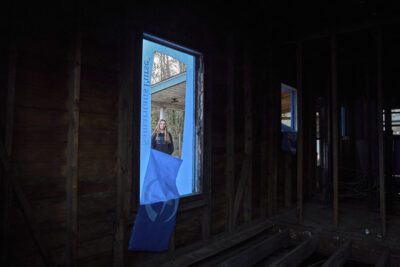
Perry Creek sits in between buildings on the Atkinson Elementary School campus. Over a three-day period during Hurricane Helene, 21.96 inches of rain were recorded south of Hendersonville. All waterways, including Perry Creek, flooded.
The school took on two inches of water, and it receded within hours, but with locked doors and no electricity, moisture ruined the floors. Students, for a time, would have to find a new home.
Where they are now
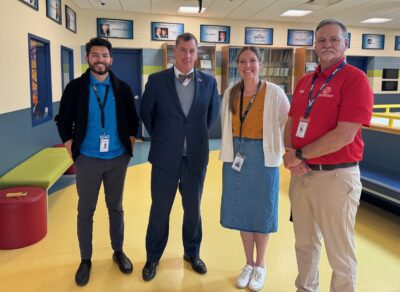
Superintendent of Henderson County Public Schools (HCPS), Mark Garrett, originally thought the students of Atkinson Elementary were going to have to split up while school floors were repaired.
However, before he had to make that call, the Henderson County Boys & Girls Club stepped in. Kent Parent, who had been the CEO of the community organization for all of one week, invited the school and its staff to use their facility.
“Those relationships, those community relationships, that you cultivate when times are good come in really, really handy when you come to a time of need,” said Garrett of the partnership with the Boys & Girls Club.
The move was successful and temporary. The floors in Atkinson Elementary were replaced by December 2024, and students were back in their building before winter break.
Since then, the partnership between the school and the Boys and Girls Club has only grown. The organization expanded transportation to schools in the district and offers after-school care until 7 p.m.
Through a grant, Boys & Girls Club employees began embedding themselves in some district elementary schools to help mentor students and assist educators.
“It provides a seamless opportunity and builds those relationships with the kids in their school setting,” said Garrett.
It’s a win-win-win situation: for students, the school, and the Boys & Girls Club. Garrett continued, “This helps teachers and everyone else at the school with that connection and relationship, and it just transitions into their after-school programming.”
Since Hurricane Helene, exciting things have been happening district wide too. HCPS’ graduation rate has improved year over year, as has the district’s accountability data. A Healthcare Fellows collaboration began in 2025 between the district, Blue Ridge Community College, AdventHealth Hendersonville, and UNC Health Pardee. The program gives 10 HCPS seniors full financial support to attend Blue Ridge, with a guaranteed job upon graduation.
Post storm, the district also focused on reviewing all emergency plans because as Helene demonstrated, “your local school district is going to be one of the biggest players in any big disaster, just because of the assets and resources that we have, and the logistics that we’re used to dealing with,” said Garrett.
What is Garrett looking forward to for the future of HCPS? “We are looking at expanding. We want to match student need and desire with postsecondary opportunities. We want kids to be better at that next level,” he said.
He said the district is continuing to “march upward,” by creating more educational opportunities and staying connected to the community.
Read more on Henderson County Public Schools

McDowell County
Where they were in September 2024
Old Fort Elementary School in McDowell County opened a new school building in 2020, which sits outside of a 500-year flood plain. The only body of water near it is Mill Creek.
The area was already saturated with water due to a predecessor rain event in late September 2024, then Helene arrived, and the creek was overrun, flooding the building and parking lot of the school. Superintendent Tracy Grit knew the building could be salvaged, but students would have to move elsewhere for the duration of repairs.
Where they are now
One thing that the school’s then-principal Jill Ward was adamant about: “Our students stay together.” The entire student body, and educators, merged with Pleasant Gardens Elementary School for the rest of the 2024-25 school year.
Ward was in her last year of principalship before Helene hit. She pushed retirement back because she felt she had to see the journey of recovery through and get her school back into its building.
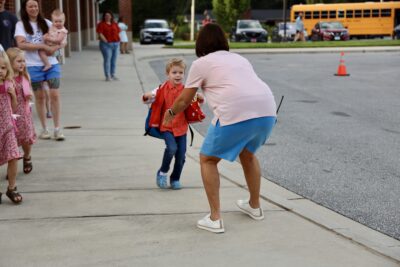
On Monday, Aug. 25, 2025, Ward was outside the front doors, welcoming students as they returned to the halls of Old Fort Elementary.
Ward said on the first day of school, “I love these people, and I love this place, and I love these kids, and I love these families.”
Once the school was back in its building, they reached another milestone. The school moved up one letter grade from a C to a B, according to North Carolina school performance grade data. “I’m so proud of the team and the staff,” said Grit. This goal was another reason Ward extended her tenure. “The sacrifice of time and self to accomplish that goal, it’s just amazing,” Grit said of Ward.
Grit is feeling excited and hopeful about McDowell County Schools as a whole, too. “Last year we saw the highest graduation rate we’ve ever seen,” said Grit. “And we’re on track to do it again.”
He said even in the time of recovery, “We didn’t let our expectations down for education.”
What is he most looking forward to? The momentum of McDowell County Schools. The district received a needs-based capital grant in December of 2025 to purchase a new piece of property and build a new school. Eastfield Global Magnet School and Marion Elementary School will merge, with the hopes of opening in 2029.
They also received a $4 million dollar grant from the state to elevate the fields at West McDowell Middle School.
For Grit, the biggest lesson learned came from the community. “Kids and people are resilient. We can face struggle and adversity, but we take care of each other during those times. I will never forget what that looked like, and what that felt like when it was happening, and it didn’t stop,” he said.
Read more on McDowell County Schools
Watauga County
Where they were in September 2024
The original Valle Crucis School building was constructed in 1935, and a symbol in Watauga County Schools. Part of the New Deal Works Progress Administration, the school was made of mountain stone and educated members of the community for decades.
The school had taken on water in bad storms, but Hurricane Helene brought unprecedented rainfall. The water pumps kept the incoming rain at bay for a while thanks to Superintendent Leslie Alexander, Valle Crucis principal Bonnie Smith, and school maintenance workers, but once the electricity went out, it was too much for the building.
Seventy percent of the historic school took on water, and students could not return to the building.
Where they are now
Before Hurricane Helene, Watauga schools had begun construction on a new Valle Crucis School, a quarter-mile down the road from the original building. The hurricane, and the complications it brought around the region, delayed the opening.
However, Valle Crucis students weren’t displaced for long. For the remainder of the 2024-25 school year, three different local educational institutions stepped up to host the school.
Appalachian State University had one preapproved classroom to take the preschoolers. Valle Crucis Conference Center and Holy Cross Episcopal Church welcomed K-5 students, and Caldwell Community College & Technical Institute housed the sixth through eighth graders.
At the beginning of the 2025 school year, preschool students moved back to the district, joining up with Cove Creek School. And on Oct. 22, 2025 — nearly a year and one month after Hurricane Helene struck the area — the new Valle Crucis opened its doors.
The Federal Emergency Management Agency (FEMA) has since awarded Watauga funds for the original building that flooded. The district is in the process of working with architects to reimagine what that 1935 building could offer the education community, and Alexander is thrilled about the possibilities.
The district is looking at creating a state-of-the-art professional development space for their teachers, she said, and providing some space for 0-3 childcare.
Watauga schools also received an insurance payout from the old Valle Crucis building — which they have put in a money market account that is accruing interest to further support necessary repairs — and added programing in the district. They have put these funds into updating HVAC systems and installed turf on the high school baseball field, which will also host a new female flag football team.
“It’s great that we’re able to use interest in a productive way, so that we can create something that’ll be a great space for all of our high school students,” said Alexander.
What was one lesson Alexander learned in all this? “That even in times of turmoil, you’ve got to think through and really understand all your options,” said the superintendent. She believes when something of this magnitude happens, it’s “easy to live in that chaos moment and not think toward the future.”
And what is Alexander looking forward to?
“This community really comes together to support anything to do with our schools,” said the superintendent. “I just think the direction that we’re headed — the people that we have in place leading our schools and working to support our schools — I think that we’re headed in a good direction, and I’m excited to see the momentum that we have.”
Read more on Watauga County Schools
Yancey County
Where they were in September 2024
The largest amount of rainfall recorded during Hurricane Helene was in Busick, North Carolina. In a span of four days, they saw 30.78 inches fall. Families were displaced, roadways and bridges were washed away, and infrastructure across Yancey County was highly damaged.
Yancey County Schools’ students were out the longest of any in the state — over seven weeks. During that period, school buildings were used for food and supply distribution. Mountain Heritage High School, the only high school in the district, was used as an emergency command center, sheltering rescue teams from across the country, as well as the National Guard.
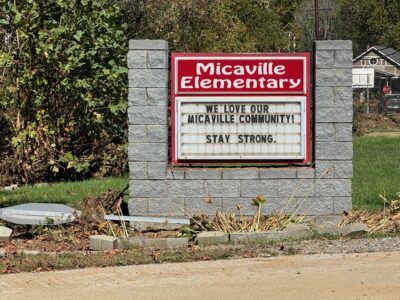
Micaville Elementary was one of four elementary schools in the district. It was constructed in 1936 as a Works Progress Administration school building, and in the fall of 2024 had 198 students enrolled. The stone building sat right off NC-80, and beside Ayles Creek, which swelled during the storm and flooded the historic school beyond repair.
Where they are now
When Yancey schools returned on Nov. 18, 2024, 48 Micaville Elementary students moved to South Toe Elementary and the remaining 150 students moved to Burnsville Elementary School.
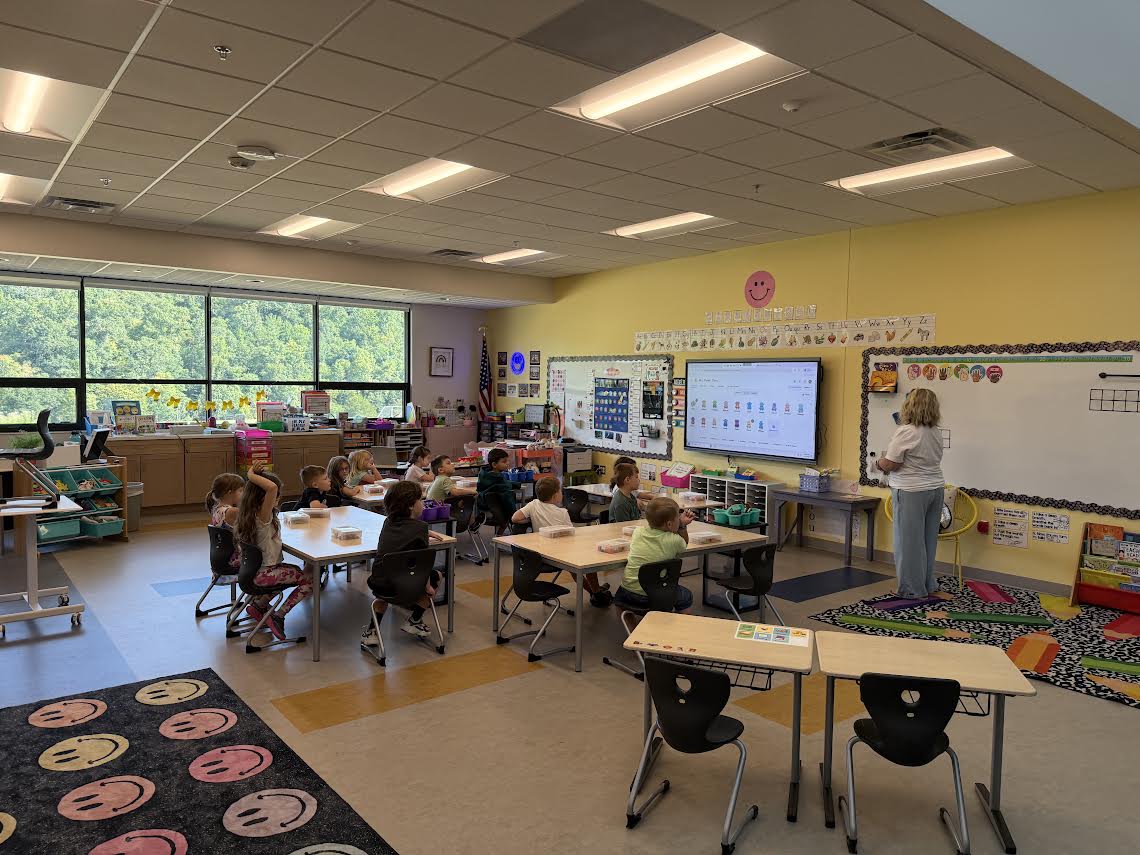
Expansion plans were put in place to add 14 classrooms to Burnsville Elementary, and an additional 12 classrooms to another school in the district, Blue Ridge Elementary, to more comfortably accommodate students. Both schools have since completed their new additions.
When the storm hit, the district was already in the middle of a 20-yearlong facility plan. Prior to the storm, the school board had saved their North Carolina Education Lottery funds for 10 years to purchase a new piece of property and build another elementary school.
Superintendent Kathy Amos, along with the school board, had to adjust some of those plans to handle urgent needs after the storm. However, they are forging ahead and hope to build a new elementary school with a combination of those reserved funds, insurance, and FEMA money.
Around 200 homes were lost in the storm, and the district is continuing to support those displaced students. Amos said 60 families are still in campers in the county. She is grateful for the communication between the county commissioners and organizations like Chief Cares, who are continuing to work together to increase housing in the area.
As the two-year anniversary approaches, Amos can look back at how far her district has come and be thankful. Samaritan’s Purse, Baptists on Mission, Mercy Chefs, the George Shinn Foundation, and Rebuilding Hollers Foundation are all still present in the area helping with continuous rebuilding.
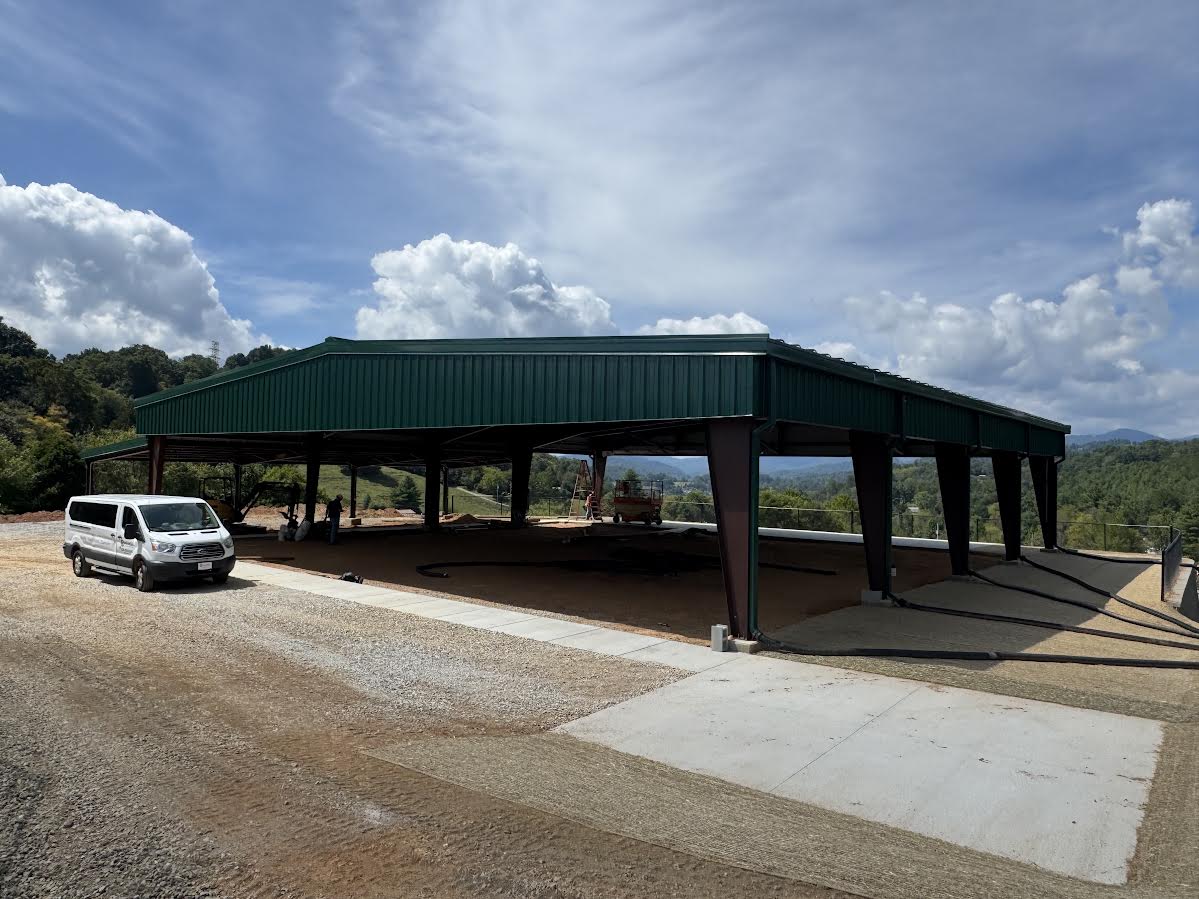
Even during this difficult time, her district was able to start an aviation pathway, ramp up their Career and Technical Education construction classes, and build an agriculture barn to support their strong 4-H program.
“I do feel like we’ve got a bright future,” said Amos. “We recognize that there is still much work to be done across our community. At the same time, we can look back with gratitude and see just how far we have come.”