
Exploring postsecondary attainment: Reaching a postsecondary attainment goal

The myFutureNC Commission is a statewide education commission focusing on educational attainment for all North Carolinians. This week, we will be highlighting findings from the myFutureNC Commission policy briefs on postsecondary attainment.

In 2009, President Obama and the Lumina Foundation both announced national postsecondary attainment goals to draw attention to the need to bolster postsecondary attainment in the face of global competition.
Since then, all but nine states have set postsecondary attainment goals. North Carolina is one of those nine, but the myFutureNC Commission is working to change that by developing a statewide postsecondary attainment goal by the end of the year.
In the myFutureNC brief, “Reaching a Postsecondary Attainment Goal: A Multistate Overview,” the Hunt Institute reviews the 41 state attainment goals and offers recommendations for North Carolina policymakers.
Review of statewide attainment goals
All but seven of the 41 states with attainment goals set their goals to target 25-64 year-olds. Colorado, Idaho, Massachusetts, South Dakota, and Texas targeted their goals to 25-34 year-olds, and Minnesota and Washington targeted 25-44 year-olds.
Defining postsecondary attainment is not universal. Some states have set their goals to include high-quality certificates, while others have limited their goals to just bachelor’s degrees or bachelor’s and associate’s degrees.
The timeline that states have set to reach their goals varies from five years in Arkansas and Nevada to 21 years in South Carolina with an average of about 10 years.
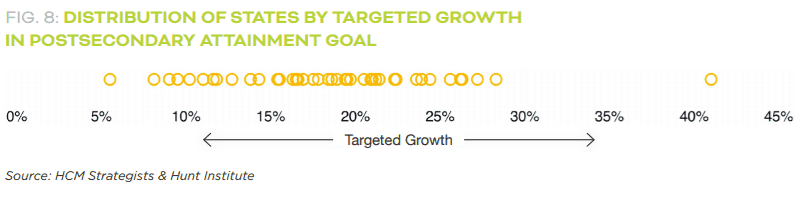
Targeted growth ranges from a low of about 5 percent to a high of 41 percent in Oregon, with about half falling in the 16 to 24 percentage range.
Few states have set specific goals for subgroups of students, although some recognize the need to close racial and ethnic attainment gaps both as an equity issue and in order to meet their overall attainment goals.
Twelve states have set interim targets to track their progress. Arizona set goals across the education continuum in recognition of the need to improve early, elementary, and secondary education in order to increase postsecondary attainment.
Recommendations for North Carolina
The brief highlights the approaches of three different states — Tennessee, Virginia, and Maine — as lessons for North Carolina. The authors then offer the following recommendations.
- Build a foundation for success: “Progress cannot be made at the postsecondary level if robust foundations are not first developed. Coordination from birth through higher education is critical. Postsecondary attainment goals are just one part of a larger strategic plan that should have the buy-in of all relevant stakeholders.”
- Establish an ambitious, measurable, and relevant goal: “States need to set targets that are both ambitious and attainable so that real progress can be made toward high standards that move states forward.”
- Focus on all students: “While increasing the total level of postsecondary attainment is important, it is imperative that policymakers focus specifically on subgroups that have historically had lower attainment rates.”
- Focus on access and affordability: “Postsecondary systems need to offer all students, regardless of background, access to higher education and an affordable path to degree completion.”
- Support students across the continuum: “The entire education continuum needs to better support all students to increase retention, persistence, and completion.”
- Leverage data and improve cross-agency coordination: “Statewide longitudinal data systems are critical for improving institutional coordination, public communication, and policy decision making.”
- Prioritize engagement: “In order to build consensus and buy-in, states need to develop a brand around attainment goals and actively promote them to the general public and across stakeholder groups.”
Read more in the brief below.