
Exploring postsecondary attainment: A focus on non-completers

The myFutureNC Commission is a statewide education commission focusing on educational attainment for all North Carolinians. This week, we will be highlighting findings from the myFutureNC Commission policy briefs on postsecondary attainment.
In North Carolina today, there are 905,000 people who have completed some college but have not received a degree or certificate — or “non-completers,” as they are known in the education and workforce world.
There are many reasons people do not finish a degree — finances, family issues, health problems, etc. However, two primary reasons are inadequate preparation and difficulty navigating the higher education system.
The myFutureNC brief, “A Focus on Non-Completers,” looks at the characteristics of non-completers in North Carolina and offers strategies to promote degree completion.
Education attainment in North Carolina
In the UNC System, 68.2 percent of students complete a degree or certificate within five years.
It is harder to estimate the persistence rate at community colleges, but the brief cites the N.C. Community Colleges’ 2017 Progress and Persistence Report, which states of all the curriculum students who were enrolled in community college in fall 2015, only 27 percent had graduated or transferred by the next fall.
There are racial and ethnic differences among non-completers as well, depicted in the graph below: 21 percent of non-completers are black, 18 percent are American Indian, 17 percent are white, 8 percent are Hispanic, and 7 percent are Asian.
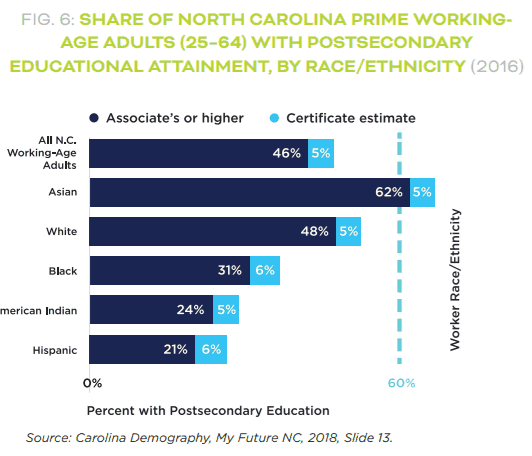
Younger generations are more likely to have any postsecondary education attainment, and women are more likely than men to have postsecondary education attainment for all ages under 65.
Supporting education attainment
Anita Brown-Graham and Catherine Moga Bryant, co-authors of the brief, outline different solutions to support non-completers. The following table breaks them down into services to individuals and services to employers.
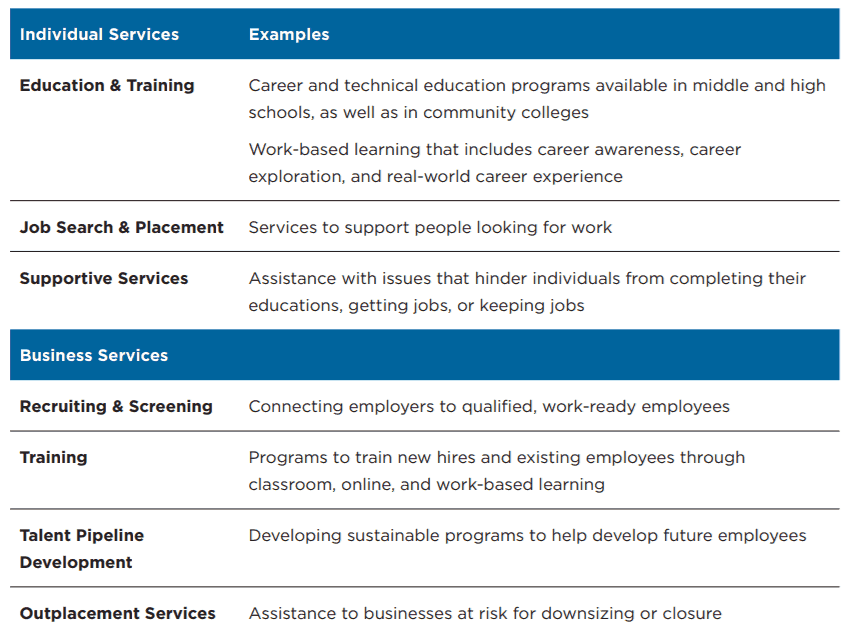
The authors identify four opportunities to provide supports for non-completers. They are:
- NCWorks certified career pathways: the NCWorks Commission established eight best practices criteria for creating comprehensive career pathways. There are now 30 certified pathways in many different fields.
- Work-based learning programs: these include internships, co-ops, on-the-job-training, transitional jobs, and apprenticeships.
- Part-way home programs: North Carolina does not have a coordinated campaign across community colleges and universities focused on part-way home students, similar to Mississippi’s Complete 2 Compete program
- Credentials for military experience and training: postsecondary institutions offer credit for military experience, credit hours through prior learning portfolio, test-based course challenges, and workplace learning opportunities
Read more in the brief below.