As Katherine Joyce prepares to retire after two decades of advocacy on behalf of public school administrators, she recalls how a teacher in a Surry County elementary school gave her a nudge of encouragement that shaped her career.
“My fifth grade teacher pulled me aside and said to me, ‘You have a skill in writing and I would really like to see you do something with that,'” Joyce said in a recent interview. “In all successful individuals’ history, there is a teacher who helped open doors.”
In December, Joyce announced that she would retire as executive director and chief lobbyist of the North Carolina Association of School Administrators (NCASA), effective June 30. Thus, 2026 becomes a significant transition not only in Joyce’s career but also for NCASA, which marks the 50th anniversary of its founding.
 Sign up for the EdDaily to start each weekday with the top education news.
NCASA has formed a search committee and is soliciting applications by Feb. 16 for this key position in the North Carolina public education network. The job description calls for applicants with “extensive knowledge of North Carolina’s political climate,” combining “a passion for public schools” and an “ability to build consensus among diverse stakeholders.”
The NCASA search committee expresses a preference for applicants with a graduate degree in education and five years of work experience in a public school system. Still, it holds open the prospect of selecting a director educated in public policy and experienced in nonprofit management.
When Joyce was selected for the position in 2013, she had traveled what she called “a non-traditional route.” Not an educator, Joyce began her route in journalism, then took a turn into public relations, and then another turn into advocacy and legislative lobbying.
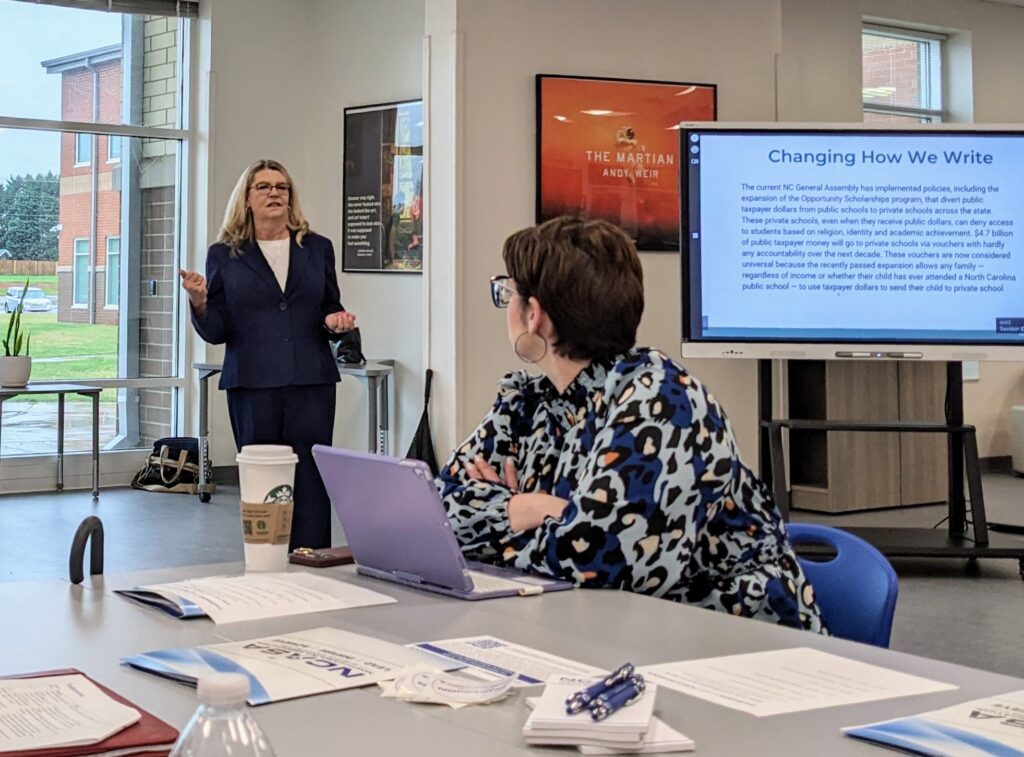
Joyce went through elementary, middle, and high schools in Surry County Schools. It was at Dobson Elementary School that she received praise for her writing from Jan Clark Goodman, the fifth grade teacher who helped focus her career aspirations.
Joyce earned a bachelor’s degree in journalism in 1988 at the University of North Carolina at Chapel Hill, where she worked at the Daily Tar Heel and in the local bureau of The News & Observer. She moved on from Chapel Hill to the Henderson Daily Dispatch where she worked for 8 ½ years.
Her turn into public relations began with a position with the State Employees Association, followed by a job with NC Electric Cooperatives. She joined the NCASA staff in 2003, and she rose to executive director a decade later.
Joyce took on the role of “heavy-duty lobbying” for the administrators’ organization, said Shirley Prince, executive director of the NC Association of Principals and Assistant Principals. “She’s really good at it.”
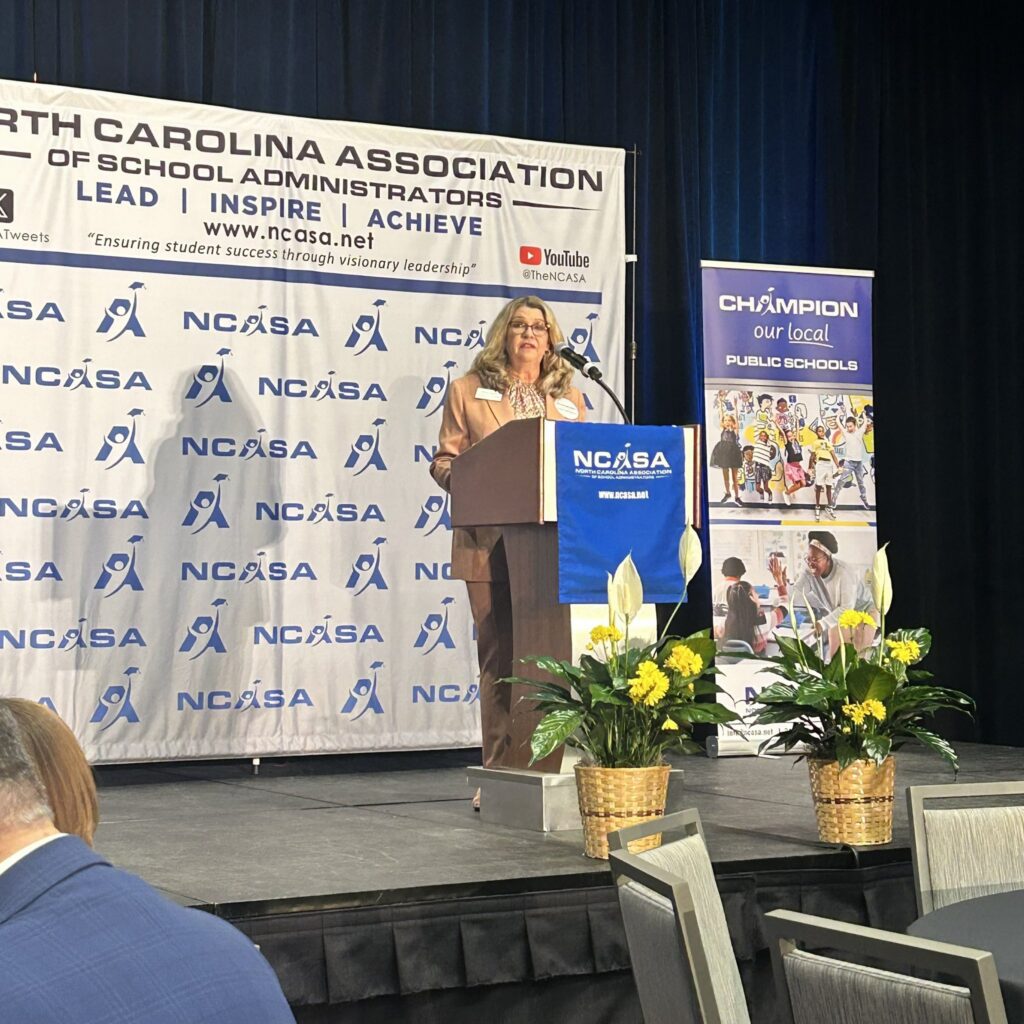
As an organization, NCASA is a collaborative of a dozen affiliates that together illustrate the diverse personnel infrastructure of public education. It has affiliates representing pupil transportation, food service, special education, and business-office administrators. Its two “core affiliates” are the School Superintendents’ Association and the Association of Principals and Assistant Principals. Of NCASA’s 8,000 members, approximately 5,000 are principals and assistant principals.
Over the past decade, said Joyce, NCASA has faced “challenges after challenges” as North Carolina state government reflected the sharpened Republican-Democratic polarization of American politics. In the state General Assembly, House and Senate Republicans enacted expanded school choice through vouchers for private school students and step-by-step reductions in individual and corporate income taxes as strategic priorities.
Joyce expressed special concern over the built-in expansion of state appropriations for vouchers, known as Opportunity Scholarships, which will reach $825 million a year in 2032-33. Traditional public and charter schools have no similar automatic increases for enrollment growth, she said.
Her successor, she said, will have the task of assisting public school systems to “market in a different way” to attract students and to “battle to retain students in our traditional public schools and school districts.”
Joyce also noted the high annual turnover of superintendents in the state’s 115 public school districts. Each year, she said, 25 or so superintendents retire, are dismissed, or move onto another job. NCASA will continue to face the challenges of providing professional development and of enhancing school and district leadership.
For NCASA itself, Joyce said, “we need a dynamic, energetic, passionate leader.”
Recommended reading