
Tax cuts, tariffs, and uncertainty mean less revenue for North Carolina, updated forecast says

Economists from the Office of State Budget and Management (OSBM) and the Fiscal Research Division (FRD) have updated what’s called “the consensus revenue forecast,” projecting that North Carolina has $180 million less in revenue for this fiscal year than anticipated in February 2025.
“The downward revision is due primarily to lower-than-expected corporate income tax collections in April, particularly related to reduced estimated tax payments from businesses,” says the updated forecast, “likely due to anticipating higher input costs and lower profits from recently implemented tariffs.”
 Sign up for the EdDaily to start each weekday with the top education news.
The consensus revenue forecast helps the state understand how much money the legislature will have to budget in the 2025-26 and 2026-27 fiscal years. The availability of revenue is driven in part by economic factors — for example, inflation — and in part by policy choices — like tax cuts.
Compared to the forecast in February, this forecast “anticipates modestly lower revenues in each year of the 2025-27 biennium due mainly to lower collections from sales, individual income, and corporate income taxes.”
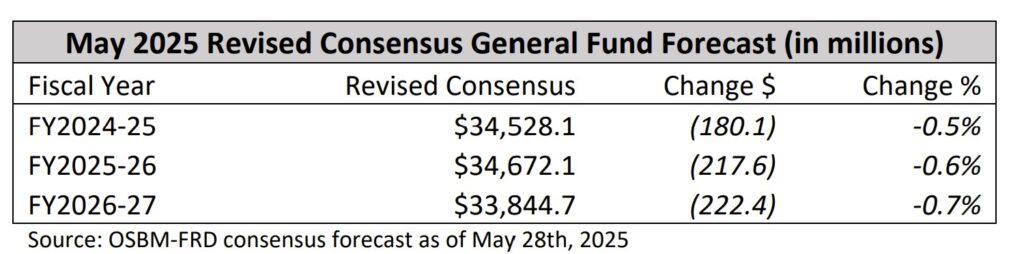
The revised forecast shows downward projections for the state’s total general fund revenues by $180 million for FY 24-25, nearly $218 million for FY 25-26, and $222 million for FY 26-27.
“The primary factor behind the anticipated year-over-year decrease in revenues,” says the forecast, is the anticipated reduction in the individual income tax rate from 3.99% in 2026 to 3.49% in 2027.
“One of the dominant themes from recent surveys of businesses and consumers,” says the forecast, “is heightened uncertainty about the economy. The revised consensus revenue forecast reflects this heightened uncertainty.”
The state budget currently proposed by the House would keep the individual income tax rate at 3.99% through tax year 2027, according to page K3 of the committee report.
You can read the full updated revenue forecast here.