
Dr. Monty Sullivan selected to lead the NC Community College System
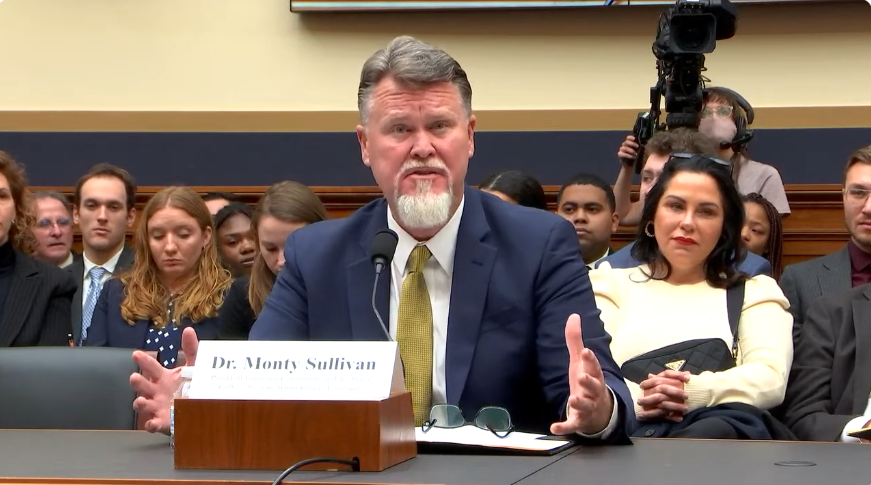
The State Board of Community Colleges has selected Dr. Monty Sullivan, the former head of Louisiana’s community college system, to serve as the next president and chief executive officer of the North Carolina Community College System (NCCCS).
For the first time, the nomination requires confirmation from the General Assembly. According to a press release from the NCCCS, Sullivan is “expected to serve as acting president, pending contract approval, while legislators consider the nomination.” A start date has not been set.
Under Sullivan’s 12-year leadership of the Louisiana Community and Technical College System, annual graduates nearly doubled and foundation assets tripled, according to the press release. Sullivan retired from that role in January 2026.
He has also served as a community college president and held senior roles in the Virginia Community College System, with more than 30 years of experience in higher education and workforce development.
“Dr. Monty Sullivan has the passion, experience, vision, character, and proven record to lead our Community College System at the speed of business and innovation. We are confident he is the right leader to strengthen our 58 colleges, serve our students and employers, and build on North Carolina’s extraordinary momentum,” said State Board Chair Tom Looney.
According to a background briefing released by the NCCCS, Sullivan is a Louisiana native and holds a bachelor’s degree in political science, a master’s in English education, and a doctorate in education from Louisiana Tech University.
“North Carolina’s Community College System has built something the rest of the country watches,” Sullivan said in the press release. “That work happens across North Carolina — in welding labs, nursing programs, and early college classrooms. I’m committed to reaching every student who wants a better job and every employer who can’t find enough skilled workers. I’m grateful to the State Board for its confidence, and we will deliver.”
Sullivan has also testified before Congress, advocating for Workforce Pell and the reauthorization of federal career and technical education programs. Scott Ralls, president of Wake Technical Community College and a former system president, has also testified before Congress and previously connected with Sullivan.
“I’ve sat in the System president’s chair and I can tell you what this moment asks for. Dr. Monty Sullivan and I made the case for Workforce Pell to members of Congress, and I watched him do the thing the best system leaders do — turn what employers need into policy that reaches students,” Ralls said. “Wake Tech serves more students than some states’ entire systems, and I want this leader for our state. There is not a better person in the country to lead North Carolina’s community colleges.”
Read more about Sullivan’s background here.
 Sign up for Awake58, our newsletter on all things community college.
The transition and the search
On Friday, Aug. 1, 2025, Jeff Cox, the former president of the N.C Community College System, announced his retirement effective June 30, 2026.
Bill Carver, former president of Nash Community College, has served as interim president since July 1.
In the last 10 years — since 2015 when then-President Scott Ralls resigned after a seven-year tenure running from May 2008 through Aug. 2015 — seven leaders (note that Carver has served three times) have held the position of interim president, acting president, or president of the N.C. Community College System.
The search process kicked off in the fall 2025 following Cox’s retirement announcement.
In October 2025, the Board created a six-person presidential search committee, composed of existing Board members. That committee is the voting body leading the search and will conduct finalist interviews before submitting a ranking of three finalists to the State Board.
The committee includes:
- Tom Looney, co-chair;
- John Kane, co-chair;
- Chaz Beasley;
- State Treasurer Brad Briner;
- Lisa Estep; and
- Chris Lumsden.
The Board also established a non-voting search advisory council of seven leaders across business, government, and higher education, including:
- Amanda Lee, president, N.C. Association of Community College Presidents;
- Gene Rees, board chair, N.C. Association of Community College Trustees;
- Chris Chung, CEO, Economic Development Partnership of N.C.;
- Ward Nye, chair & CEO, Martin Marietta;
- Sen. Michael Lee, R-New Hanover, North Carolina Senate;
- Rep. David Willis, R-Union, North Carolina House; and
- Seth Dearmin, chief of staff for the North Carolina Governor’s Office.
In January 2026, the Board selected Buffkin Baker as the firm to lead the national search for the next president and CEO.
Here is more about the development of the candidate profile and the search process.
EdNC’s coverage of the leadership transition
The confirmation process
New to the transition and search process is confirmation by the legislature.
N.C. General Statute 115D-3 says,
Subject to confirmation by the General Assembly in accordance with G.S. 115D‑3.1, the State Board shall elect a President of the North Carolina Community Colleges System who shall serve as chief administrative officer of the Community Colleges System Office. The State Board shall use the following process to elect a President:
(1) At least three final candidates shall be submitted to the full State Board from which the full State Board shall make its election.
(2) The State Board shall conduct a vote on the election of the President, and the candidate who receives a majority of votes of the entire State Board shall be elected President.
N.C. General Statute 115D-3.1 legislates the confirmation process:
(a) The State Board shall submit the name of the person elected as President for confirmation to the presiding officers of the Senate and the House of Representatives of the General Assembly on or before the fifteenth day following the election. The General Assembly shall adopt a joint resolution to either (i) confirm or (ii) deny confirmation, subject to the following:
(1) The person elected by the State Board shall not serve as President but may serve as interim‑President until the General Assembly adopts a joint resolution.
(2) If the General Assembly fails to adopt a joint resolution confirming the person by the date that either chamber reaches the thirtieth legislative day following the receipt of the name by the presiding officers, it shall be deemed that the General Assembly has denied confirmation.
(b) A person denied confirmation shall not serve as President or interim‑President.