
Take a seat: Learning in a deskless classroom

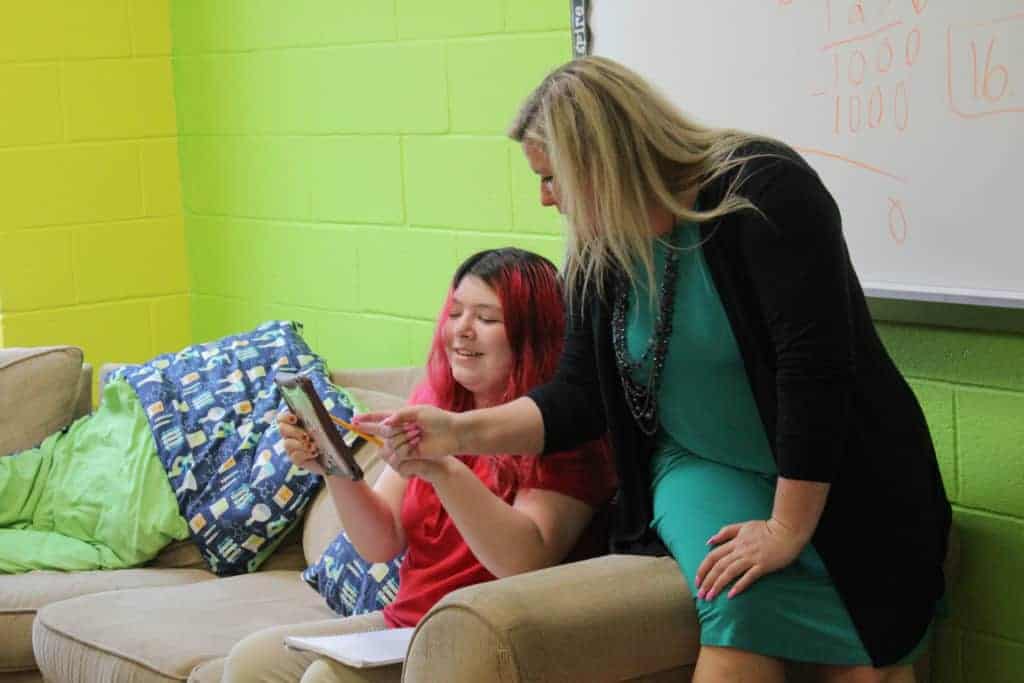
I first heard about deskless classrooms in the spring at the State Innovation Conference held at UNCW’s Watson College of Education. Since then, in my visits to classrooms for STEM stories throughout the state, I’ve seen traditional desk seating in rows, pod desk seating in clusters, and every now and then, a deskless classroom—including that of Sally Schultz’s in Rowan-Salisbury Schools.
As someone who always sat at a traditional desk from elementary school through high school, these new rooms sparked my curiosity. Students were reading and doing work on couches, seated on tires, bouncing on yoga balls, or laying on the carpeted floor. Each time I saw one of these inventive classrooms, I’d remember the innovation conference’s breakout session where teachers Chase Morgan and Bridget Wortman shared their journey and successes in completely restructuring their classrooms into one where students don’t sit at a desk to learn.
“Why do we use desks?” asked Wortman, a first grade teacher at North Topsail Elementary School in Pender County. “Because we always have used desks.”
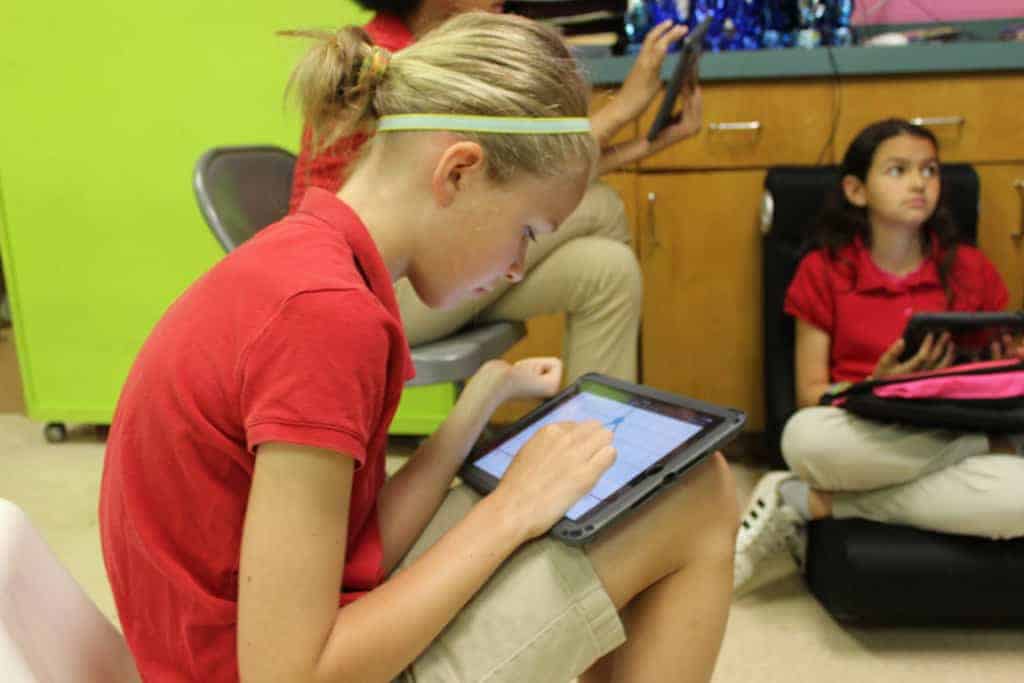
A “deskless” classroom, or one with flexible and alternative seating, means that not only are students using unconventional seating, they can also freely move around the room. To many, teaching in the unstructured nightmare that this seems to be would prove absurd.
But Morgan and Wortman experienced the opposite—less chaos, more calm.
“It was stressing me out trying to get six-year-olds to sit,” Wortman explained.
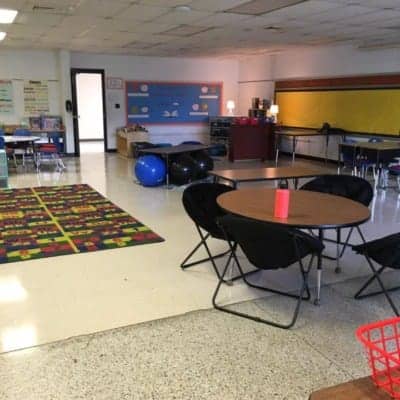
Through flexible and alternative seating, students instead had the power to make their own decisions, taking the primary responsibility off of the teacher.
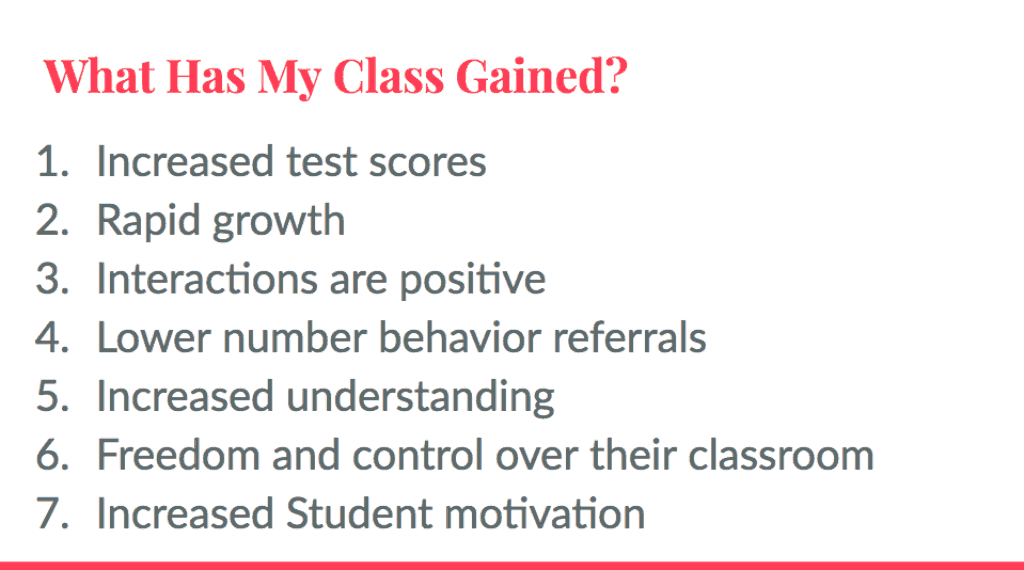
“When you give the control over to the students, then more learning and authentic experiences occurred,” said Morgan, who is now a third grade teacher at D.C. Virgo Preparatory Academy. As a result, he reports his students are more motivated, are higher-level thinkers, and are happier.
“A teacher that is happier makes a classroom that is happier. And a classroom that is happier is more productive,” said Wortman.
Students choose where they sit, what they sit on, and who they sit with. This has another interesting consequence: when no student has belongings inside a desk, collaboration, sharing, and sense of community increase.
“These things belong to everyone,” Morgan said of the deskless classroom.
Wortman also said that it means students are learning more from one another and not just the teacher. For her classrooms, this has meant more positive interactions, a less stressful environment, and fewer behavior referrals. Her test scores increased by 10-15 percent and other teachers in her school started to adopt flexible seating.
Is she an outlier case? Probably not. In a study completed in 2015 by the University of Salford in the U.K., it was found that flexible classrooms “improved academic performance in reading, writing, and mathematics by 16 percent. The personalization of classrooms—including flexibility, which Barrett defined as ‘student choice within the space’—accounted for a full quarter of that improvement.”
The researchers concluded that classroom flexibility “isolated from other measured factors, appears to be roughly as important as air quality, light, or temperature in boosting academic outcomes.” However, study authors note that it’s not the furniture itself making all the difference, but the “dynamic use of the space by the teacher and students that pays, in the end.”
For Wortman and Morgan, these results mean their deskless classrooms are here to stay.
“It’s not just a fad. It’s a philosophy of instruction,” Morgan said.