
How the College of The Albemarle bridges gaps for the U.S. Coast Guard’s workforce

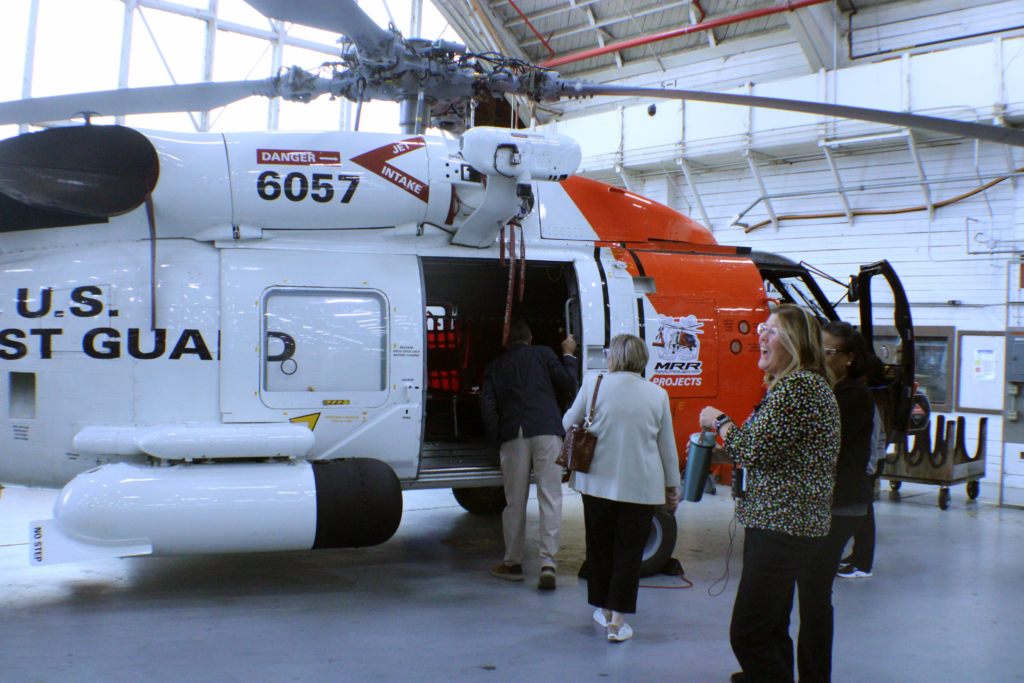
The College of The Albemarle (COA) contributes to the future of aviation logistics by educating U.S. Coast Guard personnel and civilian contractors.
Section 1A SBCCC 300.1 of the State Board of Community Colleges Code says “Educational programs offered by community colleges on all military installations
will be conducted by the home college.” For the U.S. Coast Guard base in Elizabeth City, their home college is COA.
COA has the responsibility of providing accessible education, specialized training, and pathways that help translate military experience into civilian credentials and academic advancement.
 Sign up for Awake58, our newsletter on all things community college.
One way COA is doing that is through their “Wings of Opportunity” initiative. Supported by a grant from the John M. Belk Endowment, COA has worked to provide a streamlined pathway to a diploma or degree for personnel and civilian contractors working at the Coast Guard’s Aviation Logistics Center (ALC) in Elizabeth City.
The Coast Guard is a self-certifying agency, meaning the training and certifications personnel and civilian contractors receive during their time with the Coast Guard do not translate to Federal Aviation Administration (FAA) recognized certifications.
“(The Coast Guard has) this workforce that are doing these jobs, and the FAA doesn’t recognize those certifications, or those capabilities. So getting that certification is vital,” said Dr. Jack Bagwell, president of COA.
To bridge that gap, COA has created the Wings of Opportunity initiative to allow Coast Guard personnel and civilian contractors to receive course credit for their prior training on their path to a degree or diploma. This is known as credit for prior learning.
The college offers an associate of applied science (AAS) degree in aviation systems technology as well as diplomas in airframe maintenance and powerplant maintenance.
COA also offers a Designated Mechanic Examiner (DME) preparation course. Through the course, U.S. Coast Guard personnel and other military-trained aviation professionals can prepare for FAA certification exams. Those who earn FAA certifications can receive credit for prior learning toward an associate of applied science degree in aviation systems technology.
The course of study is meant for individuals interested in careers as mechanics with air carriers, manufacturers, repair stations, fixed base operators, flight schools, and government aviation operations. Students are taken through aviation mathematics, Federal Aviation Administration (FAA) regulations, basic electricity, aircraft drawings; aircraft structures, systems, and components; aircraft engines, theory, systems, and components; and engine inspections and maintenance, per a description of the program’s curriculum. All of it is offered at the college’s Currituck campus.
Students can graduate with ratings in both airframe and powerplant — otherwise known as an A&P rated mechanic.
According to the U.S. Bureau of Labor Statistics, in 2025 the median annual wage was $79,870 for aircraft mechanics and service technicians and $82,280 for avionics technicians. By 2035, employment of aircraft and avionics equipment mechanics and technicians is expected to grow by 6% with 13,100 more positions being available each year, which is faster growth than other occupations.
Read more
Johnathan Kight manages C-130s in one of the hangars at the ALC. He has been in the field for over 16 years and is currently in the aviation mechanic program at COA.
Kight said he enrolled in the program for his own personal development.
“I’ve been working on my college degree for a long time now. Put three kids through college. Thought it was my turn, and doing the A&P was kind of an accelerated way to get some credit hours,” Kight said.
COA also plays a role in expanding local testing options so personnel can get third party and aviation industry recognized certifications.
Rob Pizano, an avionics technician at the logistics center, recently graduated with an AAS degree in aviation systems technology in July 2026.
Pizano said he was interested in the program because of the pace of it compared to other programs, which have tests every three weeks.
“The closer I got towards retirement, I was like, ‘I don’t have anything to show what I’ve done my whole adult life,’” Pizano said. “Basically, this is all I know. All I know is aviation.”
Several ALC personnel who have been in the aviation mechanics program at COA told the community college staff that they tell all of their colleagues to take advantage of it.
“Blue suitors talk to blue suitors,” Kristin Wynkoop, training and education specialist at the logistics center, said.
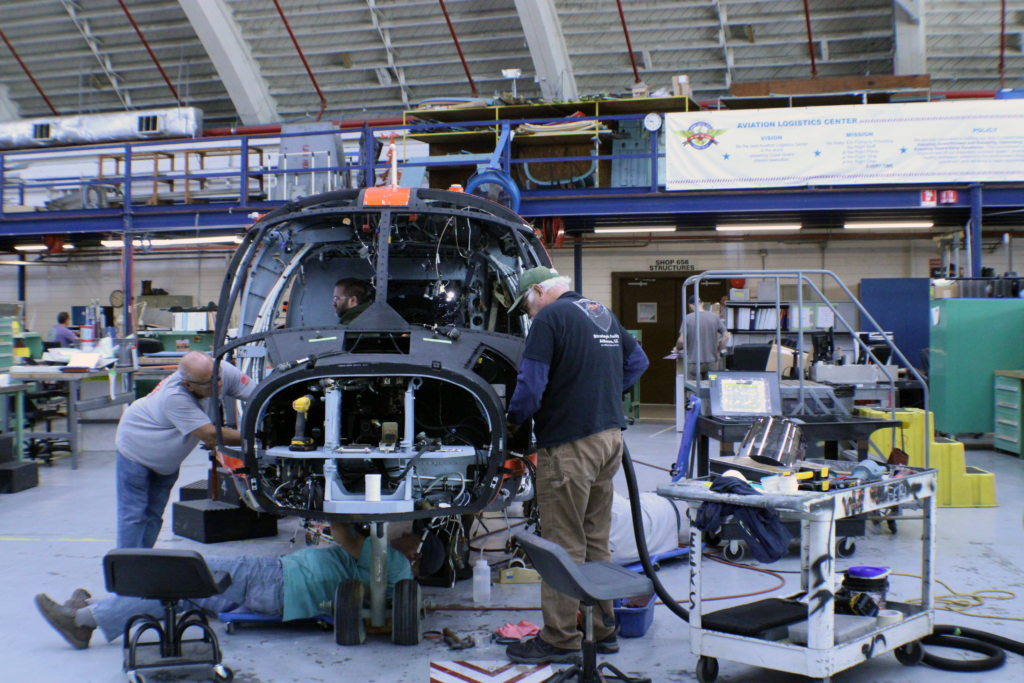
President Bagwell said he would love to see the aviation programs they offer to Coast Guard members expand, but COA has limited capacity due to issues with space and instructors.
Overall, Bagwell said they have three goals for the aviation program.
The first is to expand what the college thinks it can support long-term with their aviation program as it is now. The second is to grow their other regional offerings so they can move some programs and create some capacity for aviation maintenance at the Currituck campus. Their third goal is to see how they can help the Coast Guard train individuals in other areas, such as helping personnel get hazmat certifications, Bagwell said.
Wynkoop said if other military installations want a relationship with a nearby community college, they should simply reach out and ask what programs they can tailor to the experience they are looking for from their personnel.
“The partnership with COA is very important to us because it not only fosters community with gaining people that are qualified to be employed with us, but it also allows our current employees to get further training within the workforce that they may not have had an opportunity to get before,” Wynkoop said.
Editor’s note: The John M. Belk Endowment supports the work of EdNC.