
Credit for Prior Learning Awareness Week: Making attainment ‘all that much easier’

For many students, especially adult learners, credit for prior learning (CPL) might be the game changer for attainment. Next week, Sept. 21-25, the N.C. Community College System (NCCCS) is celebrating the inaugural Credit for Prior Learning Awareness Week by offering free trainings and a new toolkit for colleges.
Credit for Prior Learning Awareness Week is a part of National Workforce Month, and is enabled by the Statewide Credit for Prior Learning grant that the NCCCS received from the Council for Adults and Experiential Learning (CAEL) and RAND. The community college systems in Alabama and Colorado also received the grant, and Dr. Seth Kamen — NCCCS director of transfer, learning recognition, and credential alignment — told EdNC the grant has given the NCCCS the ability to collaborate with the other two states on how best to promote CPL.
“Our goals are to recognize and support the work being done to connect students to credit they’ve already earned, equip faculty and staff with the tools to recognize it, and strengthen the partnerships that make it possible,” the week’s website says.
Kamen said he hopes the week will be an opportunity for schools, industry partners, and communities to learn more about how CPL can benefit them and their students. He also outlined many of the barriers students must overcome as they seek a degree or a credential, and he explained that giving them access to CPL makes attainment “all that much easier.”
“We just want to ensure that every institution has the ability to ramp up and continue to grow in their CPL program,” said Kamen.
 Sign up for Awake58, our newsletter on all things community college.
What is CPL?
CPL is a system of awarding college credit to students for knowledge that they have already acquired and proven themselves competent in. In North Carolina, the State Board of Community Colleges defines CPL as “curriculum credit awarded for college-level learning obtained through prior learning experiences other than curriculum coursework.”
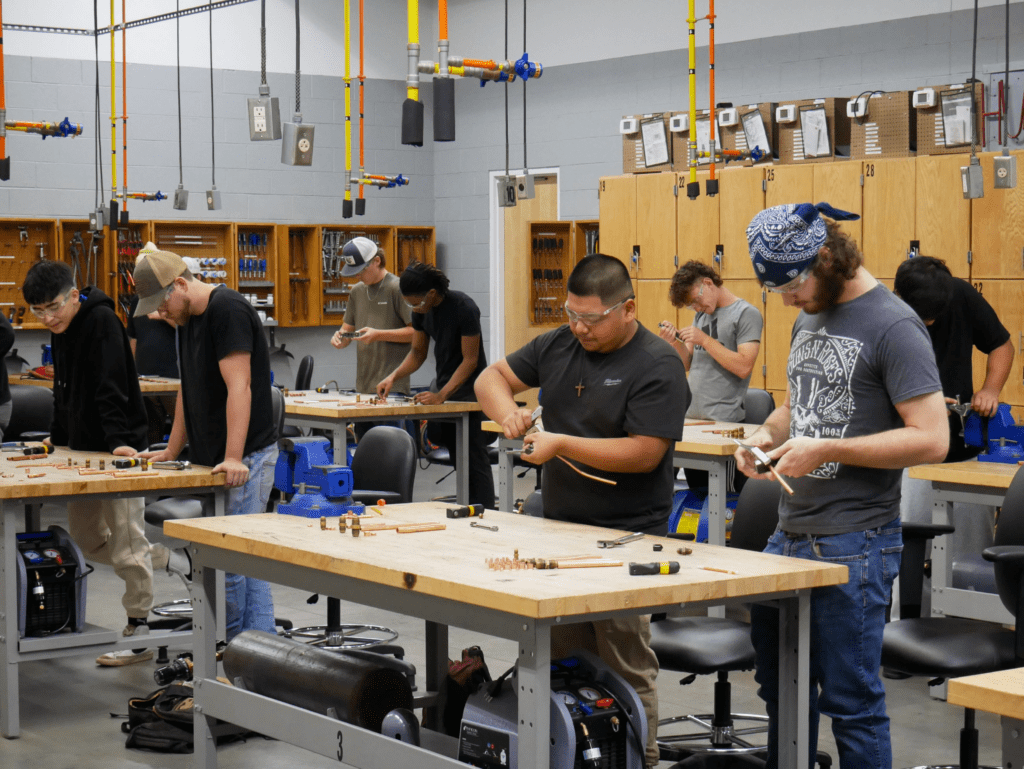
Kamen said students can receive CPL for standardized tests, AP (Advanced Placement) credit, CLEP (College-Level Examination Program) credit, as well as various other types of experiences — like military service, apprenticeships, or other work. Importantly, for students who might not have gone directly to college and instead entered the workforce or the military, CPL rewards them for their expertise.
In June 2019, myFutureNC unveiled an ambitious attainment goal — 2 million North Carolina residents between the ages of 25 and 44 completing a high-quality credential or postsecondary degree by 2030. Kamen said that expanding CPL can help reach that goal.
“We have so many students who never went to college, are in the process of upskilling, or started college and didn’t finish. Those noncredentialed students, they’ve been out in the workforce,” said Kamen. “(If) we’re asking them to move forward in their educational career, we need to help them do that. And to do that, we need to give them the credit.”
Research has found that CPL has benefits for both students and schools.
A 2020 study found that associate degree-earning adult students with CPL credits had fewer months between the date first enrolled to the date of earning their degree, compared to similar students with no CPL credit. Adult students with CPL credits seeking bachelor’s degrees also “saw reduced time to degree,” according to the same study.
Kamen explained that offering CPL can be a chance for a school to both “respect” and “empower” their students because it tells students that their school values the experience they bring to the classroom.
“You need to be able to work with the student to make them succeed in the process that they are going through,” said Kamen.
Furthermore, a 2022 study found that 84% of “likely enrollees” said that the ability to receive college credit for their life or work experiences would have a strong influence on their choice of school.
“Students who receive CPL actually end up taking more courses at the institution,” said Kamen. “They are more likely to enroll. They are more likely to graduate, and they are more likely to choose an institution that is transparent and upfront about the CPL that they award.”
Expanding the implementation of CPL
State Board code grants all community colleges in North Carolina the right to accept CPL at their respective institutions, and Kamen said the system is planning to revisit and update the code regarding CPL. He also said that all 58 schools in the system have implemented CPL in some way, but there is not continuity across the system.
“Every school has its varying policies, so sometimes it’s simply that they won’t accept a certain grade on one of the exams or (after a) length of time,” said Kamen. “The policies need to be revisited given the current environment, given our current student population.”
Kamen said he encourages schools to reflect on the “why” behind their policies that limit CPL.
At the state level, he said he hopes the week will be an opportunity to build on the ongoing commitment to workforce development and the conversation about CPL.
“We’re doing quite a lot in the system. Our students end up going other places,” said Kamen. “We need the opportunity to have conversations about the transfer of CPL to those other institutions. … We need to have conversations about how we can better fund CPL resources at the schools so that they have more time, more resources, more opportunity to do that.”
Related reads

Celebrate CPL Awareness Week
NCCCS’s Credit for Prior Learning Awareness Week kicks off next Monday, Sept. 21, and the system is hosting several free trainings and events to help schools, industry partners, and the public connect with and understand CPL.
Explore the week’s offerings below, and preregister to claim your spot. The events will also be recorded and made available to anyone who registers in advance.
- Tuesday, Sept. 22 | 10-11 a.m. — Learning Without Borders: Federal Policy and the Future of Learning Mobility
- Tuesday, Sept. 22 | 12-1 p.m. — CPL 101: Introduction to Credit for Prior Learning
- Wednesday, Sept. 23 | 10-11 a.m. — Credit for Prior Learning in the Disciplines
- Wednesday, Sept. 23 | 1-2 p.m. — From Recognition to Progress: Lessons on Credit for Prior Learning for Military Learners
- Wednesday, Sept. 23 | 2-3 p.m. — From Policy to Practice: A Campus Perspective of CPL Implementation
- Thursday, Sept. 24 | 11-12 p.m. — Inside the UNC System’s Military Equivalency System
- Thursday, Sept. 24 | 2-3 p.m. — Advancing Adult Learner Success: Insights and Action Steps from NC Reconnect and Reengage Nebraska
- Friday, Sept. 25 | 11-12 p.m. — Launching the Community College Military Evaluation Project
“I just want everybody to start embracing CPL, to better understand CPL, and then to start those dialogs at a larger level, so that the student’s interest is met. In the end, it’s all about the students,” said Kamen.
You can also explore a NCCCS toolkit for institutions on CPL here, including information on core messaging, marketing and communications, graphics, campus event ideas, and more.