
North Carolina spent decades building an early childhood system. What will it take to sustain it?

Editor’s note: This report is premised on this EdNC timeline of the history and evolution of early childhood education in North Carolina from 1990 to 2026.
This article, along with this one by Iheoma U. Iruka, will be considered by state and national philanthropists at a conference in North Carolina on Oct. 28-30, 2026, held by the Early Childhood Funders Collaborative.
In 1990, a small scholarship initiative for early childhood educators began in North Carolina. TEACH Early Childhood grew out of research examining the state’s early childhood workforce and an idea that seems straightforward today: the education, compensation, and retention of early educators are connected. Three years later, North Carolina launched Smart Start, creating a public-private, locally driven approach to improving school readiness and supporting young children and their families. By the end of the decade, the state had established a dedicated Division of Child Development, developed a quality rating system for childcare, created education-based salary supplements for early educators, and begun implementing a five-level Star Rated License.
Individually, those initiatives addressed different problems. Together, they were beginning to form something larger. North Carolina was building an early childhood system.
More than 35 years later, the state is still building it. But the questions have changed. What began largely as an effort to improve childcare, workforce preparation, quality, and school readiness has expanded to include children’s development and education from birth through 8 years, family economic security, educator compensation, employer workforce needs, community infrastructure, and economic development.
And while expectations have expanded for the early childhood system, one question has persisted across decades and political administrations:
How should North Carolina sustainably pay for it?
The question has become increasingly urgent as federal investments wind down and North Carolina reconsiders how quality, subsidies, workforce supports, and financing fit together. Understanding the choices ahead begins with understanding how the state arrived here.
Building more than programs
The early 1990s marked a significant turning point for early childhood policy in North Carolina. TEACH Early Childhood began in 1990, following the state’s first early childhood educator workforce study. The scholarship initiative sought to help educators increase their education while connecting that advancement with better compensation and retention, which eventually became a national model.
At the federal level, the Child Care and Development Block Grant Act created a new framework for helping lower-income working families afford childcare while allowing states to invest in quality improvement. The Child Care and Development Fund would become a primary source of childcare assistance for lower-income families. Then came Smart Start.
 Sign up for Early Bird, our newsletter on all things early childhood.
Launched under Gov. Jim Hunt in 1993, Smart Start was built around the idea that preparing children for school required more than a single program. Its public-private structure allowed local communities to identify needs and invest in strategies related to early care and education, health, family support, and school readiness. The approach eventually expanded across all 100 counties through local partnerships.
That same year, North Carolina consolidated childcare functions within a dedicated Division of Child Development, strengthening the state’s administrative infrastructure for early childhood. The remainder of the decade brought additional pieces.
North Carolina created a voluntary quality rating and improvement system. Child Care WAGE$ provides education-based salary supplements intended to address compensation and retention. And the state’s five-level Star Rated License began moving childcare regulation beyond minimum health and safety requirements by recognizing programs meeting higher quality standards.
What is striking in retrospect is not simply the number of initiatives North Carolina created. It is the range of problems the state was attempting to address simultaneously: affordability, workforce preparation, educator compensation, quality, local decision-making, school readiness, state administration, and public-private partnership. North Carolina was not yet talking about an “early childhood system” in all the ways the term is used today. But many of its building blocks were already taking shape.
The growing recognition of childcare as early education
The next phase of North Carolina’s early childhood history brought another shift. The question was no longer only whether families could find childcare or whether programs met basic standards. Increasingly, policymakers, educators, researchers, and communities were asking what children should experience and learn before kindergarten.
In 2001, North Carolina established More at Four, a state-funded voluntary pre-K program for at-risk 4 year olds. The program used a mixed-delivery model, with classrooms operating in public schools, Head Start programs, and private childcare centers. By 2004, it was operating in all 100 counties. That rapid expansion did not happen in isolation.
North Carolina had spent the previous decade building local Smart Start partnerships, childcare quality infrastructure, state administrative capacity, and relationships among public schools, private providers, Head Start, and community organizations. Infrastructure created for one purpose helped make the next innovation possible. At the same time, the state was becoming increasingly explicit about the educational and developmental experiences children should have before entering school.
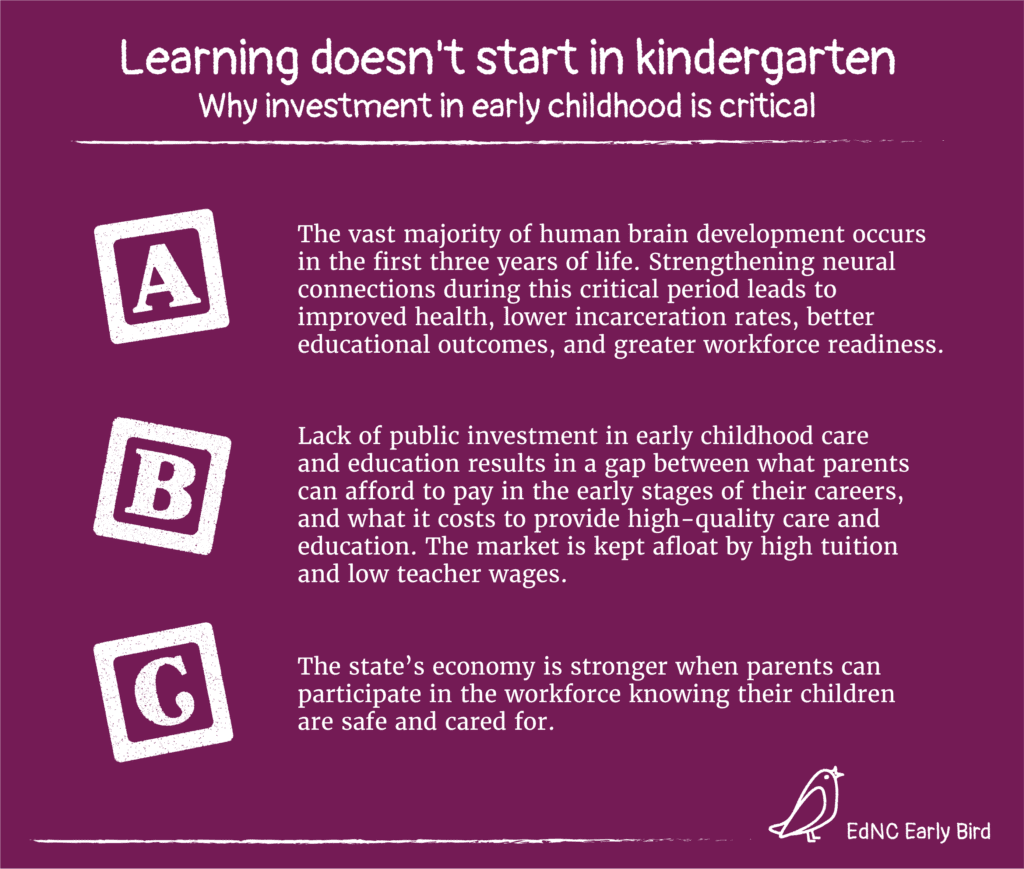
In 2005, North Carolina released Foundations: Early Learning Standards (FELD) for North Carolina Preschoolers. Two years later, Infant-Toddler Foundations extended developmental and learning guidance to children from birth through age 3.
Those developments represented more than new standards. They reflected an evolving understanding of the field itself. The language increasingly shifted from “childcare” to “early care and education,” reflecting a broader understanding of children’s developmental and educational experiences before kindergarten.
Young children’s environments were understood not simply as places where children were cared for while parents worked, but as settings in which relationships, language, cognition, social-emotional development, physical development, and early learning were taking place. That evolution also raised expectations for the adults doing the work. If early childhood programs were educational environments, the people working in them were educators.
And that brought North Carolina back to a problem it had been attempting to address since TEACH began — how to increase educator knowledge and credentials while also addressing the compensation and retention necessary to keep qualified people in the field.
Expansion met a changing fiscal reality
The early years of North Carolina’s system-building were characterized by considerable innovation and expansion. The Great Recession altered that trajectory.
According to the North Carolina Justice Center, from fiscal year (FY) 2007-08 to 2019, combined state and federal early childhood funding declined by about 26%, while state funding declined by roughly 53%. The result was greater reliance on federal resources. Yet the field continued to evolve even as its fiscal environment became more constrained.
In 2011, More at Four moved from the Department of Public Instruction to the Division of Child Development at the Department of Health and Human Services and became NC Pre-K. That same year, the Division of Child Development became the Division of Child Development and Early Education, a name that reflected the increasingly blurred line between what had historically been considered childcare and what the state now recognized as early education.
In 2013, North Carolina combined its infant-toddler and preschool guidance into the North Carolina Foundations for Early Learning and Development, establishing a birth-to-5 continuum. Two years later, Pathways to Grade-Level Reading helped broaden the conversation again, connecting early childhood policy with children’s development and learning through third grade. The progression is important.
North Carolina’s early childhood system had initially focused heavily on childcare access, quality, workforce, and school readiness. Now the lens was expanding across the developmental continuum.
The question increasingly became not simply whether a child was ready for kindergarten, but how experiences beginning at birth connected to later learning and development.

Extending the continuum: Birth through age 8
By the end of the 2010s, that broader understanding had become explicit in state policy. North Carolina expanded workforce strategies for infant-toddler educators and created clearer higher education pathways through a statewide early childhood articulation agreement.
In 2018, Gov. Roy Cooper directed the creation of a statewide Early Childhood Action Plan. When the plan was launched in 2019, it established 10 data-informed goals encompassing children’s health, safety, family well-being, learning, and school readiness through age 8. The evolution over less than three decades was significant.
North Carolina had moved from developing solutions largely centered on childcare and school readiness to considering a much broader system of conditions affecting children from birth through the early elementary years. But while the state’s understanding of what constituted a strong early childhood system had expanded, its financing structure remained complicated.
A 2019 funding shift illustrated the problem. State lawmakers moved $50 million in federal Temporary Assistance for Needy Families (TANF) funding from childcare subsidies to NC Pre-K, replaced those subsidy dollars with new federal CCDF funding, and redirected $50 million in state funding that had supported NC Pre-K elsewhere in the budget. Programs could continue. But the underlying balance between state and federal investment had changed. Within a year, that financing system would face a test no one had anticipated.
COVID made the invisible infrastructure visible
When COVID-19 arrived in 2020, childcare programs faced an extraordinary contradiction. They were financially vulnerable at precisely the moment the broader economy needed them most. Programs cared for children of essential workers. As businesses reopened, parents needed childcare in order to return to work. Childcare’s role as economic infrastructure became difficult to overlook. Then came an extraordinary infusion of federal resources.
The American Rescue Plan Act directed approximately $1.3 billion in childcare funding to North Carolina, including money to stabilize providers and additional funds to support childcare investments and affordability. Stabilization grants helped programs cover operating costs and supported recruitment, retention, wages, and benefits at a scale that had not been possible through normal financing.
For providers accustomed to operating on narrow margins, the money provided breathing room. For the workforce, it offered opportunities for bonuses, wage increases, and other compensation supports. And for policymakers, the pandemic offered something of an unplanned experiment.
What happened when significantly more money entered the childcare system? But another question followed almost immediately: What would happen when it left?
For a time, some in the early childhood field hoped that the federal Build Back Better Act might transform temporary emergency investment into a more sustained national commitment to childcare and preschool. That legislation did not pass. Stabilization grants continued to uphold programs, including compensation increases, but the resources remained temporary. The “childcare cliff” was approaching.
Related reading


From emergency response to a sustainability conversation
What happened next is important because North Carolina did not move directly from federal stabilization funding to today’s policy changes. Between those points, an increasingly broad collection of parents, providers, advocates, policymakers, philanthropies, researchers, and business leaders began asking what a more sustainable system could look like.
The Care and Early Learning, or CandL, listening initiative brought parent and provider perspectives into conversations about the future of childcare and early education. Additionally, the Hunt-Lee Commission elevated early care and learning within a broader discussion of education, workforce, and economic policy.
As warnings about the end of federal stabilization funding intensified, the state’s early childhood advocacy community organized around workforce compensation, subsidy, and sustainability. A bipartisan early childhood caucus emerged in the General Assembly, alongside a coordinated push for major new investment.
The 2023 state budget extended stabilization supports but did not provide a permanent replacement. It also created a Tri-Share pilot, introducing a model in which employers, families, and government share the cost of childcare. That development reflected another evolution in the early childhood conversation.
Public-private partnership was not new to North Carolina. It had been embedded in Smart Start since the 1990s. What was changing was the degree to which employers increasingly saw childcare as their issue, too.
A parent who cannot find reliable childcare may not be able to work. A business that cannot recruit or retain employees because workers cannot find care has a workforce problem. A community without enough childcare capacity may have an economic development problem. And a provider that cannot pay enough to recruit educators may have empty classrooms even when families are waiting for care. Those are different manifestations of the same interconnected system.
A crisis in western North Carolina underscored the connection
Hurricane Helene made those connections especially visible in western North Carolina in 2024. The storm damaged communities, businesses, homes, roads, and childcare infrastructure. For families attempting to return to work and communities beginning a long recovery, childcare became part of the recovery infrastructure. The General Assembly allocated $10 million for affected childcare facilities. Helene created an acute crisis, but it also illustrated a broader challenge.
North Carolina is not a one-size-fits-all childcare market. The realities facing a provider in a fast-growing metropolitan area can be very different from those confronting a provider in a rural eastern county or a mountain community recovering from a natural disaster. Family incomes vary. Workforce availability varies. Operating costs and enrollment patterns vary. The supply of infant and toddler care varies.
And yet programs across those communities share many of the same fundamental expenses required to employ qualified educators and provide safe, high-quality care. That geographic variation has become increasingly important as North Carolina considers how its financing system should work.
Related reading

The end of stabilization was not the end of the work
By 2024 and 2025, North Carolina was addressing immediate funding challenges while planning for the future. Temporary funding continued some compensation supports at reduced levels, and the state moved forward with modernizing its long-standing quality rating system.
At the same time, Invest Early NC began bringing organizations together around longer-term strategies, while ExCEL NC engaged business leaders more directly in childcare advocacy.
In March 2025, Gov. Josh Stein established the North Carolina Task Force on Child Care and Early Education, bringing bipartisan policymakers, state agencies, providers, business leaders, and advocates together around affordability, access, workforce, supply, and financing. Later that year, House Bill 412 became law, making childcare regulatory changes and directing additional planning related to quality rating improvement system (QRIS), subsidy participation, and payment requirements.
The task force developed recommendations focused on subsidy reimbursement, workforce supports, affordability, supply, public-private partnerships, and long-term financing. Together, these efforts signal a broader shift. Rather than simply adding new programs, North Carolina is reconsidering how its early childhood system is structured, supported, and financed.
The workforce remains a test of the system
Few issues illustrate the unfinished work better than the early childhood workforce. North Carolina has been working to address educator preparation, compensation, and retention since at least 1990. TEACH helped educators pursue higher education. WAGE$ connected education with salary supplements. Infant-Toddler Educator AWARD$ extended compensation strategies to those working with the youngest children. The statewide articulation agreement created clearer pathways from community college programs to bachelor’s degrees and birth-to-kindergarten licensure. During the pandemic, stabilization funding allowed providers to increase compensation more directly. Yet workforce compensation and retention remain central concerns in 2026.
That does not necessarily mean earlier efforts failed. Instead, it points to a longstanding challenge in the economics of childcare. Childcare is labor intensive, and appropriate ratios limit the number of young children one adult can care for. Personnel costs are therefore significant, while there is a limit to what families can afford to pay.
The result is a difficult balance: Families pay more than they can afford while providers still receive less than they need to cover the true cost of quality care. At the same time, educators earn less than their education, skills, and responsibilities warrant.
These challenges are interconnected. Reducing costs for families without replacing that revenue can hurt providers. Raising educator compensation requires a sustainable funding source. And raising tuition to cover the full cost of care can put it beyond the reach of more families. That is why the workforce challenge is also a financing challenge and why financing has moved to the center of North Carolina’s early childhood conversation.

North Carolina begins another redesign
In 2026, North Carolina took a significant step toward changing how childcare subsidies are financed. The state’s FY 2026-27 budget directed roughly $97 million in recurring federal funds toward higher subsidy reimbursement rates and established a statewide reimbursement floor. Later, a second technical corrections bill increased the appropriations for childcare services by $60 million.
The floor matters because reimbursement rates have historically varied based on local childcare markets. In communities where market prices are lower, reimbursement rates can also be lower, even though the underlying costs of providing quality care do not decrease at the same rate.
The change does not solve every childcare financing challenge, and financing is not the only part of the system being reconsidered. North Carolina is also modernizing the Star Rated License system it began building nearly three decades ago, while state leaders continue examining workforce strategies, supply, affordability, mental health supports, and public-private approaches.
In some ways, North Carolina has returned to where it began. The state is once again experimenting. The difference is that it is no longer starting with a blank page.
Related reading


What 35 years can teach us
Looking across North Carolina’s early childhood history reveals significant progress, but not a straight line. The state built programs that became national models, created local infrastructure that endured changes in political leadership, expanded public pre-K statewide, and developed standards spanning children’s development from birth through age 5 and later through age 8. It also built workforce initiatives, quality systems, public-private partnerships, and a mixed-delivery model.
At the same time, North Carolina experienced funding reductions, growing reliance on federal resources, persistent workforce challenges, uneven access, and continuing questions about affordability and sustainability. COVID-19 exposed vulnerabilities that existed long before the pandemic. The federal response temporarily changed the scale of investment, and its end forced the state to confront questions it had postponed but never fully escaped.
The state’s history also offers several lessons.
- Infrastructure matters. More at Four was able to expand rapidly in part because North Carolina had spent years building local partnerships, quality systems, and relationships among providers and public institutions.
- Local context matters. Smart Start’s structure recognized early that communities differ and that statewide goals do not necessarily require identical local solutions.
- Workforce and quality are inseparable. North Carolina’s repeated investments in education and compensation reflect a reality the state recognized decades ago: Quality ultimately depends on the people interacting with children every day.
- Public-private partnerships matter. From Smart Start to today’s employer engagement, North Carolina has repeatedly relied on sectors working across traditional boundaries.
- Temporary funding is not the same as sustainable financing. Emergency resources can preserve programs, increase compensation, and expand possibilities. Their expiration can also expose the structural problems they temporarily helped offset.
Perhaps the larger lesson is about time. North Carolina’s early childhood system was not built by one governor, one legislature, one organization, one political party, or one funding source. It accumulated over decades.
Today’s system carries decisions made in the 1990s alongside programs developed in the 2000s, alignment efforts from the 2010s, emergency interventions from the pandemic, and reforms still being designed. That history complicates any simple characterization of North Carolina as either an early childhood success story or a system in crisis. It is both more accomplished and more unfinished than either description suggests.

What comes next?
North Carolina’s early childhood question in 2026 is no longer whether the state should build a system. It has one. The question is what that system should become.
Which pieces built over the past 35 years should be preserved, and which need to
change? What should be expected of early educators, and what compensation and
support should accompany those expectations? How should quality be defined and
measured? How should responsibility for the cost of care be shared among families, government, employers, philanthropy, and other partners?
Those questions also extend beyond childcare. If the goal is to strengthen
outcomes for young children and families, how do we make sure the system supports children regardless of where they spend their days? While continued investment in regulated care is important, many young children are cared for by parents, relatives, or others outside of regulated settings. How are we supporting those children and families as well?
That means continuing to think broadly about what families need for their children to thrive, including economic security, health and developmental supports, strong family engagement, and connections to resources in their communities.
North Carolina does not enter those questions without experience. TEACH
demonstrated the connection among education, compensation, and retention. Smart Start demonstrated the potential of combining statewide investment with local decision-making, public-private partnerships, and integrated early education, health, and family support. More at Four showed how existing infrastructure could support rapid expansion. Early learning standards and the Early Childhood Action Plan reflected an increasingly broader view of children’s development, family well-being, and outcomes.
COVID demonstrated something else: Childcare is not only family and education
infrastructure; it is economic infrastructure. But North Carolina’s history also suggests that an early childhood system is larger than childcare alone.
After more than 35 years of building, the opportunity now is to consider what needs to be preserved, what needs to be strengthened, where gaps remain, and how North Carolina can better support all young children and families. The next chapter is not simply about sustaining what has been built. It is about making sure the system continues to evolve in ways that reach more children and families and create the conditions for them to thrive.
Behind the Story
Liz Bell contributed to the early childhood timeline.