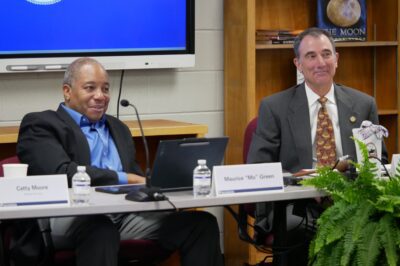
The State Board of Education’s Task Force on Accountability for Public School Units continued its work to redesign North Carolina’s school accountability system last Thursday, discussing its charge and working recommendations from the Department of Public Instruction (DPI).
Thursday’s meeting did not include any votes. Instead, the task force’s third meeting focused on reaching agreement on the group’s first cluster of performance indicators: achievement, growth, and extended graduation rate.
“What we’re trying to attempt today is to identify consensus to guide the future state accountability system design and continue allowing that work to move forward as we review and refine these and get to a final product at the end of the year,” said Curtis Sonneman, acting director of DPI’s Office of Accountability, during a presentation to the task force.
 Sign up for the EdWeekly, a Friday roundup of the most important education news of the week.
The State Board of Education first proposed the task force to develop a new school-level accountability system in October.
In North Carolina, under state law, school grades are currently based on each school’s achievement score (including standardized test grades), weighted 80%, and on students’ academic growth, weighted 20%. Education leaders have long said that formula does not capture the full picture of the work happening in the state’s public schools.
Over the last few years, and under the leadership of former state Superintendent Catherine Truitt, DPI advocated for state lawmakers to change how school performance grades are calculated to account for more factors than achievement and growth. While lawmakers initially showed interest in DPI and Truitt’s plan, they never passed legislation changing the formula. Even before Truitt, lawmakers and the Board have discussed how to change the state’s school accountability model. The creation of this task force reflects another attempt by DPI to reform school performance grades.
The task force’s purpose is to design a new theory of action and design principles for the accountability system. Members will work with the Center for Assessment, a nonprofit supporting districts and states through the design, implementation, and evaluation of school accountability systems. The Center for Assessment worked with DPI on the early development of Truitt’s accountability system plan in 2022.
Members will continue meeting throughout the year, with the goal of drafting an initial report and recommendations in December, according to a draft timeline presented during the December meeting.
The task force then plans to present its model to the State Board in May 2027, according to the draft timeline, with the hope of voting in June 2027. Statewide implementation of the new model would begin in October 2027 if the plan receives the necessary legislative approval.
You can find all meeting resources on this DPI website, and all the members on the task force in the EdNC article below.
The role of the task force
Last week’s meeting started with a reminder of the group’s role and scope of work.
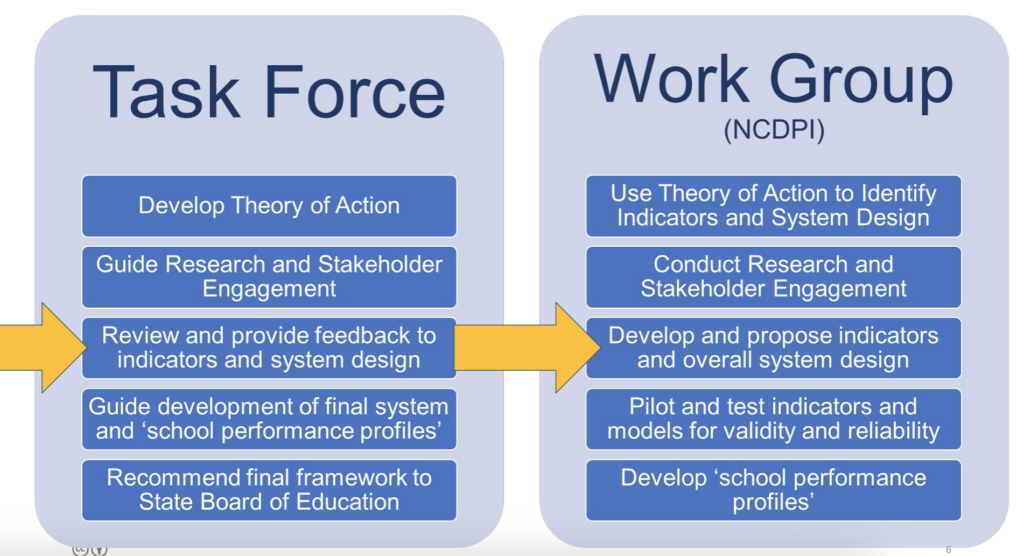
“Your role as a task force is not to design every technical component of the accountability system or make final decisions about formulas, measures, or calculations,” said Rupen Fofaria, the director of Board operations and policy. “Rather, the role is to provide direction and establish parameters. You are identifying what matters most in an accountability system — what outcomes you want to prioritize and what guardrails should shape future decisions.”
Over the next few months, the task force will work first, Fofaria said, with the work group — made up of DPI staff — responding to that work as recommendations. The work group, he said, is there as “a resource and technical actors who deal with accountability systems on a more regular basis.”
The work of the task force so far
During the task force’s first meeting in February, the group discussed the new model’s theory of action, meant to define “how” the task force would move from the current system to a new proposal.
Members spent the majority of that first meeting working through guided exercises and discussions to establish a vision for the new accountability system. Members answered questions about future graduates’ preparation and qualifications, their priorities for the accountability system, and the roles and responsibilities of different stakeholders within the system. You can read a summary of the first meeting from the Center for Assessment here.
At its second meeting in April, the group discussed a draft of its theory of action, “articulat(ing) a coherent set of priorities for what the accountability system should accomplish and how it should function.”
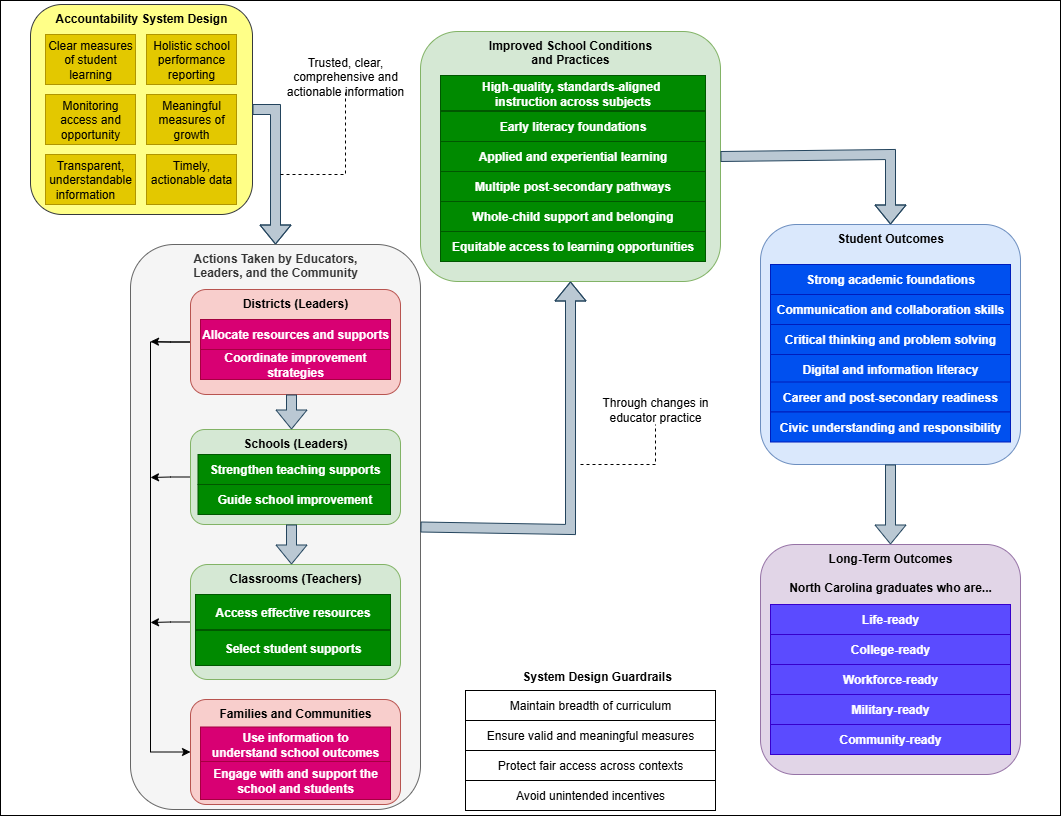
The April meeting also included discussion of design principles and priorities for the working group, including:
- A desire for the system to be clear and easy to understand.
- An openness to changing the current model, even if that limits comparisons to past data.
- An interest in balancing standardization with flexibility when it comes to which indicators are used/how they are used.
- A preference for using existing data where possible to avoid adding reporting burdens on schools.
- A preference for a system that goes beyond outcomes and reflects school- and/or district-specific opportunities and school conditions.
The group also reviewed a framework from the National Academy of Science, Engineering, and Medicine outlining 16 possible indicators of school quality, including both student outcomes and access to resource and opportunities.
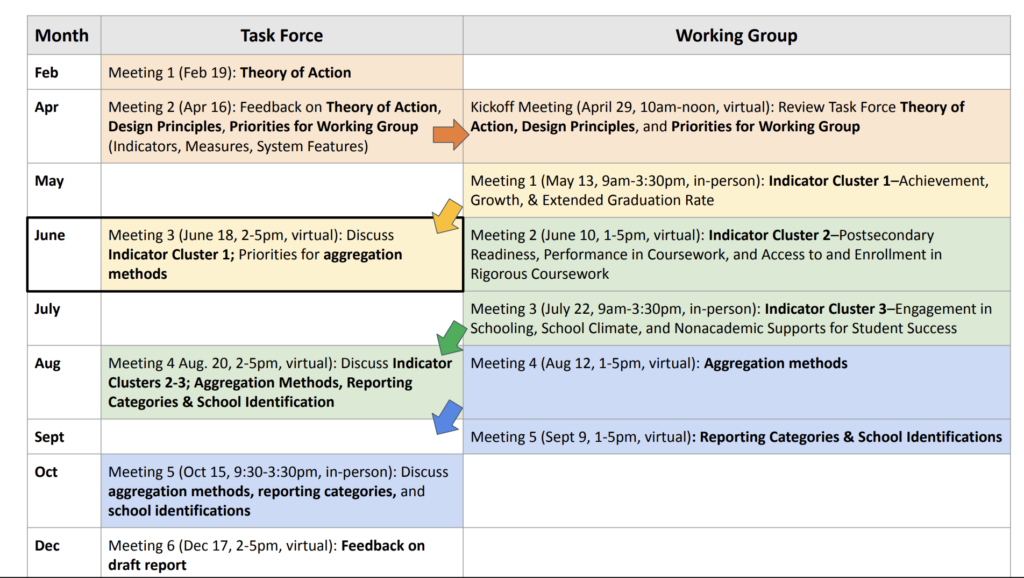
Ahead of last week’s meeting, the DPI working group then met twice to review the task force’s discussion and discuss indicators from the first cluster: achievement, growth, and extended graduation rate.
The task force is set to meet three more times this year, according to a draft document: Aug. 20, Oct. 15, and Dec. 17. According to the graphic below, the second cluster includes postsecondary
readiness, performance in coursework, and access to and enrollment in rigorous coursework. The third cluster includes engagement in schooling, school climate, and nonacademic supports for student success.
A look at the discussed indicators, aggregation
On Thursday, the task force discussed initial recommendations from the DPI working group on the first cluster of proposed indicators. As mentioned above, the task force did not vote on the recommendations last week, but its discussion will help the working group in focusing recommendations for future work.
Below is a brief look at the recommendations that were discussed. You can also review the executive summary and recommendations document task force members reviewed ahead of the meeting here.
Extended graduation
During the task force’s April meeting, members discussed the desire to explore extending the graduation rate to five years.
Given that consensus, the DPI working group recommended that DPI consider both the four-year and five-year adjusted cohort graduation rates as the graduation rate measure in the accountability system.
DPI already collects five-year cohort graduation rate data from schools, the working group said, so this change wouldn’t require additional data collection.
Using an extended-year graduation rate may incentivize and reward schools and districts to keep students on a pathway to graduation and to earning a high school diploma, even if it takes an extra year, which could lead to better long-term life and future outcomes for North Carolina’s students.
Working group executive summary document
However, the working group recommended that more weight be applied to the four-year rate over the five-year rate.
Elena Ashburn, a former school principal and the governor’s senior adviser for education policy, said she has concerns about any model incentivizing a five-year graduation rate.
“So, in my opinion, I think that the weight should be significantly on for your cohort graduation to ensure that our level of expectation is that we’re getting kids across the stage in four years, because that’s what’s best for them,” she said. “I say that also having worked with many kids who maybe did need the fifth year … I think the emphasis needs to significantly remain on four-year graduation rate, and then maybe give them some bonus points if they can additionally get some kids high school diplomas in the fifth year.”
Other members agreed, while some added concern that schools not be penalized for helping students graduate who needed a fifth year. Darrell Pennell, chair of Caldwell County Schools Board of Education and adviser to the Board, asked how the five-year rate would impact early colleges, where eligible students can opt to stay on for a fifth “super senior” year to earn their associate degree.
DPI’s Sonneman said that early colleges already indicate to DPI when they have students staying for the fifth year for this purpose, and that those students are counted as graduating in the four-year cohort (assuming they have met minimum high school graduation requirements).
Achievement
The working group discussed three different achievement metrics during its meeting: proficiency level summaries, proficiency indices, and mean (or average) scale scores. North Carolina currently uses proficiency level summaries, the executive summary document says.
“The Working Group was provided with detailed information on the three metrics, their advantages and challenges, and then discussed potential benefits and practical barriers to implementation for all three. The group overwhelmingly supported the change to proficiency indices,” the document says.
The working group’s recommendation was that DPI “should consider using a proficiency index to calculate the achievement indicators in the state accountability system.”
Task force members expressed interest in learning more about a proficiency index, and how it could provide differentiation in scores. “Proficiency indices provide more information on school achievement because the percent of students scoring in each achievement level is used rather than collapsing that information into 2 categories (percent proficient and above or not proficient),” the document says.
Members also noted the importance of reporting on proficiency clearly, letting the public know what percentage of students are proficient within a school.
Sonneman clarified that it is a federal requirement for states to provide the percentage of proficient students within a school, so that measure is not going away. However, he said, that number doesn’t have to be used in the state’s accountability system.
Beckie Spears, principal at Wilkesboro Elementary School and advisor to the Board as 2024 Wells Fargo Principal of the Year, said that “proficiency needs to mean something.”
“It’s a yes or no question on proficiency, depending on where you set the mark,” Spears said, referring to grade level standards. “It’s something that we do need to be able to define for parents to understand are students meeting the expectation for a grade level? Because as a parent I would want that perspective.”
Growth
Much of the task force’s discussion was spent discussing growth models.
In May, the working group discussed evaluation criteria to guide the selection of growth models, reviewing three different types of growth metrics: categorical models (e.g., value tables), growth percentiles, and regression or value-added models. North Carolina currently uses a value-added model through their agreement with EVAAS, the working group document says.
“Without compelling reasons or benefits to change, the group overwhelmingly supported continuing with a value-added model approach to calculating the growth indicator for elementary and middle schools,” the document says.
However, “some in the working group also recommended that NCDPI consider a value-added model approach in the future that could produce adequate and appropriate student-level growth data for internal use by school/district leads, not for school identifications or public reporting.”
Ultimately, the working group recommended DPI continue using a value-added growth model (e.g., EVAAS) to calculate the grades 3-8 growth indicators in the state accountability system.
Task force members presented a spectrum of opinions about the current EVAAS system, with some liking it and others not.
Vice Chair Alan Duncan and Sonneman clarified that EVAAS will continue to be used to track student growth in North Carolina. The question, Duncan said, is whether the state will use EVAAS as its accountability measure tool.
After a lot of discussion, most members expressed interest in looking at different models for the accountability system beyond EVAAS. Duncan asked the working group to come back with more specifics.
“Perhaps it’s worth taking this opportunity to at least find out what else would be out there, and whether or not we should be seriously considering it for informational purposes, if for nothing else,” Duncan said.
Thursday’s presentation noted that “the 80/20 weighting of achievement to growth is a key concern,” and that aggregation methods would be discussed once there is agreement on the indicators of the new system proposal.
At the end of Thursday’s meeting, the task force discussed such aggregation methods.
Aggregation is the process of combining indicator-level results into a single summative score or grade. The method chosen, not just the underlying data, influences the final rating.
DPI/Center for Assessment presentation
North Carolina currently uses a compensatory approach where all indicators are combined to produce a single score, the presentation said. That score is then used to assign a single letter grade (A-F) to the school.
The presentation said concerns among task force members with the current system “suggest the need to examine how different aggregation approaches would change what the system communicates and which schools are identified.”
The working group plans to bring more information about aggregation approaches and indicators to the task force’s next meeting on Aug. 20. At that meeting, the group is also set to continue discussions on aggregation and performance indicators, along with reporting categories.
In addition to the already scheduled meetings in October and December, Duncan said there may be an additional in-person meeting in September.

Recommended reading