
‘Achieving Educational Excellence’: Strategic plan for public schools takes hold across North Carolina


Following the launch of a strategic plan calling for North Carolina public schools to be the best in the nation, Superintendent Mo Green embarked on a tour of the state in fall 2025.
The biggest surprise? Green excels at drone soccer, garnering local support for him to join the Asheboro High School team.
Green and leaders from the N.C. Department of Public Instruction (DPI) traveled 1,413 miles, visiting 21 districts, 26 schools including one charter, five construction sites, three community colleges, and two four-year universities, according to a summary report of the tour.
At each stop, Green asked educators and stakeholders a simple question: “Where do you see yourselves in the plan?”
The answers to that question were important because, as the superintendent told those he met along the way, “It’s not just Mo Green’s plan.”
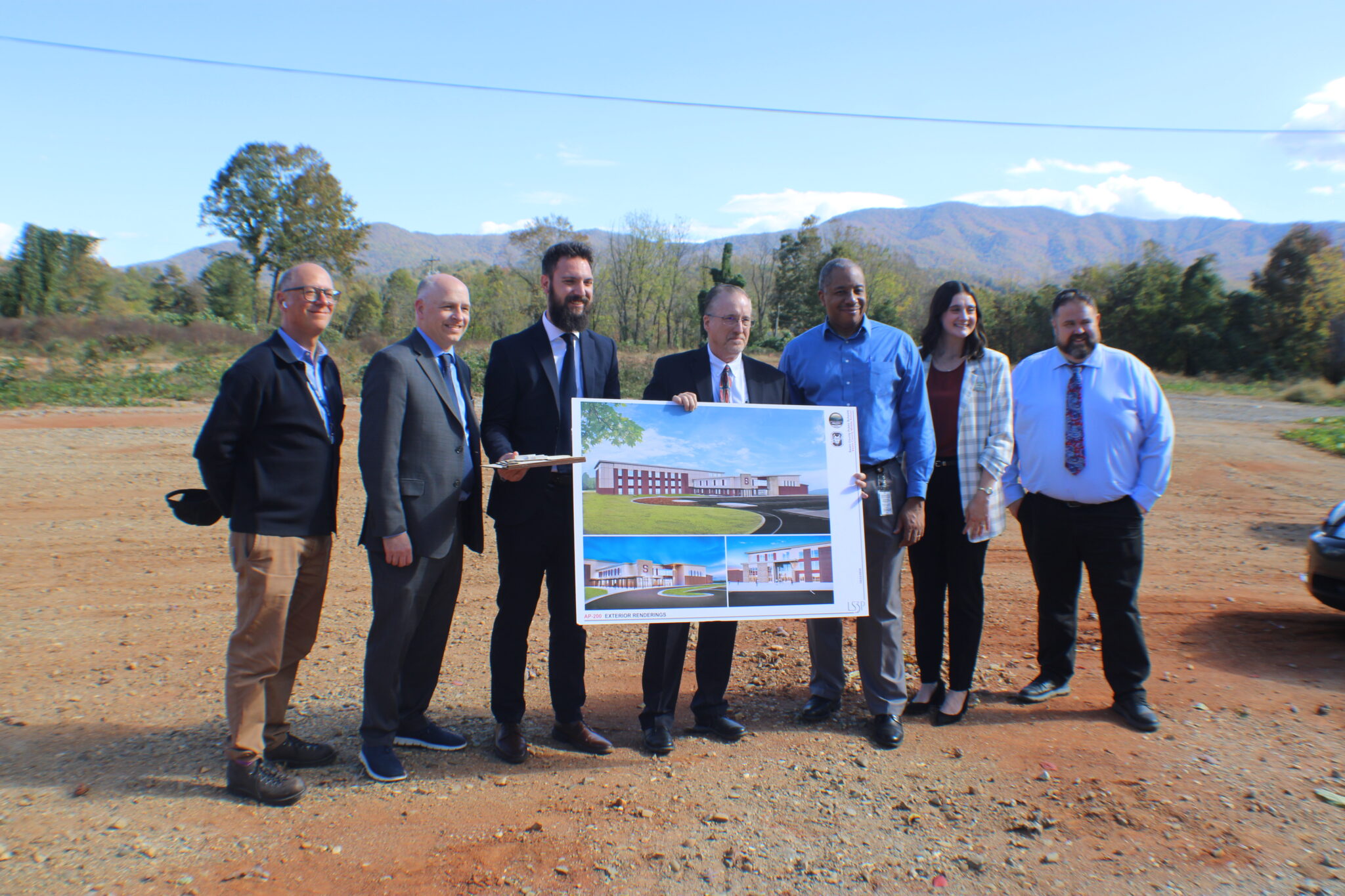
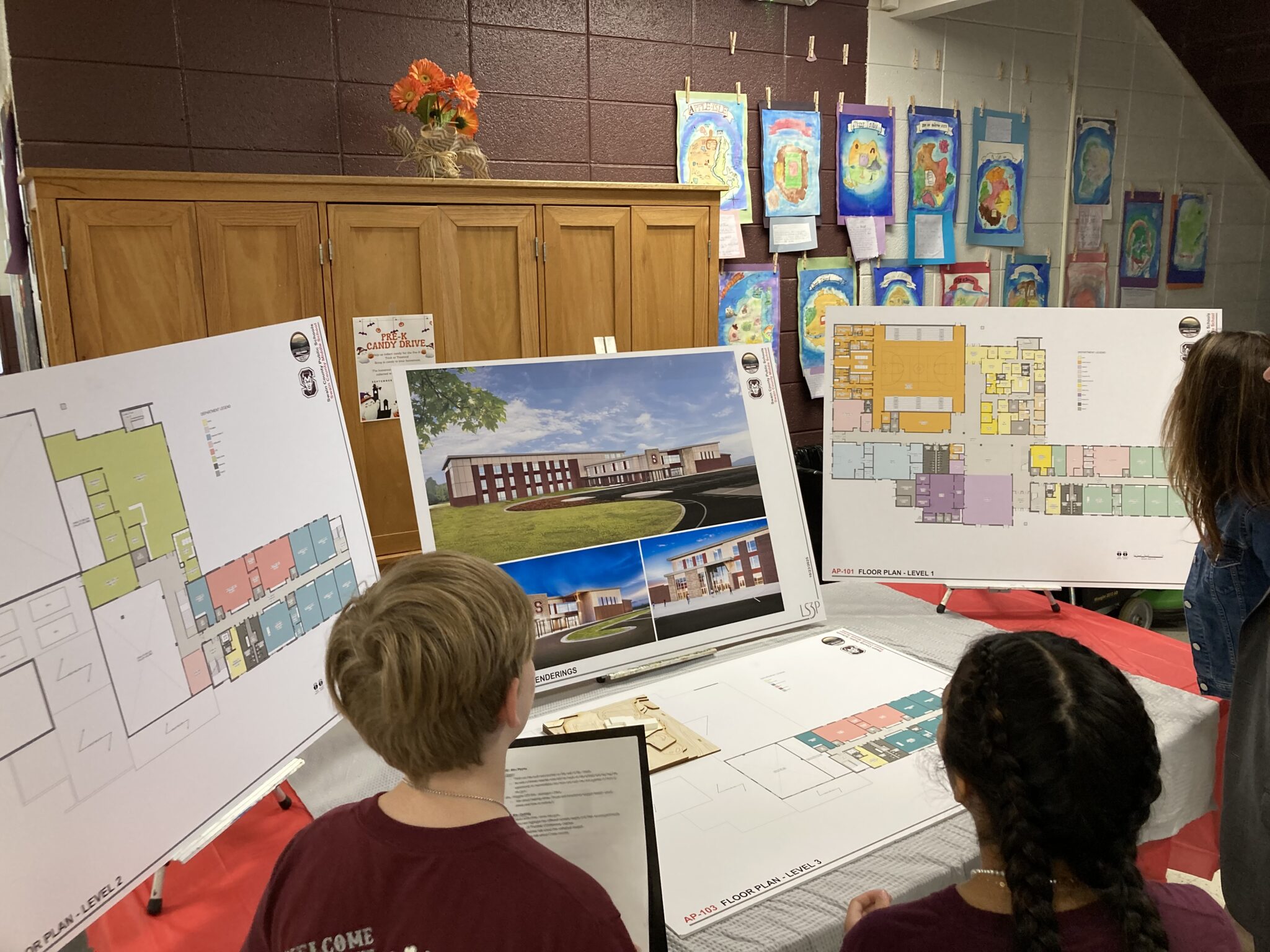
In Swain County, Superintendent Mark Sale stood in the middle of an empty field, the future site of a $52 million, 100,000-square-foot building for up to 500 middle schoolers, with the state superintendent.
Green’s strategic plan calls for healthy, safe, and secure learning environments.
This school construction project will get underway only once the water and sewer infrastructure for the site is sorted out, Sale said, noting he needs the superintendent’s help.
“I wanted Mo to stand here with me and hopefully agree this matters, and we need to solve these problems,” he said. “And I’m asking you all to help us solve these problems however you can.”
Prior to serving as state superintendent, Green was a district superintendent himself. He knows first hand the challenges of getting school buildings built.
Sale was among dozens of public school leaders to share gratitude and goals with Green regarding their communities during his months-long statewide tour.
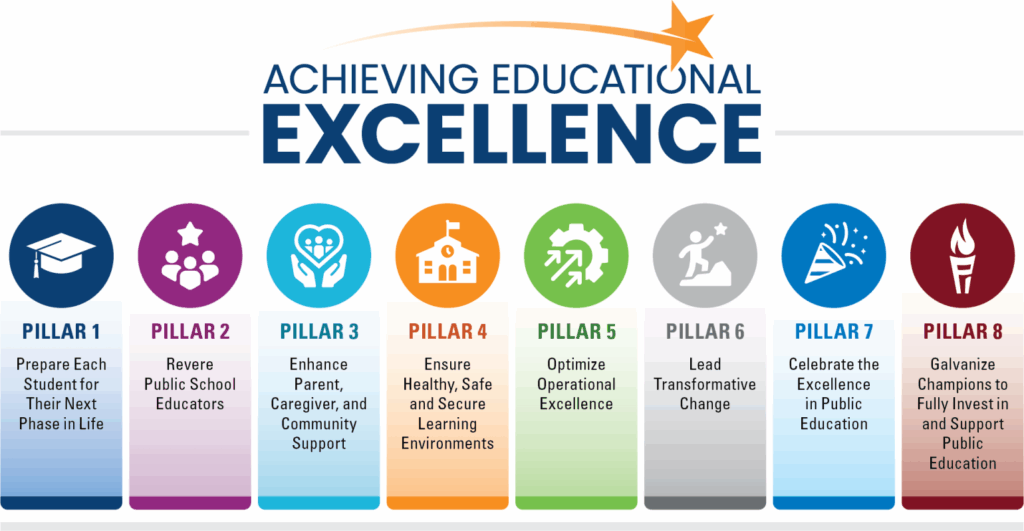
Green, North Carolina’s first Black state superintendent, was sworn into his role on Jan. 1, 2025. After spending months gathering information and feedback on the state of North Carolina public schools, he worked with DPI and the State Board of Education to create a 37-page, five-year strategic plan titled, “Achieving Educational Excellence.”
Driving the goal for North Carolina public schools to be the best in the nation, the plan lists 110 action items across eight pillars.
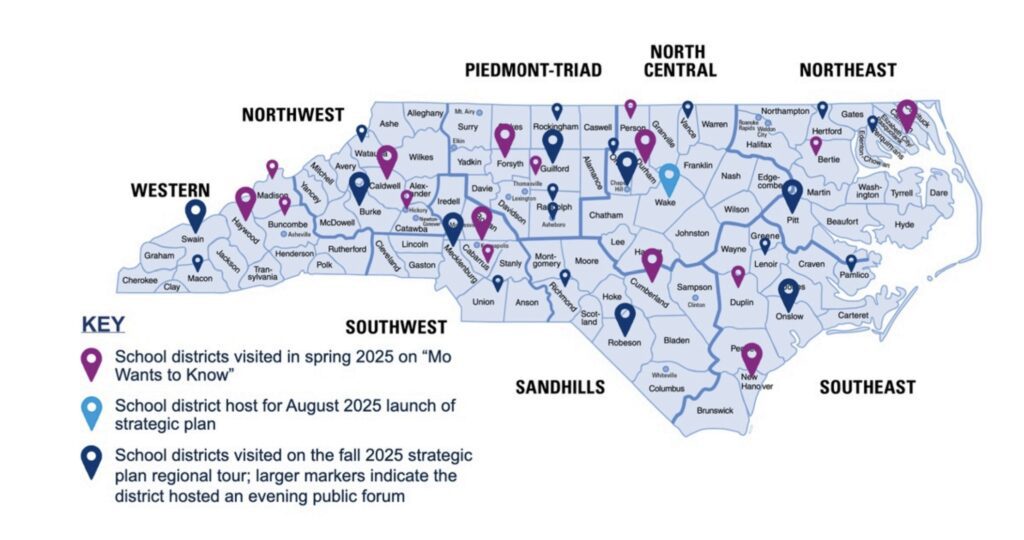
Local and statewide leaders joined the tour in all eight regions to learn about what is happening in public schools across the state.
Each of the counties and districts visited in the fall were different from those visited during Green’s spring listening tour to develop the plan.
EdNC accompanied Green and the team at each stop to document the tour, where it went, who leaders met with, the types of experiences incorporated, how the strategic plan addresses feedback from the spring listening tour, how the strategic plan is already being implemented statewide, and receptivity to Green’s leadership.
In DPI’s summaries from each stop, you can see the legislators that joined the tour and the local media coverage along the way.
The entire tour was on the record.
 Sign up for the EdDaily to start each weekday with the top education news.
Northeast: A future-ready plan
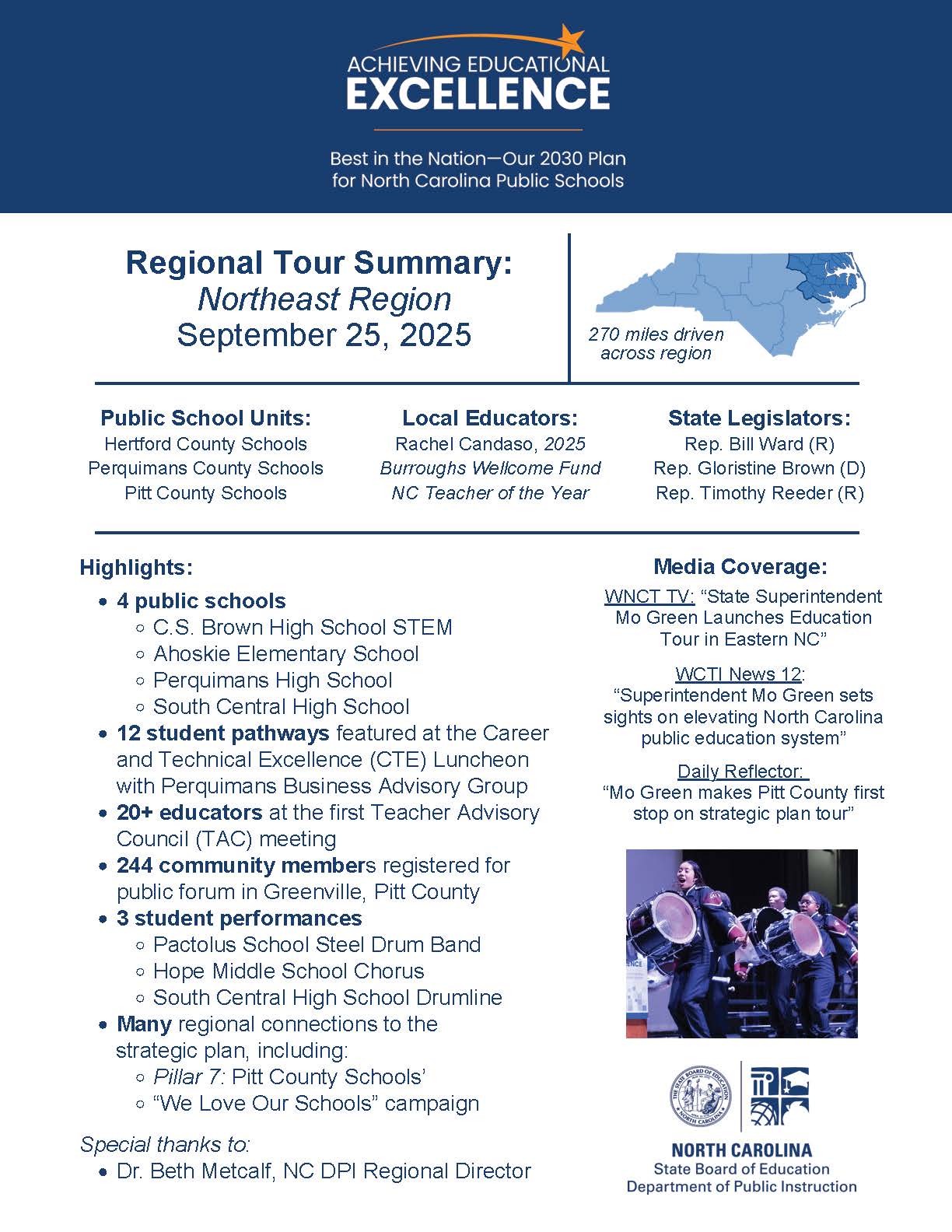
Schools in northeastern North Carolina are pushing to have their students future-ready. Career and technical education (CTE) departments in the region check off boxes in the new statewide strategic plan’s first pillar to “prepare each student for their next phase in life.”
This “means giving them the tools that all people need to function in the 21st century,” the plan reads. “It also means ensuring access to opportunities after they graduate from high school.”
When Green walked into C.S. Brown High School STEM in Hertford County during the first stop of the strategic plan tour, several textbook-sized machines were racing across the classroom. Students had just learned how to program their Sphero RVR+ robots with “a brain” in order to control them. Now they were working on getting them to change colors. RVRs are bots shaped like all-terrain tanks that are designed for students who are learning how to program for the first time.
The class’s ultimate goal was to build a robot for the statewide FIRST Robotics Competition, which will take place in April 2026.
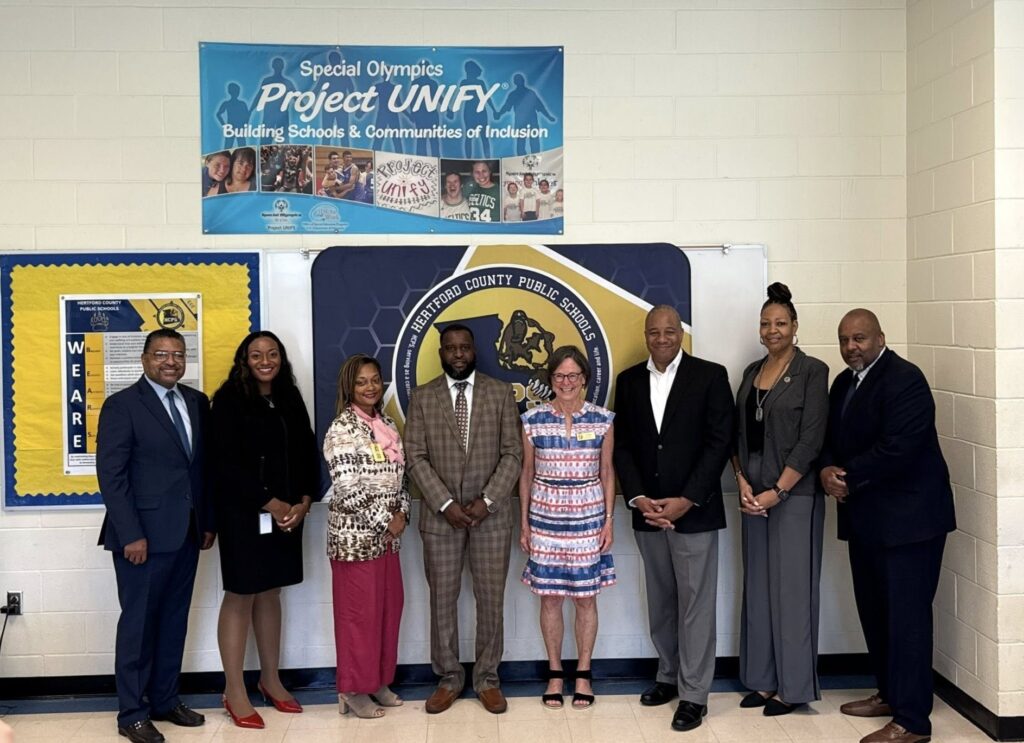
The class was just one example of how Hertford County Public Schools is a student-centered, equal-opportunity district, according to Superintendent Jesse Pratt.
“We want to make sure everyone has the access to a quality education each and every day, and then we hold ourselves accountable for that,” Pratt said.
While C.S. Brown demonstrated how to prepare for the future, the school also means a lot to the community’s history. C.S. Brown was the first Black high school in North Carolina and the alma mater of education leader Dudley E. Flood.
“The Northeast may be rooted in history, but it is rising with innovation, collaboration, and heart,” 2025 Burroughs Wellcome Fund Teacher of the Year Rachel Candaso wrote in a DPI blog. “Like Dr. Flood before us, we continue to build bridges for those who will follow, because every student, in every county, deserves to see the promise of their future reflected in the schools that serve them.”
In the next county on the tour, Perquimans, leaders showcased student opportunity across all pathways. Visitors heard presentations from students in agriculture, health science, family and consumer science, business, industrial, and dual enrollment tracks.
“You champion public education when you advocate for CTE,” said Tanya Turner, Perquimans County Schools superintendent.
District CTE Director Melissa Swain said they formed a student advisory council in order for instructors to get more insight from students.
“Being removed from the classroom, you often forget what it’s like to be a student in the classroom,” Swain said. “And from a teacher perspective, we forget what we’re not seeing — the skills every day that students may need to work on.”
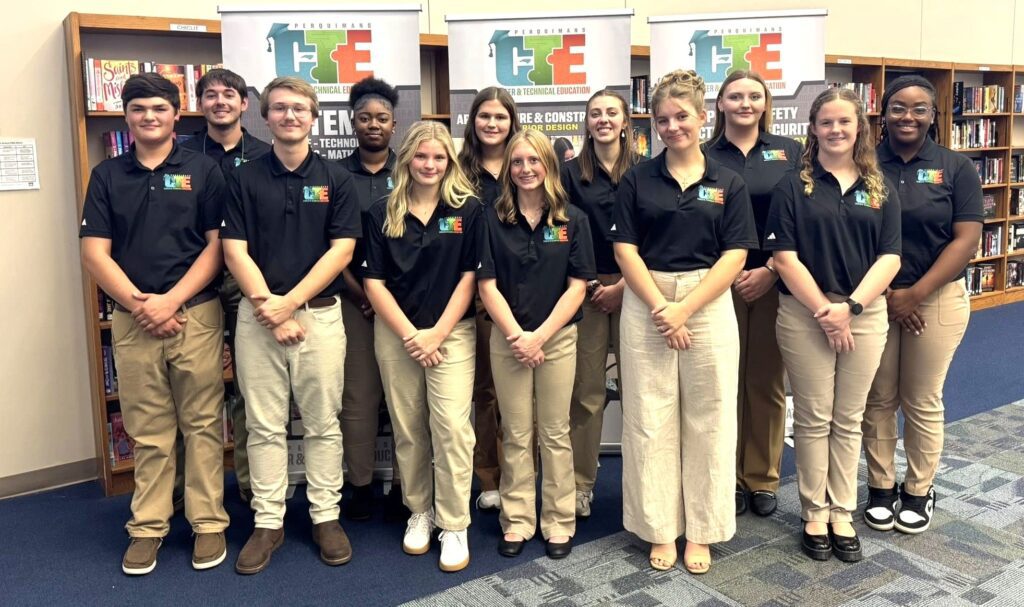
The 12 students on the council participated in a leadership boot camp over the summer. During the tour, they were tasked with presenting their experiences as students in leadership positions. Most of the council members were involved in several extracurricular activities on top of earning vocational credentials.
Senior Lanna Howell, for example, participates in five student organizations while taking health science CTE courses, dual enrollment courses through College of The Albemarle, and working part-time.
She said one experience that stood out to her was taking a child development class while being a peer mentor at a local elementary school.
“I’ve been able to adapt my communication skills in order to more easily understand my students and learn guidance strategies to become a better role model and create more supportive environments for their work,” Howell said.
Sarah Barnard, a senior at Perquimans High, said the hands-on experiences she had in her health classes helped her better understand what she doesn’t want to do in the future. For example, after doing a health career boot camp with East Carolina University, she realized she was not interested in biomedicine and now wants to explore other options in the medical field.
Throughout all of his visits on the fall tour, Green said he saw action steps included in the strategic plan already being taken by educators and students. He also engaged in panel discussions to show communities how the strategic plan addresses concerns raised during the spring listening sessions.
When Green engaged with this region’s education stakeholders in April, for instance, they shared concerns about special education department caseloads, a desire for universal early childhood education, and the challenges of school funding in rural areas. All of those things require more money.
Funding reform is addressed in the strategic plan’s sixth pillar, which is “lead transformative change.” Its associated actions are launching as soon as this January, according to the plan document.
Green said educators should expect there to be an increase in advocacy for higher teacher salaries, and his team is exploring a broader weighted student funding model, which could mean a heavier weight for rural students. Green pointed to Tennessee as a successful example of this kind of model being implemented.
“I’m willing to do all the heavy lifting, all of the analysis, all of the things that have to happen for us to do an effective weighted student funding formula,” Green said.
In addition to Green’s remarks, the night included a student performance, welcoming remarks from regional director Beth Metcalf, and the local point of view from Pitt County Schools Superintendent Steve Lassiter.
“We need resources… especially for teacher pay and staff support,” Lassiter told WNCT. “Recruiting top talent depends on it.”

At the end of each night on the tour, Green closed with an ask of the audience.
Southeast: A builder’s plan

The strategic plan calls for schools to be future-ready, which the plan says requires investing in strong foundations.
One example is building on the state’s science of reading investments and “high impact literacy practices” for early learning.
Literacy was highlighted at the beginning of the southeast leg of the strategic plan tour.
Chief academic officers and principals from across the state have looked to Pamlico County Schools as a role model for literacy momentum, local educators said.
Savannah Alexander, principal of Pamlico County Primary School, said it is just as important for students to have context to make meaning of the words as it is to focus on phonics.
“Our students here don’t always have as many opportunities as students who might live in the Triangle with access to museums,” Alexander said. “We do the best that we can to bring that knowledge and those experiences back to our students at school, because we know that even though that’s not the decoding and the phonics aspect, it’s just as important for them to make meaning from that text.”
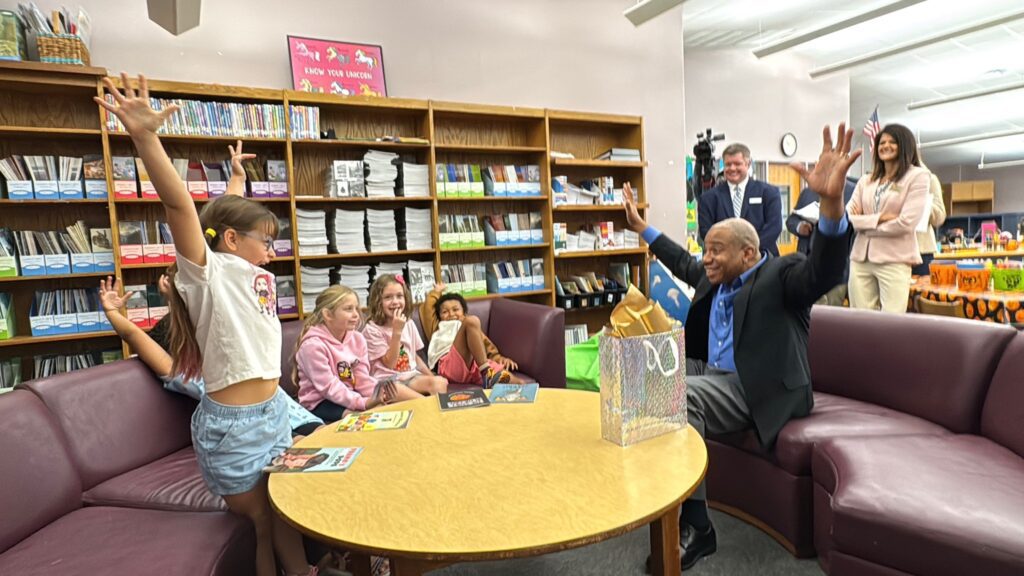
The school serves pre-K through third grade students. In 2023, the school’s educators found that the kindergartners were scoring below average on their state reading assessments at the beginning of the year. After implementing new strategies, the district said the kindergarten class of 2024 jumped from 18% proficiency to 47% proficiency–almost 30 percentage points.
“We want them to read… so that they can go to college, they can join the military, they can learn a trade in CTE, and they can be successful in doing that. We never want that barrier for them to be because we failed them here,” Alexander said.
Constructing a tighter community
Just around the corner from Pamlico Primary, the future middle and high school these students will attend is under construction.
The principal said a new building was necessary due to the damage the school sustained during Hurricanes Irene and Florence.
Pillar 4 of the strategic plan focuses on safe and healthy school environments to ensure students and staff can focus on teaching and learning.
“This is our vision: to have all of our schools within a stone’s throw of each other. One school serving K-5, one serving 6-12,” said Jeremy Johnson, Pamlico County Schools superintendent. “I can honestly say that a building doesn’t make the school. People make the school, but our people also deserve a place where they can learn and grow in a safe and healthy environment too.”
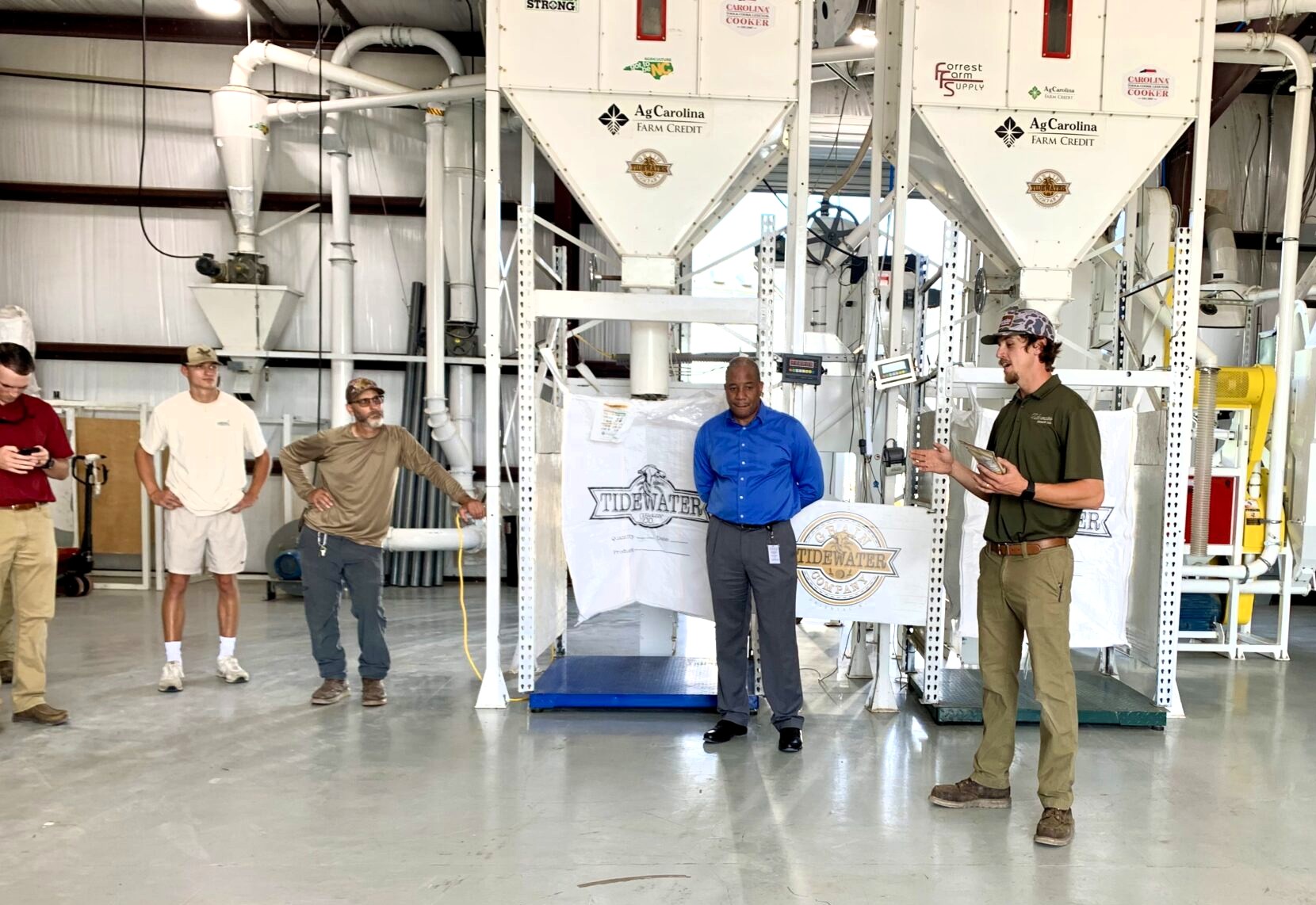
Green later visited Tidewater Grain company — a farm-to-school partner, further driving home the goal of keeping students healthy.
Creating career pipelines
In Lenoir and Onslow counties, the district superintendents provided Green with examples of future readiness through CTE in their districts at their respective tour stops.
Brent Williams, Lenoir’s superintendent, said they resist the idea that students in “a small, poor school system in eastern North Carolina” are “anything less than the best.”
“Instead, we have chosen to embrace the belief that our students not only can excel educationally and achieve at the very highest levels,” Williams said. “But also that they will do so, each and every day in our school system.”
Amy Jones, director of CTE in Lenoir, said that the sooner students are introduced to different career opportunities, the sooner they can make decisions on their desired paths.
For example, one workforce development opportunity, Workforce Ignite Lenoir, includes partners like Crown Equipment Corporation, which places high school juniors and seniors in summer internships, leading to full-time employment for some students.
The day concluded with Onslow County Schools welcoming Green into the Eastern North Carolina Regional Skills Center, which houses CTE opportunities for the district, to host his public forum.
During his remarks, the district’s superintendent, Christopher Barnes, said their CTE credential attainment increased 47% over the past four years.
“These achievements reflect dedication and innovation of our students and families and the power of community support. None of this work happens without the dedication of principals and educators, many of whom are in the room, and I want you to know that your leadership makes the difference in our public schools,” Barnes said. “You are what makes public education a noble profession, one that deserves to be revered and respected and supported.”
Piedmont Triad: The community’s plan

Strong relationships with families, local businesses, and other community partners help students perform better, according to the strategic plan’s third pillar, “enhance parent, caregiver, and community support.” The plan encourages educators to include all stakeholders in decision-making processes.
Asheboro City Schools offers a physical space for this purpose, the Global Innovation Center, which is not only available for students, but the entire community. One of the building’s suites serves as a welcome center. Inside, parents can ask logistical questions like how to access Infinite Campus, the district’s operating system for student information.
The welcome center’s staff have also helped parents sign up for English as a Second Language (ESL) classes at the local community college, find food resources, and obtain assistance with job searches, said Dr. Wendy Rich, assistant district superintendent.
“We did not feel that an innovation center was complete without that heavy family component, and exposing families to the same level of innovation that we want to do for our students,” Anthony Woodyard, chief information officer for the school district, said.
Over the course of three years, the district was able to convert the building using over a quarter of a million dollars in grant funding from the Digital Learning Initiative. The district partners with different organizations to allow them to sponsor a room. One room is the Asheboro Spark Lab, where students learn about coding and other aspects of computer science while earning microcredentials.
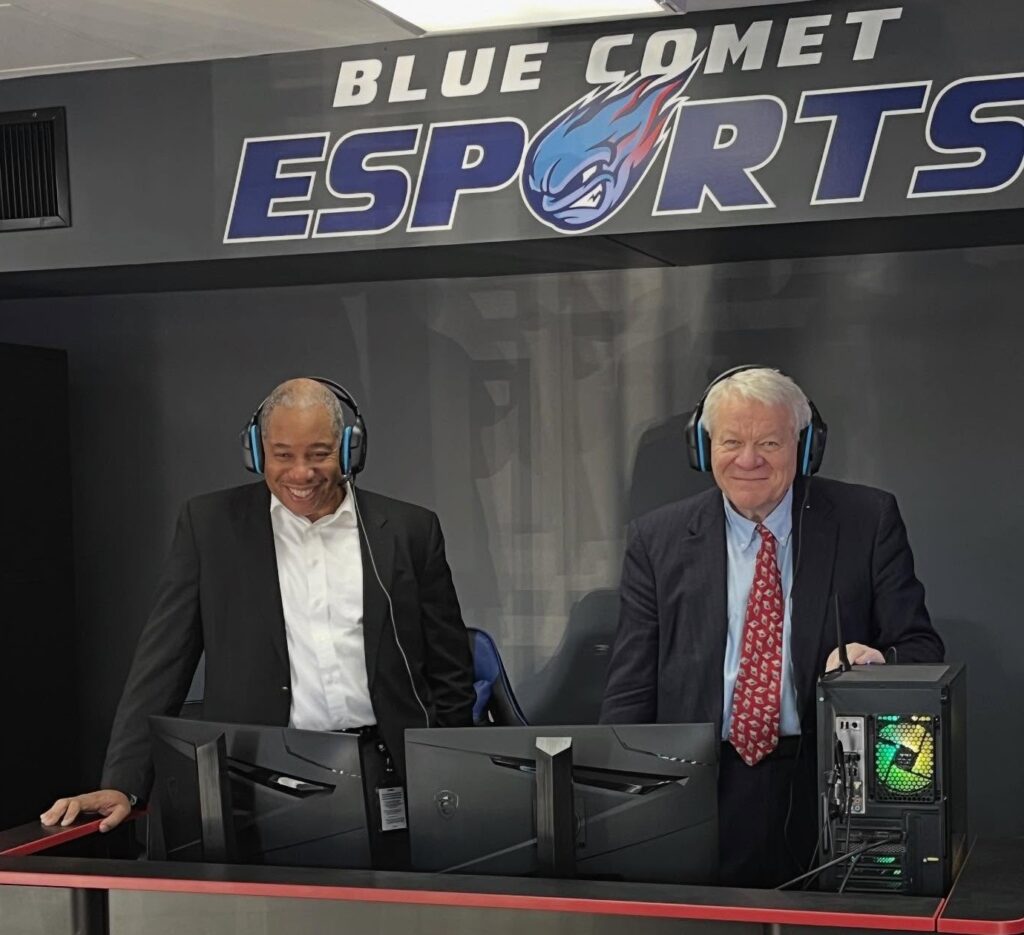
The building also includes an esports gaming center, a robotics lab, and a podcast studio — where Green became one of their most high-profile interviewees.
While being filmed and interviewed by students, Green was asked what advice he would give himself if he were a high school senior.
“I think about when I was a senior, there were a lot of efforts to say, well, certain students, ‘You’re academically inclined, and so you should go through that pathway, or you’re more sort of vocational education inclined, and so you should go that way,’” Green said. “So I would say to myself, do it all. Do it all. Because you just never know what will come of it, so don’t limit yourself.”
A trip to Asheboro would not have been complete without a visit to one of the state’s largest tourist attractions: the North Carolina Zoo.
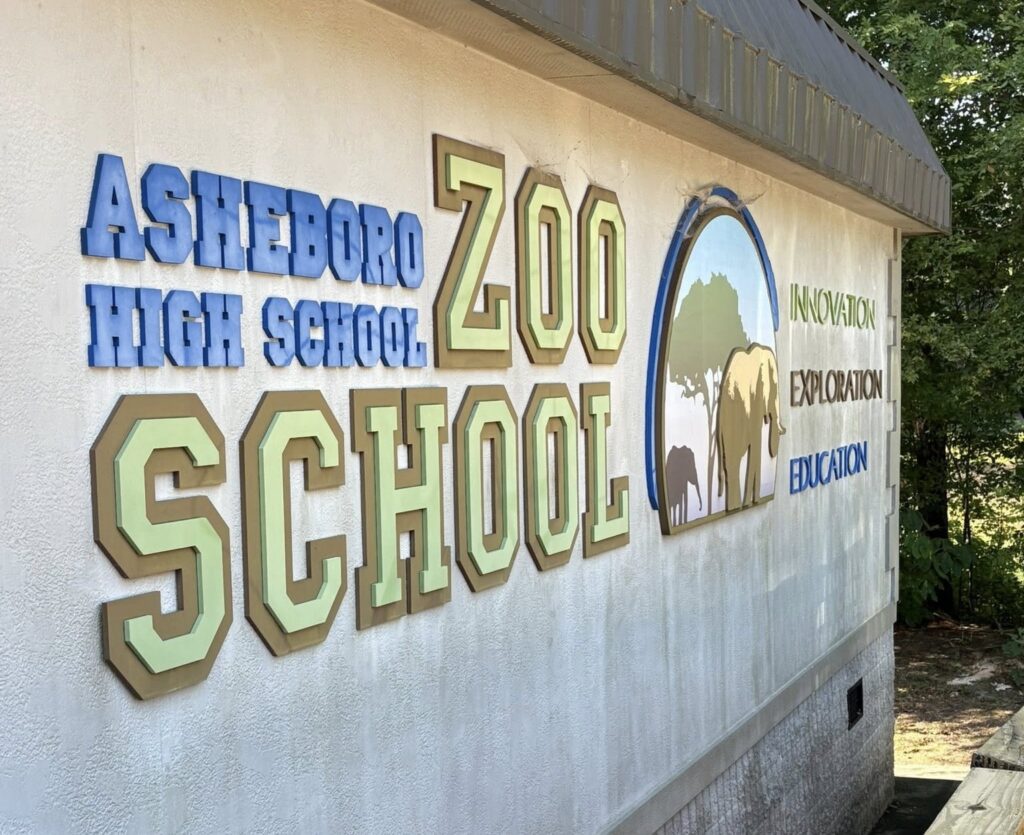
If a visitor can focus their gaze beyond the throngs of students walking through the zoo’s entrance on field trips, they’d notice a one-story building off to the right. That’s the Asheboro High Zoo School, where students are bused from Asheboro High School, typically to take two classes at the zoo.
Students who attend the zoo school receive hands-on instruction regarding animal behaviors and maintaining the landscape of the zoo. A certification in horticulture is also available.
Between the opportunities students have at the Global Innovation Center and the North Carolina Zoo, the district provided direct examples of how to teach students skills and apply them to real-world situations, a priority when Green previously stopped in the Piedmont-Triad in March, according to his report. Other priorities for the region included higher educator salaries, more full-time nurses and counselors, and community partnerships.
Later, Green along with other state and local educators spent time with students and faculty at Southeastern Randolph Middle School. Most of the discussion was centered around pillars three, four, and seven of the strategic plan, which discuss parent support, mental health, and celebrating public schools.
The third leg of the statewide tour concluded with a lunch and tour of Rockingham County Schools CTE Innovative High School, located on the Rockingham Community College campus.
In its inaugural year, the school is meant to fill skill gaps for in-demand careers in their area, especially construction, District Superintendent of Curriculum Instruction Charles Perkins said. In the fall, the school had 38 students split among three pathways: advanced manufacturing, health science, and construction trades.
“One of the things that drew me here was the chance to learn in a more engaging, practical way,” said Chloe Moore, a student on the advanced manufacturing track. “At the CTE Innovative High School, learning goes beyond the classroom. We get to work on real projects and begin exploring our future careers while still in high school. That kind of exposure is rare, and it’s already helping me see how what I can learn connects to a real world outside of school.”
CTE Director Nina Walls shared how the district has career planning programs at the middle schools —Paxson Patterson Career Ready Labs — to help students start exploring CTE certifications early.
Laura Carter, principal of CTE Innovative High, reflected on her experience as someone who entered the workforce right out of high school.
“My first postsecondary experience was right here on campus at Rockingham Community College. As I serve as the principal of the CTE Innovative High School in the early college, it’s important to me to guide those students through experiences and let them understand that your opportunities do not have to be lateral,” Carter said. “I might get my certification as a certified nurse’s assistant, but maybe later I want to be a nurse or even branch out to a totally different direction.”
Inside of the health sciences track, students are required to take a health career management class. Their instructor, Christy Hensley, helps students develop elevator pitches, invite organizations in for mock interviews, and draft “passionate plans” for the future.
“We tie that career development plan into their interest, their talents, their personality profiles, all the things that they’ve done to learn about themselves that are integrated into their postsecondary plan, whether they’re enrolling and listing or going straight into employment, or all of the three,” Hensley said. “So when they graduate and they shake the principal’s hand, superintendent’s hand, they are ready to make that decision.”
Hensley also serves as the school’s career development coordinator. She spoke about why connections with local businesses are important. She said that she hopes students are introduced to industries in the community they can continue with after graduation.
“Start local, go far — but we would love for them to reinvest back into our community,” Hensley said. “That’s why these partnerships are so critical when it comes to work-based learning, internships, apprenticeships, job shadows, career speakers, mock interviewers.”
At the public forum, Principal Darrell Harris said Eastern Guilford High School has had a mission to provide excellence in education long before Green declared it a statewide movement that they are now proud to be a part of.
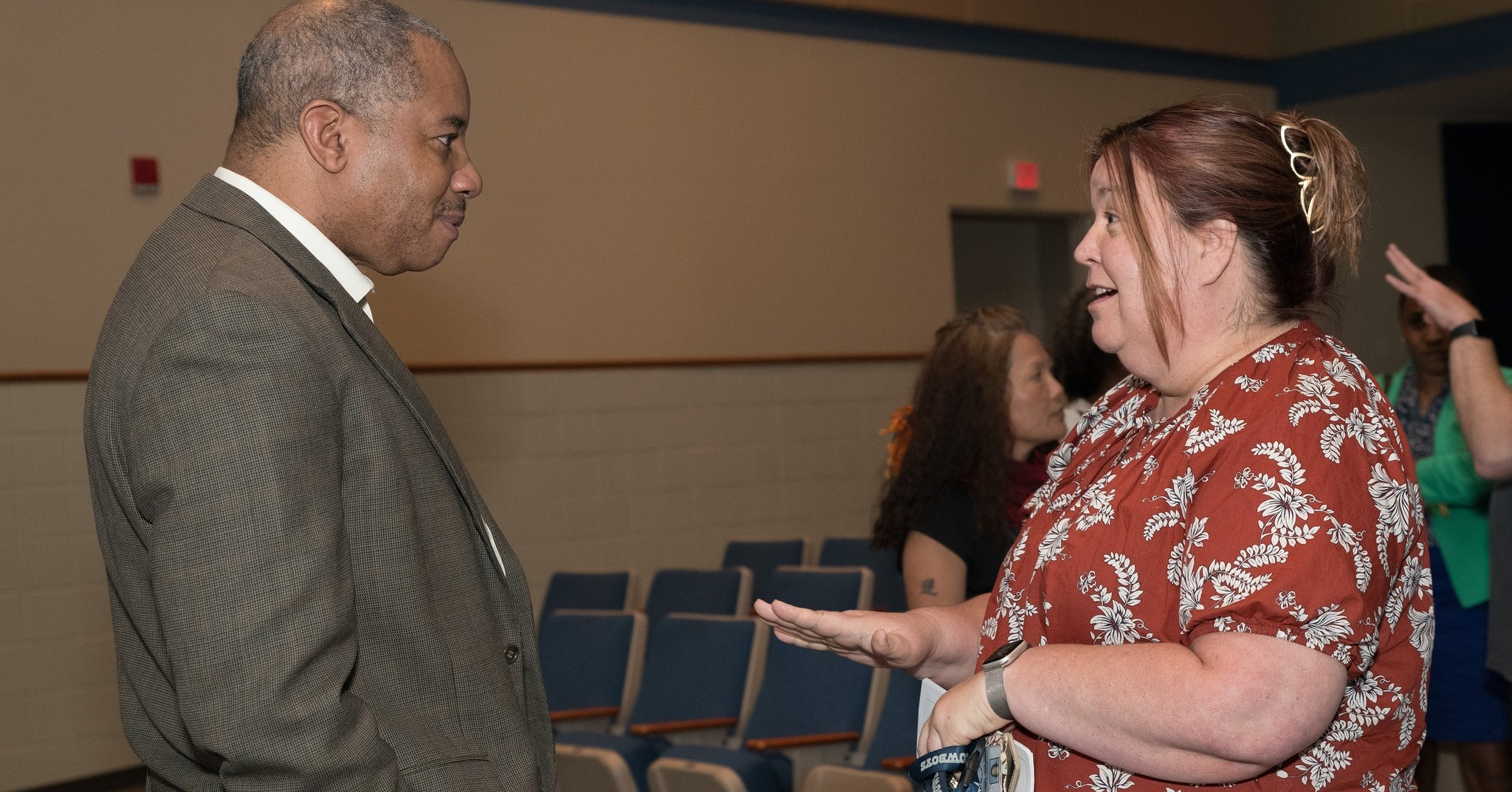

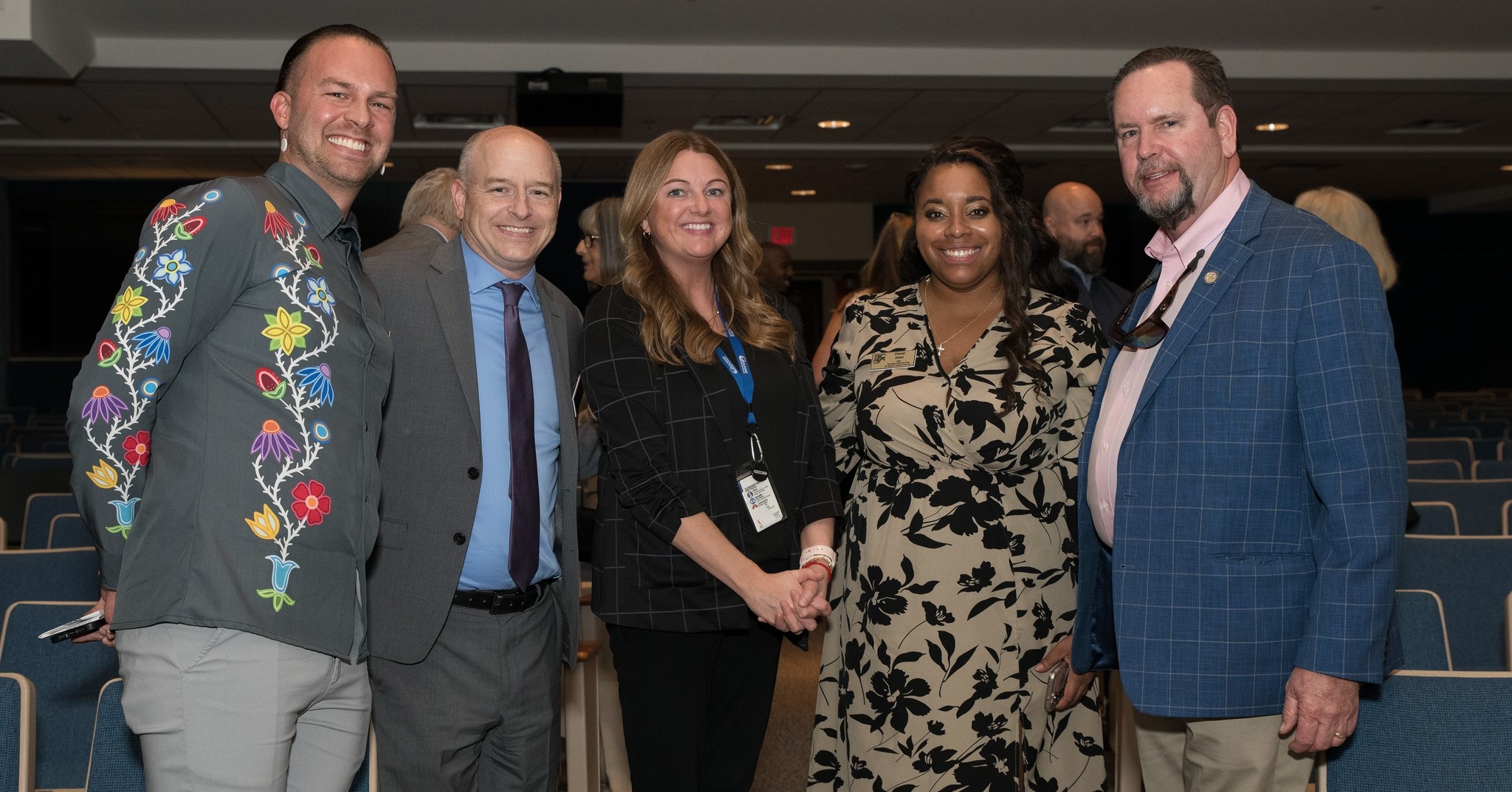
In his remarks, Harris also reflected on how the community was impacted when the high school burned down in 2006. When the school reopened, he said Green was there to help ease the transition. Green previously served as superintendent of Guilford County Schools for seven years.
“He didn’t just lead from a distance, he came with his sleeves rolled up ready to work, ready to help us move in and begin again. And here we are now, nearly 20 years later, in this building that rose from that fire,” Harris said. “Tonight, Superintendent Green returns not to help us unpack boxes, but to unpack a strategic direction that will help build the future of public education for all North Carolinians. The symbolism isn’t lost on us.”
Southwest: A plan for pipelines
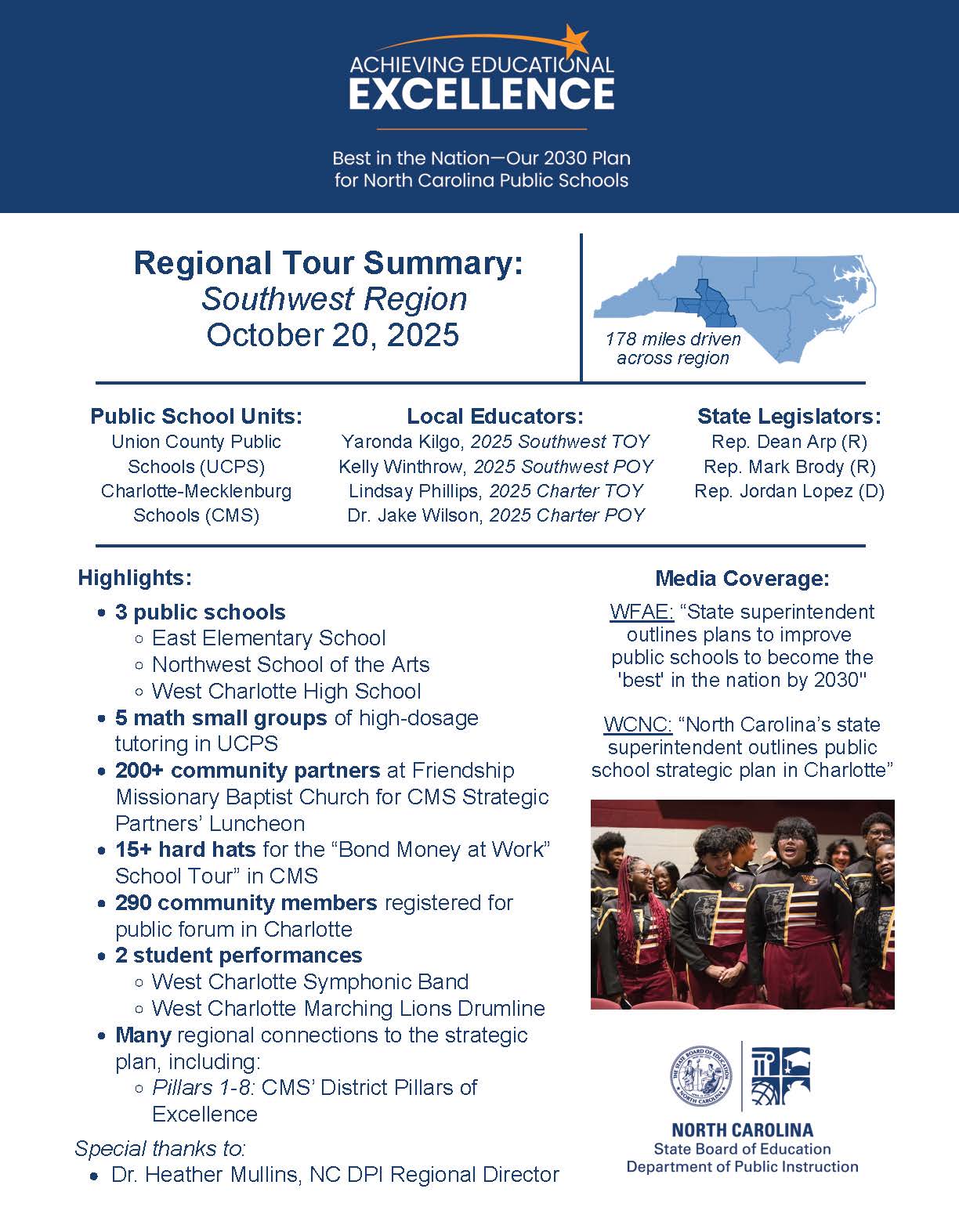
One of Green’s favorite words in the strategic plan is the word “revere.”
“I revere our public school educators. It’s the best word I can come up with. This is higher than respect,” Green said after touring the southwest region. “This is a noble profession that I revere. Also appreciate that it is more than just your teachers, right? This includes your cafeteria workers, the custodians, the bus drivers. They’re all, I believe, educators.”
Pillar two of the plan includes expanding recruitment and retention pathways into the profession.
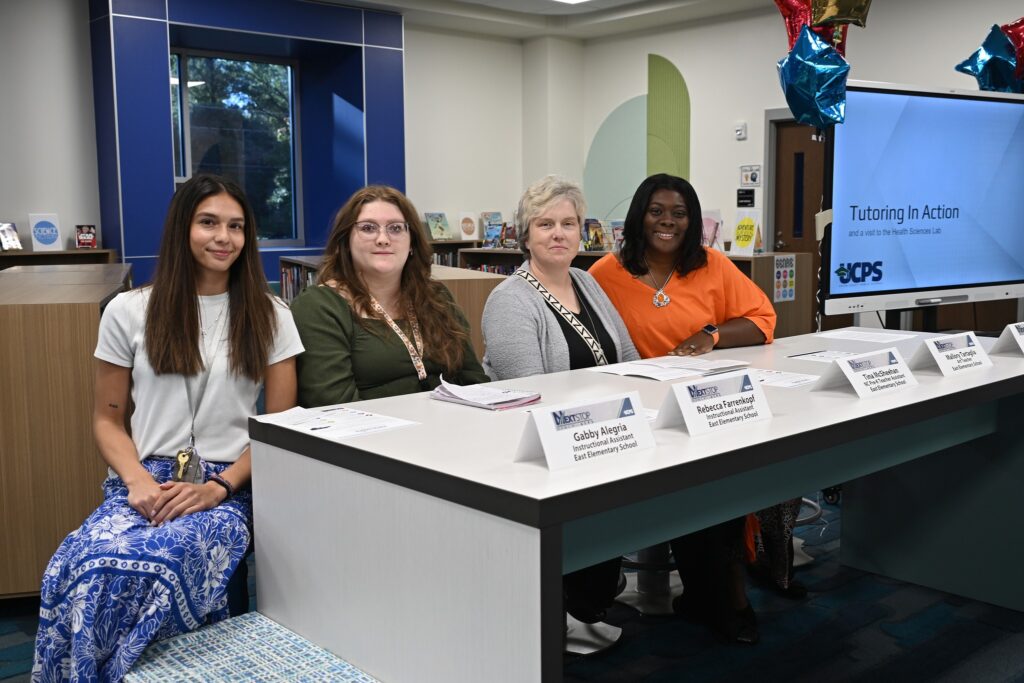
An example of such pathways would be the Next Stop TEACH program in Union County Public Schools (UCPS). This teacher preparation program offers both student and adult pathways. High school students are able to take courses for college credit and have field experiences before they graduate. Early college students are able to earn associate degrees in teacher preparation. Since the program’s inception in 2023, 26 students have graduated and completed the program.
Many participants in the adult pathway are people who already work in the school district in other roles. They are also often supported through getting an associate’s and subsequent four-year degree.
In a panel discussion, Mallory Tartaglia spoke about making the transition from instructional assistant to being a residency-licensed teacher. She said her enrollment at Wingate University would not have been possible without the financial support from the program.
“The courses I’ve been taking have been super illuminating on the world of education, what’s necessary to be a responsible and impactful guide to these young minds as they grow and mature into adult members of society,” Tartaglia said.
Green also had the opportunity to observe a Health Science Academy based at East Elementary School during his visit. UCPS offers these classes through a partnership with Atrium Health.
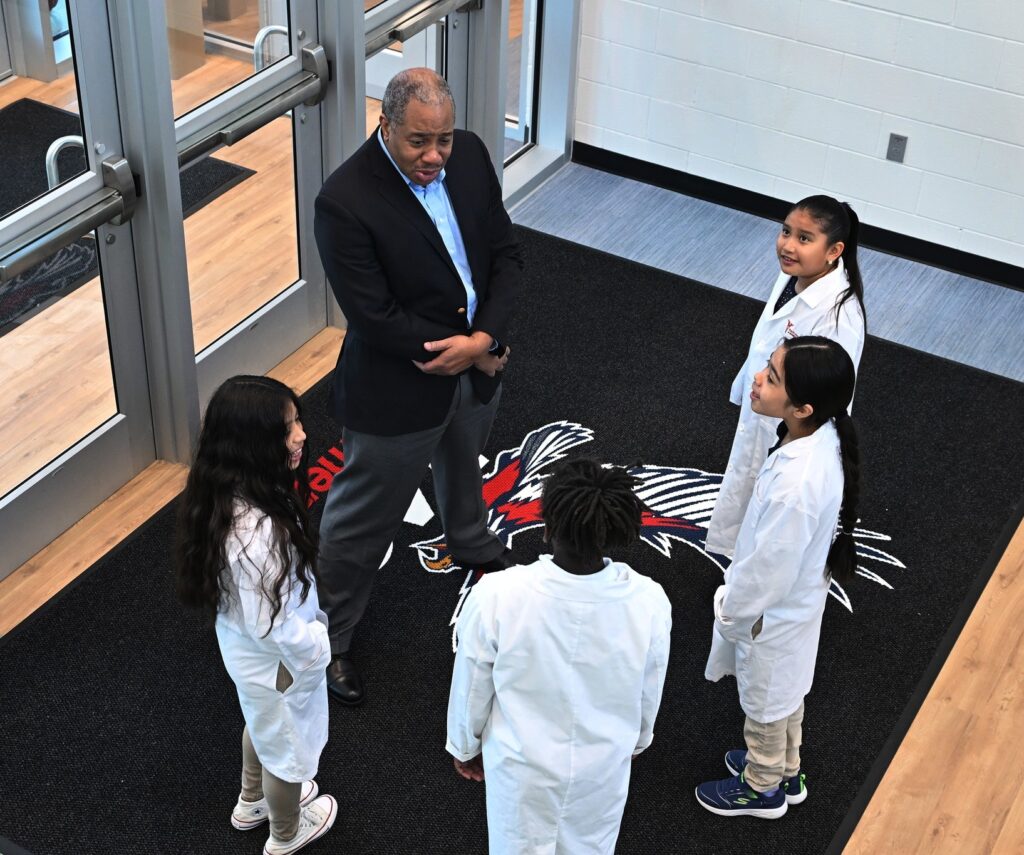
“The number of people working is just smaller out there. And this is borne out across all industries and to see education, particularly, engaging in this type of personnel development, really the career path, is pretty phenomenal, too,” Rep. Dean Arp, R-Union, said when praising the district’s programs.
Another highlight from UCPS was the success they found in a high-dosage tutoring model, which is recognized as a national model and was evaluated by UNC-Chapel Hill between 2023-25. It was initially adopted in 2017 to support low-performing schools and then expanded a few years later.
Through high-dosage tutoring in the district, fourth and seventh grade students are pulled out of class to work on math with an instructor in groups of three. Since using the model for pandemic recovery, the district said it has seen a 10% increase in fourth grade math proficiency and an 11% increase for seventh grade.
Crossing the county line to Charlotte-Mecklenburg Schools, attendees of a strategic partners lunch learned more about how the work being done in the district aligns with the state’s strategic plan. Green pointed out how last year, 89.1% of CMS schools met or exceeded growth.
“As someone who had the wonderful opportunity to be an administrator in Charlotte-Mecklenburg Schools, it is nice to come back and see that good things are happening, right? And certainly the educators deserve enormous praise,” Green said.
The district is in the middle of constructing a new additional building for their Northwest School of the Arts (NWSA). Students and faculty are set to occupy the new offices, visual arts spaces, and classrooms in August 2026. A leader from the district said the school can enroll 900-1,000 students at capacity to make sure that “every student in Charlotte-Mecklenburg Schools who wants to study the preprofessional arts can.” The school currently has 994 students enrolled, based on the most recent school report card data.

It was shared with Green during his listening tour in March that rapid population growth was a concern for the infrastructure of the schools of the Southwest region. The expansion of NWSA is a demonstration of how districts are working to mitigate such challenges while also adding opportunities for their students.
According to the listening tour report, educators in the southwest also mentioned they want to offer students more opportunities for character development and advanced learning opportunities to support their interests and career pathways. They also said they value revering teachers and support staff and want to embrace input from the community as they plan for the future of their schools.
NWSA students asked questions about Green’s day-to-day responsibilities as a superintendent, what motivates him, and the difference between issues handled by local school boards and what gets handled by state officials.
Amie Hanson, a senior at the high school, asked Green how he sees artificial intelligence changing the education system.
“Where I think this is going to go is I actually think we’re going to see more and more instances of where actual classrooms are essentially flipped, and a lot of what students interact with will not be with people, but will be with other avenues of providing information to students,” Green said. “And then, students will have the ability to connect with teachers as appropriate to address any concerns.”
Northwest: A plan for those in need
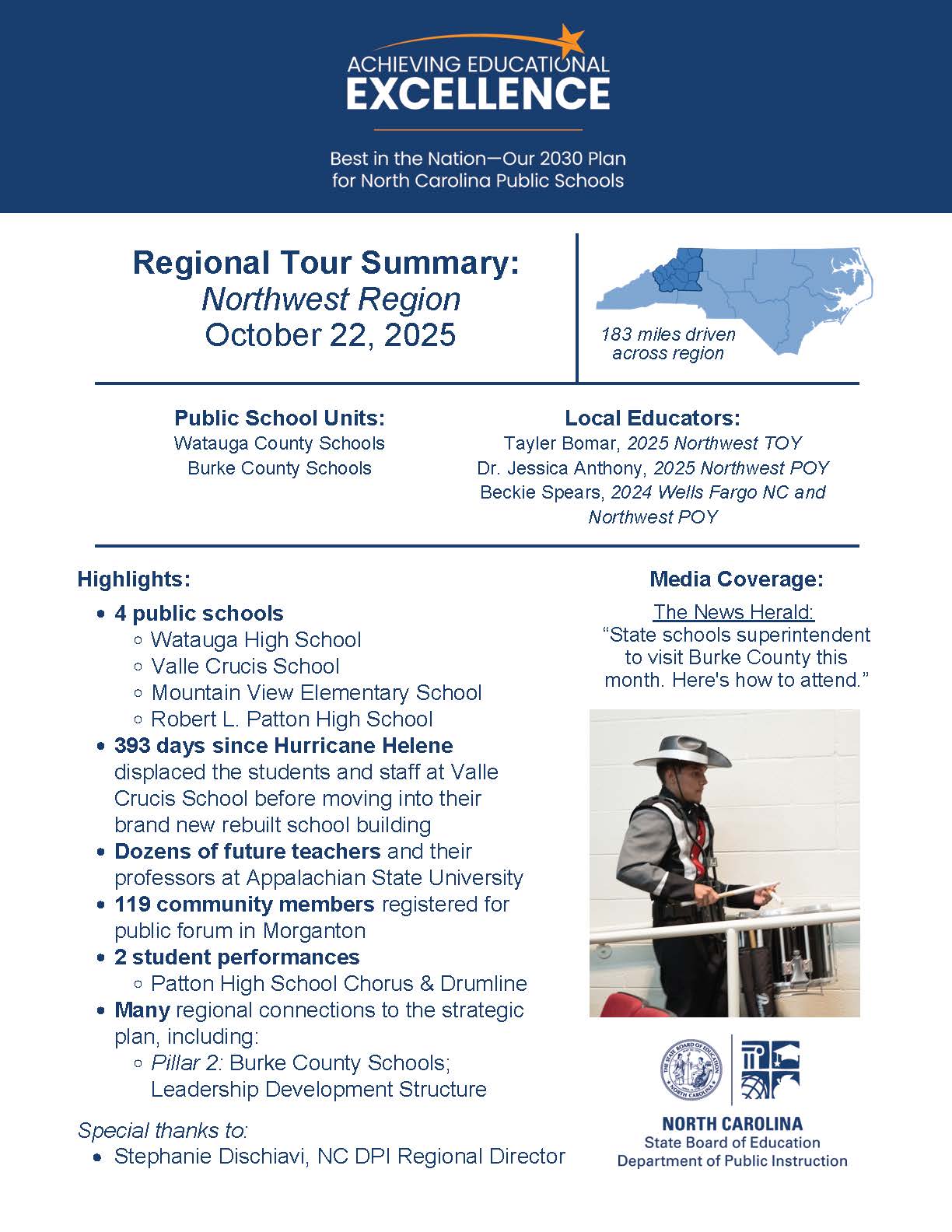
At the start of the second half of the tour, Watauga County Schools officials wanted to show Green and his team what they are doing in the district to fully align with the new plan. They also shared stories of growth and resilience in the year following Hurricane Helene.
According to Superintendent Leslie Alexander, the district saw the highest graduation rate last year since the 1920s.
Philip Norman, the district’s chief academic officer, said that rather than starting from the top down, they feel like the students are the reason they are all there.
“We believe that our students are not percentages, they’re not data points. They are actual human beings, and we start our school improvement process with teachers looking at students and deciding, ‘How we can best meet their needs, how we can best support them, and can we get them to proficiency this year?’” Norman said. “So we set ambitious goals, we set realistic goals, but we start with the student and then we work our way up from the student level to the teacher level, to the classroom, to the grade level school, and then to the district.”
Norman said the district does not currently have any low-performing schools, but it’s not a “laurel they choose to rest on.” In the next few years, they hope to have all of their A and B schools exceeding growth.
Chris Blanton, assistant superintendent of human resources, also spoke about career advancement opportunities for educators, which aligns with the strategic plan. Recently, the county commissioners committed $25,000 to the district to help teachers achieve national board certification, Blanton said.
According to the National Board for Professional Teaching Standards, North Carolina has nearly 25,000 board certified teachers — the most of any state in the nation.
Watauga County Schools currently has 98 nationally board certified teachers in the county, almost 25% of teachers in the district. Blanton said that number might double counting the 60-70 teachers that are currently working on it.
Blanton said the district is facing challenges with retaining classified staff, such as bus drivers and custodians, in part due to the state of the housing market in the county. He also pointed to the lack of available child care.
“We have a number of teachers who have found that it’s just more cost effective to stay at home, and so when they have children, you know, they’re more likely to stay at home and not return to the profession, at least for a number of years,” Blanton said. “So we’re trying to find some creative ways to partner with some folks around the community to not only find more options for child care, but also to make it more affordable for our folks.”
Community support has taken on a whole new meaning for this school district following Helene, which caused a great deal of damage to western North Carolina. Community colleges and community organizations stepped up to create stability for students in their local public schools.
“You know who your partners are in a time of need,” Alexander said.
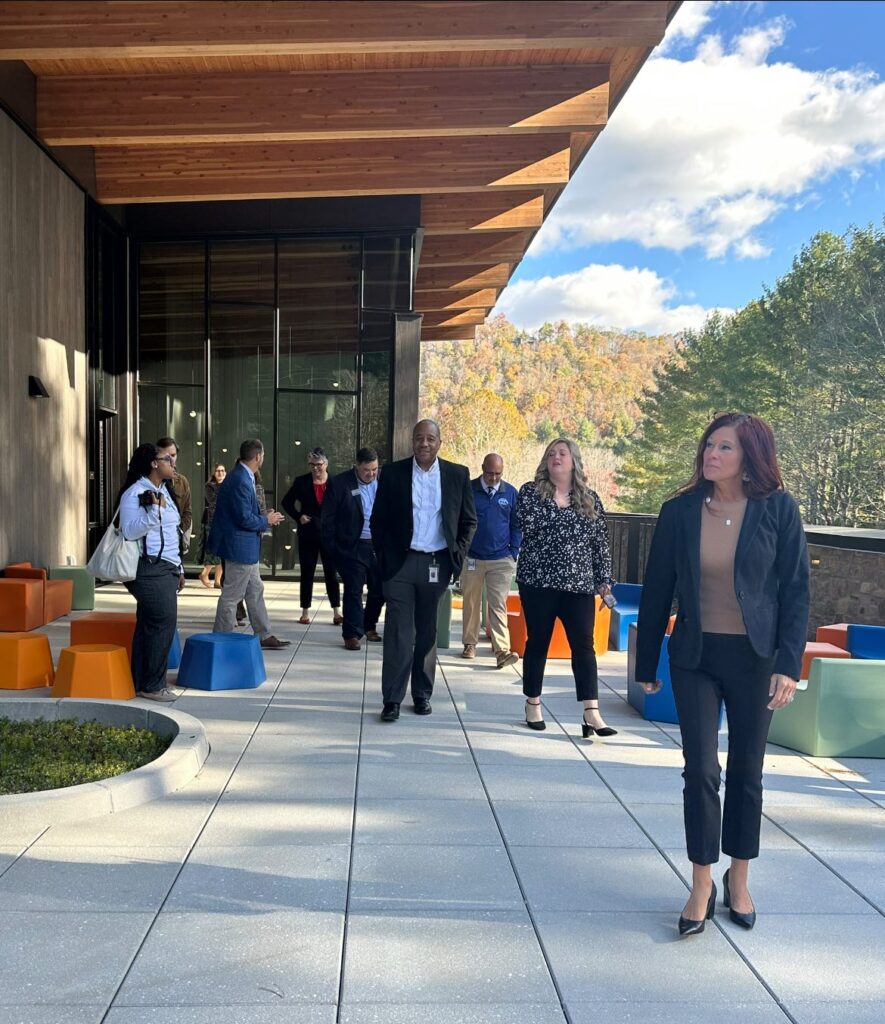
For example, when a K-8 school was flooded during the storm, Caldwell Community College and Technical Institute took in the district’s middle school students from Valle Crucis School last school year and at the beginning of this year. They also extended free tuition to them if they choose to go to the community college in the future.
Another new partnership between CCC&TI and the district is RISE — Regional Initiative for Skilled Employment — which will provide students with work-based learning experiences. While the program will eventually involve all local industries, it will start with health care, hospitality, and skilled trades. The first cohort of students is set to begin working in January.
Green arrived in the region just in time to see the first day of the new Valle Crucis School.
Leaders on the tour asked the students in Jennifer Stevens’ second grade class what they liked best about their school. Most of them were just happy to have a cafeteria again.
“It’s like our family is complete,” Stevens said. “And we are just ready to love these babies big and just be one big, happy family here at Valle Crucis. We are VC strong and we’ve come across the mountain now, and here we are all together, and we are so happy.”
Appalachian State University, a leader in educational leadership
A few miles away is another partner to the school district — Appalachian State University’s Reich College of Education. According to Melba Spooner, the college’s dean, their doctoral program in education leadership is the largest graduate program on the university’s campus with 172 students enrolled. The North Carolina Teaching Fellows program also returned to the university last year, with 167 students enrolled in that program. They represent one-fifth of all fellows across the state, the dean said.
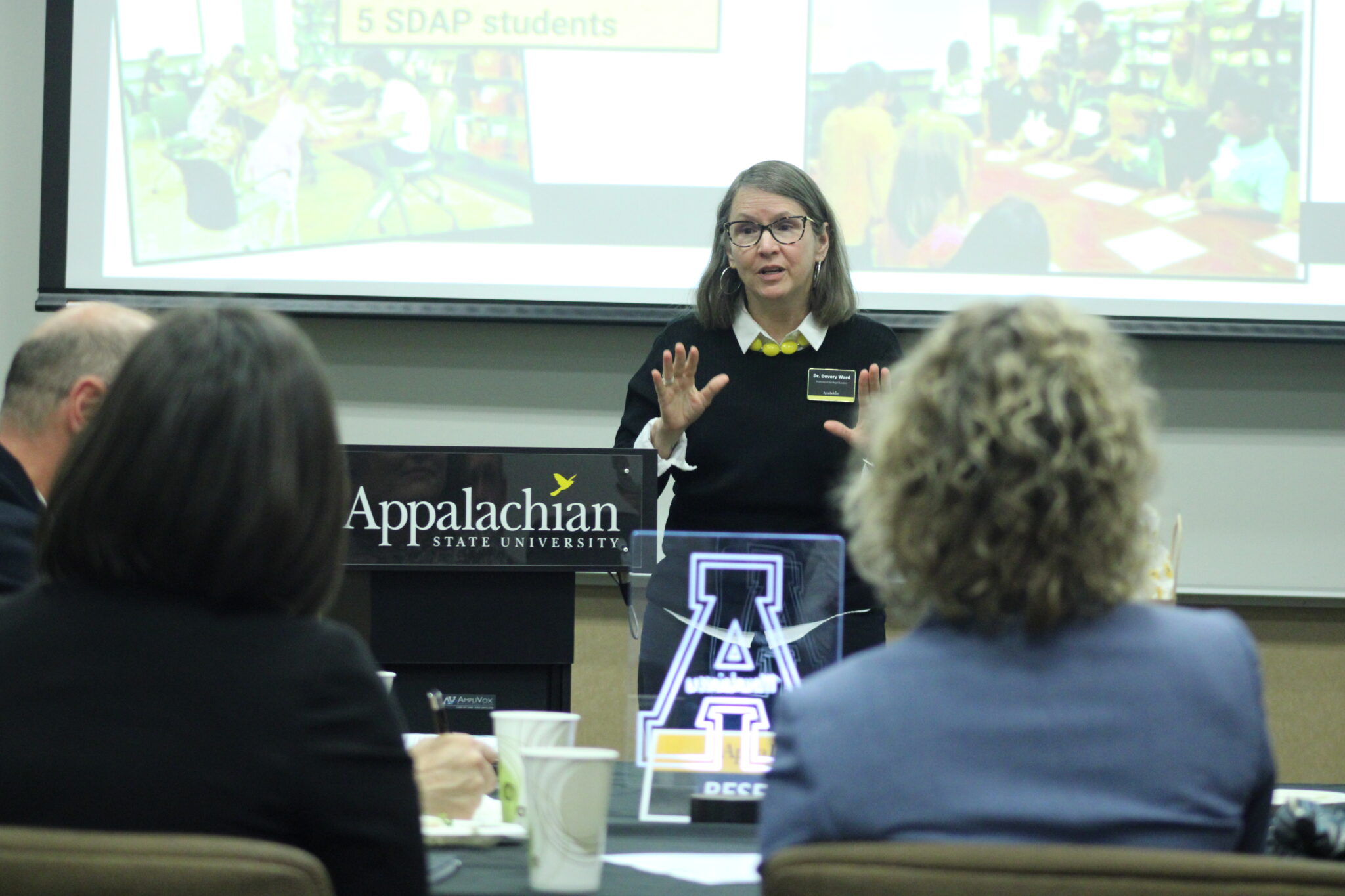
In their presentation to Green and other visitors, the professors outlined how the university supports the plan’s second pillar by calling for more educator recruitment pathways. Developing teacher pipeline programs was a common concern across all eight regions, according to the regional listening tour report.
The university has two clinics underneath their teacher preparation program. The Anderson Reading Clinic is the only university-based clinic in North Carolina offering year-round teacher training, according to the university’s website. Also mentioned during the state superintendent’s visit was The Mathematics Clinic. The university is the first in the UNC System, and one of few colleges nationwide, to integrate math clinics into teacher preparation, the university said.
The university is also in partnership with Watauga, Caldwell, and Catawba County Schools for a new career pathways program aimed at addressing the shortage of special education teachers in rural Appalachia. Thanks to a grant from the U.S. Department of Labor for more than $1.4 million in August, the program offers tuition assistance, stipends, and professional development.
“Here in the Reich College of Education, we do believe that meaningful change begins with meaningful collaboration,” Spooner said.
A lesson in dual-language immersion and fundamentals
According to the most recent data available, North Carolina has the third most dual-language immersion (DLI) programs in the country. Most of those programs are focused on Spanish.
Green was able to see an example of such a program in Burke County Public Schools during the tour. According to the plan’s first pillar, DLI can help “eliminate barriers for students and prepare them for their next phase in life.”
Through the program, students learn their grade level curriculum half of the time in English and the other half in Spanish. Half of the kindergartners accepted into the program are native English speakers. The first class of kindergartners began the program in 2018, and the program began extending into middle school in the 2024-25 school year.

Green stayed after the elementary school’s dismissal carpool line died down to visit the Mountain View YMCA 21st century program. Students in the after-school program receive academic enrichment in reading and math. Students are also gifted with books every month, according to the program’s website.
Casey Rogers, the district’s CTE director, looks at growing the department with a competitive mindset, making sure they have the needed community partnerships, internships, work-based learning, and apprenticeships in place.
“We feel like we’re doing a really good job here in Burke County. We are third this past year in credential attainment rate in terms of the credentials we received. And, as you guys know, we’re not going to catch Mecklenburg County, we’re not going to catch Wake County, but we can catch other folks in terms of the attainment rate,” Rogers said.
The last highlight from the county was the emphasis of “balanced instruction through reduced screen use.” In a recent resolution, the county’s school board stated their support for physical instruction tools, such as pen and paper, instead of screens.
“We are helping shape the minds of tomorrow, and they’re coming to us at ages 3, 4, and 5,” said Tiana Beachler, chair of the Burke County Board of Education. “So prior to us putting the device in their hands, let’s teach them the fundamentals.”
Western: A plan to scale opportunities
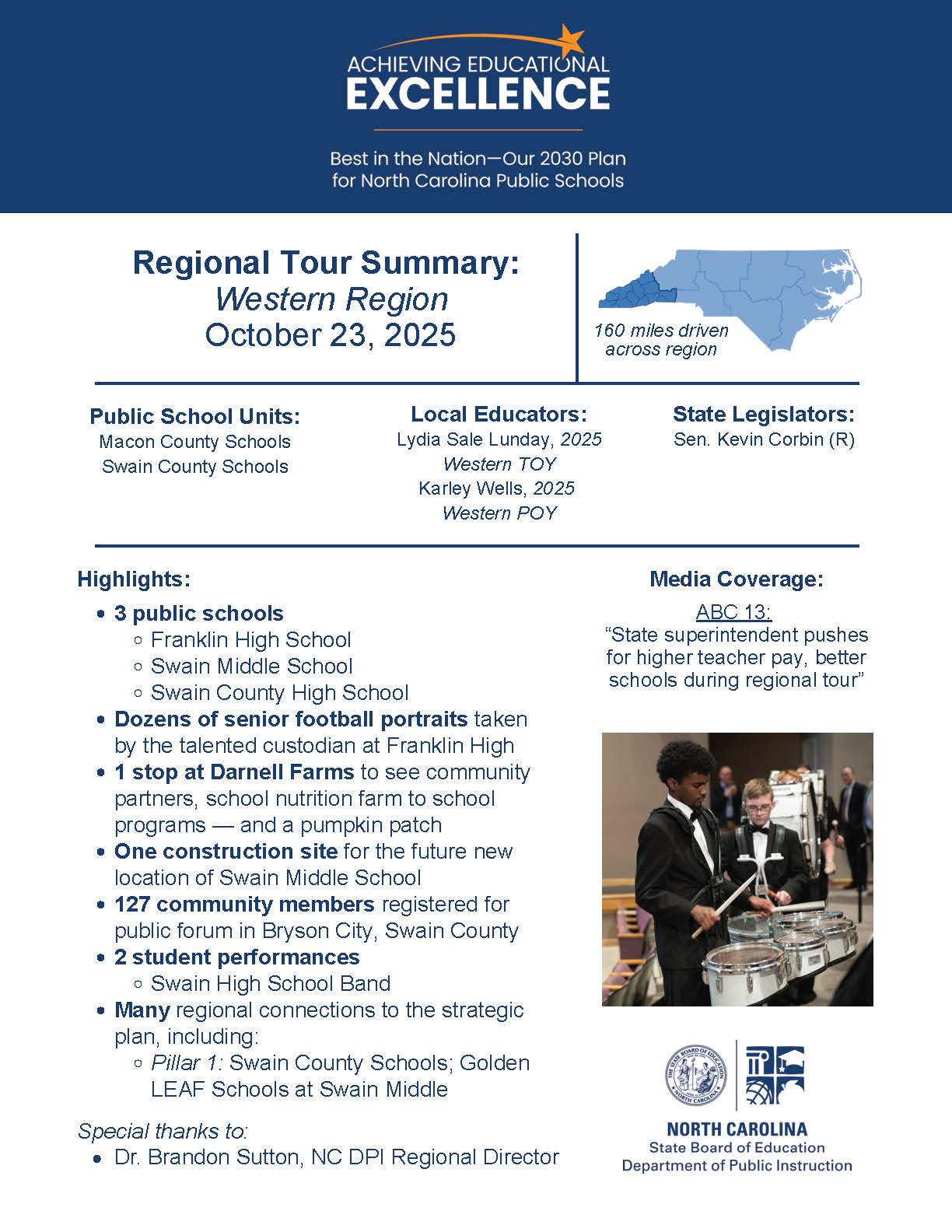
When Green first visited the western region in the spring, stakeholders said they wanted to invest in early learning programs and innovative approaches to delivering curriculum. Valuing the arts was emphasized. Areas of improvement that were mentioned to Green included teacher pay, workforce stability, and mental health supports.
To ensure healthy, safe, and secure learning environments as Pillar 4 calls for, Macon County Schools calls in the big dogs.
Or maybe just one. In partnership with the local police department, school resource officers (SROs) at Franklin High School have been using a German Shepherd — fondly named SRO Thor — to sniff out cigarettes, vapes, and other products containing nicotine.
According to Officer Adrian Mace, this has helped with the school’s vaping problem. When they first began using Thor two years ago, the SRO said, they found bags and bags of vaping paraphernalia. Since the implementation, Mace said he can hold everything he finds into his own two hands.
While visiting the district, Green was also able to view the progress on the construction of the new Franklin High School buildings.
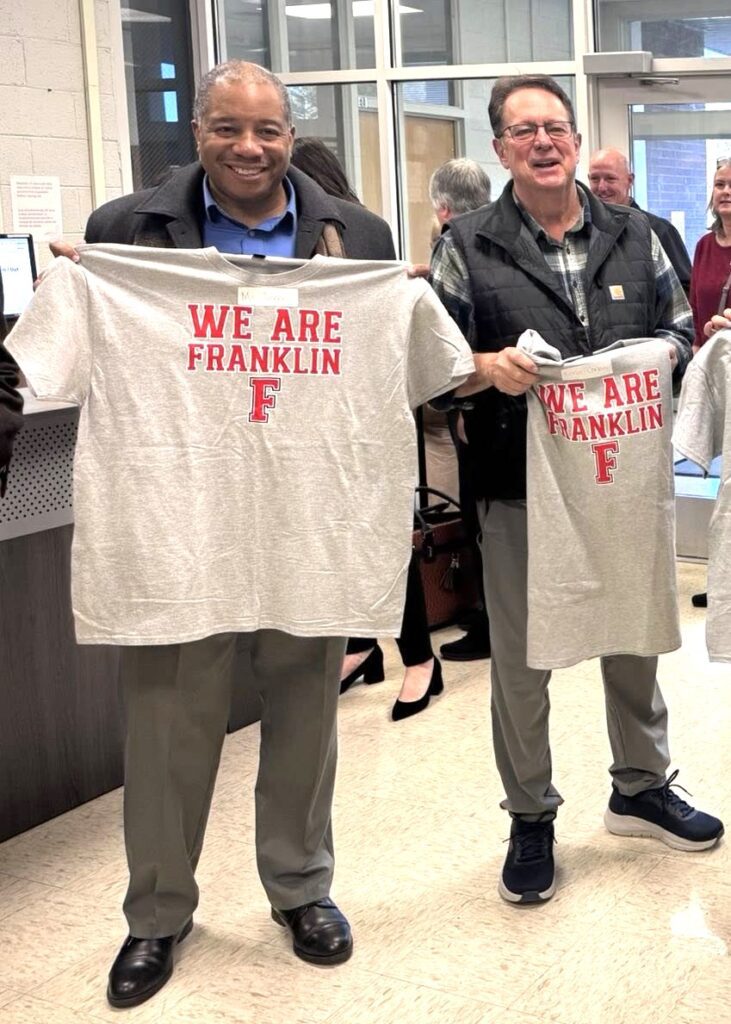
“By capitalizing on the NC Lottery Funds and a partnership with the County Commissioners, Macon County is in the process of building a high school equipped with up-to-date technology to prepare students for years to come,” Brandon Sutton, DPI’s western regional director, said in a Facebook post.
Darnell Farms is a farm-to-school partner, and when the tour stopped by the farm, visitors were taking tractor rides and enjoying funnel cake even in the middle of the week. The family run business guides visitors through how they take care of their acres of crops while being good stewards of the land they are on.
Nate Darnell, who likes to go by Nate the Farmer, particularly likes to emphasize how he’s a product of Swain County Public Schools. He said the key takeaway visitors should have from their farm is that it is OK to have fun.
“It’s getting them to relax and understand that, by and large, whether it’s a school system or a farm like ours, we’re trying to give you something positive — whether it be knowledge, a good foundation — to take you into the world,” Darnell said.
According to Cindy Marion, a child nutritionist, North Carolina has the oldest and best farm-to-school program in the United States.
“That helps our local economies here in North Carolina. That helps bring more nutritionally dense foods to our kids, and it helps our kids know where their food comes from,” Marion said.
The third destination of the day was Swain Middle School. James McNab, the school’s assistant principal, emphasized how much they value their student population.
“One of the most important things we can do is embrace the cultures that we’ve got because we have a high level of children that are enrolled members of the Eastern Band of Cherokee Indians,” McNab said. “And it’s a real blessing to be in part of this environment where we just have so many different cultures represented here, and I’m thankful for that.”
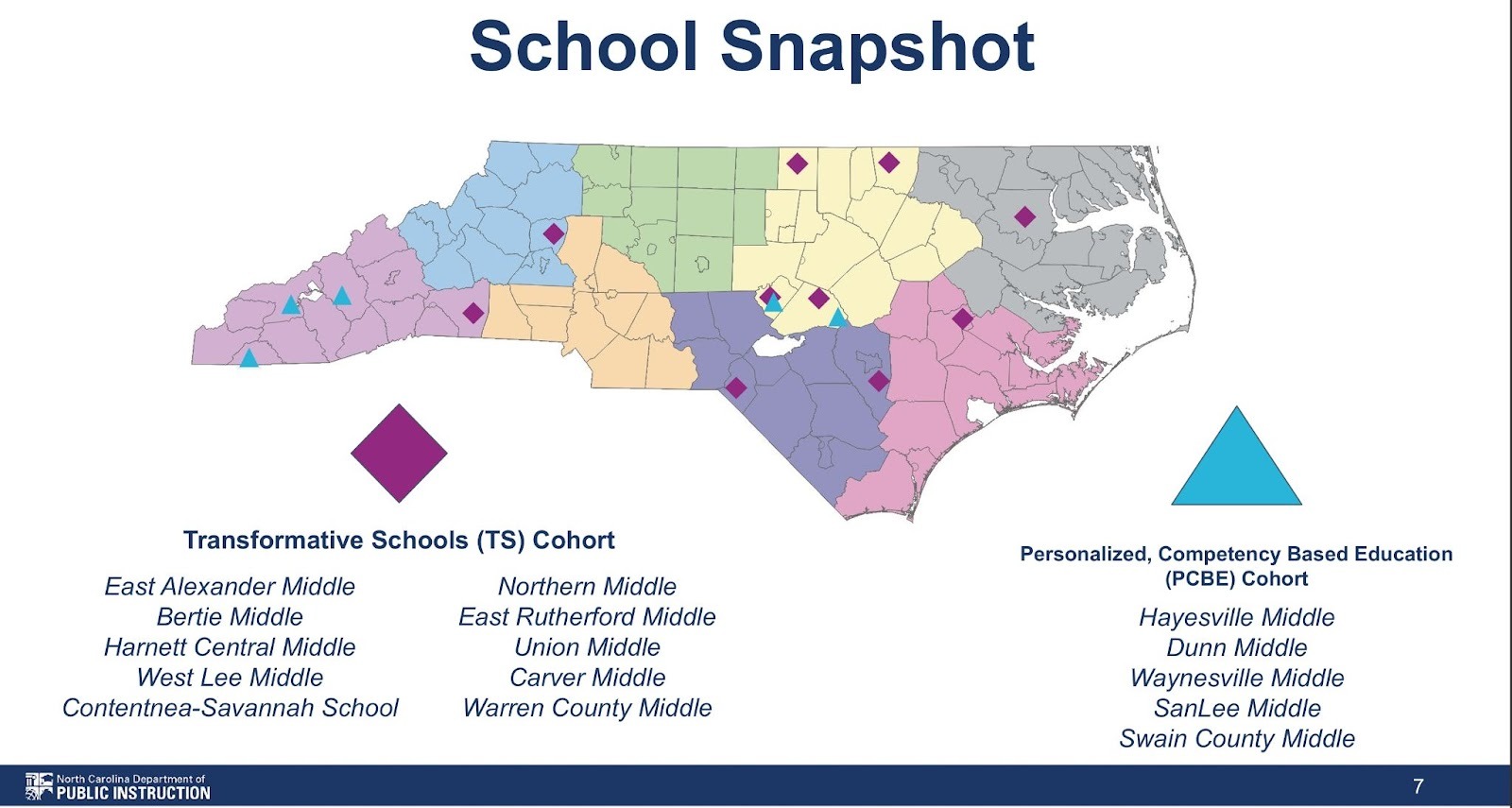
Swain Middle School is also a part of the Golden LEAF Initiative. Participating schools will receive funding and instructional support for mathematics and career development over the course of five years. Swain Middle is a part of the Personalized, Competency-Based Education Cohort (PCBE), meaning they will receive coaching, support, and resources tailored for the needs of staff and students.
Implementing the Golden LEAF Initiative is its own specific action in the strategic plan because its success will “transform educator practice and student outcomes in rural schools.”
Superintendent Mark Sale compared the potential of students and teachers in their county as a good sports team coming away from a season with a less than perfect record.
“I think that those players and those coaches are very likely doing the very best they can every day,” Sale said. “And yet, what needs to happen is the players need to be coached and the coach needs to be coached because in order for the players to be coached, they have to have a coach who’s getting stronger every day.”
Sale also voiced support for the 10 million books campaign in the strategic plan. He said the district was outpacing the state average for graduation rates. North Carolina’s statewide graduation rate is 88% while Swain’s is 92%.
During a walk through of the middle school, Green observed students in a business CTE class. That day, students were role playing scenarios in what they called a “Durable Skills Showcase.” The first group to present was going through a misunderstanding with a customer at a car dealership. Their teacher, Savannah Cook, asked the class what skills could have helped the employees in that situation, and one of them was communication.
Throughout the middle school campus, students were eager to voice their opinions about their school and North Carolina education as a whole. Some of the students asked Green for his autograph.
Lydia Sale Lunday is not only western regional teacher of the year, she also grew up in Bryson City. Sale, who is a first-grade teacher, said that a lot of people think that the western region stops once you get to Asheville, but there is more to the state beyond that.
“And sometimes, since it’s so far to get out here, it seems like we may go unnoticed. So getting Superintendent Green and his team out here to this part of our state meant the world to us and shows us that we’re seen and that our needs are heard, too,” she said.
Sandhills: A plan for expansion

One of the key takeaways Green and DPI had from the spring regional listening tour was the need to modernize school facilities, according to the regional report.
That was true for Richmond County Schools, which is why Green’s first stop in this region of the tour was to Richmond Senior High School. This year, they were able to begin using their new auxiliary gym. The facilities, which included six new classrooms and a basketball court, were key to bringing all four grades under one roof. Before 2010, the school district had junior high school for grades 7-9 and senior high school for 10-12 grades. After the district was restructured, ninth graders had their own separate academy until the completion of the auxiliary gym and repurposing of the spaces in the original high school.
The construction at the high school was made possible by the Elementary and Secondary Schools Emergency Relief (ESSER) funds given to schools during the COVID-19 pandemic. They were permitted to be used for “construction, renovation, repairing and improving school facilities to reduce risk of virus transmission and exposure to environmental health hazards, and to support student health needs,” according to DPI’s website.
Principal Joyce McRae said that rehoming the ninth graders also allows them to take advantage of CTE courses the high school offers.
In one of CTE classes, students were working on elevator pitches and other interview skills. The course’s curriculum requires this, so students are prepared to interview for future electrician positions. This is the first class in the specialization’s track.
Laura Bailey, 2025 Wells Fargo Sandhills Region Principal of the Year, said in a DPI blog that the tour reminded her that “some of the most innovative, student-centered work in Career and Technical Education is happening in our rural districts.”
“Before, they were limited to only being able to come to the first block or fourth block, because that’s when we transported them over. And now they have more opportunities to take those classes throughout the day,” McRae said.
McRae also said students leaving campus to take classes at the community college helped make room for the ninth graders in their building.
At Richmond Community College, all advising offices are placed right at the front door. President Brent Barbee said this is to literally meet students where they are.
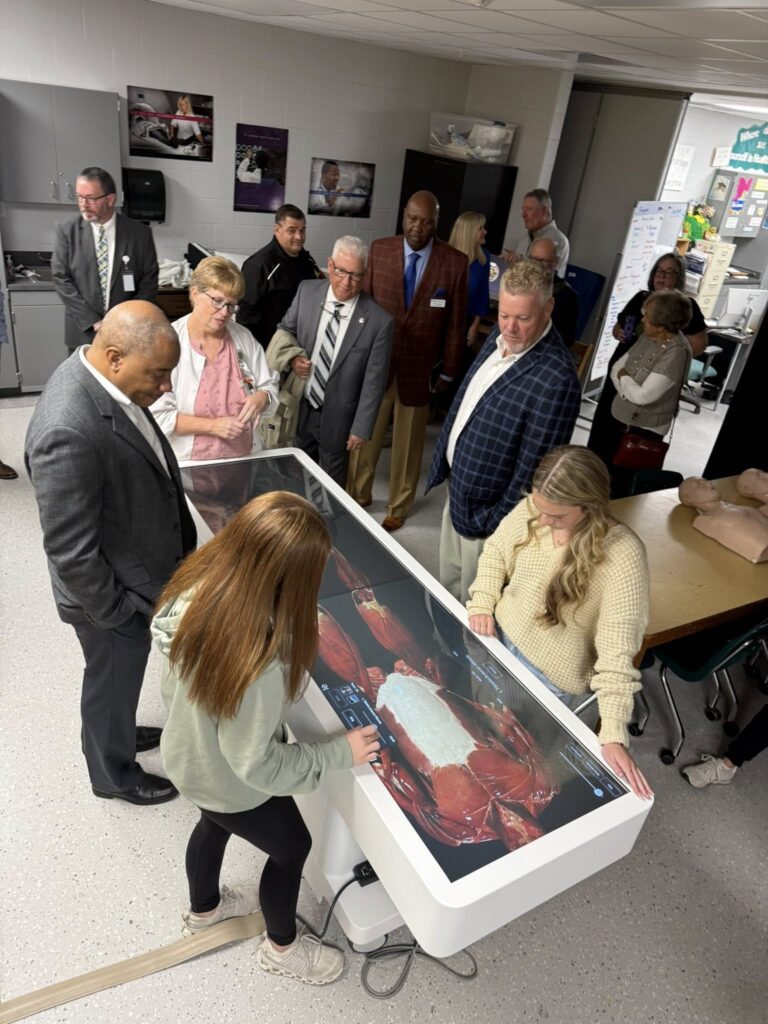
“We’re here to serve them in one way or another, and it does not matter whether they’re coming in for an associate degree, or if they’re coming in to do truck driver training or some other short-term credential,” Barbee said. “We will bring them in right here, and all of our advisors are kind of a one-stop shop, everybody knows all of our programs. So we’ll try to have them move forward.”
Leaders said RCC has a strong partnership with the Richmond and Scotland County school systems. For one, Barbee said that they like to make sure Richmond Early College students are well integrated into the campus lifestyle. Instead of having a separate building, they set up classrooms in their two busiest buildings.
“We didn’t want it to seem like a high school just located on the college campus. We wanted it to be younger students that were located within a college population,” Barbee said.
In the future, RCC hopes to have more high school students enrolled in short-term, continuing education classes. Last spring, they had a Richmond Senior High student graduate from their electrical linemen program.
Another budding partnership for RCC is the future construction of the Amazon data center. The company is investing into the community college system and public school system to ensure there is a pipeline for center jobs. Examples include project engineers, electricians, plumbers, fiber techs, and journey line workers — roles that maintain the infrastructure.
“We work backwards from demand,” said Quin Jernigan, a manager of economic & workforce development at Amazon Web Services. “Most of this work is done in partnership with our technical and community colleges. That is because most of the tradesmen come from community colleges.”
Building and shaping student pathways
“These districts aren’t waiting for opportunity to arrive — they’re building it, shaping it and partnering to make sure every student has a pathway to success,” said Bailey, the regional principal of the year.
For example, Green was able to visit the construction site of the Robeson Career & Technical Education Center and Planetarium, which is set to be completed by fall 2026. Once completed, the facility will be a hub for new and existing CTE programs.

A pride point in the construction is the spaces dedicated for “reverse internships.” Classrooms have been specifically designed for different industries to come in and work with students for a semester. The rooms are designed flexibly so that there are no limits to the equipment that can go in there. District leaders said that this combats one of the key barriers for students: transportation.
Herman Locklear, CTE director for Public Schools of Robeson County (PSRC), described the circular problem. A lot of industry has left the county. When they tried to lure more companies in, they would refuse because they could not prepare an adequate workforce for them.
“But to get a good workforce, you have to get those students prepared before they get out of high school,” Locklear said. “If our kids can’t go to them, we’ve got to bring them to us.”


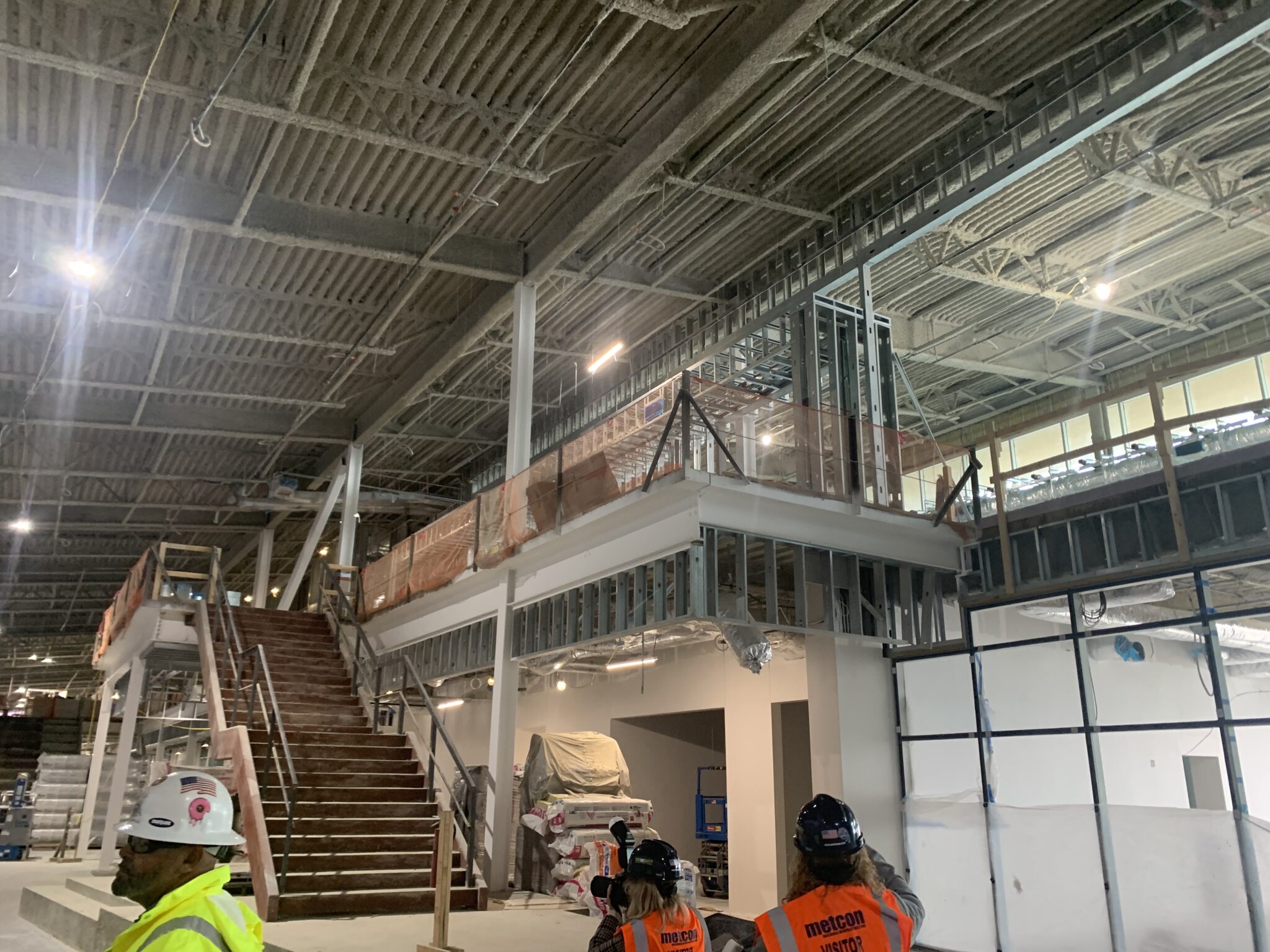
Not only will the building be a way to modernize school facilities, a recommendation listed in the regional listening tour report, it will also “establish formal collaboration programs between schools and industry to enhance real-world learning,” the report reads.
Green told Border Belt Independent that it’s difficult to provide a high-quality education in low-income communities. According to the Office of State Budget and Management, about 28% of people in Robeson County lived in poverty in 2023, compared to an estimate of 15.5% statewide. Organizations like Communities In Schools that focus on providing services beyond education are crucial, Green said.
Partnerships with the military and community organizations also stood out as a priority for the region during the spring regional listening tour. One key partnership for PSRC is UNC Pembroke’s School of Education, which aims to ensure a healthy pipeline of educators.
“We are moving from theory to practice — and it’s happening in real time. Another part of our turnaround work is that we have to align through partners and we certainly have that strong alignment with UNC Pembroke,” PSRC Superintendent Freddie Williamson said in a press release.
It was shared at the public forum that night that the Sandhills Regional Education Consortium plans to hold a mental health symposium after the success of the inaugural one held in June of next year, and Ron Hargrave, executive director of the consortium, said that there is an ongoing effort to establish a stronger relationship with families through the North Carolina Community Schools Coalition. According to him, every district in their region has a community school.
“This plan is very bold. It’s very competitive, and we in the Sandhills are not afraid of competition,” Hargrave said.
North Central: The students’ plans

Every student at Henderson Collegiate aspires to go to college.
Eric Sanchez, Henderson Collegiate’s co-founder and CEO, explained their push for college readiness amid other postsecondary options.
“We respect any decision a student makes, we support it no matter what. Our persistence team helps students that make any career choice — whether it’s trade, community college, military, or otherwise, there’s a lot of support that goes into any kid. And once they leave Henderson Collegiate, they tell us their dreams, and we help them pursue it. It’s not our dreams, it’s theirs,” Sanchez said.
The school’s graduate profile encourages students to demonstrate P.R.I.D.E. — Pride, Responsibility, Integrity, Determination, and Enthusiasm. The school strives to provide students with skills and character development to be successful in the future.
“We believe 51% character, 49% academics,” Carice Sanchez, co-founder and chief academic officer, said. “So we tell our kids all the time, if your report card is all 4s, it doesn’t matter if your character traits are not strong. We tell our teachers you can be a master of your content, but if your classroom is not inclusive — where kids feel safe, where they can take risks — learning is not going to happen.”
Malachi Jackson, a senior at Henderson Collegiate, said his experience at the school made him feel respected and like he had more of a personal connection with his educators.
“When you have somebody in your corner like that, you feel more open to talk to them,” the student said.
While in the region, Green also had the opportunity to tour Vance County Schools’ Center for Innovation. Not only is it home to their STEM early college, but all 16 of the district’s schools can arrange for field trips there. The building includes a podcast studio, television studio, a makerspace with 3D printers, and a coding and robotics lab in partnership with SparkNC. Students can also enter the SLICE medical labs for simulated health care experiences.
The building that houses the center was once a historic high school. District leaders said that they were able to obtain most of the resources students have in the building by way of “braiding resources.”
Superintendent Cindy Bennett said that they would like to increase the rate of classes from across the county visiting the center, but transportation is a challenge.
“It is our plan as a district to help our students experience the world outside of just this district and just our classrooms,” Bennett said. “When we think about the students that we serve, we do not allow comments about their socioeconomic status or anything. Those are excuses, and we don’t deal with excuses. We deal with offering opportunities.”
Feedback that Green received during his prior visit to the region last spring included concerns about being able to alleviate professional stress and using technology without students being over reliant on it.
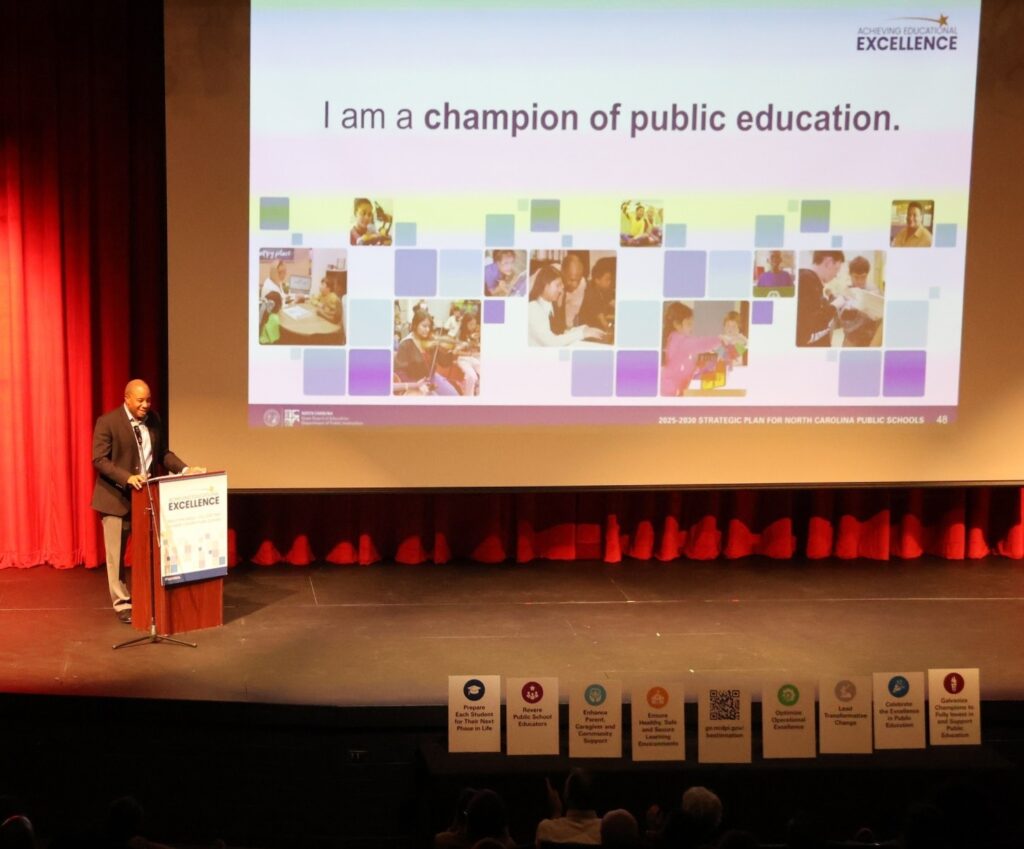
During a public forum Green had after concluding his strategic plan tour at Chapel Hill High School, the state superintendent mentioned the impact of ongoing cellphone restrictions on students in schools.
“This has been a game changer,” Green said. “As I listen to educators across the state of North Carolina, I even had teachers who say, ‘Oh, I can now see my children’s eyes again.’”
InspirED
Green and other visitors from DPI were able to step into the world of Principal of the Year Jason Johnson. At Orange High School, students and staff were able to share ways they innovate. They also directly told Green what they wanted to see from public schools in the future.
The school’s newest student club, InspirED, is for students who are interested in becoming educators. New this school year, the club is led by 2022 Beginning Teacher of the Year Xavier Adams and supported by a grant through the NC Teaching Fellows program.
The students said the following would get more people in their age group interested in teaching:
- Publicly praising teachers more often;
- Higher pay;
- Hearing more positive things about the profession from teachers themselves;
- More teachers bonding with students; and
- Hands-on experiences with teaching while in high school.
Maria Wilson, a senior at the high school, said that being a part of InspirED was the first time since she decided she wanted to become a teacher — which was in elementary school — that the idea became plausible for her.
“I’ve always wanted to be a teacher, but it’s sort of a hard thing to want, because so many of my teachers have said, ‘You do not want this. Do anything else,’ and it’s very disheartening,” Wilson said. “But when I came to Orange High School in 10th grade, then I was suddenly surrounded by teachers like Mr. Xavier… and they really made it seem like this is something you can do, and it’s something that actually benefits us and it’s hard, but it’s worth it.”
Moving forward
After sharing her experiences with Green and other leaders on the tour, Julie, a sophomore at Orange High School, asked, “What are y’all gonna do, moving on or with the information that you’ve gathered from schools, from students in their different ideas? What’s the plan moving forward?”
Many may be wondering the same thing.
At the end of the tour, Green and the DPI team concluded that the state had many people interested in being “champions for public education.” Such support was evident in the positive feedback from attendees at their public forums and bipartisan support from the 14 state legislators that made it to at least one tour stop.
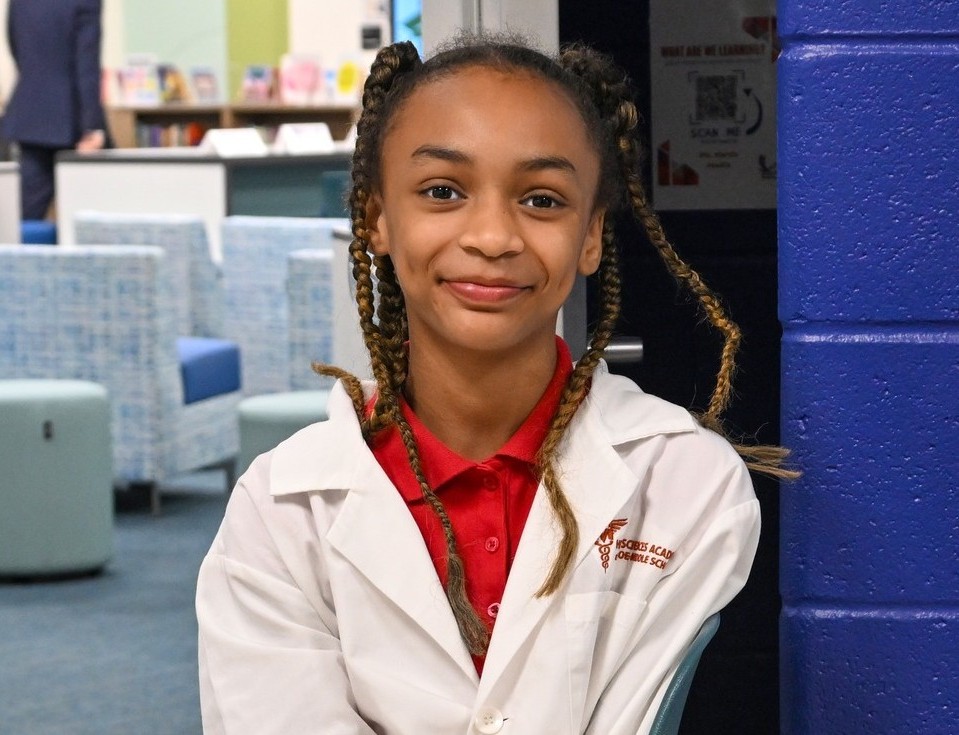

According to the state Board, six out of eight of the plan’s pillars have been launched. At the Board’s November meeting, the plan’s progress was laid out pillar by pillar.
Pillar 1 | DPI has fully assembled an execution team for this pillar. As part of the Golden LEAF Initiative, the 10 schools in the program’s Transformative Schools cohort began implementing a new math curriculum and line leadership development. They have also launched a comprehensive needs analysis to learn where the strengths and gaps in the selected schools are. They are still forming their support team for the Personalized, Competency Based Education (PCBE) cohort. The goal is to have five more schools join the PCBE cohort and begin the initiative this summer.
It was also mentioned that they are continuing to promote NC College Connect. A key factor to the program’s future success is funding, Rupen Fofaria, director of Board operations and policy, said.
Pillar 2 | The current main focus for this pillar is creating more opportunities for advanced teaching roles. As of the November Board meeting, 37 districts have advanced teaching role models. The Board is leaning on action from the General Assembly to scale the opportunities. In practice, this would mean an additional $2 million in ATR grants and $14.1 million for salary supplement funds, according to DPI’s presentation. Those items were included in the Senate budget proposal last year, and partially in the House’s proposal. Legislators recently allowed districts that lost ATR grant funding to still have K-12 class size flexibility.
Pillar 4 | The five-year, School Facility Needs Survey will be launched in January, DPI said. This year, the survey will be distributed through a cloud-based web app. DPI’s Office of School Facilities will also be updating their facility guidance documents soon. They also said they will continue to advocate for more capital funding, which is largely sourced from lottery funds, and for schools to use the money they receive from it wisely.
Pillar 5 | As of July 1, the new student information system, Infinite Campus, launched for five million users. This system does not require blackout periods or downtime for maintenance. The IT Management Office was happy to report that 52% of families were using the new parent portal. The hope is for 70% of families to be enrolled by the end of the academic year, with a satisfaction rate of 80%
Pillar 6 | The Board finalized their task force on school accountability in November and met for the first time in December, where it discussed its two-year timeline for making recommendations to the Board.
Pillar 7 | According to a research synthesis done by Neiman Collaborative and New Bridge, the following messages resonate statewide: “future ready preparation,” “multiple pathways,” and “safe and caring schools.” The Board said they are testing the messaging to support five additional actions to support this pillar.
Actions for Pillars 3 and 8 are launching during the month of January. For the third pillar, they aim to develop different versions of DPI resources based on student demographics. For the eighth pillar, DPI will launch a campaign for students to read a collective 10 million books statewide.
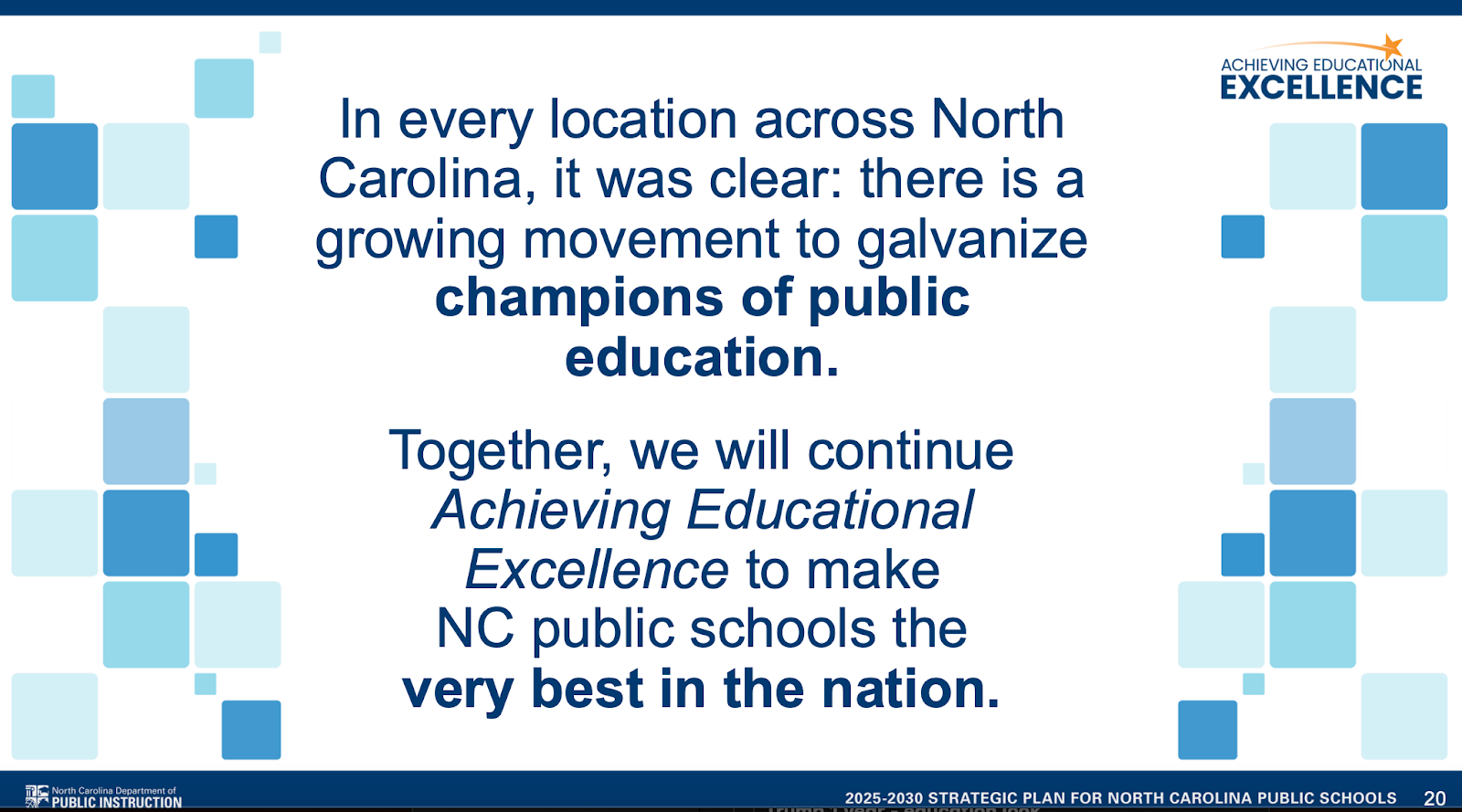
Board Chair Eric Davis also listed several milestones the state has hit that align with the pillars and actions in the plan.
First, DPI named the inaugural recipients of the State Blue Ribbon School awards. The four schools recognized were said to have demonstrated academic excellence.
The U.S. Department of Agriculture also recently awarded 14 school districts for providing healthy school meals.
Additionally, recent data showed that North Carolina outpaces the nation in Advanced Placement test takers and students receiving qualifying scores, meaning they can receive college credit. National data finds that 65% of test takers receive qualifying scores, while in North Carolina its 72%.
“So there it is. Indisputable evidence that our strategic plan is taking hold,” Davis said.
Resources
- DPI’s website for the strategic plan, where you can find the plan
- Executive Summary, Mo Wants to Know: Listening to North Carolina’s Voices for Achieving Educational Excellence
- Strategic Plan Regional Tour Report