
Planning to vote in the 2026 general election? Here’s what you need to know

North Carolina voters have several important decisions to make in November that will affect their local, state, and federal government. From selecting their representative in the U.S. Senate and voting on several constitutional amendments to picking members of the North Carolina Supreme Court, a lot is at stake that could impact the educational landscape of our state.
Election Day for the 2026 general election is Tuesday, Nov. 3. Early in-person voting begins Thursday, Oct. 15, and ends at 3 p.m. on Saturday, Oct. 31. Voters will be asked to show photo ID.
Before you cast your first ballot, you must register to vote. However, even if you have voted before, you may need to update your registration if your address, name, or party affiliation changed since the last election.
The last day to register to vote in North Carolina for the 2026 general election is Friday, Oct. 9 at 5 p.m., but voters may complete same-day registration during the early voting period.
Keep reading to learn more about voting and registering in the upcoming election. You can navigate through this page’s table of contents to answer your specific questions about the election.
The North Carolina State Board of Elections is the source for most information in this article.
 Sign up for the EdWeekly, a Friday roundup of the most important education news of the week.
Qualifications to vote
To vote, individuals must meet the following qualifications:
- Be a U.S. citizen, though citizenship documents are not required for registration
- Have been a resident in the county of registration for at least 30 days before Election Day
- Be at least 18 years old by the date of the General Election
- Not be actively serving a felony sentence, probation, post-release supervision, or parole. Those who have fully completed their felony sentence can vote, but must reregister.
However, regarding the requirement to be a resident of an N.C. county for at least 30 days before Election Day, the Uniformed and Overseas Citizens Absentee Voting Act grants active duty military or their families, as well as U.S. citizens abroad, special rights that “provide an expedited means to register and vote by mail-in ballot.” Read more here.
Check your voter registration status
To check your voter registration status and registration details, use the State Board of Elections search tool. All you have to do is enter your name, birth year, and county.
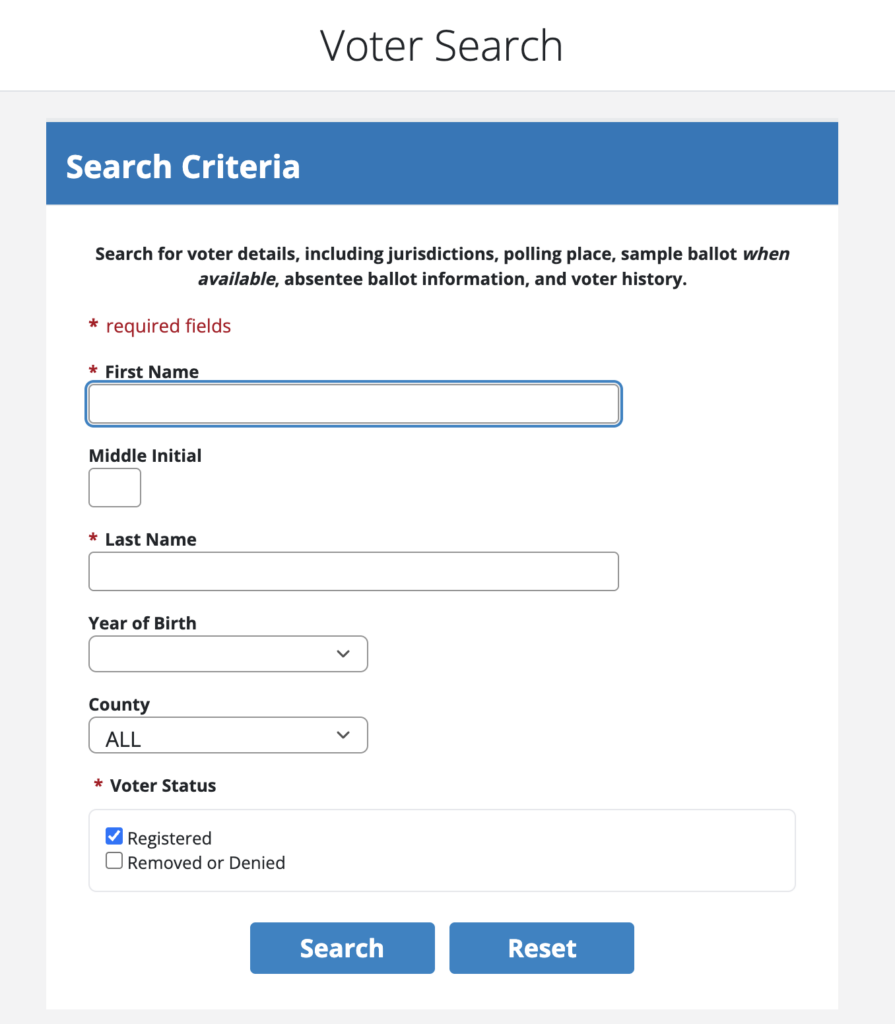
Screenshot from the N.C. State Board of Elections voter search tool.
If you are registered to vote in North Carolina, the search tool will allow you to view your party affiliation, your Election Day polling place, your voting districts, your voter history, and even your sample ballot.
As of Sept. 26, the board’s website said there were nearly 7.9 million registered voters in North Carolina.
You will also be able to see if you are an active or inactive voter. According to the State Board of Elections, “Inactive voters are still registered voters.” An inactive voter registration simply means that you haven’t voted in the last two federal election cycles — in this case, since 2022. If that is your case, you will be sent a forwardable address confirmation in the mail and are required to return the mailer within 30 days of receiving it.
If you don’t verify your address, you can still vote. You will just be asked to verify or update your address when you go in person to vote. No additional documentation will be required to verify your address to allow you to cast a ballot.
Registering to vote or updating your registration
Existing N.C. Division of Motor Vehicles (DMV) customers may submit an online voter registration application, and anyone can register to vote in person at the DMV. You can also register to vote in person at several state agencies. Explore the full list here, and find the closest DMV to you here.
You can also register to vote by mail. Click here for the voter registration application in English. (Haz clic aquí para obtener la solicitud de inscripción en el registro de votantes en español).
Before the voter registration deadline, currently registered voters can update their information following similar steps. Voters needing to change their name must do so in person or via mail rather than online.
The last day to register to vote or update your registration in North Carolina for the 2026 general election through these steps is Friday, Oct. 9, by 5 p.m. However, you can still register to vote and update your voter registration in person at early voting sites.
Voting in person on Election Day
Those voting in-person on Election Day must vote at their assigned polling location and bring their photo ID with them. To find your polling location, you can search here by looking up your residential address.
Polling places will be open from 6:30 a.m. to 7:30 p.m. on Election Day. However, any voter in line at their assigned polling place at 7:30 p.m. will be able to vote.
“The busiest times tend to be early in the morning and just before the polls close. Avoid longer lines by voting at off-peak times,” said the State Board of Elections.
On Election Day, curbside voting is also available to voters “who are unable to enter the voting place without physical assistance due to age or disability.” Read more about what assistance is available to voters here.
Curbside voters must sign an affidavit affirming that they are unable to enter the voting place without physical assistance to cast their ballot.
Voting early in person
During the early voting period, voters may cast a ballot at any early voting site in their county. Find voting sites in your county using this search tool.
You may register to vote or update your voter registration at any of the voting sites in your county during the period of early voting.
Early voting in North Carolina starts on Thursday, Oct. 15., and ends at 3 p.m. on Saturday, Oct. 31. Just like voting in-person on Election Day, voters are required to bring their photo ID to check in to vote.
Voting with an absentee ballot
According to the State Board of Elections, “any North Carolina registered voter may request, receive, and vote a mail-in absentee ballot for the 2026 elections.” As of Sept. 27, the board’s website says nearly 90,000 absentee ballots have been requested in North Carolina, and nearly 12,000 absentee ballots cast.
In order to vote by mail-in absentee ballot, voters must request an absentee ballot with an official NC Absentee Ballot Request Form, accessible through:
- The online NC Absentee Ballot Portal
- The 2026 NC Absentee Ballot Request Form to be printed and submitted to your county board of elections in person or by mail
The deadline to request an absentee ballot is two weeks before Election Day, or Tuesday, Oct. 20. The deadline for military and overseas citizen voters is different, and you can read more about the requirements for military and overseas citizen voters here.
Voters who vote by mail must include a photocopy of an acceptable ID. If they qualify, they may also complete a photo ID Exception Form with the absentee ballot return envelope.
Once you request your absentee ballot, you can track the status of your mail-in ballot “from printed to accepted” here. To submit your absentee ballot, you may submit it:
- By mail
- By commercial courier service — like DHL, FedEx, or UPS
- In person at your county board of elections office
- In person at an open early voting site in your county
- You can find early voting sites in your county by using the Early Voting Site Search.
You may not return an absentee ballot to a polling place on Election Day.
To submit your absentee ballot by mail, make sure to include correct postage on your ballot return envelope. According to the State Board of Elections, return postage is $1.98 for the 2026 general election. Three Forever stamps (82 cents apiece) would cover this amount, for example.
Previously, state law provided for a grace period if your ballot was postmarked on or before Election Day and received within three days after the election, but that is no longer the case. Your ballot must be received by your county board of elections by 7:30 p.m. on Election Day.
Voter identification
Explore the list of acceptable photo IDs for voting in NC elections here.
Many college or university ID cards and state or public employee ID cards are also acceptable forms of identification for voting. Find out if your student or public employee ID is valid for voting here.
Poll workers will check the ID to ensure the photo presented matches the voter and the name matches or closely resembles the name in the voter registration records, though a matching address is not required.
If you have a photo ID but did not bring it with you to the voting site, you have the following options:
- Go get your photo ID and return to the voting site to vote a regular ballot.
- Vote using a provisional ballot and bring an acceptable ID to your county elections office by noon on the fifth business day after Election Day. For this upcoming election, that would be Tuesday, Nov. 10 at 12 p.m.
All voters will be allowed to cast a ballot regardless of if they present a photo ID or not, though voters without an ID will have to vote with a provisional ballot.
What to do if you don’t currently have a photo ID
If you don’t currently have an acceptable photo ID, North Carolina registered voters can get a free voter ID from their county board of elections.
Find your local county board of elections here, using your county. They can issue a free voter ID any time during business hours, except for the period between the end of early voting through the end of Election Day. For this election, the board of elections will not issue free voter IDs between 3 p.m. on Saturday, Oct. 31, and 7:30 p.m. on Tuesday, Nov. 3.
When obtaining a free photo ID from your local county board of elections, you are not required to present any documents. Simply provide your name, date of birth, and the last four digits of your Social Security number using the request form provided by your county board of elections.
Typically, you will receive your photo ID same day, but your county board of elections may need to mail the ID card to you or inform you that the ID card is ready to be picked up, whichever you prefer.
You cannot receive a free voter ID and register to vote at the same time, so make sure that you are properly registered to vote before visiting your local county board of elections.
North Carolina residents may also access a no-fee state ID at any N.C. Division of Motor Vehicles (DMV) office. Those seeking these IDs must provide the DMV a document verifying their age and identity; a Social Security card or document offering proof of their Social Security number, such as a W-2; and one document proving their residency.
Those unable to travel to the DMV due to a disability may get assistance obtaining a state ID if they can provide a letter from a physician along with documents proving their age, identity, residence, and Social Security number. Those requesting this assistance can contact the DMV online here, or click this page to see a full list of contact options.
The State Board of Elections offers a full list of exceptions for showing a photo ID to vote, including those with religious objections to being photographed or those with a “reasonable impediment” such as lacking a birth certificate.
If any voter is unable to show photo ID when voting (whether in person or by mail), they may fill out an ID Exception Form and vote their ballot. If voting in-person, they will vote a provisional ballot.
Voting with a provisional ballot
A voter may be asked to vote using a provisional ballot if a voter’s qualification or eligibility to vote is called into question, for instance if they vote at the wrong polling place or have no acceptable ID.
State law mandates that no person shall be denied the option to vote a provisional ballot. In no circumstance should a voter be turned away.
Election officials hold provisional ballots aside as they conduct research about the voter’s eligibility. Based on the research, county board of elections members make final determinations about voter eligibility. Election results are not finalized until all provisional ballots that are eligible are counted.
If you vote with a provisional ballot, you will receive a Provisional Identification Number (PIN), which will allow you to check the status of your ballot. To check your provisional ballot’s status, you may:
- Check online
- Call 919-814-0700 or 866-522-4723 (toll-free)
You can view more resources on voting on the board’s website.