As President Donald Trump took office on Jan. 20, 2025, EdNC adopted an approach to our coverage that treats news as the first draft of history. We learned a lot.
“In one year, the Trump Administration has ended business as usual in education,” said U.S. Secretary of Education Linda McMahon in a press release issued on the anniversary. “As we enter year two: buckle up, because our foot is on the gas.”
Articles in our From DC to NC coverage identify the responsible leaders, the actions being taken, and the legal authority being cited with links to primary sources, including ongoing analysis of the impact on our people, places, and policies. Many for-profit outlets don’t link to primary sources because they can’t afford to drive traffic off their websites.
EdNC has published more than 75 articles over the last year on federal politics and policy, including our most read article of 2025: “Trump signs seven more executive orders impacting K-12 and higher ed,” now with nearly 200,000 pageviews.
Our readers did not suffer news fatigue; instead, this content largely drove a 15% increase in readership, including growing our audience outside of North Carolina thanks to Google search and, in particular, Google Discover.
I commend you for your well structured and concise articles about the issues and current events happening within the North Carolina education system. It has been refreshing to read them truly due to the linked attachments to primary sources and supporting articles. I also appreciate the straightforward description of what is happening within the world, which excludes biased perspectives.
— Sabree Flood, North Carolina educator
Our reporting has allowed us to track how voters, reporters, philanthropists, and policymakers are keeping up to date with everything that is happening; shifts in the importance of issues relative to federal policy change; longer-term implications; and the opportunity costs of reacting to federal policy.
Here are eight takeaways from our reporting on the first year of Trump’s second term as president.
 Sign up for the EdWeekly, a Friday roundup of the most important education news of the week.
1. Keeping up with what is happening is challenging
Part of the story of the first year of this Trump administration can be told through numbers and what the numbers mean for real people trying to keep up with what is happening.
Trump signed 225 executive orders in 2025. That’s more than he signed in his first term as president all together, and the most in one year since President Franklin D. Roosevelt. President Barack Obama’s high was 42 executive orders in 2016, and President Joe Biden’s high was 77 in 2021. Here is where you can keep track of all of the executive orders.
This New York Times poll tracker allows you to see the “daily average of polls conducted by dozens of different organizations since Inauguration Day.” The latest YouGov poll sponsored by CBS found the president has a 59% disapproval rating and a 41% approval rating, according to the New York Times. Using the YouGov data, The Economist projected the president’s net approval rating by state, finding -13.2% in North Carolina. According to the analysis by The Economist, education is still not in the top 10 issues for voters.
Education Week is tracking education-related lawsuits, finding “72 lawsuits challenging the administration’s education actions or broader policy changes that affect education” in 2025. Here is where you can keep track of all of the ed-related lawsuits. Here is a New York Times tracker on all of the lawsuits filed against the administration. In addition to lawsuits, federal rulemaking is also serving as a brake on policy change, slowing down the process and creating an opportunity for public input.
The Hechinger Report has this week-by-week tracker on the “administration’s major education actions.”
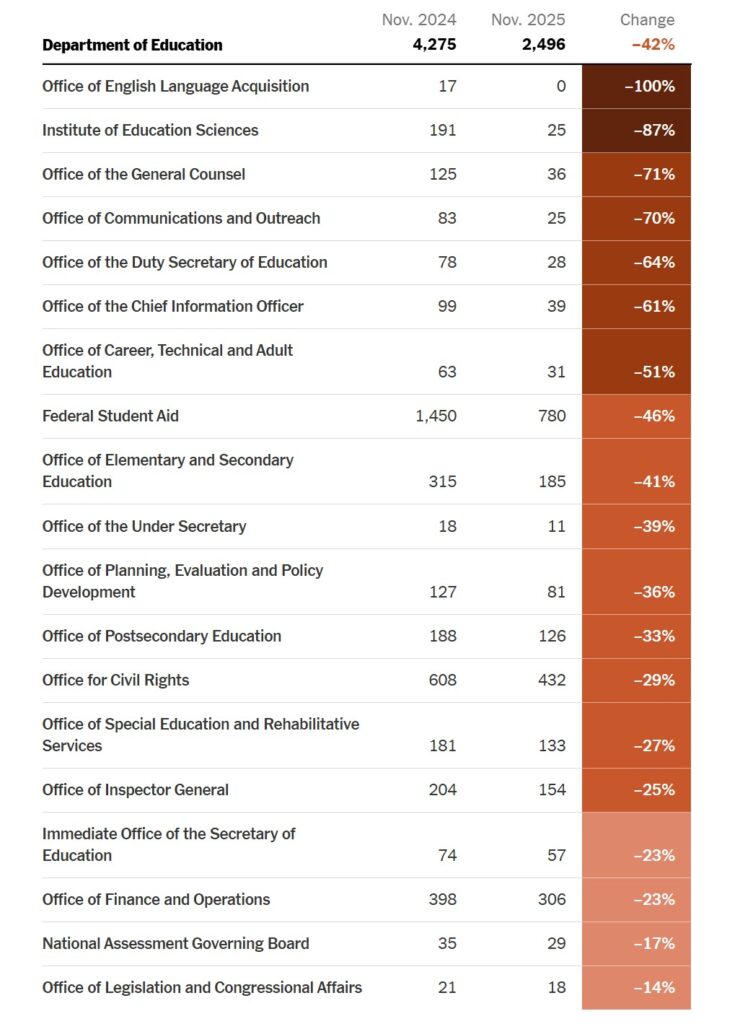
The New York Times is also tracking workforce changes by federal agency. The ripple effects of the administration’s plan to close the U.S. Department of Education will be far reaching, as you can see in this chart, which shows the number of workers in various offices within the agency.
Education Week estimates at least $12 billion in school funding disruptions by the administration.
EducationCounsel is a mission-based education consulting firm — affiliated with the law firm Nelson Mullins — “combining experience in policy, strategy, law, and advocacy to drive significant improvements in the U.S. education system to help all children thrive,” according to its website. The firm’s bi-weekly e-updates have emerged this year as a go-to source for those interested in federal education policy.
2. Issue importance is shifting
Another part of the story of the first year of this Trump administration can be seen through how the importance of issues is changing relative to federal policy being in flux for voters, educators, advocates, philanthropists, policymakers, and other stakeholders.
Issue importance can be seen in polling results. EdNC also reports on federal priorities that have more bipartisan support, including a much-improved FAFSA, apprenticeships, Workforce Pell Grants, and charter schools.
Issue importance can be evaluated by analyzing what’s featured in state and national headlines, from DEI (diversity, equity, and inclusion) to cellphones and artificial intelligence (AI) in the classrooms.
We can see through traffic on our site what remains important to our readers, including recovery in western N.C., literacy, youth well-being, learning differences and special education, community schools, school safety, vaccines and school health, school performance, LGBTQ+ youth, the strength of teacher and principal pipelines, STEM, arts and education, and more.
EdNC has previously reported on our top 10 issues to watch in the 2025-26 school year.

3. The stability of federal funding across administrations has been disrupted
Longer-term implications of changes in policy and practice in 2025 also tell part of the story of the first year of this Trump administration.
Historically, grantees of funding from the U.S. Department of Education have not had to worry that their federal funding would be terminated because of a change in administration. Funding might not be renewed at the end of the grant, but local and state leaders have been able to consider this funding stable during the grant period.
Last summer, a three-sentence email sent on June 30 froze billions of dollars of federal funding across the education continuum around the country the night before the funding was anticipated. Leaders on the right and the left had to write letters, file lawsuits, and respond to panicking constituents to move money Congress had already approved to be spent.
More recently, federal funding for community schools was terminated mid-grant cycle at the end of 2025, and a similar bipartisan uprising has ensued.
As the U.S. Department of Education is dismantled, and if funding continues to be unpredictable, it is hard to imagine how to build local and state infrastructure — leadership, funding streams, staffing, services — around this instability.
Republican U.S. Sen. Shelley Moore Capito from West Virginia and other congressional leaders are calling for the bipartisan funding decisions of Congress to be respected.
“The education formula funding included in the FY2025 Continuing Resolution Act supports critical programs that so many rely on. The programs are ones that enjoy longstanding, bipartisan support,” she has said.
If federal grants are not going to be honored moving forward when administrations change, the process may need to be revised so grantees at a minimum are given an opportunity to reapply with the new administration’s priorities in mind.
4. Increasingly, local, state, and philanthropic funding will have to be aligned
Philanthropy in North Carolina has long served as our first responder in times of crisis by providing the quickest dollars. That’s been true whether the crisis was economic, a natural disaster, or political.
But, for a long time, philanthropy and the state have been able to count on federal dollars, which in many cases has been both the largest source of funding and the most dependable.
In one year, that has changed, and it changed the year after an unprecedented philanthropic response to Hurricane Helene. Now, our counties and philanthropy are being asked to fill the many emerging gaps resulting from changes in state and federal funding.
Just last week, Gov. Josh Stein announced a public-private partnership to ensure SUN Bucks is returning to North Carolina for another summer, according to this press release. SUN Bucks is a U.S. Department of Agriculture (USDA) program that provides grocery-buying benefits for families during the summer months when schools are out, according to the website.
The state is working with several philanthropic partners — including the Blue Cross and Blue Shield of North Carolina Foundation, Coca-Cola Consolidated, and The Duke Endowment, among others — to make sure eligible families will have access to the program and be able to put food on the table since the legislature did not pass a state budget in 2025.
But how far can local, state, and philanthropic dollars be stretched in response to the changes in federal funding?
Through our reporting, EdNC is tracking more than 15 multimillion dollar requests to philanthropy in North Carolina from education organizations in the hopes of securing matching funds from state appropriations in the 2027 long session of the legislature. In my 30-year career, that’s unprecedented, and it comes at a time when state revenue is projected to decline.
All of the issues for which funding is sought — education reform and innovation, high-impact tutoring, community schools, alternative schools, rural schools, literacy, attainment, early childhood education, work-based learning, adult learners, and more — are important.
Almost certainly, grantees and funders will have to find new ways to coordinate and align investments going forward.
EdNC will continue to track the local, state, and federal funding of early education, our schools, and our community colleges, and how shifts in funding are stressing philanthropic resources statewide.
5. Access to education cannot be taken for granted
For more than 40 years, students without legal status have been allowed to attend public schools free of charge in districts across the United States, and over time that has included access to early education and postsecondary opportunities.
Federal case law cites reasons for this decision, including:
- Not wanting to penalize children for their presence in the country;
- Recognizing that many students will remain in the country, some becoming lawful residents or citizens;
- Not perpetuating “a subclass of illiterates within our boundaries, surely adding to the problems and costs of unemployment, welfare, and crime;” and
- Concluding that “whatever savings might be achieved by denying these children an education, they are wholly insubstantial in light of the costs involved to these children, the State, and the Nation.”
The 74 reports, “From cradle to career, President Donald Trump has launched a comprehensive campaign to close off education to undocumented immigrants, undercutting, advocates say, the very reason many came to the United States: for a chance at a better life.”
“This policy shift threatens to undermine community development, workforce readiness, and economic mobility across the nation,” says a statement issued by The Presidents’ Alliance on Higher Education and Immigration, an alliance of American college and university leaders.
With the presence of Immigration and Customs Enforcement (ICE) in communities across the state, increasingly those with legal status also fear coming to school.
As our open door begins to close, North Carolina’s beloved Dallas Herring reminds us what is at stake. “Education of the masses of humanity, not only as economic beings, but especially as human beings, will be essential to the achievement of peace and prosperity,” he wrote.
EdNC will continue to track access to opportunity in North Carolina across the educational continuum.
6. Discrimination may increase. Here’s why
In April 2025, the president signed an executive order titled, “Restoring Equality of Opportunity and Meritocracy,” accompanied by this additional information, which will impact education and all other federal agencies.
This order makes it the policy of the United States to eliminate the use of disparate impact theory as far as legally possible.
According to a manual from the U.S. Department of Justice Office of Civil Rights about the Civil Rights Act of 1964, disparate impact theory ensures “that public funds, to which all taxpayers of all races contribute, not be spent in any fashion which encourages, entrenches, subsidizes, or results in racial discrimination.”
In calling for the enactment of the Civil Rights Act, according to the Department of Justice, President John F. Kennedy stated:
Simple justice requires that public funds, to which all taxpayers of all races contribute, not be spent in any fashion which encourages, entrenches, subsidizes, or results in racial discrimination. Direct discrimination by Federal, State, or local governments is prohibited by the Constitution. But indirect discrimination, through the use of Federal funds, is just as invidious; and it should not be necessary to resort to the courts to prevent each individual violation.
This administration’s order says, “A bedrock principle of the United States is that all citizens are treated equally under the law. This principle guarantees equality of opportunity, not equal outcomes. … It encourages meritocracy and a colorblind society, not race- or sex-based favoritism.”
Discrimination may increase because the federal policies that have been in place for 60 years to decrease discrimination are no longer the law of the land.
EdNC will continue to track this policy change and any impact on student achievement gaps.
7. The policy implications of school choice aren’t being wrestled with enough
School choice is personal for parents as they consider and evaluate the best “fit” for their child.
And school choice is political, with implications for local public schools as funding has not kept up with inflation and public school market share declines in some places.
Often, important policy implications of school choice get lost in those dynamics.
On universality and fiscal responsibility
Whether taxpayer-funded vouchers should be provided to families regardless of income continues to be debated, even among conservatives.
Michael Petrilli, president of the Fordham Institute, in an article titled, “School choice need not mean an expensive windfall for the rich,” says under the surface of school choice expansion, “an important debate is brewing: how to balance the drive for educational freedom with other essential values, including fairness and fiscal responsibility. Simply put: Must the expansion of school choice result in windfalls for America’s wealthiest families, particularly those that already send their children to fancy private schools? Especially when that means blowing big holes in state budgets?”
The primary race between Sen. Phil Berger, R-Rockingham, and Sam Page features key differences in school choice between Republican candidates.
On pluralism
In democracies around the world, according to the leading research on educational pluralism conducted by Ashley Rogers Berner at the John Hopkins School of Education, states don’t exclusively deliver education. But where other countries build choice into their systems, they also build in quality control.
Quality, not accountability, is the word of choice internationally.
Berner talks about why academic content needs to change and expectations need to increase regardless of educational setting.
“To be blunt, a libertarian, let-a-thousand-flowers-bloom approach,” she says, is unlikely to improve important outcomes at scale.
On churn
With more school choice comes what researchers call “churn,” or how often students change schools.
“There are real, tangible impacts on a students’ learning and wellbeing at every churn — especially mid-year,” says an article published by the Fordham Institute titled, “School choice is great, but the churn it allows comes at a cost.”
On unbundling
A November 2025 article in The Economist looks at the experiment happening in Florida, a frontier state for school choice expansion.
“Parents empowered with $8,000 state vouchers to school their children as they see fit are fuelling a new kind of educational marketplace. It blends traditional homeschooling, charter schools and new hyper-specialized ‘microschools’ or ‘co-ops’ that offer unbundled classes on every thing from algebra and forestry to karate,” says the article.
The Economist says parents act as general contractors, “selecting their children’s schooling from a wide range of suppliers and shuttling them between lessons and extra-curricular classes.” It notes that “many of these pupils have learning disabilities that make conventional school hard.”
In one county, “public schools lost 7,000 pupils to ‘deschooling'” and other school choice options.
The article says, “The unbundling of education is shaking up the school system. Conventional schools want to join in.”
Across the country, public school districts are wrestling with how to be more responsive to the expansion of school choice. This study “finds 16 states have statewide cross-district open enrollment and 17 states have statewide within-district open enrollment.”
The Economist article raises the question of whether “unbridled capitalism” will lead to better student outcomes, and given the lack of requirements and reporting, whether researchers will even know.
8. The rest of the world is busy thinking about the future of education
One of the most disconcerting parts of the story of the first year of this Trump administration can be seen in the opportunity costs associated with the preoccupation and reactivity required by what is happening now here in the United States.
On trips to Japan and Singapore in 2025, it was hard for me to wrap my mind around just how far ahead of us other countries are.
While education in the United States is being increasingly politicized, the Organisation for Economic Co-operation and Development (OECD) engaged seven high-performing Programme for International Student Assessment (PISA) countries to think about the future of education.
“Our schools today will be our economy, our society, and our democracy tomorrow,” notes a conceptual framework OECD released in November 2025, providing a blueprint for how education is shape shifting internationally.
This framework is already being used to change the metrics for measuring educational success, including PISA, in tomorrow’s world.
According to OECD, education will have to address five student competencies in the future: adaptive problem-solving, ethical competence, understanding the world, appreciating the world, and acting in the world. Why those? “Because by 2040 AI will be effective in critical thinking, creative thinking, ethical reasoning, flexibility and collaboration,” predicts the report, citing research.
Importantly, these new competencies “do not replace foundational literacies but build on them.”
That’s what policymakers are talking about in countries like Singapore and the other countries that lead the world in PISA scores. In 2022, when PISA scores were last released, the United States did not break the top 30.
While we continue to struggle to teach reading and math and improve continuously low performing schools, countries like Singapore are rapidly iterating their already state-of-the-art education system to ensure they will continue to lead the way in educating the workers of tomorrow. For a state that loves its No. 1 rankings in business and workforce, that should give us pause.
And, with the passing of our Education Governor Jim Hunt, a lot is being written about how children’s futures should transcend politics. It will take cross-partisan advocacy for that to be true across North Carolina and to prompt the all-important OECD question: “What are the goals of an education worth giving to our young?”
Editor’s note: Blue Cross and Blue Shield of North Carolina Foundation and The Duke Endowment support the work of EdNC.

Recommended reading