
2026 Center for Education Reform analysis ranks NC’s charter school laws 7th best in the nation


North Carolina laws that authorize and regulate charter schools were recently ranked No. 7 in the nation, based on an analysis of each state’s authorization model, potential for growth, operational quality, and equity principles by the Center for Education Reform (CER), according to a press release. The center’s full analysis of state charter laws can be found on page 35 of this reference guide.
“North Carolina families have an array of options for their children, including thriving public charter schools,” said Executive Director of the NC Coalition for Charter Schools Dave Machado in a press release. “That’s because North Carolina’s lawmakers have adopted good, sensible policies that empower parents to choose the school environment that best suits their kids, and they deserve thanks for their many years of work in this sector.”
Charter schools were initially established in North Carolina in 1996. In 2023, charter school law was amended, shifting the approval authority from the State Board of Education to the new Charter Schools Review Board (CSRB). The CSRB now has sole authority to review, approve, deny, and renew charter applications; the State Board of Education maintains rulemaking authority and can review appeals of decisions by the CSRB.
 Sign up for our monthly roundup of news and updates about North Carolina’s charter schools.
In its analysis of the authorization process in North Carolina, CER highlighted the independence that the new structure creates, while still “preserving statewide accountability.” CER gave the state’s authorization process a 7/15, examining if the state has multiple authorizers, authorizer activity, and if the authorizing bodies act independently. North Carolina’s authorization score remains the same from 2022.
“Recent reforms have strengthened an already solid charter law by making it easier for successful schools to expand,” says the CER analysis. “Now it’s time to finish the job by ensuring that charter schools have equitable access to facilities funding and the resources they need to serve even more students.”
Explore more of EdNC’s coverage of charter schools

The 2023 amendments also enabled charter schools to “expand enrollment…, add or remove a grade level, and enroll out-of-state students, foreign exchange students, children of active-duty military personnel, and certain preschool students under specified circumstances” without state authorization, CER said in its reference guide.
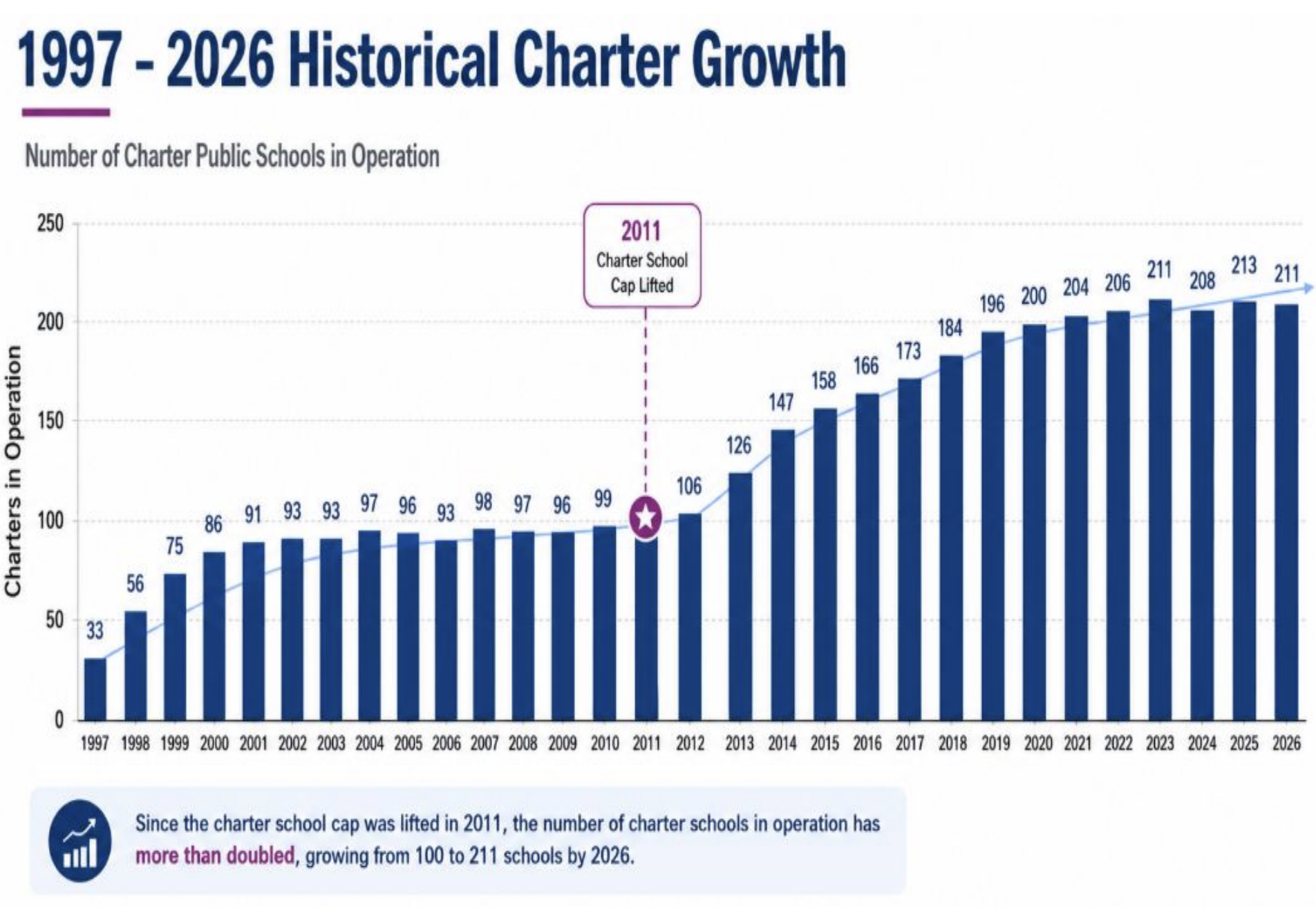
Since 2011, there has been no cap on the number of charter schools allowed in North Carolina. During the August State Board of Education meeting, Ashley Logue, executive director of the Office of Charter Schools, noted how impactful removing the 100-school cap on charter schools was to their growth in the state.
“Following that lift, we saw 113% growth until 2025, when we had our highest number of 213 schools,” said Logue. “The growth of charter schools is the direct result of authorizing charter applications.”
The CER analysis says these changes to enrollment have “strengthened opportunities for charter growth and replication.” CER gave North Carolina a growth score of 14/15, which encompasses charter cap and the ability to scale. This score has also remained the same since 2022.
Furthermore, CER said charter schools in North Carolina have “broad operational autonomy.” Under operations — examining school autonomy, teacher freedom, and the freedom to innovate — North Carolina received a score of 15/20, which is an increase from the 13/20 it received in 2022.
Finally, states were evaluated with regard to their charter school laws’ equity, which compares charter funding to traditional public school funding. In North Carolina, charter schools receive the same per-pupil allocation as traditional public schools, CER said, but “North Carolina still does not provide a dedicated statewide per-pupil facilities funding program, leaving many charter schools to finance facilities through operating revenues or local initiatives.”
Examining if operating funds are specified, funding for pre-K, and facility funds and financing, North Carolina scored a 9/17, which is an increase from the 5/17 the state received in 2022.
Overall, North Carolina improved two spots since 2025 and six spots since 2022.
“North Carolina’s growth is owing to the increased opportunities to grow and the strength of charter school funding mechanisms, which was hard fought by advocates for decades,” according to the CER analysis.