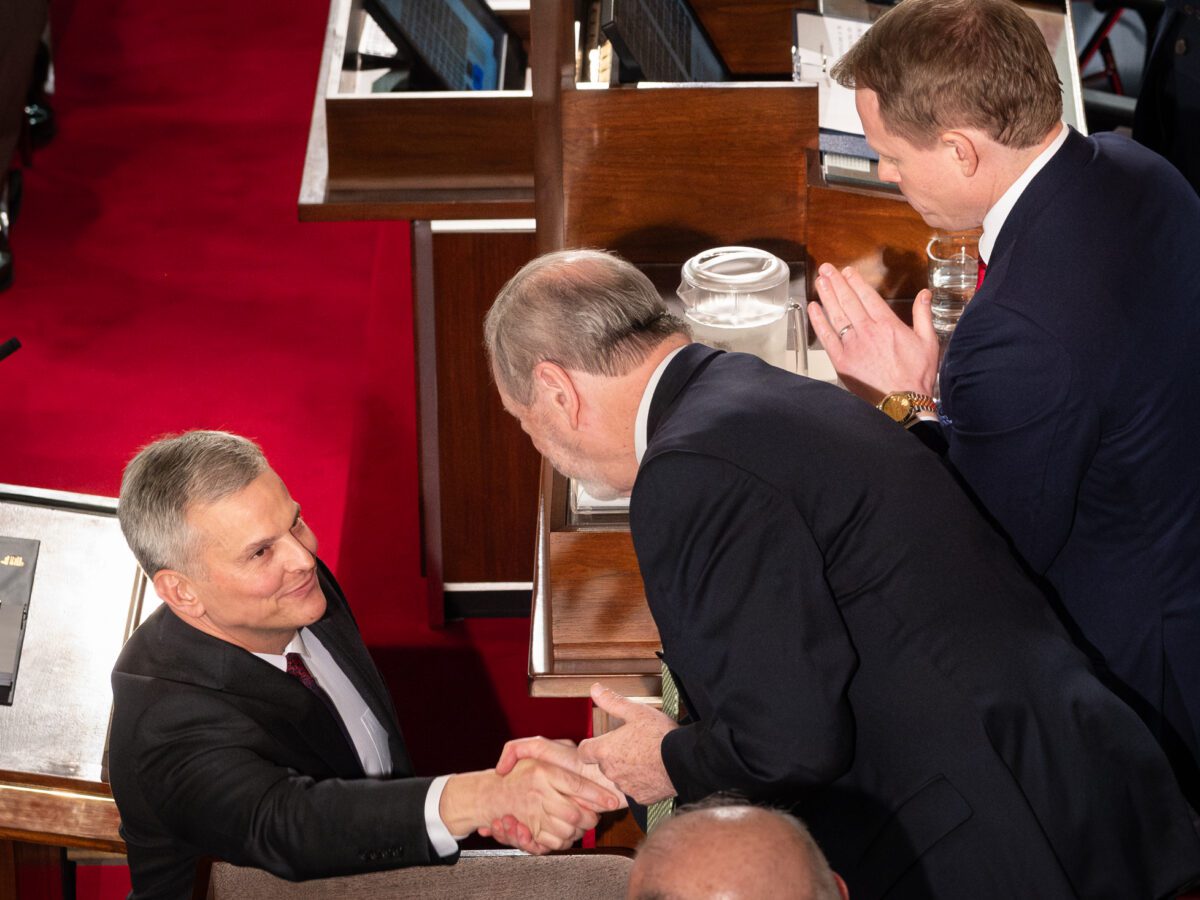
Gov. Josh Stein, Senate President Pro Tem Phil Berger, and Speaker of the House Destin Hall announced the formation of a Blue Ribbon Commission on Public Education on Tuesday, according to a press release and accompanying executive order.
The commission has been charged to “study the structure and implementation of public education in the State,” including:
- Teacher training and student advancement,
- Administrative operations,
- Educational leadership, and
- Accountability.
 Sign up for the EdWeekly, a Friday roundup of the most important education news of the week.
The staff of the governor’s office will coordinate with the nonpartisan professional staff from North Carolina General Assembly Legislative Services on the work of the commission.
A report including findings and recommendations is expected to be sent to the governor and General Assembly by Dec. 31, 2026, in advance of the long session of the legislature in 2027.
Why?
The executive order notes:
North Carolina has a constitutional duty to ensure all children have the opportunity to receive a sound, basic public education,
North Carolina’s public schools are foundational to our state’s prosperity, ensuring the long-term economic vitality, civic strength, and social well-being of our state and its people, and
Support and resources are needed to effectively meet the academic and social-emotional needs of students and the organizational needs of schools and school systems.
Why now?
Superintendent Mo Green has launched a new strategic plan with the goal of public schools across North Carolina being the best in the nation. A new accountability task force began meeting last month.

The establishment of the new blue ribbon commission takes place at a moment in time when it has been more than two years since oral arguments the Leandro lawsuit, which addresses the state’s support for funding the constitutional right to access a sound, basic education.
“North Carolina has gone nearly two and a half years without passing a new state budget — the only state in the country to finish 2025 without one,” Stein said earlier in the week.
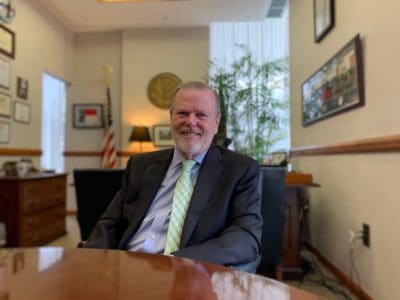
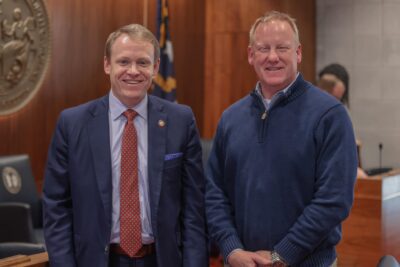
Berger, regarded for his leadership on literacy, is in a tight reelection race, and Hall, who is in his first term as speaker, serves as a school board attorney.
Across the state, key education organizations are also in transition: the Public School Forum of North Carolina and the N.C. Association of School Administrators are in the midst of searches for new leaders, and LatinxEd has recently hired a new director, Andrea Freile.
With the announcement of the commission, Stein, Berger, and Hall all weighed in on why and why now.
“Excellent public schools create meaningful opportunity for every North Carolinian to succeed,” Stein, a Democrat, said in the release. “This commission represents a bipartisan commitment and an opportunity to make North Carolina’s public schools the best in the nation.”
“The educational opportunities in North Carolina open a world of possibilities for our citizens,” said Berger, a Republican. “It’s imperative that we continue to work collaboratively to ensure North Carolinians have the skills they need to enter the workforce. We need everyone — business leaders, educators, and policymakers — to come together to meet the real-world needs of our students. I look forward to seeing the proposals this group suggests to improve educational outcomes for all students.”
“North Carolina has the talent and the foundation to become a national leader in education, and we intend to do just that,” said Hall, also a Republican. “By bringing top educators, business leaders, and elected officials to the same table, this new commission will take an honest look at what’s working and what isn’t in our public schools. I look forward to collaborating with them to strengthen schools across our state.”
Who will serve on the commission?
Twenty-eight of up to 30 members have been announced, all of whom were jointly appointed by Stein, Berger, and Hall.
- Anne Faircloth, President, Buffalo Investments & Lafayette Farms (Commission co-chair)
- Dr. Don Martin, Chair, Forsyth County Board of Commissioners (Commission co-chair)
- Mo Green, Superintendent of Public Instruction
- Sen. Jay Chaudhuri, D-Wake
- Sen. Kevin Corbin, R-Macon
- Sen. Dana Jones, R-Forsyth
- Sen. Brad Overcash, R-Gaston
- Sen. Gladys Robinson, D-Guilford
- Rep. Cynthia Ball, D-Wake
- Rep. Brian Biggs, R-Randolph
- Rep. Tricia Cotham, R-Mecklenburg
- Rep. Brandon Lofton, D-Mecklenburg
- Rep. David Willis, R-Union
- Eric Davis, Chair, State Board of Education
- Brenda Berg, President & CEO, BEST NC
- Dr. Connie Book, President, Elon University
- Teresa Branch, School Board Member, Caldwell County Schools
- Matt Bristow-Smith, Principal, Edgecombe Early College High School, Edgecombe County Public Schools
- Dr. Jonathan Bryant, Chief Administrator, Lincoln Charter, Lincoln County
- Dr. Del Burns, Retired Superintendent, Wake County
- Allen E. Gant, Jr., Chair, Glen Raven, Inc.
- Dr. Jason Gardner, Superintendent, Mooresville Graded School District
- Lisa Godwin, Beginning Teacher Coach, Pender County Schools
- Peter Hans, President, University of North Carolina System
- Dr. Bill Harrison, Chair, North Carolina Public School Forum
- Marisha Merchant, Teacher, Onslow County Schools
- Anna Spangler Nelson, Chair, Spangler Companies, Inc.
- Dr. Robert P. Taylor, Superintendent, Wake County Public School System
The executive order requires that members “represent the geographic, professional, and demographic diversity of North Carolina.”
Currently, there is no representation from the N.C. Community College System. Given the importance of dual enrollment, attainment, career and workforce development in the state, it may be one of the extra seats is being held for the new president, as the system is currently in transition.
A brief history of commissions on education in North Carolina
What follows is not an exhaustive list, but here are some of the key commissions that have shaped education policy over the decades in North Carolina.
In 1968, Gov. Dan Moore’s Study Commission on the Public School System of North Carolina issued a 323-page report with the goal of “A Child Well Taught,” which included 172 recommendations. It became known as the state’s blueprint for public education, covering:
- curriculum development and improvement;
- early childhood, vocational, and specific education;
- educational materials;
- educational research;
- extended school year;
- organizational structure;
- teacher recruitment, utilization, compensation, and preparation;
- auxiliary services; and
- educational finance.
In 1984, Gov. Jim Hunt’s Commission on Education for Economic Growth also included an advisory panel and established “A Friends for Improving Public Education.”
In 1988, the Public School Forum of North Carolina released, “Thinking for a Living: A Blueprint for Educational Growth,” including almost 80 recommendations costing nearly $720 million.
“During the 1990s,” according to the West Ed Report, “North Carolina posted the largest student achievement gains of any state in mathematics, and it realized substantial progress in reading, becoming the first southern state to score above the national average in fourth grade reading and math, although it had entered the decade near the bottom of the state rankings. Of all states during the 1990s, it was also the most successful in narrowing the minority-White achievement gap.”
Some leaders attribute these improvements at least in part to the work of previous commissions.
Hunt in his state of the state address in Feb. 1999 called for our schools to be the best in the nation by 2010. He proposed a 10-point plan, and the education cabinet went on to draft its “First in America School Goals.”
In May 2001, Gov. Mike Easley launched his Education First Task Force.
In December 2001, this report, known as the “Bridges report” after the superintendent who chaired the commission, was issued by the N.C. Commission on Raising Achievement and Closing Gaps to the N.C. State Board of Education.
More recently, on Dec. 10, 2019, the West Ed report in the Leandro case was released. Although not the product of a commission, the full and accompanying reports have been influential for advocates.
In January 2020, Gov. Roy Cooper’s Commission on Access to a Sound Basic Education, which ran from 2017-20, issued this report with recommendations on finance, teachers, principals, early childhood, assessment, and accountability.
Most recently, in April 2022, the Hunt Institute’s Hunt-Lee Commission released a report with 16 recommendations to improve public schools.
The foreword of that report said, “We know that the best solutions to our longstanding challenges in North Carolina’s education system (early learning through higher education) do not lie with any single group; real change requires that leaders from across the state, across the education continuum, and across sectors build trust, find common ground, and work together on behalf of students and families.”
If you know of other key commissions, email me at mrash at ednc.org.

Recommended reading