
State Board of Community Colleges: Transfer agreements and law enforcement training

The State Board of Community Colleges met this week to discuss a number of matters, including an annual report on transfer agreements to UNC System schools and additional training for law enforcement.
Here is a look at some of those discussions.
Articulation agreement
Back in 2014, the community college system signed a comprehensive articulation agreement with the UNC system. The purpose of this agreement is to make it easier for community college students to transfer smoothly to four-year colleges in the state by standardizing the credits that can transfer from community colleges to four-year colleges.
The State Board of Community Colleges heard an annual report to the General Assembly on the articulation agreement Friday. Included in that report was data on community college student enrollment in UNC System institutions.
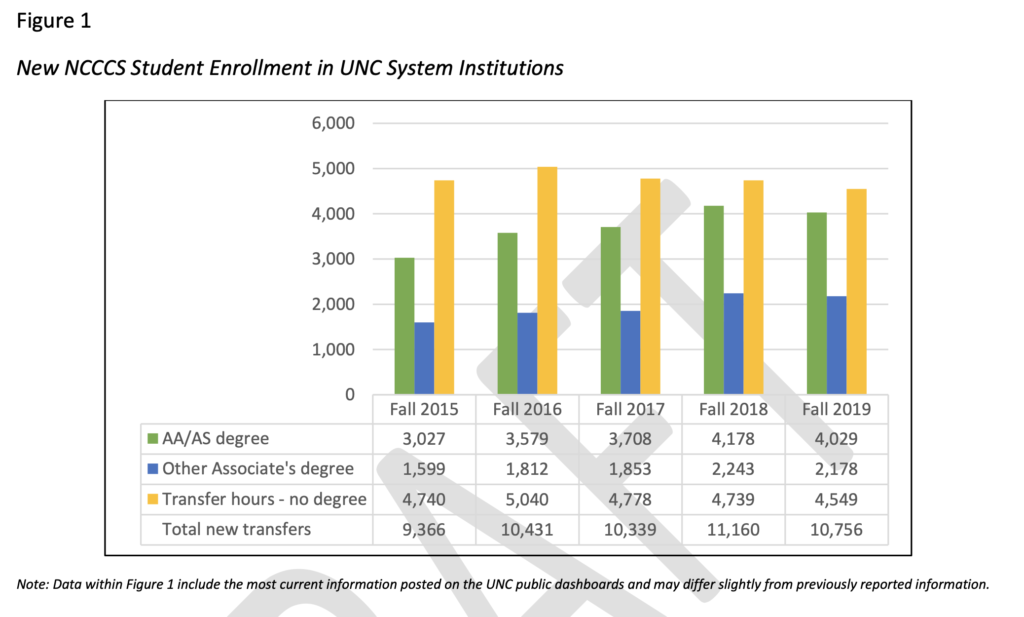
Enrollment from community college students to four-year colleges has generally increased each year since the articulation agreement, though there was a slight decrease from 2018 to 2019.
Similarly, the number of transfer students who transfer with a completed associate degree has generally increased, with a slight decrease from 2018 to 2019.
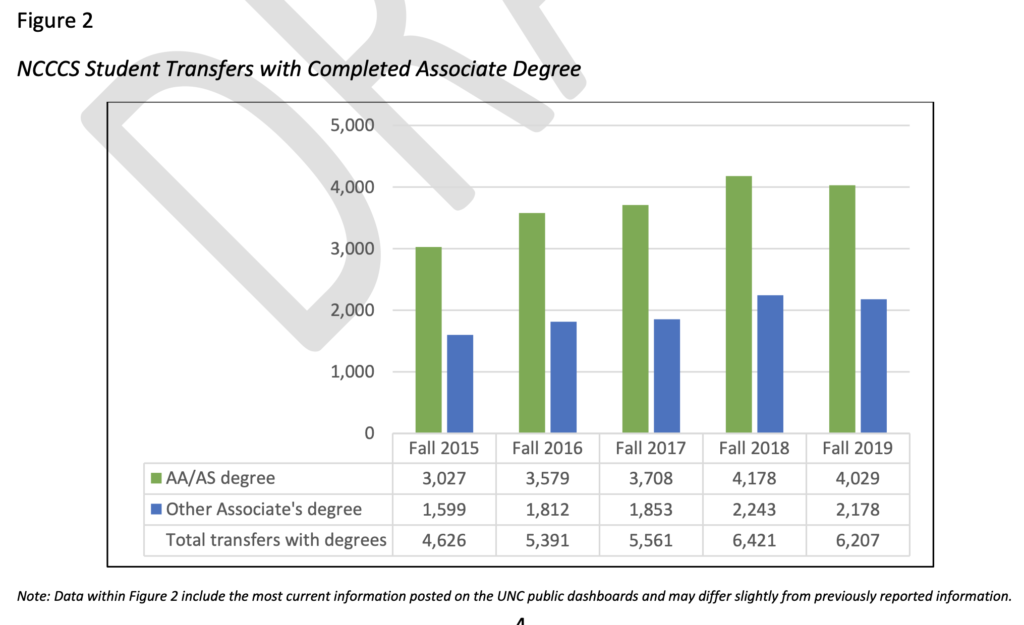
“We really encourage students to transfer with an associate degree,” said Kim Gold, chief academic officer of the community college system.
Also included in the report is data comparing the performance of community college transfer students to that of native UNC students.
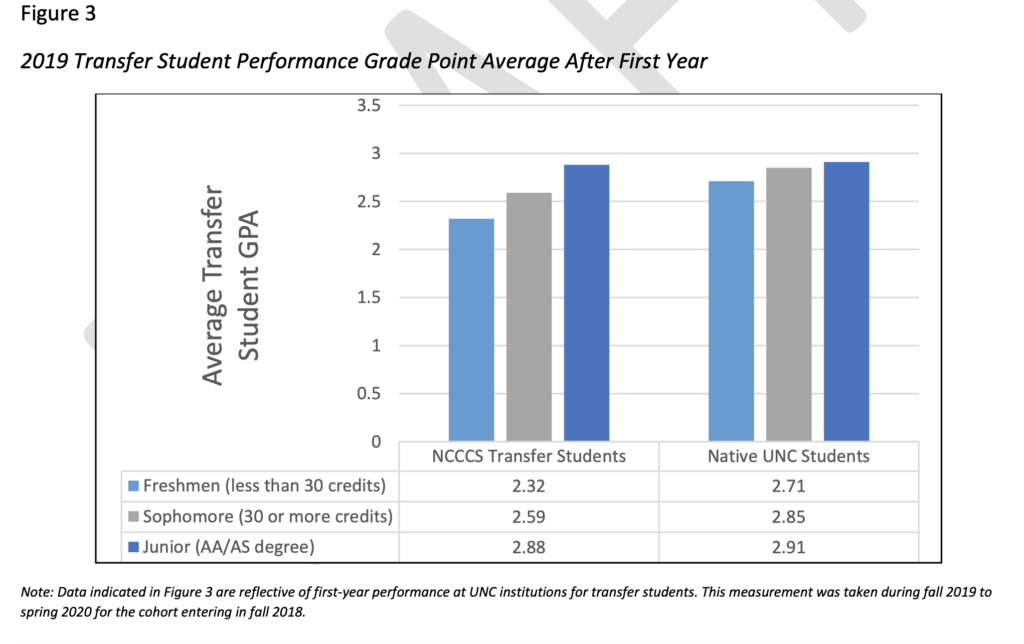
The report also includes a section on challenges that have arisen due to COVID-19.
The report states that there was “difficulty in predicting enrollment trends with both transfer and traditional student populations and the implementation of grading systems that were fair to students during the unprecedented times faced in spring 2020. Understandably, universities were unsure how students and families would react to the worldwide pandemic as regards to their enrollment in higher education. This made it difficult to plan accordingly for fall 2020. Additionally, decisions regarding the nature of grading (a traditional grading scale versus a pass/fail scale) and its relationship to transferring students were difficult to make. Fortunately, most, if not all, universities decided to hold students harmless for grades earned during the spring 2020 semester, regardless of whether they were traditional or transfer students.”
For more on transfers, click here.
Related Readings


Law enforcement training
The State Board of Community Colleges approved an additional $62,500 for training law enforcement.
Back in June, the State Board approved $100,000 for law enforcement training in things “such as de-escalation, relationship-based policing, and community interaction.” The move came following nationwide protests after the killing of George Floyd in May.
The additional money will be for “train-the-trainer topics such as verbal de-escalation for law enforcement and the delivery of training on topics for law enforcement managers. Training for managers represents the second phase in the work and will cover topics related to dealing with toxic officers, improving community relations, and best practices for recruitment and hiring.”
 Sign up for Awake58, our newsletter on all things community college.