North Carolina had the third-highest number of students enrolled in Career and Technical Education (CTE) courses in the nation during the 2023-24 school year, according to a Department of Public Instruction (DPI) presentation, with 550,918 students participating in CTE courses. Relative to overall K-12 enrollment, the state ranked second for participation in these courses nationwide, with 36.1% of students enrolled in a CTE course.
During the 2024-25 school year, CTE students earned 382,964 industry-recognized credentials — the highest total in state history.
“The record amount of credentials represents real opportunities for our students,” said State Superintendent Maurice “Mo” Green in a DPI press release. “When a student earns an industry-recognized credential, they’re not just completing a course, they are gaining a competitive advantage in the job market and building a foundation for long-term career success.”
 Sign up for the EdDaily to start each weekday with the top education news.
Trey Michael, senior director of the Office of Career and Technical Education at DPI, shared these achievements during the State Board of Education’s February meeting on Wednesday.
“Industry-recognized credentials give students a head start on their careers,” Michael said in the press release. “Whether a student is pursuing nursing, cybersecurity, construction or culinary arts, these credentials validate their skills and open doors to good-paying jobs.”
Michael said 65,000 new CTE concentrators — students who take two or three courses in a career pathway — enroll annually, with a four-year cohort graduation rate of 98.57%. According to the office’s 2024-25 Credential Report, nearly three-in-four concentrators received an industry-recognized credential in their concentration.
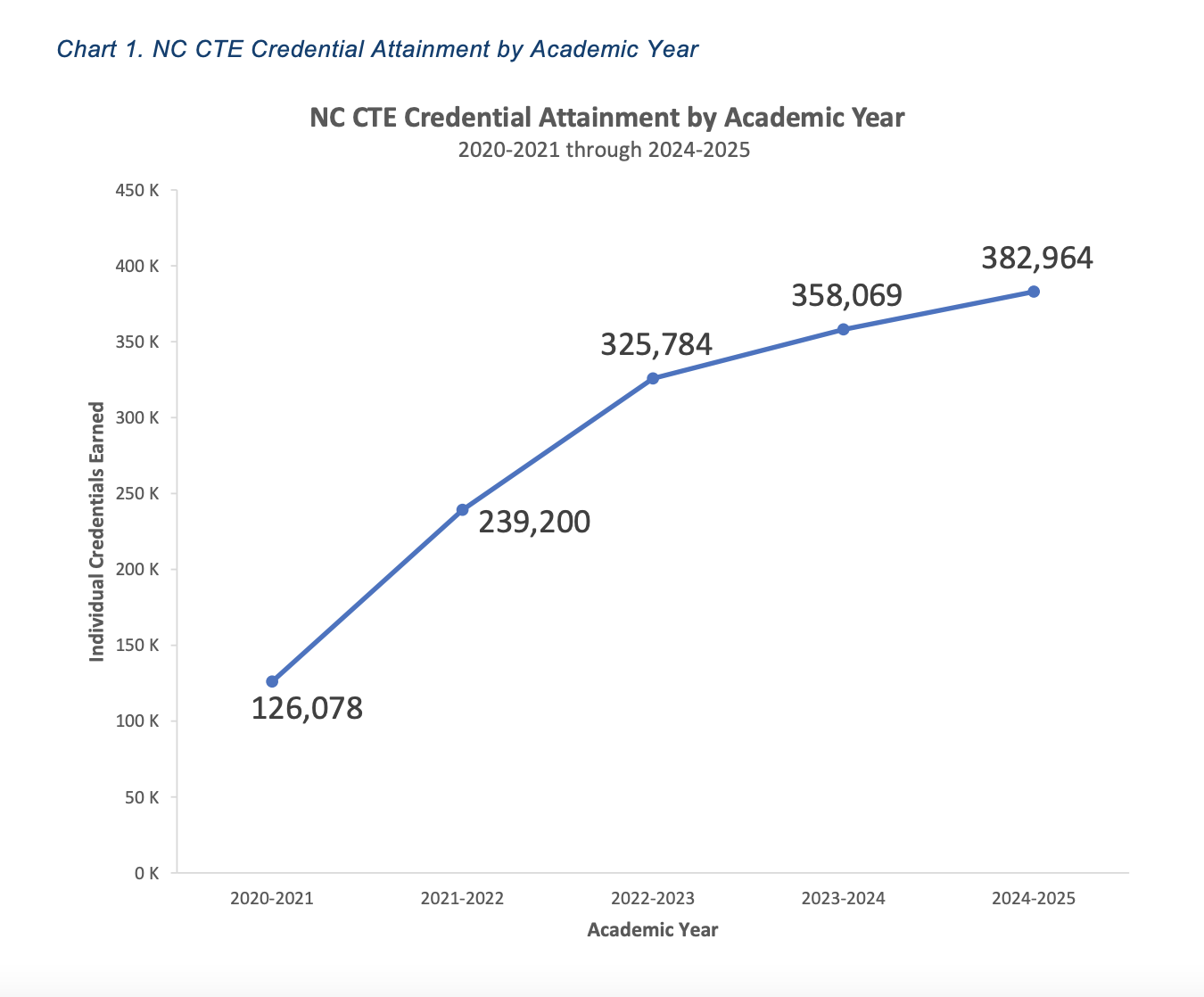
The number of individual credentials earned reached during the 2024-25 school year reflects a 6.9% increase from the previous year and triple the amount of credentials earned in 2021.
DPI said the growth since 2021 can be partially attributed to increased funding from the General Assembly, which reached $15.8 million in 2022-23, according to the press release, enabling schools “to offer credentialing opportunities to virtually all CTE students.”
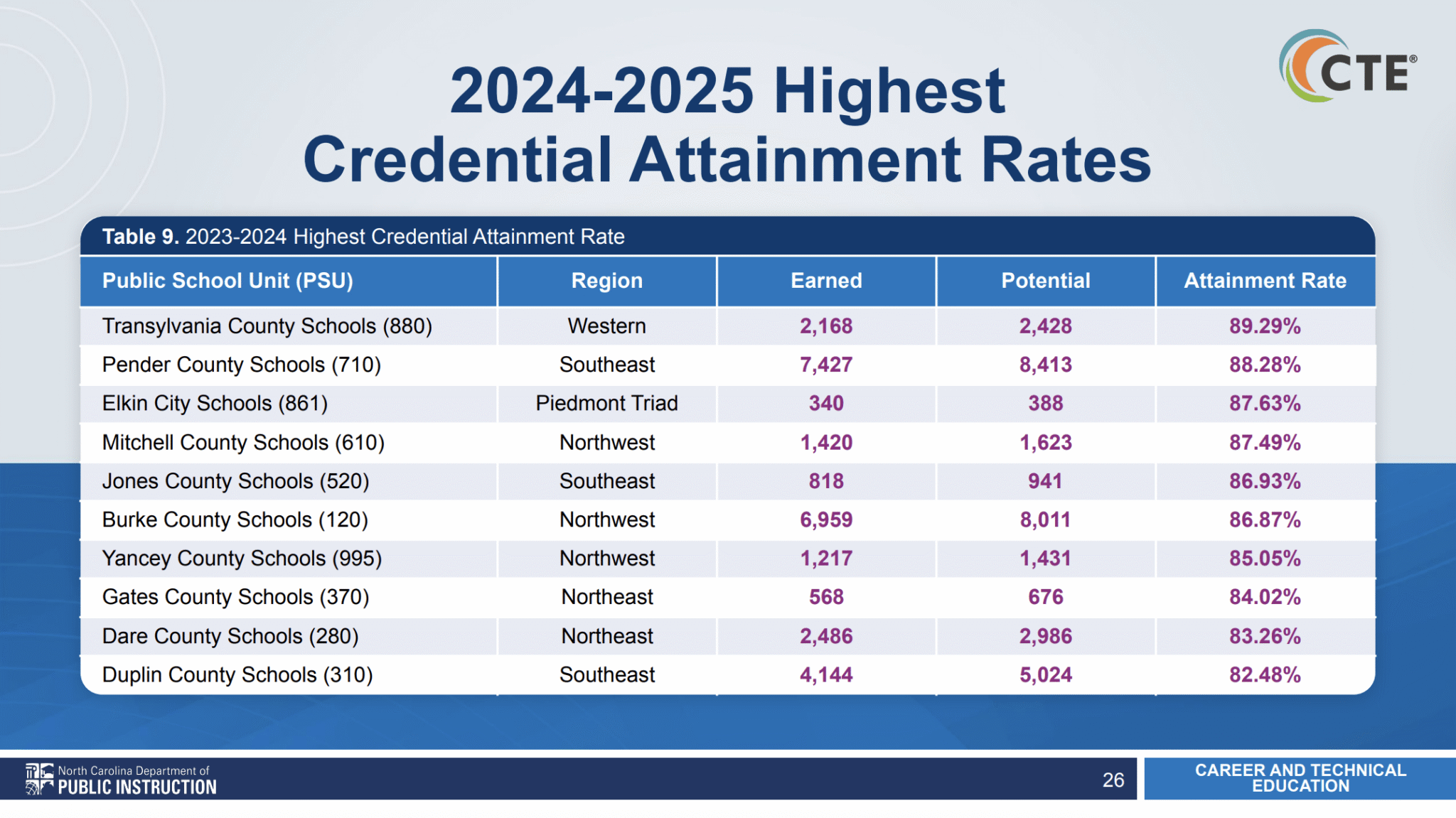
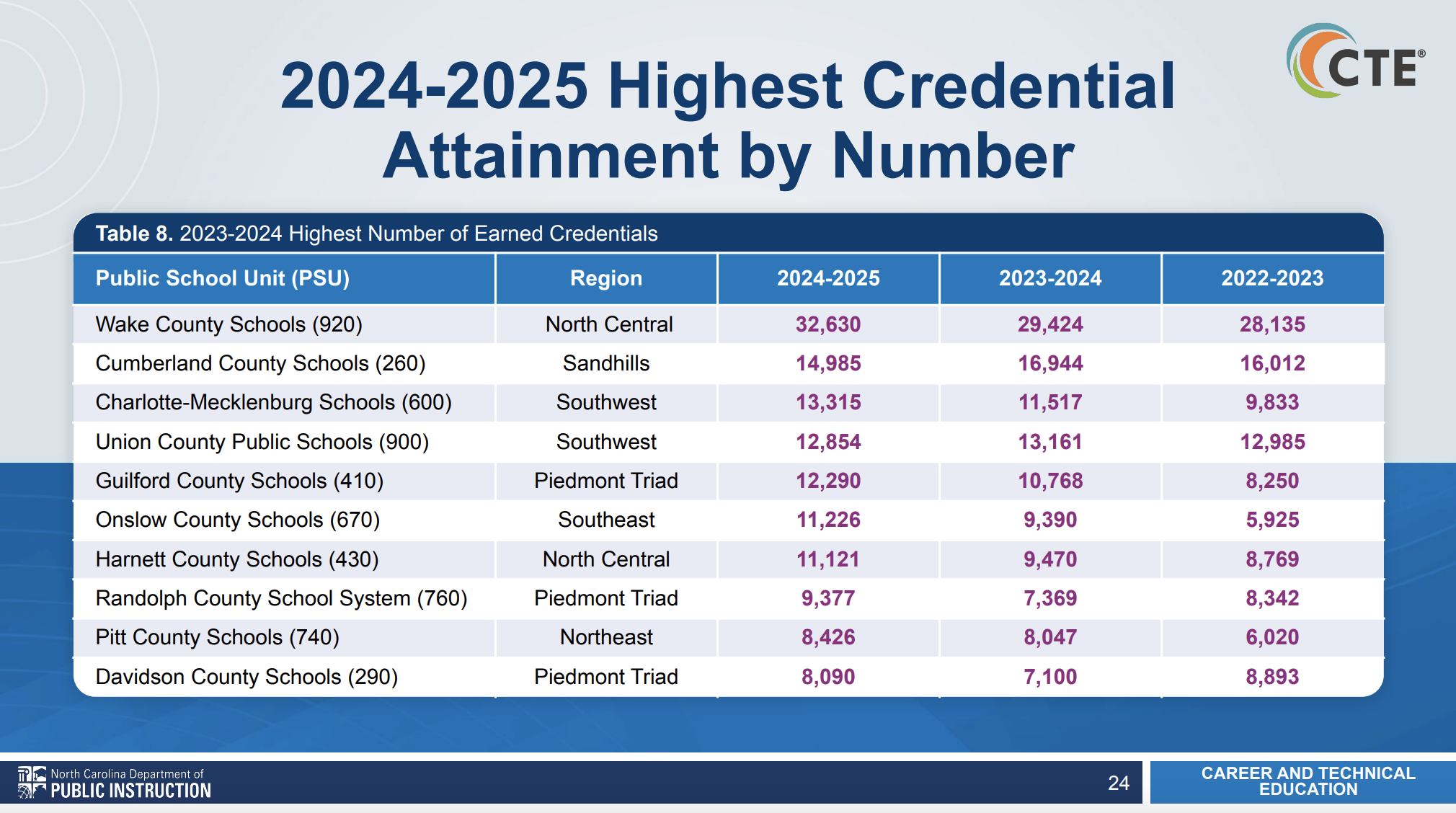
Below is a look at the districts with the highest credential attainment in 2024-25, both by rates and by number.
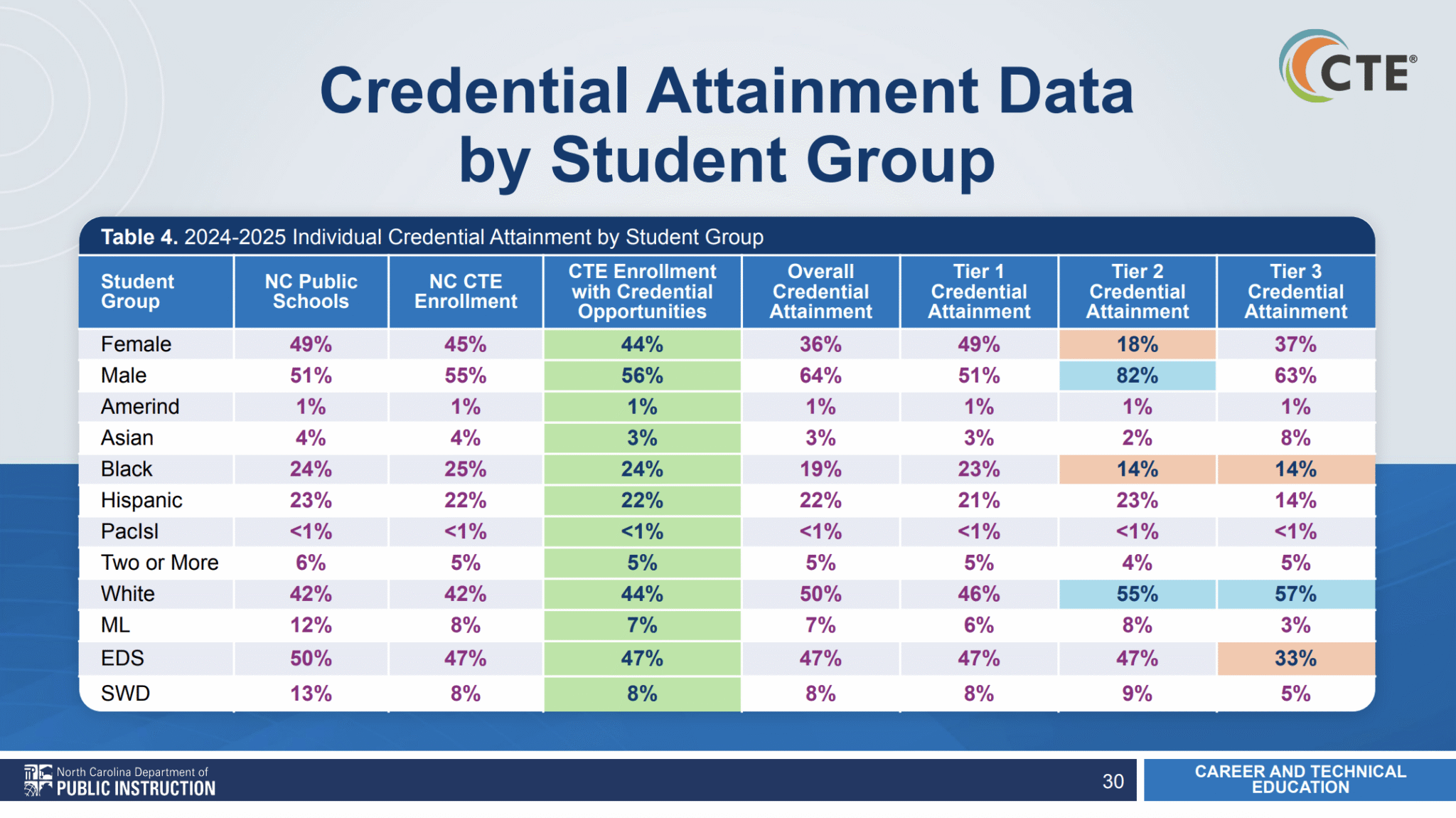
Still, the state is working to improve trends around equity and access, said Dr. Nancy Cross, section chief of DPI’s CTE office.
Despite making up 44% of enrolled students in CTE courses with credential opportunities, female students earned 36% of all credentials and only 18% of Tier 2 credentials, for example. Likewise, Black students earned 14% of Tier 2 and 3 credentials, but made up 24% of the program’s enrollment.
According to the press release, “credentials are organized into three tiers based on academic rigor, employment value and industry demand,” with Tier 3 credentials as the most advanced certifications, often required for employment.
During the 2024-25 academic year, there were 292 unique individual credentials measuring workplace readiness skills or proficiency in career-specific skills available to North Carolina students, per the report.
Since the 2010-11 school year, CTE students in North Carolina have earned 2,992,831 credentials.
“Attainment of industry certifications and credentials in North Carolina public schools plays a central role in preparing students for postsecondary education, workforce entry, and long-term economic mobility,” the report says.
You can view DPI’s full presentation here, and the credentials report here.
Legislative priorities
The Board also heard a presentation from Geoff Coltrane, senior director of government affairs for DPI, on legislative priorities for the 2026 short session, which is set to convene on April 21.
Coltrane said the superintendent, DPI, and the Board have an “overall” priority for fiscal year 2026-27 to strengthen public schools by raising all public school employees’ pay, with the goal of having the highest teacher salaries in the Southeast.
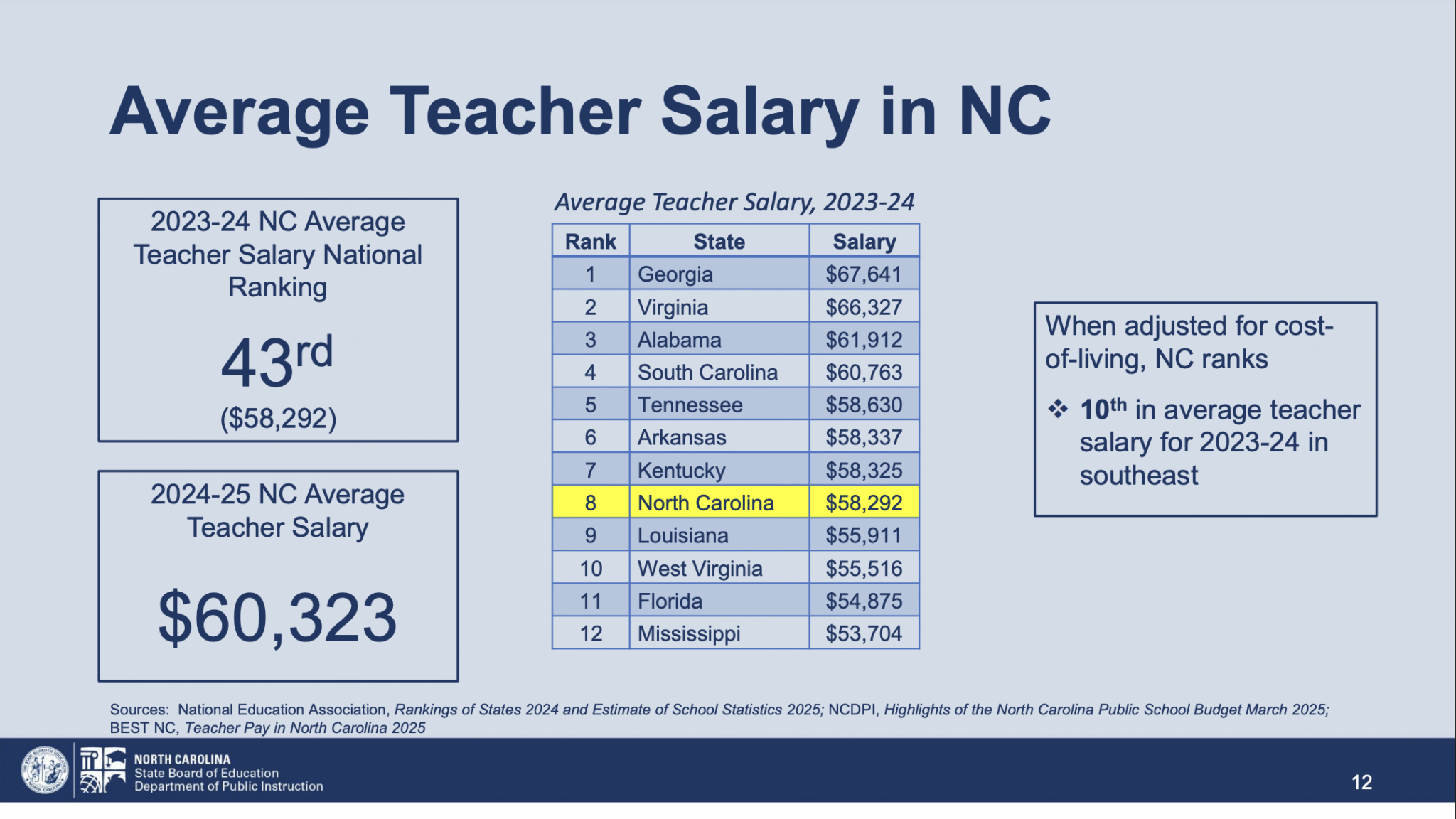
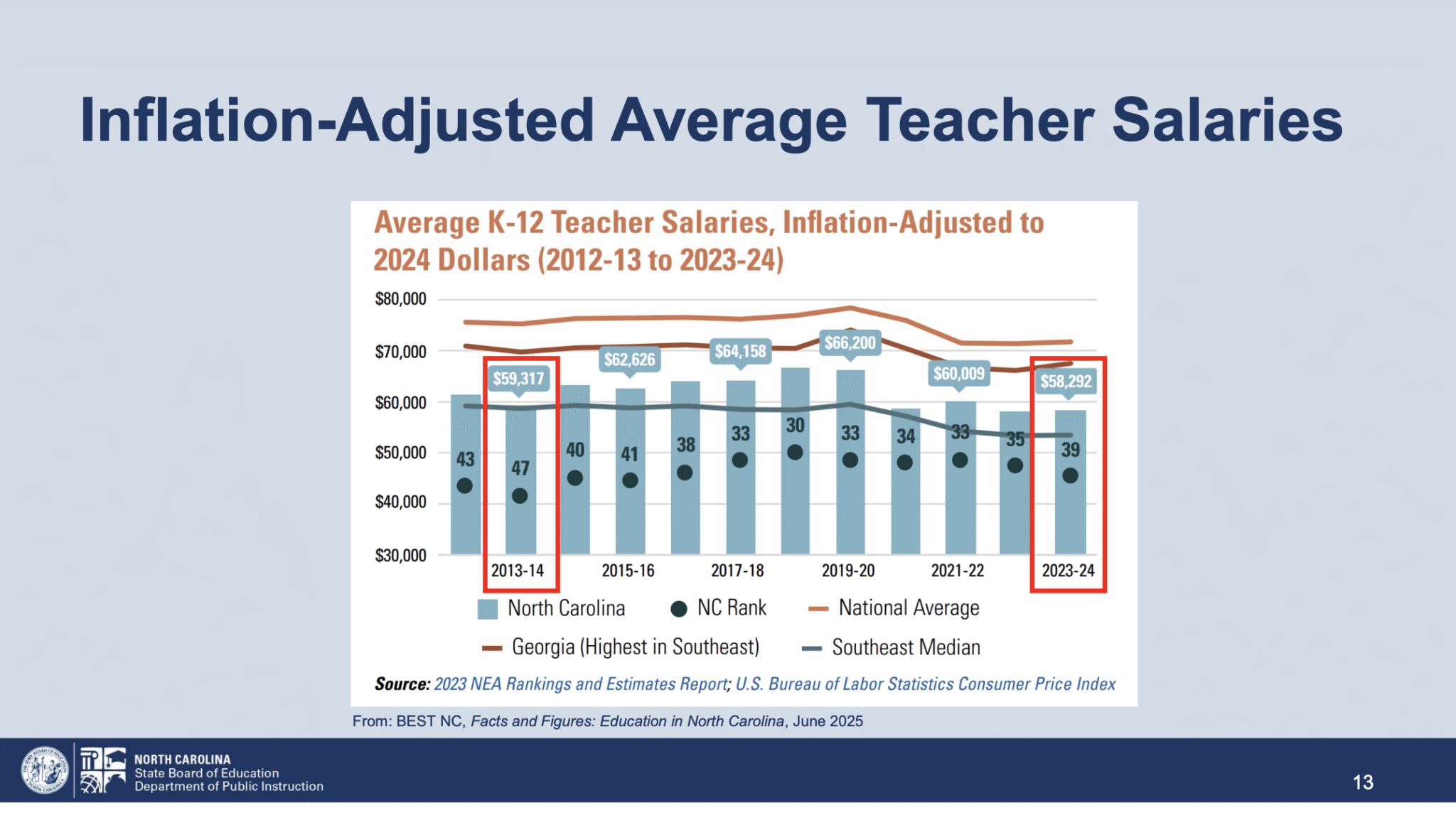
BEST NC estimated that after adjusting for cost-of-living, the state’s $58,292 average teacher salary ranked 10th in the Southeast, according to Coltrane’s presentation. Without that adjustment, the state ranked eighth in the region and 43rd nationwide during the 2023-24 school year.
The National Education Association estimates that the state’s 2024-25 average salary was $60,323, which would still rank North Carolina eighth in the Southeast, Coltrane said.
When adjusting for inflation, Coltrane said, the state’s 2023-24 average teacher salary was lower than the 2013-14 level.
Additional overall priorities for the fiscal year include funds for school facility needs in Helene-impacted districts, reforming principal pay, addressing the $13 billion in school construction needs, and restoring master’s pay for teachers. Finally, the Board is also asking lawmakers to pause the expansion of funding for Opportunity Scholarships, which help families pay for private school tuition.
Coltrane said DPI has 11 main priorities for the upcoming short session, the priciest of which include money for the Needs-Based Public School Capital Fund ($117 million recurring), implementing the exceptional children weighted funding formula ($198.6 million), and increasing the number of school health personnel ($64.3 million). Here are the other priorities:
- Expand DIBELS Diagnostic to Grades 4-5 (estimated $1.4 million recurring and $966,508 nonrecurring)
- Expand Literacy Professional Development and Support to Grades 6-8 ($14 million recurring and $25 million nonrecurring)
- Advanced Teaching Roles (ATR) Salary Supplements ($26.6 million)
- Advanced Teaching Roles (ATR) Grants Expansion ($2 million)
- Additional State Funds for Federal E-Rate Match ($2.5 million)
- Beginning Teacher Support Program ($500,000 recurring and $750,000 nonrecurring)
- Revised Limited English Proficient (LEP) Funding Formula ($117 million recurring)
- Public School Repair and Renovation Fund ($25 million recurring)
DPI also has ongoing priorities that the Board already approved in 2025 for the legislature’s long session. These include providing school breakfast and lunch at no cost to students, high-impact tutoring support, and modernizing schools’ finance and HR systems, among other requests.
The joint legislative priorities also include non-budget requests, included below:
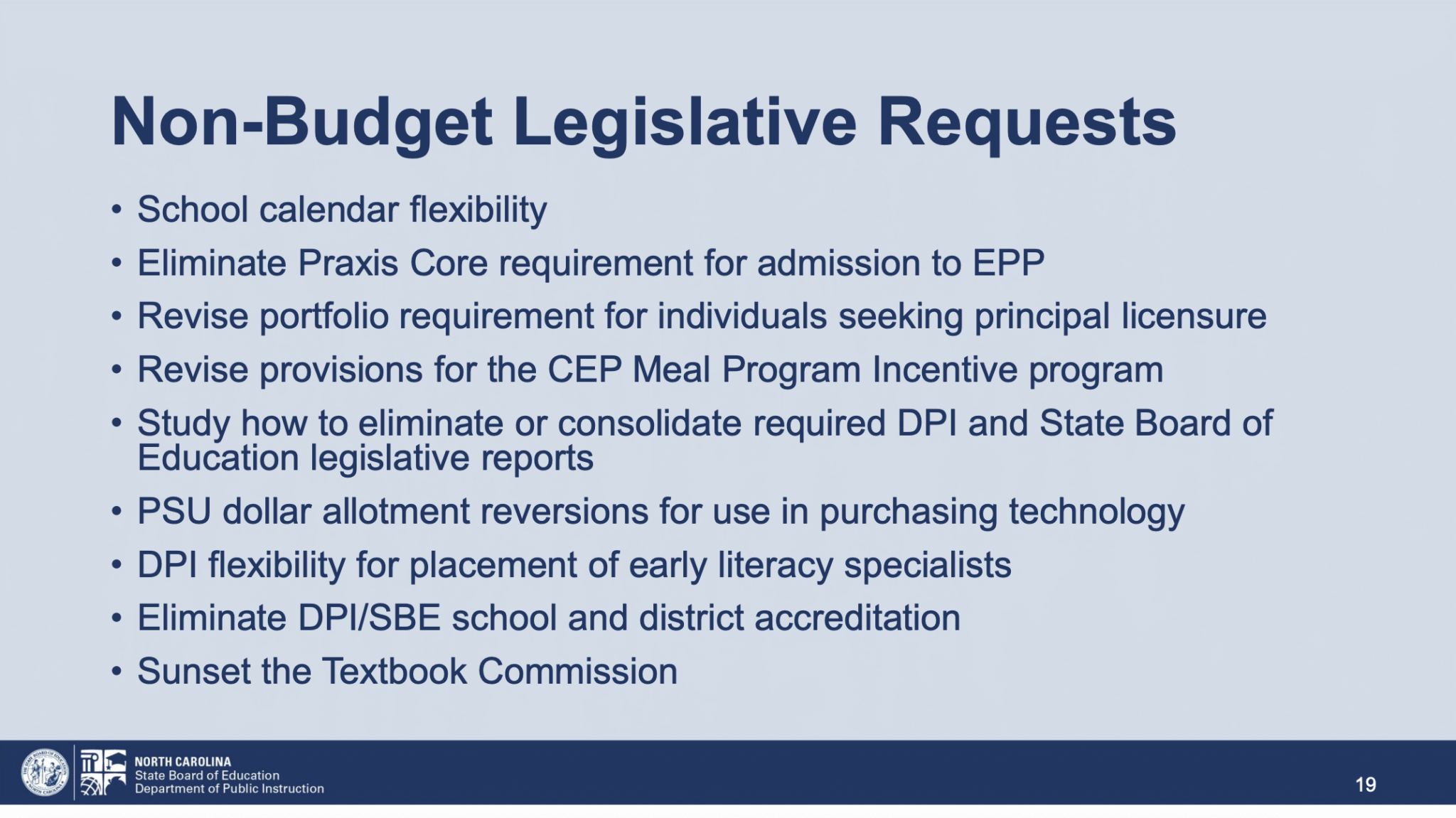
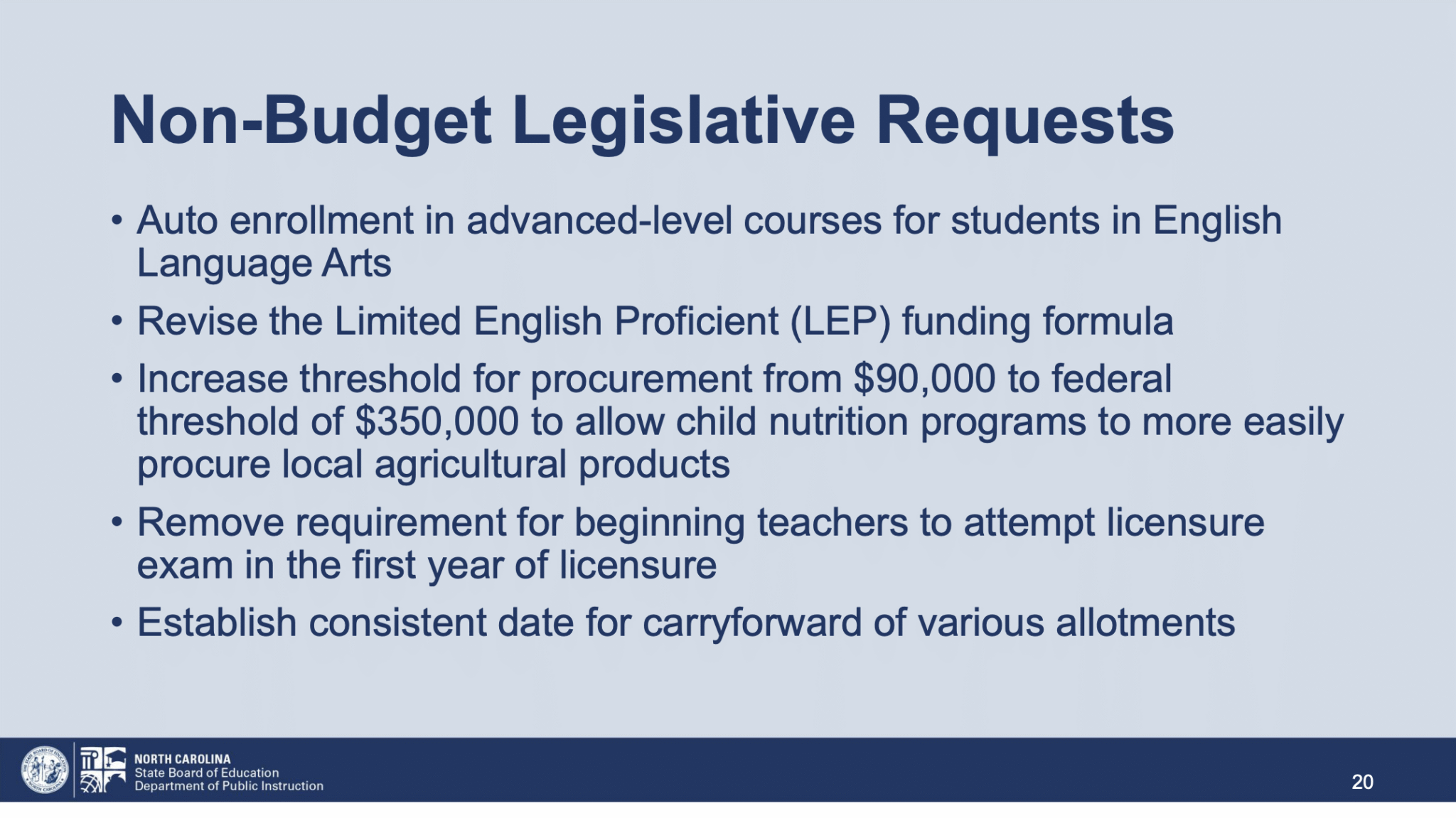
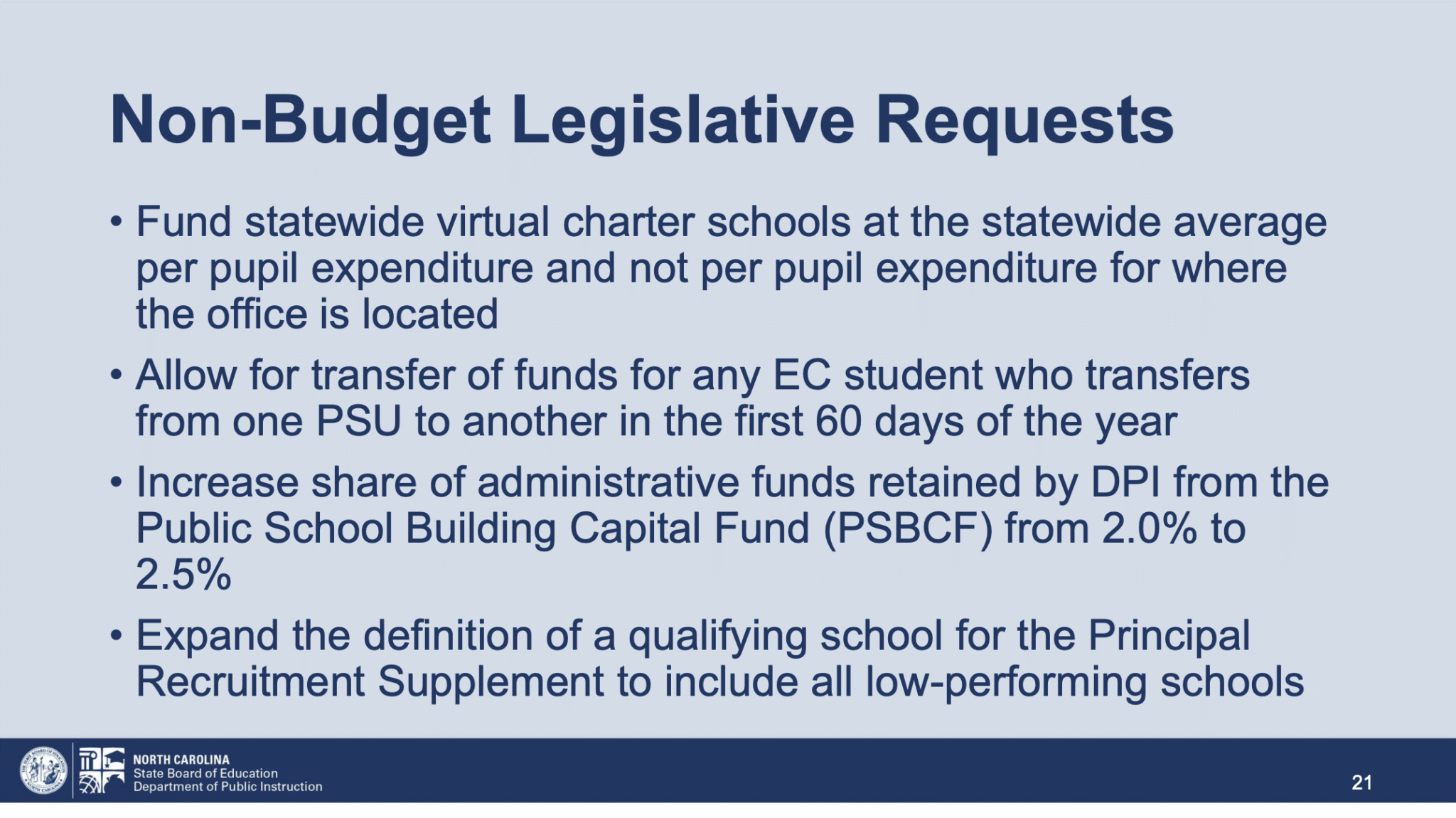
The Board passed these short session legislative priorities 8-2, with Dr. Olivia Oxendine and Treasurer Brad Briner voting against them.
Before the vote, Briner had noted that the Board is requesting approximately $800 million in funding while revenue projections for the state budget are expected to increase by only $100 million.
During discussions about a request for funding for 1-to-1 digital device refreshes, Oxendine said the Board should first study how much time students spend in front of screens and the effects this exposure could have on them.
You can view the full presentation on legislative requests here.
Strategic planning and new task force
The Board heard a quarterly update on DPI’s progress in the implementation of the 2025-2030 Strategic Plan for North Carolina Public Schools. Following a request from the strategic planning committee, Board Chair Eric Davis established a task force on educator licensure and advancement on Thursday.
“Teachers are the difference-makers for students’ success,” the committee’s presentation says. “The single best thing we can do to improve education in North Carolina is to focus on improving the experience of educators — from recruitment to preparation to retention.”
Once members are nominated and appointed, that task force will develop a theory of action and framework for the state’s licensure model and bring a recommendation to the Board.
Related reads

A pilot to raise the high school dropout age
The Board approved a legislative report on the state’s 12-year-old pilot program to raise the high school dropout age from 16 to 18, which aimed to reduce dropouts and improve graduation rates. The pilot, launched during the 2015-16 school year, currently includes two of the four original districts: Rutherford County Schools and Newton-Conover City Schools.
The report says that participating districts lacked programs specifically tied to the pilot, but relied on wraparound services to support at-risk students, including coaching, credit recovery, and mentoring, among other resources.
Still, these districts also reported a need for additional mental health services for students and additional funding for alternative learning programs.
“Districts expressed the need not only to keep students in school until 18 but also expressed the strong desire for every student to succeed,” the report says.
The Board also heard a presentation on the drop in reported crime and violence in North Carolina public schools during the 2024-25 school year. You can read EdNC’s coverage of that report in the article below.
Winston-Salem/Forsyth County Schools audit findings
An independent audit found that Winston-Salem/Forsyth County Schools’ financial controls still need strengthening despite system changes that have stabilized the district’s finances.
The auditing firm confirmed to the Board on Wednesday that the district had achieved a balanced budget as of Nov. 30, and the implementation of a new financial management software system has helped the district address key weaknesses.
But vacancies in financial leadership roles, staffing shortages, and a payroll and HR system that still relies on an older platform pose ongoing risks, the auditor said.
Superintendent Dr. Don Phipps said the district is quickly implementing the audit’s recommendations, including widening the search for a new CFO, increasing pay for the new CFO, and tightening decision-making authority over budget adjustments to a smaller circle.
“We’re not going to make any decision like that without going to the Board and finding out where we can come up with the funds, rather than just moving money and not having a way to account for it and reconcile,” Phipps said.
Phipps reassured the Board that the district has already taken steps to reduce the risk of future shortfalls, while an action plan presented to the Board aims to guarantee the district’s long-term financial sustainability.
Principal recruitment program, EC grants, and more
The Board heard an update on the Principal Recruitment Supplement Program, created by the General Assembly in 2019. The program offers 40 eligible, highly effective principals a $30,000 salary supplement for up to three years if they take leadership roles in low-performing schools ranked in the state’s bottom 5%.
The report says that 16 principals in the first two cohorts participated for the full three-year cycle, and half of their schools exited the low-performing status. Last year, two of the three participating schools exceeded growth and removed their low-performing designation. This year, eight principals have joined the program, raising the number of participating schools to 20 — rebounding to its highest level.
EC competitive grants
The Board approved funding for 109 Exceptional Children (EC) grant applications submitted by 88 districts to support the recruitment and retention of EC personnel, improve EC services, provide professional development, and increase access to instructional materials.
Districts had requested $9.3 million in school-age funding and $850,000 in preschool funding, but only $4.6 million and $625,000, respectively, were awarded.
Literacy intervention plans
The Board approved a report to the General Assembly on the state’s Literacy Intervention Plans, frameworks that govern districts’ reading interventions and access to state literacy funding. DPI reviews the plans and notifies districts of their approval or denial by Feb. 15.
Fall 2025 saw the highest number of approved plans without recommendations since the approval process launched in 2022, reaching 69 districts. Plans approved with recommendations reached their lowest levels, with 46 districts receiving feedback on their submissions.
An appeal to the Charter Schools Review Board
The Board voted to remand an appeal from Cape View Leadership Academy (CVLA) back to the Charter Schools Review Board (CSRB).
In December, the CSRB denied the Pender County school’s 2025 application to become a charter school that would open in 2027. The Board’s Education Innovation and Charter Schools Committee met Tuesday to discuss the school’s appeal to the decision.
The CSRB will consider the matter again during its March meeting — though John Blackburn, the committee chair, said that discussion would be limited to questioning ACCEL Schools, the proposed management company for CVLA, about the school’s application.
The Board’s next full meeting will be held on March 4-5.

Recommended reading