
1.4 million North Carolinians may miss SNAP payments on Nov. 1 due to federal shutdown

Update, Nov. 3: On Monday, Nov. 3, the Trump administration announced plans to use $4.65 billion in emergency funds to disperse 50% SNAP payments to the 41.7 million Americans who receive the benefits. Read more about the status of payments, and find local resources, here.
More than a million North Carolinians are at risk of missing their Supplemental Nutrition Assistance Program (SNAP) benefits at the end of the week due to the federal government shutdown.
Democratic Gov. Josh Stein and Attorney General Jeff Jackson issued statements this week urging the U.S. Department of Agriculture (USDA), the agency responsible for funding the federal food assistance payments, to use its reserves to provide benefits on Nov. 1.
 Sign up for the EdDaily to start each weekday with the top education news.
On Oct. 10, the USDA issued a notice stating it may not provide participants with their full benefits starting on Saturday, Nov. 1. The agency instructed states to hold off on payments for now.
The decision would disrupt assistance payments for 1.4 million North Carolinians, including more than 580,000 children, among whom are 40,000 infants under 18 months, according to Stein and Jackson’s statements. On average, the monthly payments are about $175 per North Carolinian. Nationwide, the program provides average monthly payments of $187 to 41.7 million low-income Americans.
On Tuesday, Jackson also announced he is suing the USDA and the Office of Management and Budget for refusing to fund the program.
The lawsuit was filed by 25 states and the District of Columbia in the U.S. District Court for the District of Massachusetts, and alleges that the USDA’s decisions violate the Administrative Procedure Act and the SNAP Act.
The lawsuit would require the agency to pay out benefits and cancel the notices instructing states to freeze payments. Jackson said he is also filing a temporary restraining order asking the court to restart benefits immediately.
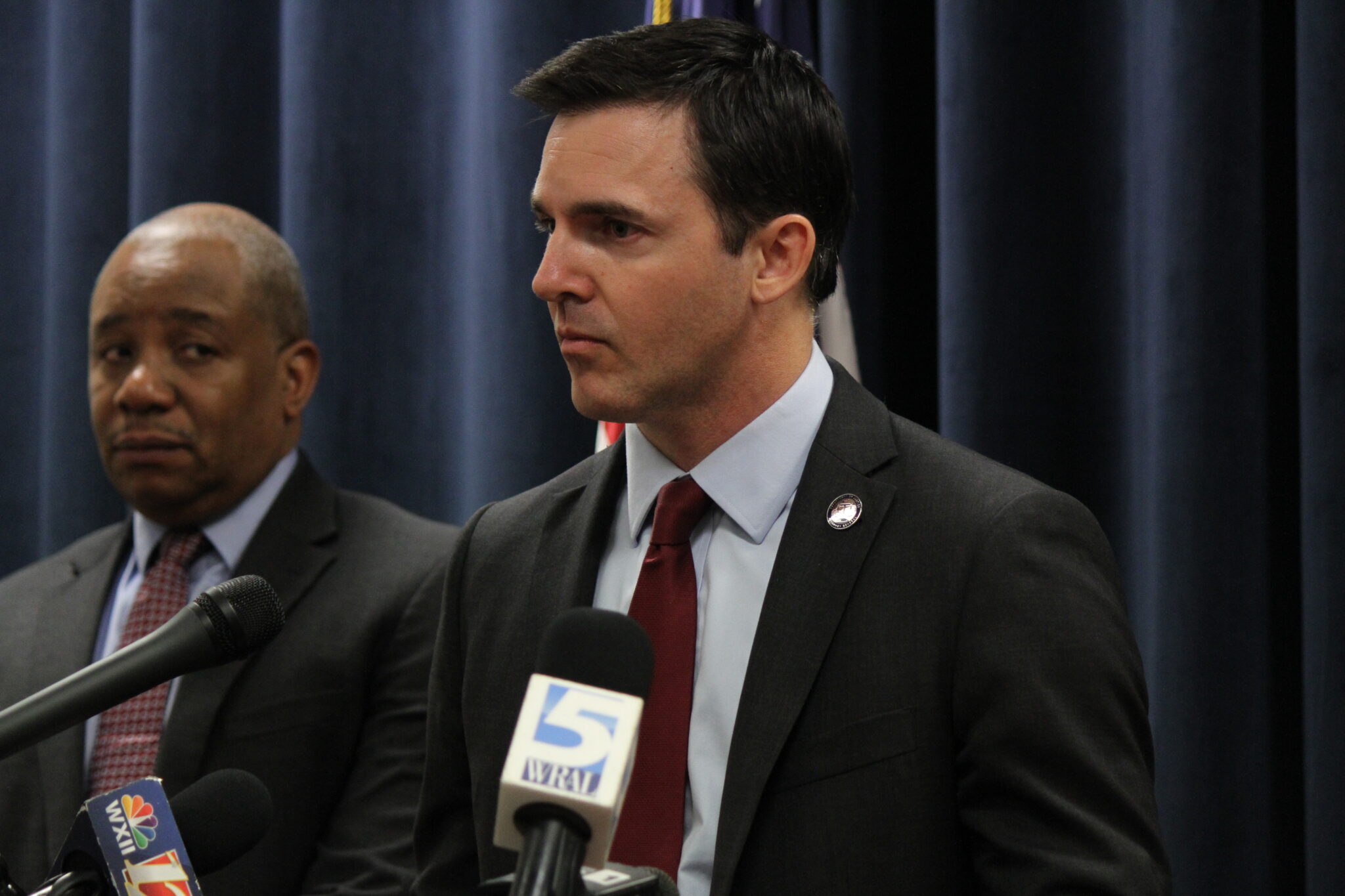
“This is the deliberate precipitation of a major hunger crisis. It’s unlawful, and we’re going to do everything we can to fight it,” Jackson said during a Tuesday press conference. “… In short, we are asking the court to act with emergency speed to meet this emergency. I think there’s a very good chance that we get a favorable ruling that puts this on hold relatively soon.”
The cliff in SNAP funding comes as the federal government shutdown continues, now the second-longest in history. The program had already allocated funds for October, so it was not affected when the shutdown began. Now, the USDA website says “the well has run dry,” and no benefits will be issued on Nov. 1.
Superintendent of Public Instruction Mo Green highlighted the importance of SNAP for North Carolina’s students and the impact these payment delays could have on families.
“SNAP benefits and school nutrition programs are interconnected lifelines for over 500,000 North Carolina children — when SNAP funds are frozen, families rely even more on our schools’ breakfast, lunch, and weekend backpack programs,” Green said in Jackson’s press release on Tuesday. “I support Attorney General Jackson’s urgent action because hungry students can’t focus on reading or math — they can only focus on their next meal.”
Stein issued a press release on Monday urging the agency to use its federal contingency funds to prevent any disruptions.
On Friday, ahead of announcing the lawsuit, Jackson signed a letter sent by 23 state attorneys general to the USDA in response to the agency’s notice. The letter asks the agency to clarify its justification for the Oct. 10 notice and asks for details on its contingency plan.
The letter also points out that the agency has reserve funds to keep the assistance program going.
“The USDA has the money to keep SNAP running — including $6 billion in reserve funds set aside for exactly this situation. Refusing to use those funds would be unlawful and a stunning disregard for the wellbeing of roughly 600,000 children in our state,” Jackson said in a Friday press release. “The USDA cannot withhold food from children just to play shutdown politics — and we will take them to court if they try.”
In a memo obtained by NPR, however, USDA said on Monday that its contingency funds are not legally available to cover regular benefits.
“SNAP contingency funds are only available to supplement regular monthly benefits when amounts have been appropriated for, but are insufficient to cover, benefits,” the memo says. “The contingency fund is not available to support FY 2026 regular benefits, because the appropriation for regular benefits no longer exists.”
The memo says that transferring funds from other sources impacts other programs and that states cannot be reimbursed for covering the costs of the program.
“The best way for SNAP to continue is for the shutdown to end,” the memo says.
You can read more about the impacts of the federal government shutdown on SNAP benefits and more on the NC Department of Health and Human Services’ website.
Editor’s note: Analisa Sorrells Archer contributed to this report.